

What is a Book of Business? Meaning, Examples, and Value
When a job listing asks for an “established book of business,” it usually means existing client relationships rather than a reading list. If you are wondering what is a book of business, the short answer is the portfolio of customers, accounts, or policies a professional or company manages, along with the business those relationships generate.
That portfolio might belong to an insurance agency, a sales team, a financial advisory practice, or a consultant. Understanding the term helps you evaluate a job, organize your customers, and interpret claims about how much a client portfolio is worth.
Quick Answer: What is a book of business?
A book of business is a group of client relationships managed as a commercial portfolio. It commonly includes account details, services purchased, revenue history, renewal dates, and information needed to maintain those relationships.
The dictionary definition of a book of business emphasizes customers considered together for their commercial value. In everyday use, someone may refer to the customer portfolio itself, the records documenting it, or the revenue associated with it, so context matters.
Key Takeaways
- A book of business represents customer relationships and the business associated with them.
- Its meaning varies slightly across sales, insurance, finance, customer success, and logistics.
- A contact list can support a book, but contacts alone do not demonstrate paying relationships.
- Revenue, profitability, retention, and transferability matter more than account count alone.
- Managing a book does not automatically mean you legally own it or can sell it.
- A useful book needs accurate records, clear account responsibility, and regular follow-up.
What Does a Book of Business Include?
A practical book combines information about the customer with information about the relationship. The goal is to help you understand who needs attention, what business is active, and where revenue may be at risk.
Common fields include:
| Information | What to record | Why it matters |
|---|---|---|
| Account identity | Customer name and unique account ID | Keeps records organized and reduces duplication |
| Key contacts | Decision-maker, service contact, and approved contact details | Helps you reach the right person |
| Products or services | Policies, subscriptions, retainers, or service agreements | Shows what the customer actually purchases |
| Revenue | Actual revenue for a defined period and separately labeled recurring revenue | Supports planning without mixing different measures |
| Important dates | Renewal, contract end, review, and follow-up dates | Makes upcoming actions visible |
| Relationship status | Active, inactive, at risk, or former customer | Prevents outdated accounts from inflating the active book |
| Account responsibility | Assigned salesperson, account manager, or service team | Clarifies who should act |
| Service history | Relevant requests, issues, commitments, and outcomes | Supports continuity and useful conversations |
You do not need every possible detail about a customer. The guidance on protecting personal information in business records recommends keeping sensitive information only when there is a legitimate business need and restricting access to people who need it.
Book of Business Meaning Across Different Industries
The underlying idea stays similar: a defined portfolio of commercial relationships. What changes is the type of account, the work involved, and the measure used to describe its size.
What Is a Book of Business in Sales?
In sales, a book of business usually means the customer accounts assigned to or developed by a salesperson or account manager. Some employers also use the term for a broader assigned account list that includes prospects, so ask how the company defines it.
For example, a representative might manage 25 existing customers and identify renewal or expansion opportunities within those accounts. Understanding the Account Executive role helps explain why some salespeople primarily win new business while others continue managing customers after the sale.
What Is a Book of Business in Insurance?
An insurance book of business generally consists of the clients and policies an agent or agency manages. Records may include policy types, insurers, renewal dates, premiums, and commissions, as described in this insurance book of business explanation.
One distinction is especially important: premium volume is not the same as agency revenue. If someone describes a “$1 million insurance book,” you need to know whether that figure refers to premiums, commissions, or another measure before making a comparison.
What Is a Book of Business in Finance?
For a financial advisor, the term generally refers to client relationships and the accounts served through the advisory practice. Its size may be described using client households, assets under management, or annual advisory revenue.
Assets under management are client investment assets, not the advisor’s earnings. Two advisors with similar asset totals can generate different revenue because their fee arrangements, service models, and account types differ.
What Is a Book of Business in Customer Success?
In customer success, a book of business is the customer portfolio a customer success manager is responsible for supporting. That responsibility may include onboarding, product adoption, customer outcomes, renewal coordination, and identifying suitable expansion opportunities.
Imagine one manager supporting 12 complex enterprise customers and another supporting 70 smaller accounts. Account count alone cannot tell you which workload is heavier; implementation needs, service expectations, risk, and renewal timing also matter.
What Is a Book of Business in Logistics?
In logistics, the term often describes the shipper or customer accounts a broker, salesperson, or logistics company serves. Useful records might include shipment frequency, lanes, service requirements, revenue, and gross margin.
For example, a freight broker could manage several manufacturers that need regular transport on recurring routes. Shipment revenue should be separated from the margin remaining after carrier costs when assessing the commercial strength of those relationships.

A Simple Book of Business Example
Suppose an independent consultant has four active clients on monthly service agreements. The following figures are fictional and demonstrate how a small portfolio could be organized.
| Client | Monthly recurring fee | Relationship status | Next action |
|---|---|---|---|
| Client A | $1,200 | Active | Review next quarter’s priorities |
| Client B | $800 | Renewal approaching | Discuss the next agreement |
| Client C | $1,500 | At risk | Resolve a service concern |
| Client D | $500 | Newly onboarded | Confirm the initial deliverables |
| Total | $4,000 | Four active clients | Prioritize renewal and service risk |
The consultant’s book includes all four relationships, rather than only the $4,000 monthly fee total. Annualizing that amount gives $48,000, but this is a planning figure assuming the same fees continue for 12 months, not guaranteed revenue or a sale valuation.
Client C contributes $1,500 of the $4,000 monthly total, or 37.5%. That concentration matters because losing one relationship would have a substantial effect even though three customers remain.
Book of Business vs. Client List vs. Sales Pipeline
These terms overlap, but they answer different questions. Separating them helps prevent prospects and inactive contacts from being presented as established revenue.
| Term | Main purpose | Typical contents |
|---|---|---|
| Client or contact list | Identify people and organizations | Names, contact details, and basic classifications |
| Book of business | Manage a portfolio of customer relationships | Accounts, commercial history, services, responsibility, and renewal information |
| Sales pipeline | Track possible future deals | Opportunities, sales stages, estimated deal values, and expected close dates |
| CRM system | Store and coordinate relationship information | Contacts, accounts, activities, opportunities, and service records |
A CRM can contain all three categories, but the software itself is not your book of business. This explanation of customer relationship management describes how a CRM helps organize interactions with current and potential customers.
I would keep prospects, active customers, and former customers clearly labeled, even if they share one system. That makes reports easier to interpret and gives each group an appropriate follow-up process.
How to Build a Book of Business
Building a book means turning suitable prospects into customers and then maintaining those relationships. A growing contact database helps with organization, but growth becomes commercially meaningful when customers purchase, stay, or return.
1. Define the Customers You Can Serve Well
Start with a clear customer profile: the problem you solve, the buyer you serve, and the work you can deliver profitably. A focused offer makes it easier to recognize suitable opportunities and explain your value.
For example, a consultant offering appointment workflow support to clinics has a more specific starting point than someone offering unspecified business help. The focus can change as the business develops, but it gives early outreach a practical direction.
2. Track Prospects Separately
Record the prospect’s needs, the last conversation, and the next agreed action. Keep estimated opportunities separate from actual customer revenue so you do not mistake possible business for established business.
Once a deal closes, add the service agreement, account contact, and onboarding information to the customer record. Preserve the relevant sales history so the person delivering the service understands what was promised.
3. Make Onboarding Clear
Confirm the scope, responsibilities, communication method, and immediate next steps. Customers should understand what they need to provide and when they can expect progress.
Clear onboarding also reduces avoidable confusion inside your team. Record important commitments instead of relying on one person’s memory.
4. Maintain a Useful Contact Schedule
Plan contact around the customer’s service needs and decision dates. Renewal discussions should allow enough time to address concerns, obtain approvals, and complete any necessary changes.
Avoid sending messages simply to meet a contact quota. A conversation about an unresolved issue or a relevant improvement is more useful than a generic check-in with no purpose.
5. Grow Through Appropriate Referrals and Expansion
Ask satisfied customers for introductions when the timing is suitable. Consider additional services only when they address a real need, and you can deliver them well.
At larger companies, coordination between acquisition, retention, and expansion may sit within the Chief Revenue Officer’s responsibilities. For a smaller business, the same coordination can happen through a shared account review and clear responsibilities.
A Practical Book of Business Template
You can start with a spreadsheet and move to a CRM when shared access, reminders, or reporting become harder to manage. I recommend using one row per account in the overview, with separate linked records for multiple contacts, policies, or transactions.
Use these columns as a starting structure:
| Template field | Recording guidance |
|---|---|
| Account ID and name | Use a stable identifier rather than the name alone |
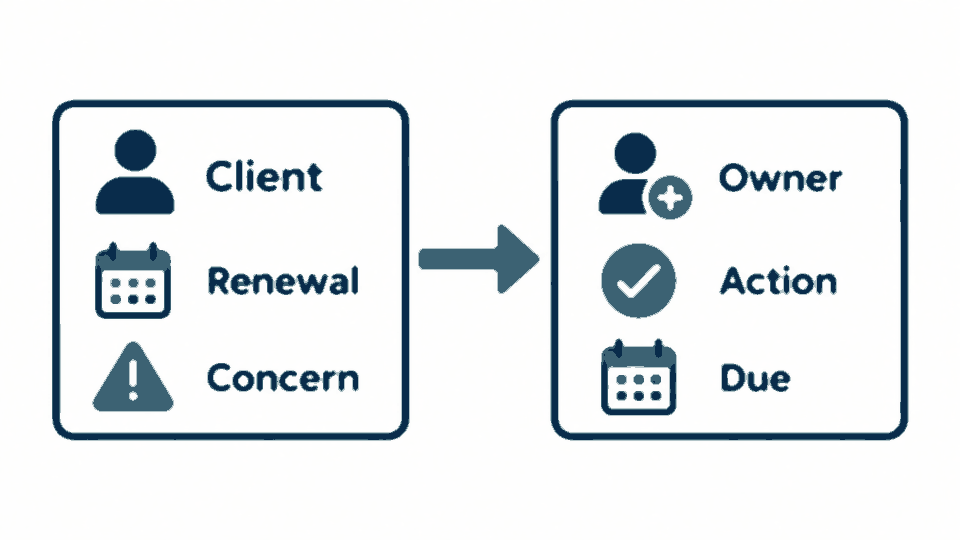
| Assigned manager | Specify who is responsible for the next action |
| Account status | Use consistent categories such as active, inactive, and at risk |
| Primary contact | Record relevant work contact details |
| Service or product | Summarize the active purchase or agreement |
| Revenue and reporting period | Specify whether the figure is monthly recurring revenue, annual revenue, or another measure |
| Contract or renewal date | Record the actual date where one applies |
| Last meaningful interaction | Note the date and a short factual summary |
| Customer goal or concern | Record the issue that should guide the next conversation |
| Next action and due date | Assign a specific task rather than a vague reminder |
Keep factual observations separate from assumptions. For instance, “customer reported an unresolved delivery issue” is more useful than marking an account at risk without explaining why.
How to Measure the Health of Your Book
A healthy portfolio needs more than a growing customer count. Review whether customers stay, revenue holds up, service remains manageable, and profit supports the work involved.
Useful measures include:
- Active account count: Customers meeting your documented definition of active.
- Customer retention: Starting customers still active at the end of the period, divided by starting customers, multiplied by 100.
- Recurring revenue: Revenue that repeats under your stated reporting definition.
- Customer concentration: The share of revenue coming from your largest accounts.
- Renewal exposure: Business approaching renewal, with unresolved concerns highlighted.
- Cost to serve: The resources required to support each account.
- Account coverage: Whether important accounts have an assigned manager and a current next action.
If you start a year with 20 clients and retain 18 of those same clients, customer retention is 90%. Customers added during the year belong in growth reporting, but they do not change that starting-customer retention calculation.
Customer retention and revenue retention measure different things. You could retain most customers but lose significant revenue if your largest account cancels or reduces its contract.
What Is a Book of Business Worth?
There is no universal price or revenue multiple that applies to every book of business. Its value depends on the income a buyer can reasonably expect to retain, the cost of serving customers, the risks involved, and the rights that can actually transfer.
The guidance on valuing an existing business before buying it outlines several valuation approaches, including earnings and intangible asset methods. Those approaches provide a starting framework, but a client portfolio still needs an assessment specific to its industry and transaction.
Important considerations include:
| Factor | Question to investigate |
|---|---|
| Revenue quality | Is income recurring, project-based, or dependent on uncertain future sales? |
| Profitability | What remains after delivering the service and covering relevant costs? |
| Retention | How much business has historically stayed, and what might change after a transfer? |
| Concentration | Would losing one or two clients materially reduce earnings? |
| Transferability | Which agreements, relationships, records, and revenue rights can move? |
| Personal dependence | Are customers attached to the individual, the firm, or both? |
| Record quality | Can a buyer verify revenue, obligations, and service requirements? |
| Deal terms | Is payment fixed, deferred, or conditional on retained business? |
A price conditional on future retention is different from an unconditional payment at closing. Compare the full terms, transition responsibilities, and risk allocation rather than only the advertised amount.
For an actual purchase or sale, get qualified valuation, accounting, and legal advice. This article explains general concepts and is not a personalized valuation or legal opinion.
Who Owns a Book of Business?
Managing customer relationships does not automatically give you ownership of customer records or the right to transfer those relationships. Employment agreements, agency arrangements, service contracts, confidentiality obligations, and applicable law can all affect what you may do.
The phrase “my book” often describes responsibility rather than legal ownership. Before leaving a firm or negotiating a sale, establish which rights you hold and what approvals or customer communications are required.
I would review these questions before making any promises:
- Who owns or controls the account records and relevant contractual rights?
- Which confidentiality, solicitation, or other contractual restrictions apply?
- Can agreements be assigned, and do customers need to consent?
- What privacy and professional obligations apply to any data transfer?
- How will customers be introduced to the successor or new service provider?
The answers vary by contract, industry, and jurisdiction, including state-level differences. Customers also retain their own choices, so contractual rights alone do not guarantee they will continue buying.
Common Mistakes to Avoid
The most common reporting mistake is treating every saved contact as an active customer. A second is mixing premium volume, managed assets, sales revenue, and profit as though they represent the same thing.
Other problems include counting dormant accounts in current revenue forecasts, missing renewal dates, and storing important details only in personal inboxes. A book can also become difficult to manage when account assignments ignore service complexity or cluster too many renewals at the same time.
Review these weaknesses before increasing acquisition spending. New customers will add work, so reliable records and a manageable service process help you support growth.
Frequently Asked Questions
What is another name for a book of business?
Common alternatives include client portfolio, customer portfolio, client base, and account portfolio. “Client list” is sometimes used informally, but it may describe only contact records rather than the commercial relationships and revenue behind them.
What is a current book of business?
A current book of business generally means the accounts or policies actively managed as of a stated date. For a useful report, define “active” and distinguish current customers from prospects, dormant relationships, and former clients.
Can you have a book of business without recurring revenue?
Yes, a portfolio can consist of project-based or transactional customers. Its future revenue may be harder to forecast because repeat work is not necessarily contracted or scheduled.
Does a job requiring a book of business mean I must bring clients?
Often, the employer expects established relationships that could generate business, but the wording alone does not specify the requirement. Ask about account count, recent revenue, expected portability, confidentiality restrictions, and whether the company provides an existing portfolio.
How long does it take to build a book of business?
There is no dependable timeline that applies to every profession. Sales-cycle length, service capacity, referral sources, starting relationships, and customer retention all affect how quickly a viable portfolio develops.
Conclusion: Turn Your Client Portfolio Into a Working Plan
If someone asks what is a book of business, think of a managed portfolio of customer relationships and the commercial activity connected to them. Its usefulness comes from knowing which customers are active, what they need, what business they generate, and what action should happen next.
Start by reviewing your current accounts and separating prospects from paying customers. Then give each active account a clear manager, a defined revenue measure, and a practical next step so your book becomes a tool you can use every week.


