
How to Get a Business Address: Options for Your LLC
You can get a business address without renting an entire office. The harder part is choosing one that works for the reason you need it. An address that receives invoices may not meet your bank’s requirements or qualify as a customer-facing location.
If you are researching how to get a business address, start with its intended use: receiving mail, forming an LLC, protecting your home address, opening a bank account, or meeting customers. This guide explains the options, the checks to make before paying, and how to put your chosen address into use.
Quick Answer
To get a business address, use an eligible home or commercial location, rent a PO box or private mailbox, or subscribe to a virtual mailbox or office service. Confirm that the address meets the requirements of each organization that will receive it, complete any required verification, and test mail delivery before relying on it. A mailing service does not automatically provide an acceptable physical operating location or registered office.
Key Takeaways
- Choose an address by purpose, rather than appearance alone.
- A virtual business address usually provides mail handling, not premises where you operate.
- LLC address requirements depend on the state and the particular form field.
- Banks may need your actual operating address even if you use a separate mailing address.
- Compare forwarding, scanning, storage, and cancellation charges alongside the subscription fee.
Understand the Different Types of Business Addresses
“Business address” is a broad term. Before choosing a service, work out which of these functions you need it to perform.
| Address function | What it means | Main check |
|---|---|---|
| Mailing address | Where letters and eligible packages arrive | Can someone receive and route your mail reliably? |
| Principal or operating address | Where the business is based or operates, as the relevant rules define it | Does the location accurately match the requested information? |
| Registered office | The designated location for your registered agent to receive legal papers | Does it meet your state’s registered-office requirements? |
| Customer-facing address | Where customers visit your business | Do you actually serve customers there, and meet platform or licensing rules? |
A registered agent is the person or company designated to receive legal documents for your entity. Hiring one does not automatically give you permission to use its address for invoices, ordinary mail, banking, or every field on your LLC paperwork.
One detail I would not overlook is the difference between mail access and workspace access. A street address attached to a mailbox is real, but renting that mailbox does not mean you occupy an office in the building.
Compare Your Business Address Options
The right choice depends on how you work and how much privacy you need. Use this comparison to narrow the options before requesting quotes.
| Option | Best suited to | Main advantage | Main limitation | Cost consideration |
|---|---|---|---|---|
| Home address | Eligible home-based businesses | No separate address rental | May expose your home address | Check lease, zoning, and other operating restrictions |
| PO box | Businesses needing a separate postal mailbox | Separates business and household mail | Does not establish an operating location | Fees depend on location and box size |
| Private mailbox | Owners who want staffed mail receipt and local pickup | Street-address mailing format | Remains a mailbox service | Check package, storage, and forwarding fees |
| Virtual mailbox | Remote owners who need online mail access | Scanning and forwarding options | Does not provide a working office | Check included items, scanned pages, and postage |
| Virtual office | Businesses needing selected office services | May include meeting rooms or reception | Access and staffing depend on the contract | Address-only and workspace plans differ |
| Coworking or leased office | Businesses needing actual workspace | Provides premises you can use | Greater cost and contractual commitment | Confirm address rights, access, and additional fees |
Using Your Home Address
Your home may be suitable when you actually operate there, and the applicable requirements allow it. Before using it, check local zoning, your lease, homeowners association rules, and any restrictions connected with your business activity.
Privacy deserves a separate decision. Depending on the filing, a home address may appear in public records or on customer documents, and changing it later may not remove historical copies.
Choosing a PO Box or Private Mailbox
A PO Box is useful when your immediate need is a separate place for postal mail. It should not be treated as proof that your company operates at the post office.
A private mailbox is provided by a commercial mail receiving agency, often called a CMRA. Ask which carriers, package sizes, and delivery types the specific location accepts, rather than assuming every mailbox plan offers the same service.
Choosing a Virtual Business Address
A virtual mailbox lets you manage incoming physical mail through an online account. Depending on the plan, you can view envelopes, request content scans, collect items, or have them forwarded.
A virtual office may add meeting-room access or reception services. Read the contract carefully, because an address-only subscription can be quite different from an arrangement that gives you actual office use.

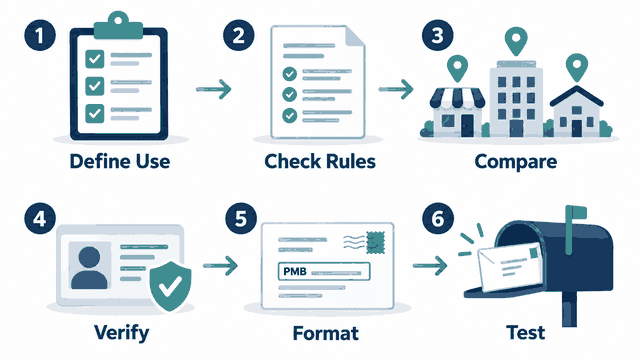
How to get a business address in Six Steps
I would start with the form or account you are trying to complete. That tells you more about the address you need than a provider’s sales page does.
1. List Every Intended Use
Write down where the address will appear and what each field asks for. Separate “mailing address” from “physical address,” “principal office,” and “registered office.”
For example, a freelance designer might need a public contact address, a bank’s operating-address record, and an LLC registered office. Those functions may require more than one address, even though they belong to the same business.
2. Check Requirements Before Buying
Read your state’s filing instructions and contact your intended bank if its policy is unclear. For a regulated business, check the licensing authority’s premises requirements as well.
Ask the provider what the contract permits, but verify acceptance with the organization requesting the address. A provider cannot guarantee that every bank, state agency, or marketplace will accept the same arrangement.
3. Compare the Actual Location and Contract
Review the particular mail center you would use, especially when a service sells plans across many locations. Check pickup hours, handling procedures, customer support, and what happens if the location closes.
Ask these questions before subscribing:
- Which legal business names and trade names can receive mail?
- Are envelope scans and content scans charged separately?
- What are the package size and storage limits?
- How are urgent or signature-required deliveries handled?
- Does the plan include workspace or only mail services?
- What happens to incoming mail after cancellation?
4. Complete Mail Authorization and Identity Checks
For CMRA mail delivery, complete PS Form 1583 and supply acceptable primary and secondary identification. Follow the location’s process under the mail authorization and signature rules; an authorized CMRA representative or a qualifying notary can witness or acknowledge the signature, including through permitted live video procedures.
Do not assume payment activates mail receipt. Wait for the provider’s confirmation that verification is complete.
5. Use the Correct Address Format
Get the full mailing format from the provider. CMRA addresses require the appropriate PMB or # designation; do not replace a private mailbox designation with “Suite” to imply office occupancy.
Keep a reference sheet with your approved mailing address and any separate operating or registered-office details. Enter each one only where it belongs.
6. Test Delivery and Update Your Records
Send a test letter and check the notification, scanning, pickup, or forwarding process. This small check helps you spot a wrong recipient name or missing mailbox number before important correspondence arrives.
Then update the relevant accounts and documents. Keep copies of confirmations and assign someone to monitor the mailbox regularly.
How to Get a Business Address for an LLC
An LLC may need several address entries across formation documents, tax records, and annual filings. Check the instructions for each field instead of assuming that one accepted mailing address satisfies every requirement.
Texas provides a useful example. Its LLC formation address requirements allow a PO box or street address for the initial mailing address, while the registered office must be a street location where legal papers can be served on the registered agent during normal business hours. A mailbox-only service does not qualify as that registered office. Other states have their own requirements, so apply this example only to the relevant Texas filing.
Can You Use a Virtual Business Address for an LLC?
Potentially, if the state allows that arrangement for the particular address field and the provider permits the use. Acceptance as a mailing address does not establish acceptance as a principal office, registered office, or licensed premises.
Check the agreement for registered-agent services separately. Also review whether member, manager, or organizer address fields could still expose information you hoped to keep private.
Is There a Free Business Address for LLC Owners?
Using an eligible address you already control can avoid an additional address-service fee. For many home-based owners, that means considering their home address and accepting the privacy implications.
A “free business address for LLC” offer may depend on buying formation services, paying after a trial, or purchasing a separate mail plan. Compare the renewal terms and permitted uses before treating the offer as a permanent free solution.
Will a Virtual Address Work for Banking and Tax Records?
Banking is where a low-cost mailbox can become an expensive mistake. Before choosing an address primarily to open an account, ask the bank which address types and supporting documents it accepts.
The bank’s customer identification requirements call for a principal place of business, local office, or other physical location for an entity such as a corporation or partnership. A bank may therefore require your actual operating location even when it accepts a separate mailing address for correspondence.
If you operate from home, ask whether that address can satisfy the operating-location requirement while your commercial mailbox handles mail. Request the bank’s document checklist rather than buying a service advertised as universally “bank approved.”
Tax forms also distinguish address functions. The IRS Form SS-4 address instructions separate mailing-address fields from physical-address fields and prohibit a PO box in the latter. Complete each field accurately instead of copying the mailbox address throughout the application.
Can You Use the Address on Google Business Profile?
A mail-handling subscription does not establish eligibility for a local business listing. Under Google’s business location guidelines, a rented mailing location where you do not operate is ineligible, while coworking offices must meet signage, customer-reception, and business-staff requirements.
For an eligible service-area business that travels to customers, hiding the operating address may be the appropriate privacy option. Buying a mailbox to appear in another neighborhood is not a substitute for meeting the listing rules.
If your concern is an existing home address or an outdated location, review the options for hiding a business address or correcting a Google listing. Choose the action that matches the actual problem, because removing management access and changing public location information are different tasks.
How Much Does a Business Address Cost?
The price depends on the location, service, and amount of mail you receive. A plan that looks inexpensive can become less attractive once content scans, package storage, and forwarding are added.
As one current reference point, a provider advertises virtual mailbox plans starting at $29 per month. That is a provider-specific starting price, not a market average or a guarantee of your total bill. Check the current plan and chosen location before subscribing.
For a useful comparison, calculate the likely monthly total:
Subscription + extra mail items + content scans + forwarding postage and handling + storage + optional services.
Request two estimates: one for a quiet month and one for a busy month. If you expect product returns or frequent packages, package charges may matter more than the headline subscription.
Activation time also depends on the arrangement and verification process. Ask when mail receipt will actually begin, and allow separate time for any bank or agency review.
Changing Addresses Without Losing Important Mail
Changing a mailbox does not automatically update business registrations, tax records, banks, or customer documents. Make a list of every place using the old address and handle each update directly.
Check these records:
- State filings and any registered-agent records affected by the change.
- IRS records, bank accounts, payment services, and insurance.
- Licenses, supplier accounts, invoices, contracts, and return instructions.
- Website contact details and eligible public business listings.
Use Form 8822-B for relevant business address changes with the IRS. For a genuine customer-facing relocation, also check your business address and map position on Apple Maps so visitors reach the right entrance.
CMRA mail has a separate transition process: a standard postal change-of-address order is not used when that relationship ends. Ask the provider about post-termination remailing, applicable charges, and any instructions in your agreement before cancellation.
Common Problems and How to Fix Them
Most address problems become easier to resolve once you identify whether they concern delivery, verification, or permission to use the location. Start with the exact rejection message or missing item rather than replacing the service immediately.
| Problem | What to check first |
|---|---|
| A bank rejects the address | Whether the field requires an actual operating location and which evidence is acceptable |
| A filing is rejected | The instructions for that address field, including state and registered-office rules |
| Mail is returned | Recipient authorization, business name, mailbox designation, and activation status |
| Scans are delayed | The location’s processing schedule and whether content scans require a separate request |
| Bills exceed expectations | Included volumes, page charges, postage, storage, and add-on services |
| Customers arrive at the mail center | Whether public materials clearly identify it as a mailing address |
Keep public descriptions honest. If customers cannot visit, do not describe the mailbox location as your shop, headquarters, or appointment office simply because it has a street address.
This guide provides general information. Address requirements vary by state, agency, institution, and business activity; check the applicable instructions or seek qualified advice for your situation.
Frequently Asked Questions
How Do I Get a Business Address Without an Office?
Consider an eligible home address, a separate mailbox, or a virtual mail service based on the use you need. If an organization asks for your operating location, provide accurate information about where you actually work rather than assuming a mailing subscription meets that requirement.
Can I Use a Friend’s Address for My Business?
Only consider it with the owner’s permission and after checking the applicable rules and property restrictions. You also need dependable access to mail, and you should not describe the address as your operating location if you do not operate there.
Can I Get a Physical Address for Business Through a Virtual Mailbox?
You can obtain a street-format mailing address through many virtual mailbox services. That provides a physical place for mail delivery, but it does not necessarily provide premises you occupy or satisfy a request for your actual operating address.
Can One Address Receive Mail for Multiple Businesses?
Some services allow several business names, while others charge for each recipient or require separate accounts. Confirm authorization for every entity and trade name before directing its mail there.
Does Renting an Address in Another State Mean I Must Register There?
An address rental alone does not answer whether your business must register in that state. Registration and tax obligations depend on applicable law and your actual activities, so assess those separately before choosing a location for perceived advantages.
Conclusion
Learning how to get a business address starts with identifying what the address must do. A remote freelancer may need dependable mail scanning, while a customer-facing business needs suitable premises, and an LLC needs addresses that satisfy its specific filing requirements.
Write down your intended uses, verify acceptance with the relevant organizations, and compare the full cost before subscribing. Once the service is active, test delivery and update your records so the address works in practice as well as on paper.


