
What Is a Business Pitch? Examples and How to Write One
What is a business pitch? It is a short, persuasive explanation of a business idea, product, or service. You use it to help someone understand what you offer, why it matters, and what you want them to do next.
That “someone” could be a customer, investor, lender, potential partner, or manager. The details you include will change with your audience, but a useful pitch always makes the main idea easy to grasp. This guide shows you what to include, how to write it, and how to adapt it for different situations.
Key Takeaways
- A business pitch explains your offer, the problem it solves, and the reason it deserves attention.
- The audience determines which details matter most. Customers and investors usually ask different questions.
- A pitch can be spoken, written in an email, or supported by slides.
- Specific evidence is stronger than broad claims. Use real customer feedback, sales, tests, or experience when you have them.
- End with a clear request, such as a meeting, trial, introduction, or funding discussion.
What Is a Business Pitch Used For?
A pitch starts a conversation that can move your business forward. You might use one to introduce a service to a prospective customer, explain a new venture to an investor, or propose a project to your manager. In each case, the immediate goal is to earn a useful next step.
A pitch does not have to answer every possible question. It should give the listener enough information to understand the opportunity and decide whether to learn more. If your idea is still taking shape, first clarify your business concept: what you offer, whom it helps, and how it creates value.
Common types of business pitches
| Pitch type | Typical audience | Main purpose |
|---|---|---|
| Elevator pitch | New contacts | Explain the idea briefly and invite a question |
| Customer pitch | Potential buyers | Show how the offer addresses their needs |
| Investor pitch | Potential investors | Explain the opportunity, progress, business model, and funding need |
| Partnership pitch | Potential partners | Show what each side could gain |
| Internal pitch | Managers or colleagues | Gain support for a proposal or change |
The same business may need several versions. A customer wants to know how your service will help them, while an investor may also want to understand how the business earns money and grows. Before writing, decide who will hear the pitch and what decision you want them to make.

What Should a Business Pitch Include?
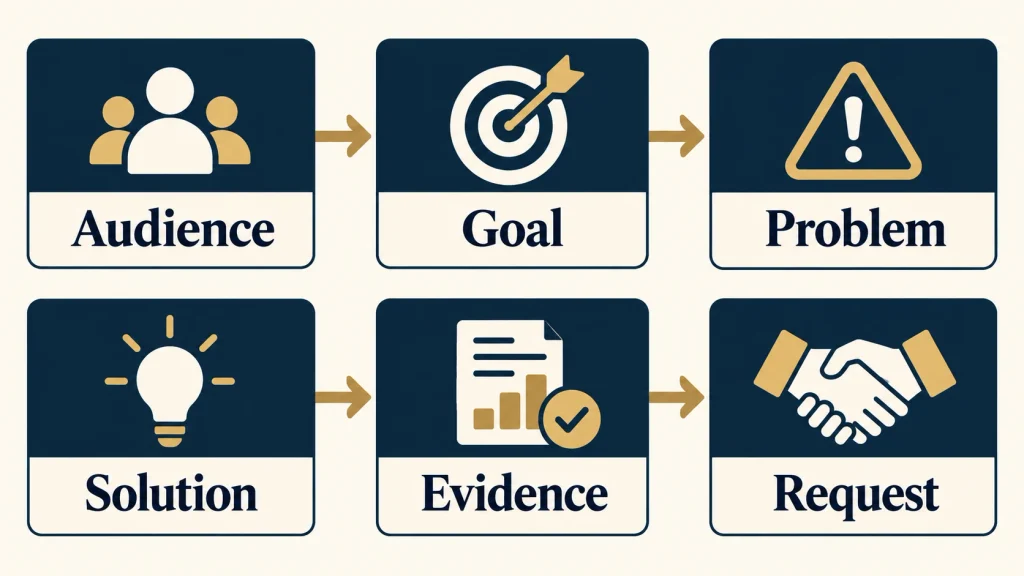
The best place to start is the listener’s question: Why should I care? You can answer it with a few essential parts. You may spend more time on some parts than others, depending on the audience and the time available.
- Who you help. Name the customer or group clearly enough that the listener can picture them.
- The problem. Explain the specific difficulty, unmet need, or opportunity you have identified.
- Your solution. Say what your product or service does in plain language.
- The value. Describe the useful result it offers. Focus on the outcome rather than a long list of features.
- Your evidence. Share genuine proof when available, such as early orders, a working demonstration, or feedback from potential customers.
- Your request. Tell the listener what you would like to happen next.
You do not need to force all six parts into a single sentence. A brief introduction might cover only the customer, problem, and solution before inviting a conversation. A formal presentation can develop each part and leave time for questions.
Be careful with evidence. A forecast is a prediction, while a completed sale is an actual result. Label both accurately. If you have not tested demand yet, explain what you plan to test instead of presenting an assumption as a fact.
How to Write a Business Pitch Step by Step
1. Choose one audience and one goal
Write down who will receive the pitch and what you want from them. “Interest in my business” is too broad to guide your writing. “A meeting to discuss a pilot project” gives you a clearer target.
This choice also determines what to leave out. A customer may care about the cost and delivery of your service, while a potential investor may ask about customers, revenue, and the use of any proposed funding.
2. Describe the problem in concrete terms
Start with something your audience will recognize. Instead of saying that a market is “inefficient,” describe the task people struggle to complete. Be precise about whose problem it is and what happens because of it.
Do not assume everyone experiences the problem in the same way. If you are still exploring the idea, conversations with potential customers can help you check whether the problem matters enough for them to seek a solution.
3. Explain your solution simply
Describe what you do before explaining how every part works. A listener should be able to repeat the basic idea after hearing it once. Remove specialist terms unless your audience uses them comfortably.
One practical starting sentence is: “We help [specific group] solve [specific problem] by [what we provide].” Treat it as a drafting tool, then rewrite it until it sounds like something you would naturally say.
4. Add the detail that makes your offer credible
Ask what the listener would need to believe before taking the next step. That may be a demonstration, relevant experience, an explanation of your process, or evidence that customers are interested. Choose the strongest detail you can honestly support.
If you are pitching a new business with no sales yet, you can still explain what you have learned and what remains uncertain. A thoughtful test plan is more useful than an unsupported claim that everyone will want the product.
5. Make a specific request
Close with one action the listener can reasonably take. You could ask for a short meeting, permission to send a proposal, feedback on a demonstration, or a conversation about funding. Make the request fit the relationship and the stage of your business.
Then stop and allow a response. A pitch works best as the beginning of a discussion, so prepare to answer questions and listen to objections.
Business Pitch Examples You Can Adapt
The examples below are fictional. They show how the same basic structure changes with the audience, rather than offering claims or results you should reuse as your own.
Example 1: A short customer pitch
“Independent cafés often spend valuable time coordinating supply orders across several vendors. We offer a single weekly ordering service for everyday café supplies, with one point of contact for changes. Could I ask how your team currently handles ordering and see whether a trial would be useful?”
This pitch identifies a customer and a problem, describes the service, and ends with a low-pressure request. It opens a conversation instead of assuming the café needs the offer. That gives the business owner room to learn what the customer actually values.
Example 2: An early-stage investor pitch
“Small event teams often manage bookings, staff updates, and supplier details in separate places. We are building a planning tool that brings those tasks into one shared workspace. We have a working demonstration and are testing it with event organizers. We would like to discuss our findings and the next stage of product development.”
This version explains the idea and its stage without inventing sales or promising growth. An actual investor discussion would need supporting details, including the customer need, competing options, business model, progress, team, and any specific funding request. The opening pitch simply establishes enough context for that discussion.
Example 3: An internal business pitch
“Our team answers the same onboarding questions in separate emails each week. I propose creating a shared guide with the answers and assigning an owner to update it monthly. Could we test the guide with the next group of new clients and review the feedback afterward?”
Here, the audience already knows the organization, so a long company introduction would waste time. The pitch focuses on the current problem, a manageable solution, and a test the manager can approve. That makes the proposal easier to discuss and refine.
Business Pitch vs. Pitch Deck vs. Business Plan
These terms are related, but they describe different things. A business pitch is the message you deliver. A pitch deck is a set of slides that can support that message. A business plan usually develops the business idea and its execution in greater detail.
| Item | Main job | Typical use |
|---|---|---|
| Business pitch | Communicate the case for an idea | A conversation, presentation, or email |
| Pitch deck | Show the key points visually | A presentation or follow-up discussion |
| Business plan | Explain how the business intends to operate | Planning and more detailed review |
A deck cannot rescue an unclear idea. Work out what you need to say before designing slides, and keep each visual focused on a point the audience needs to understand. If you already have a plan, a pitch can help you explain it to others; Rarely Notes also covers what to do after creating a business plan.
Common Business Pitch Mistakes
Starting with too much background. Your audience needs the idea early. Introduce yourself as much as the situation requires, then explain whom you help and why the problem matters.
Describing features without benefits. A list of tools or functions may be accurate but still leave the listener asking what changes for the customer. Connect the most relevant feature to a practical outcome.
Claiming there is no competition. Customers usually have another way to handle a problem, even if it is slow or inconvenient. Acknowledge those alternatives and explain where your approach may be more useful.
Using numbers you cannot explain. If you mention a market estimate, projected revenue, or customer result, know where it came from and what it measures. Keep assumptions separate from verified performance.
Ending without a request. The listener should not have to guess why you approached them. State a sensible next step and make it easy to answer.
How to Deliver Your Pitch With Confidence
Read your draft aloud and time it against the opportunity you have been given. Spoken sentences often feel longer than they look on a page, so cut anything you struggle to say clearly. Practice until you know the main points well enough to speak naturally rather than recite every word.
Ask someone unfamiliar with the idea to tell you what they understood. If they cannot explain whom you help or what you offer, revise the opening. Prepare short answers to likely questions, and be willing to say when you do not yet know an answer.
For a business pitching presentation, make the slides support your explanation. Use readable text, show only evidence you can stand behind, and leave room for discussion. The goal is understanding, not filling every slide with detail.
Conclusion
A business pitch gives another person a clear reason to consider your idea. Start with the audience, explain a real problem, show how your offer helps, support your claims honestly, and ask for one practical next step.
If you are writing your first pitch, draft a short version today and say it aloud to someone who does not know the business. Their questions will show you where to make it clearer.
FAQs
How do I write my pitch if my business is new?
Begin with the customer, the problem, and the solution you intend to offer. Explain what you have learned so far and what you still need to test. You do not need to claim sales or results you have not achieved.
How do I pitch my business to a customer?
Focus on the customer’s situation and the result your offer could provide. Ask a question before giving a long explanation so you can tailor the pitch to their needs. End with a relevant next step, such as a demonstration or proposal.
What is a business pitch in a business plan?
A business plan contains the details behind the venture, while a pitch presents selected points to a particular audience. You can use the plan to check your facts and shape your message. The pitch should be shorter and tailored to the decision you are asking someone to make.
What is a business pitch deck?
A pitch deck is a slide presentation that supports a business pitch. It can help show a product, explain a process, or present verified figures. The slides should make the idea easier to understand when you present it.
How long should a business pitch be?
Follow the time limit or submission instructions you are given. For an informal introduction, use only enough detail to explain the idea and invite a question. A scheduled presentation can cover more evidence and allow time for discussion.