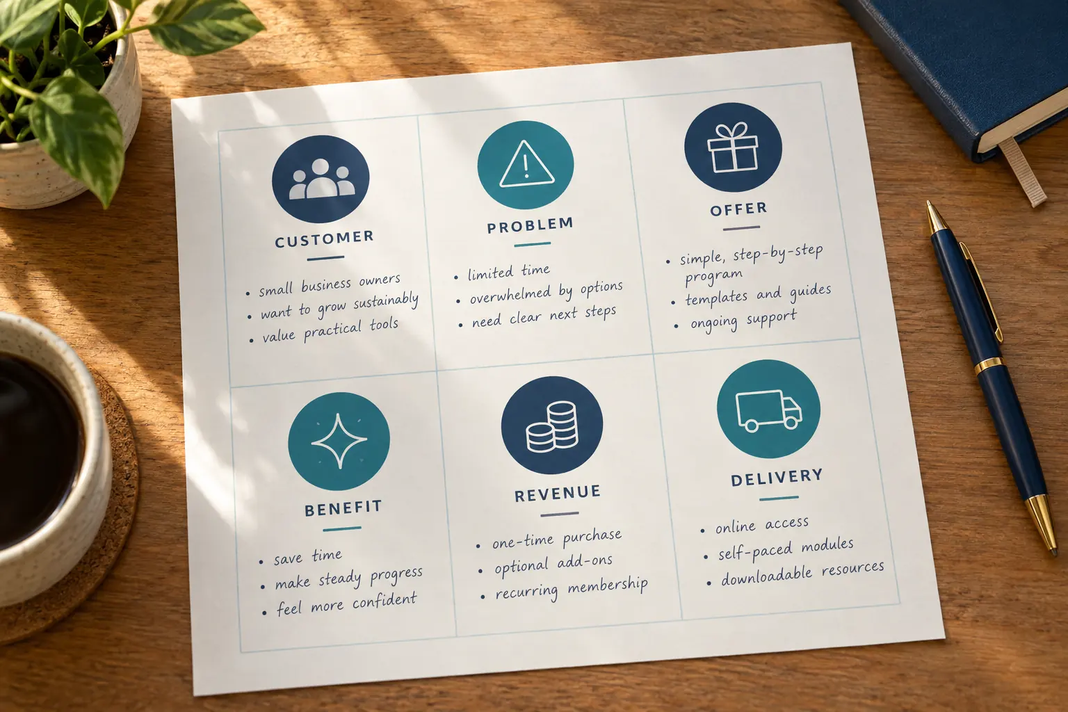
What Is a Business Concept? Meaning, Examples, and How to Write One
What is a business concept? It is a clear explanation of a business idea: what you will offer, who it is for, what problem it solves, and how the business expects to earn money. It gives an idea enough shape that you can discuss it, test it, and decide whether to develop it further.
You do not need a lengthy document to start. A short paragraph can capture the concept for a simple business, while a more complex venture may need additional detail. This guide shows you what to include, how to write it, and how to tell whether the idea makes sense outside your own head.
Key takeaways
- A business concept explains the offer, customer, problem, value, and basic way the business will earn money.
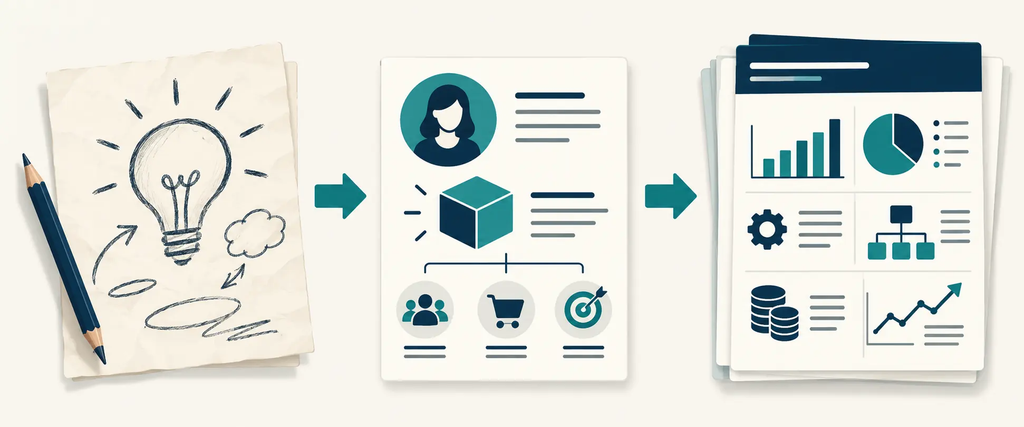
- It is more specific than an initial idea and usually less detailed than a business plan.
- A strong concept names a particular customer instead of claiming to serve everyone.
- Writing the concept is a starting point. Customer conversations and market research help you test its assumptions.
What is a business concept in entrepreneurship?
In entrepreneurship, a business concept turns a broad idea into a proposal you can examine. “I want to sell food” is an idea. “I will deliver ready-to-heat lunches to office workers who have limited time to leave their workplace” begins to describe a business concept.
The second statement gives you something to investigate. You can ask office workers what they currently buy, learn what matters to them, estimate delivery costs, and see whether the proposed service would be practical. The concept does not prove that the business will succeed, but it makes the questions clearer.
A business concept can describe a new company, a new product within an existing company, or a different way to serve an existing market. Its purpose is to give the people involved a shared understanding of what the business intends to do.
What should a business concept include?
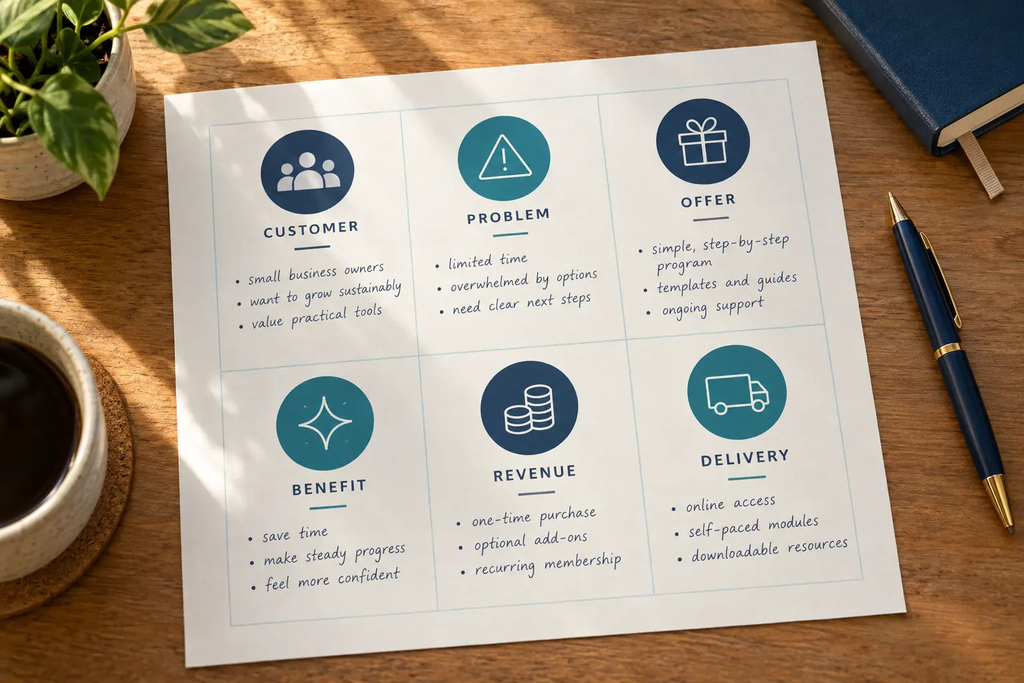
A useful concept answers a small set of practical questions. You can write the answers as a paragraph or expand them into a brief concept statement when you need to share the idea with a partner or adviser.
| Element | Question to answer | Simple example |
|---|---|---|
| Customer | Who is most likely to buy? | Parents who need after-school care |
| Problem | What difficulty or unmet need do they have? | Pickup times conflict with work hours |
| Offer | What will you provide? | Supervised care with flexible pickup |
| Value | Why might they choose this offer? | Hours that fit their schedule |
| Revenue | How will the business be paid? | A weekly fee per child |
| Delivery | What must happen to provide the offer? | Suitable space, staff, and scheduling |
The table is a thinking tool, not a guarantee of demand. If you cannot explain one of its rows, mark it as a question to investigate. For example, “parents want flexible pickup” is an assumption until you speak with potential customers.
The customer and the problem
Start with a group of people you can describe clearly. “Busy people” is too broad to guide decisions, while “office workers in buildings with few nearby lunch options” gives you a group whose needs you can explore.
Then describe the problem in the customer’s terms. A founder may be excited about an app, but the customer may simply want to avoid waiting on the phone. That distinction can change what you build and how you sell it.
The offer and its value
Say what the customer will receive. Name the product or service plainly before discussing features, branding, or technology.
Next, explain the reason someone might choose it. Convenience, reliability, a particular level of service, or a better fit for a narrow group can all matter. You should be able to describe the benefit without claiming that your offer is “the best” before you have evidence.
Revenue and delivery
A concept should say how money may come in, such as individual purchases, subscriptions, project fees, or recurring service contracts. You do not need precise financial forecasts in an early concept, but you do need to know who would pay and what they would pay for.
Also consider what it takes to deliver the offer. A meal service needs more than a menu; it needs a workable approach to preparation, ordering, and delivery. These practical details often reveal whether a promising idea needs to change.
Business idea vs. business concept vs. business plan
These terms describe related work at different levels of detail. You may revisit all three as you learn more about customers and costs.
| Stage | What it does | Example |
|---|---|---|
| Business idea | Suggests an opportunity | “Sell prepared lunches.” |
| Business concept | Defines the customer, offer, value, and revenue approach | “Deliver ready-to-heat lunches to office workers through preorders.” |
| Business plan | Explains how the business intends to operate and pursue its goals | Customer research, marketing, operations, costs, and financial assumptions |
A business concept may also become part of a business plan. The plan develops the concept with more evidence and execution detail. If your customer research changes the offer, update the concept before building a plan around an outdated assumption.
For a closer look at what happens once planning is complete, see what an entrepreneur should do after creating a business plan. It covers the move from planning toward launch activities and operations.
How do you write a business concept?
You can draft a useful version in one sitting. Treat it as a working description that improves as you learn, rather than a statement you must get perfect on the first try.
1. Name a specific customer
Write down who has the need and when it appears. If you plan to serve several groups, choose the one you would approach first. A focused starting point makes it easier to check whether your offer appeals to anyone.
2. Describe the problem you want to solve
Explain what the customer currently finds difficult, inconvenient, expensive, or unavailable. Be careful with problems you have noticed, but customers have not confirmed. Keep those as assumptions to test.
3. State your offer in plain language
Write what you will sell and how the customer will receive it. A reader should understand the offer without knowing your industry terms. If your explanation needs several sentences of jargon, simplify it.
4. Explain the benefit and payment method
Describe the main reason a customer might choose you, then state how the business expects to earn revenue. At this stage, a possible payment method is enough. You can test prices and costs separately before relying on them.
5. Check the idea against reality
Look at existing alternatives and talk with potential customers. Ask what they use now, what frustrates them, and what they would need to see before buying. Their answers may lead you to narrow the audience, change the offer, or drop an assumption.
Here is a template you can adapt:
We will provide [product or service] for [specific customer] who [problem or need]. The offer helps them [main benefit] through [how it works]. Customers will pay through [basic revenue method].
The template gives you a first draft, not a substitute for research. If a sentence depends on a guess, identify the guess and decide how you will check it.
Business concept examples
The examples below are fictional. They show how a concept connects a particular customer and need with an offer and a way to earn money.
Example 1: A local service
A bicycle repair service offers scheduled pickup and return for commuters who cannot visit a repair shop during opening hours. Customers book a repair, receive an estimate, and pay for the agreed work and pickup service.
The concept identifies both the customer and the convenience being offered. It still needs testing: the founder would have to check whether enough commuters want pickup, what they would pay, and whether the travel time makes the service viable.
Example 2: A product business
An online sticker shop sells small batches of original designs for people decorating journals and laptops. Customers buy individual designs or themed packs through the shop.
This concept has a clear product and sales method, but it does not answer every launch question. The owner still needs to learn which designs customers want and whether the selling price covers production, packaging, and fulfillment. Rarely Notes’ guide to starting a sticker business explores those later decisions.
Example 3: A business-to-business service
A bookkeeping service offers monthly record organization for independent service providers who struggle to keep their transactions up to date. Clients pay a monthly fee for an agreed scope of work.
Here, the scope matters as much as the headline offer. The founder would need to define exactly what the monthly fee includes, how records are shared, and which tasks fall outside the service.
How can you tell if your concept is strong?
A clear concept is easy to explain, but clarity alone is not proof that customers will buy. Use it to guide a small set of checks before committing substantial time or money.
Ask yourself:
- Can I identify a real customer? You should know whom to approach for a conversation, even if the customer group changes later.
- Can I explain the problem without describing my product? This helps you separate a customer need from your preferred solution.
- Do customers already use an alternative? Competitors, do-it-yourself solutions, and doing nothing all deserve attention.
- Can I describe how the offer reaches the customer? A good offer still needs a practical way to be found, purchased, and delivered.
- What assumption could make the idea fail? Test that assumption early, whether it concerns demand, price, cost, or delivery.
One common mistake is treating positive comments as confirmed demand. Someone may like an idea without wanting to pay for it. Follow encouraging feedback with more specific questions about current behavior and the conditions under which a person would buy.
FAQs
How do you write a business concept?
Name a specific customer, describe their problem, explain your offer, and state how the business expects to earn money. Write it in plain language, then revise it after researching alternatives and speaking with potential customers.
What are examples of business concepts?
Examples include a pickup bicycle repair service for commuters, an online shop selling original sticker designs, and a monthly bookkeeping service for independent professionals. Each becomes a useful concept when you explain its customer, benefit, and payment method.
What is a business concept in a business plan?
It is the core description of what the business intends to offer, whom it serves, and why that offer has value. A business plan adds detail about the market, operations, marketing, costs, and goals.
How long should a business concept be?
It should be long enough to make the offer and customer clear. A paragraph may work for a simple idea, while a complex or unfamiliar venture may need a short document with supporting detail.
Are there five or seven standard types of business concepts?
There is no single required list of five or seven types. Guides group concepts in different ways, such as products, services, online businesses, or business-to-business offers. The most useful classification is the one that helps you explain your own customer, offer, and revenue approach clearly.
Conclusion
Now that you know what is a business concept, try writing yours in one short paragraph. Name the customer, the problem, your offer, its main benefit, and how you expect to be paid. Then choose one assumption to test with real potential customers before you build a larger plan.