What Is Turnover in Business? Formula and Example
What is turnover in business? In a sales context, it is the value of goods or services a business sells during a stated period, usually after adjusting for returns and allowances. You may also hear it called sales turnover or sales revenue. It tells you how much the business sold, but it does not tell you how much profit it made.
The word needs context. “Turnover” can also describe how often employees leave or how quickly inventory sells. This guide focuses on sales turnover and shows you how to calculate it, read it alongside profit, and avoid the most common mix-ups.
Key takeaways
- Sales turnover measures sales over a defined period, such as a month or year.
- For a useful net sales figure, start with gross sales and subtract returns and allowances.
- Profit comes later, after the business accounts for the costs and expenses associated with those sales.
- Turnover and cash received can differ, depending on when a sale is recorded and when a customer pays.
What does turnover mean in business accounting?
When someone says a company has “$500,000 in annual turnover,” they generally mean it recorded roughly $500,000 in sales during that year. The number describes the scale of sales, not the amount the owner takes home. In many financial statements, you will see a related figure labeled revenue, sales, or net sales rather than turnover.
The precise definition can depend on the document you are reading. For example, UK government guidance on turnover defines it, for a particular legal purpose, around goods and services supplied in ordinary business activities after specified deductions. For everyday analysis, the practical habit is to check what a report includes before comparing its turnover figure with another company’s revenue.

How do you calculate sales turnover?
Choose a period first, then total the sales recorded for that period. If you want net sales turnover, subtract sales returns and allowances from gross sales:
Net sales turnover = Gross sales − Sales returns − Sales allowances
A return is a sale reversed because the customer sends an item back. An allowance reduces the selling price without necessarily reversing the whole sale. The IRS guide for small businesses uses this gross-receipts-minus-returns-and-allowances sequence to arrive at net receipts, then subtracts the cost of goods sold to calculate gross profit. Your accounting or tax treatment may require additional care, so use the terms shown in the specific report or form you are completing.
What is turnover in business with an example?
Imagine a shop records $120,000 in gross sales during one year. Customers return $4,000 of purchases, and the shop grants $1,000 in price allowances. Its net sales turnover for that year is $115,000.
| Item | Amount |
|---|---|
| Gross sales | $120,000 |
| Less: returns | $4,000 |
| Less: allowances | $1,000 |
| Net sales turnover | $115,000 |
Suppose the items sold cost the shop $70,000. Its gross profit would be $45,000 before other operating expenses. If those additional expenses total $32,000, the example leaves $13,000 before any further items that apply to the business, such as interest or income tax. The $115,000 turnover figure and the eventual profit answer different questions.
For a business selling a single product at one price, units sold × selling price is a quick way to estimate gross sales. If prices vary or customers receive discounts, use the actual recorded sales and adjustments instead of relying on one average price.

Is turnover the same as revenue or profit?
Turnover and revenue often refer to the same sales activity, especially when both figures cover the same period and use the same adjustments. They are not labels you should assume are identical in every report. “Revenue” may be used more broadly, while “sales turnover” points the reader toward sales from the business’s usual activities.
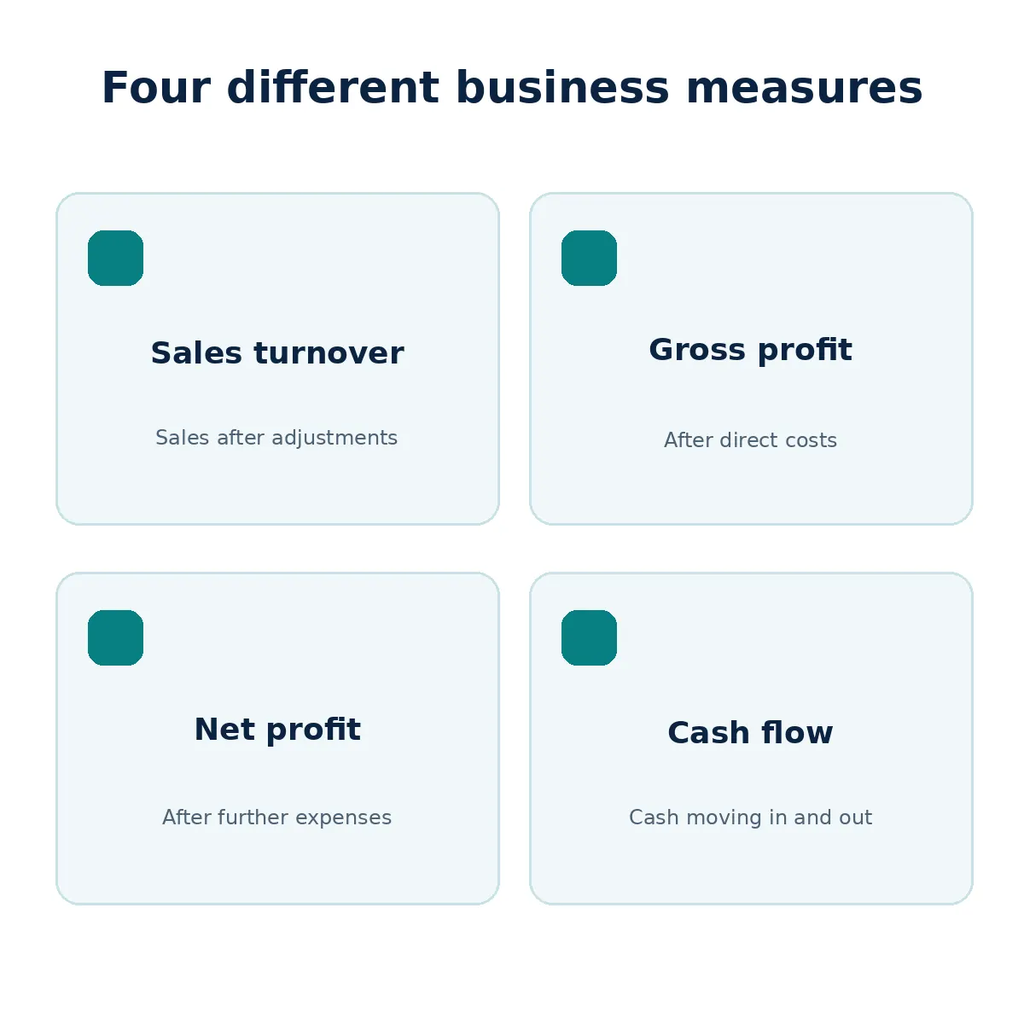
Turnover and profit are different. Turnover describes sales before the business has accounted for all the costs of earning them. Profit describes what remains at a particular stage of the calculation. The SEC’s guide to income statements shows the progression from sales through returns, cost of sales, operating expenses, and finally net profit or loss.
| Measure | Question it answers | Using the shop example |
|---|---|---|
| Gross sales | What was sold before returns and allowances? | $120,000 |
| Net sales turnover | What sales remain after those adjustments? | $115,000 |
| Gross profit | What remains after the cost of goods sold? | $45,000 |
| Profit after the example’s other expenses | What remains after a further $32,000 of expenses? | $13,000 |
A rise in turnover is therefore not automatically good news for earnings. More orders might require expensive advertising, extra staffing, or heavy discounts. I would check turnover and profit together before deciding whether growth is helping the business.
If you are learning to read the underlying reports, Rarely Notes’ guide to using QuickBooks for a small business explains the role of the profit and loss statement. Its guide to making money in an HVAC business also gives a service-business context for thinking about sales and gross profit.
Does turnover mean cash in the bank?
No. A business can record a sale and still be waiting for the customer to pay. It can also receive cash at a different time from when its accounting records recognize the related income. That is why a sales report and a bank balance should never be treated as interchangeable.
Timing depends in part on the accounting method and the transaction. The IRS explanation of cash and accrual methods says the cash method generally includes income when received, while the accrual method generally reports income when earned, regardless of when payment arrives. For your own books, use the method applicable to your business consistently and ask a qualified accountant about a reporting or tax question specific to your circumstances.
Consider a service business that completes a $2,000 project and sends an invoice at the end of March. If the client pays in April, the sales activity and the cash receipt happen in different months. Which month shows the income in a particular set of records depends on the accounting basis and applicable rules. The example is a reminder to check both sales performance and cash available to pay bills.

What else can “turnover” mean?
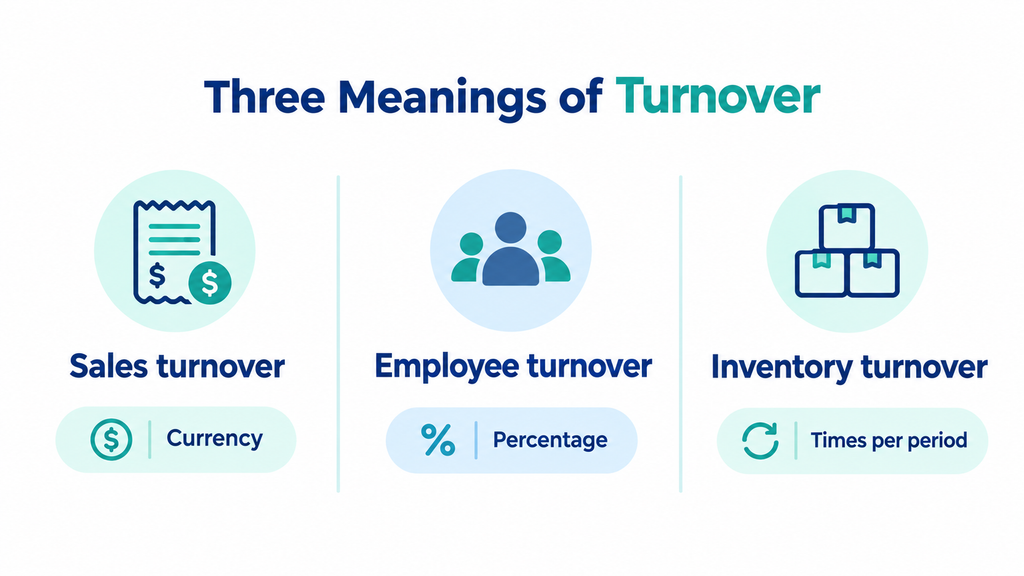
The surrounding words matter. If a report mentions sales turnover, it is discussing sales value. If it mentions employee turnover, it is discussing staff departures. Inventory turnover describes how often inventory is sold or used over a period; it is a ratio, not a sales amount. The SEC’s financial statement guide describes inventory turnover as cost of sales divided by average inventory.
This distinction is especially useful when someone says, “Our turnover is 20%.” Sales turnover is normally expressed as money, so a percentage alone needs more explanation. The speaker might mean a 20% change in sales, an employee turnover rate, or another turnover ratio. Ask which measure, period, and calculation they mean before acting on it.
How to use turnover when checking business performance
Start by comparing like with like. Monthly turnover can reveal a short-term change, while annual turnover gives a broader view. A seasonal business should also compare a month with the same month in a previous year, since comparing a busy season with a quiet one may lead to the wrong conclusion.
Next, look at what happened below the sales line. Did returns rise? Did the direct cost of delivering each sale increase? Did higher sales require more spending? These questions help explain why a business can sell more but keep less. The SEC’s breakdown of an income statement provides a useful order for reading those figures.
Finally, check cash flow. A strong sales month may still leave bills difficult to pay if customers pay late or large expenses come due first. Turnover is a helpful starting point, but the useful decision comes from reading it alongside costs, profit, and cash.
Frequently asked questions
Is turnover the same as profit?
No. Sales turnover measures sales over a period, while profit is what remains after the relevant costs and expenses are deducted. A business can have high turnover and low profit, or even a loss.
How do I calculate my turnover?
Choose a period and add the sales recorded in it. For net sales turnover, subtract returns and allowances from gross sales; check how discounts and other adjustments are recorded in your own accounts.
What does 20% turnover mean?
The percentage needs a label. It could describe a 20% increase in sales compared with another period, an employee turnover rate, or a different ratio. Ask for the measure and the comparison period before interpreting it.
What is a good turnover for a company?
There is no single sales figure that makes every company healthy. A useful assessment compares turnover with the company’s costs, profit, cash needs, past performance, and type of business.
Is turnover the same as revenue?
Often, sales turnover and sales revenue describe closely related figures. Read the report’s definition, though: figures labeled revenue may include items or adjustments that make a direct comparison misleading.
Conclusion
Understanding what is turnover in business starts with a simple question: How much did the business sell during this period? Calculate that figure consistently, then look at returns, costs, profit, and cash flow to see what those sales achiturnover is manage a business, begin with your latest profit and loss statement and compare its sales and profit figures for the same period.