What Does OOO Mean in Business? A Practical Guide
Quick answer: If you are wondering what does ooo mean in business, OOO means “out of office.” It tells coworkers or customers that someone is temporarily unavailable or may take longer than usual to respond. You might see it in an email auto-reply, a calendar event, a team chat status, or a message such as “I’ll be OOO Friday.” It does not, by itself, say why the person is away or whether the time off is paid.
A short abbreviation can cause a surprisingly practical question: should you wait, contact someone else, or expect a reply later today? This guide explains how to read an OOO notice, how OOO differs from PTO, and how to write a clear notice of your own.
Key takeaways
- OOO = out of office: A signal about someone’s availability, often paired with a return date.
- PTO = paid time off: A leave or pay category, subject to the employer’s policy.
- An OOO status does not automatically mean vacation, and a person can be away from a physical office while still working.
- A useful OOO message states when to expect a response and who can help with urgent work.
What does OOO mean in business communication?
The dictionary definition of OOO identifies it as an abbreviation for “out of office.” In everyday work messages, it usually means the person is unavailable for ordinary contact during a stated period. People may write it as OOO, OoO, or “out of office”; the meaning is the same.
You could see “OOO until Monday” beside a colleague’s name or receive an automatic reply after sending an email. The abbreviation also works in an ordinary sentence: “Mina is OOO this afternoon, so I’ll handle the client call.” The key information is the person’s availability, not the reason for their absence.
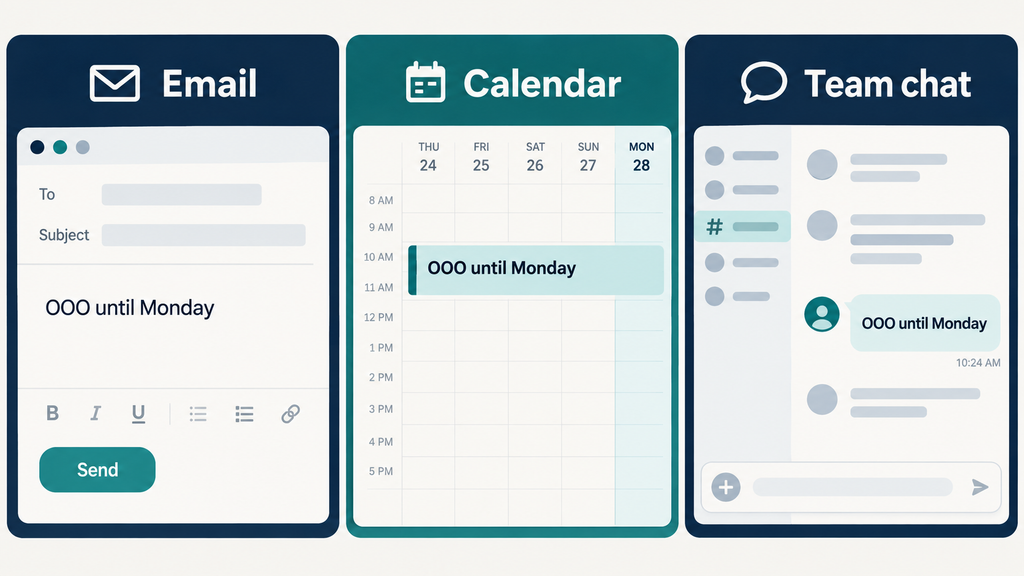
Does OOO mean someone is not working?
Often, yes: a vacation or personal day may leave someone unavailable for work. But you cannot tell that from “OOO” alone. A person may also be at a conference, visiting a customer, attending training, or away from their usual desk while still working.
Treat an OOO notice as a guide to when and how to reach someone. If the message says they are not monitoring email, do not assume they will answer from a phone. If it says responses may be delayed, they may still reply when time permits. Follow the actual wording instead of guessing.
OOO vs. PTO: What is the difference?
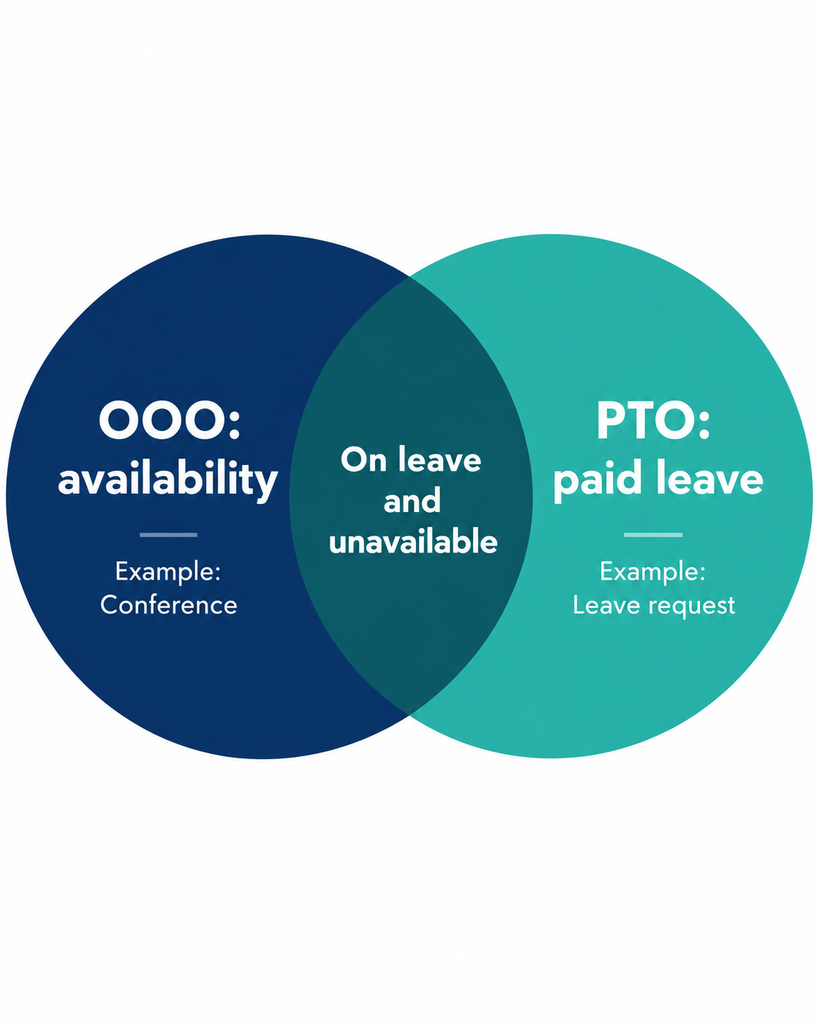
OOO describes availability. PTO means paid time off, a type of absence or leave under an employer’s rules. For example, someone can be on approved PTO and mark their calendar OOO so colleagues do not schedule meetings. Someone else can mark themselves OOO during a work conference without taking PTO.
| Term | What it tells you | What it does not tell you |
|---|---|---|
| OOO | The person is away or unavailable for usual contact. | Whether leave was approved or paid. |
| PTO | The person is using paid time off under an applicable workplace policy. | Whether an email reply, calendar block, or handoff has been set up. |
The two can overlap, but they serve different jobs. The Society for Human Resource Management’s explanation of PTO accrual discusses how employees earn paid time off; the specific rules come from the employer’s policy. An OOO calendar event or email setting does not itself submit a leave request. Check your workplace’s process if you need approved time off.
Where will you see OOO at work?
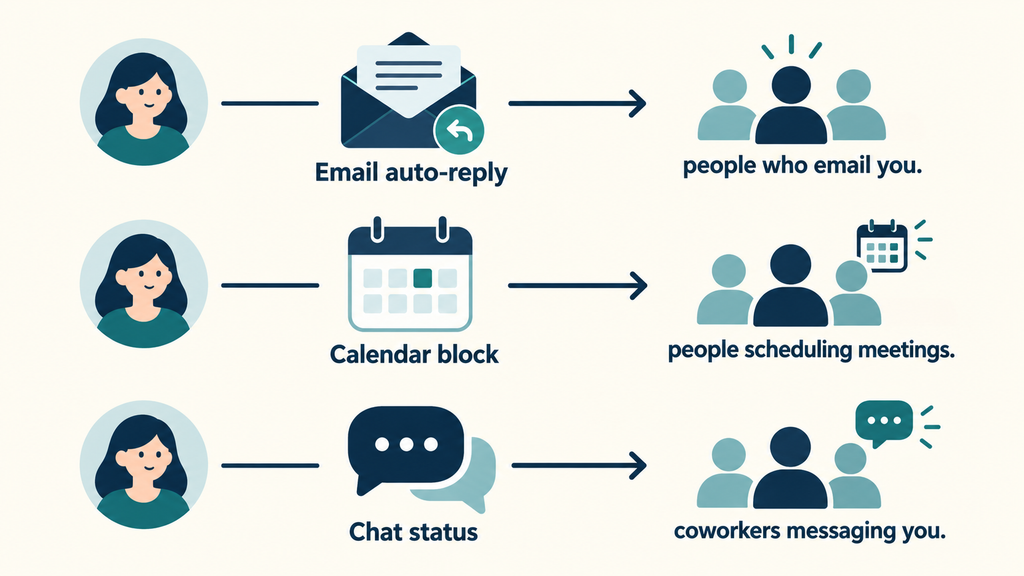
An email auto-reply tells senders that an answer may be delayed and can name an alternate contact. Microsoft’s Outlook instructions explain how to schedule automatic replies and, for supported work or school accounts, write different messages for internal and external senders. Settings differ by account and app version, so check the options available to you.
A calendar OOO event reserves time when meetings should not be scheduled. Google’s out-of-office guidance explains that its Calendar out-of-office event can decline meetings during the selected period. A team chat status makes the same absence visible to coworkers; Slack’s help page describes its dedicated out-of-office status and how to add a message and end date.
These signals do not always update one another. An email auto-reply might be active while a chat status is blank, or a calendar might show OOO without giving a customer an alternate contact. When you are the person going away, check each channel your team actually uses.
How to respond when someone says they are OOO
Start with the return date and any alternate contact in the message. For a routine request, leave the information the person will need and allow time for them to catch up after returning. If the matter cannot wait, contact the named colleague or team inbox instead of sending repeated messages to the unavailable person.
If no alternate is listed, use the team’s usual escalation route or ask a manager who owns the task. Avoid sharing sensitive details with a newly suggested contact until you confirm that person is authorized to handle them. “OOO” tells you to adjust the path of your request; it does not give every coworker access to every project.
Example: You send an invoice question and receive “OOO through Thursday; for urgent billing requests, contact the billing team.” A routine correction can wait. A payment deadline on Wednesday should go to the billing team with the invoice number and deadline, using your normal secure channel.
How to write an effective out-of-office message
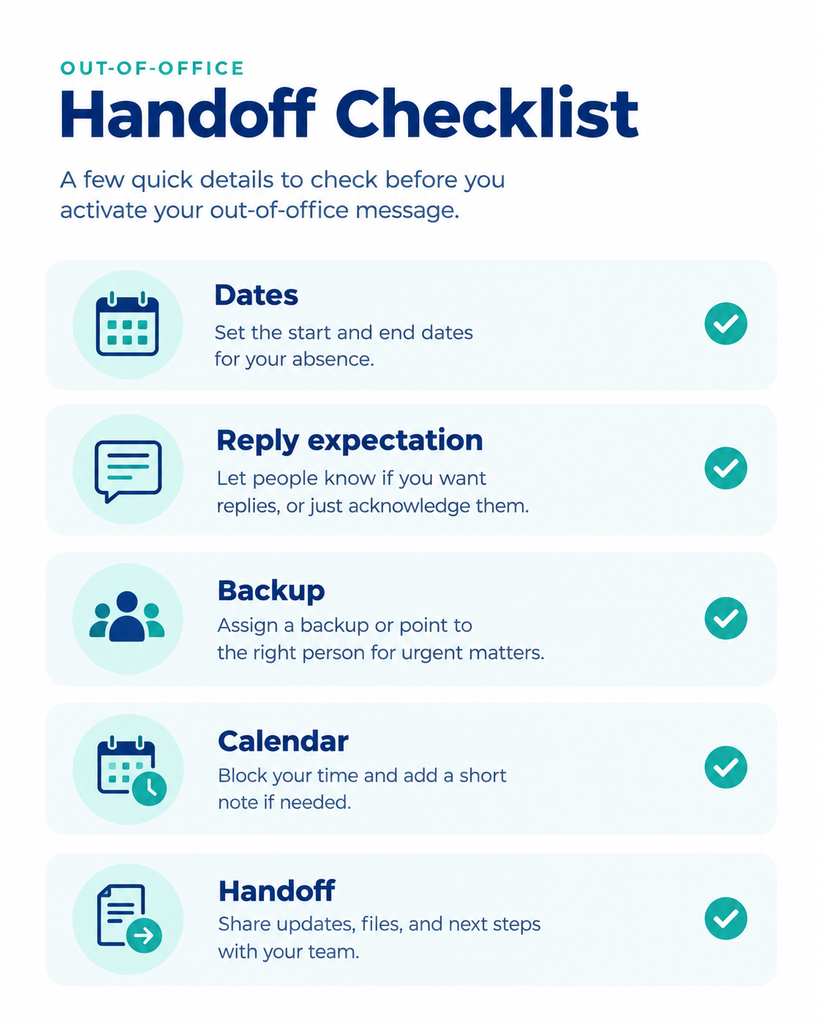
An OOO reply works best when it answers four questions: When are you away? When can someone expect a response? Who can help sooner? Which matters genuinely require that alternate contact? You can keep your reason private; “I am away” is usually enough.
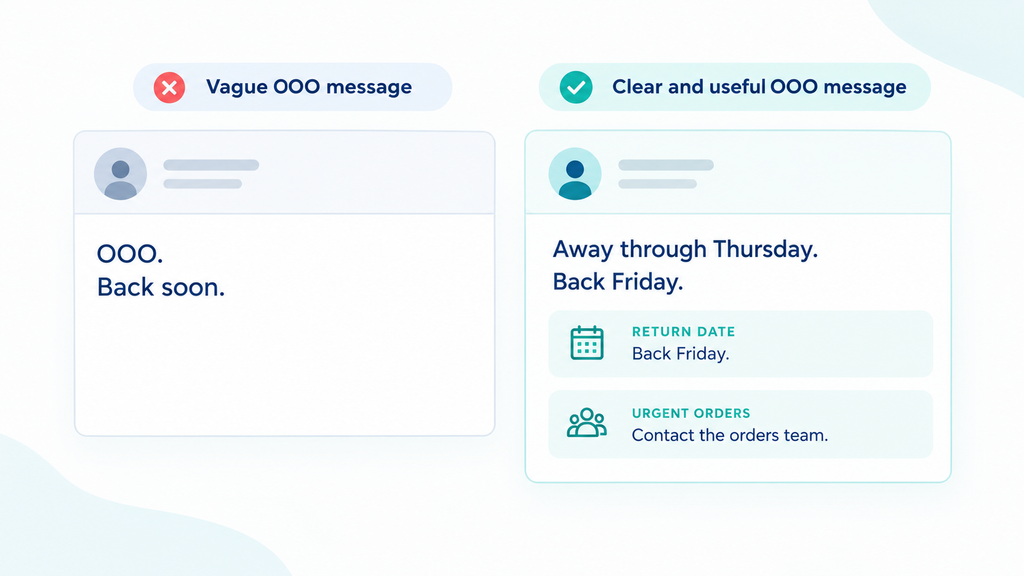
- Give a clear time frame. “I am out through Thursday and will return Friday” is easier to act on than “back soon.” Add a time zone if your audience works across regions and the exact hour matters.
- Set a realistic reply expectation. “I will respond after I return” is safer than promising to answer every message immediately on your first day back.
- Name the right backup. Confirm that the colleague or shared inbox is available, knows the handoff, and can receive the relevant requests.
- Check what outsiders will see. An external reply may be sent to people beyond your team. Share only the contact details and project information appropriate for that audience.
- Set the end date and review meetings. Scheduling an auto-reply is only part of preparing for an absence. Update your calendar and reschedule anything that still needs your attendance.
If you are handing off longer-running work, record the next action, owner, and deadline in the team’s normal system. That small step also helps keep your short-term work goals connected to longer career goals when you return, without turning an automatic reply into a project plan.
Out-of-office email example
Subject: Out of office through Thursday
Thanks for your message. I am away through Thursday and will respond after I return on Friday. For urgent requests about current orders, please contact the orders team using our usual support address. Thank you for your patience.
The subject and reply can be even shorter for internal use. Replace “current orders” with the actual topic your backup handles and include an approved contact route. If no one is covering your work, omit the backup line and give a reasonable response expectation instead.
Short team chat and calendar examples
For chat, a status such as “OOO through Thursday; urgent order questions → orders team” gives coworkers enough to act. For a calendar event, use the correct out-of-office setting, dates, and meeting-decline options for your calendar. A plain “busy” block and an out-of-office event may behave differently, depending on the tool.
Common OOO mistakes to avoid
A vague message can create more work for everyone. “OOO” without dates tells people you are away but not when to follow up, while a backup contact who has not agreed to cover the task sends urgent requests to another dead end.
Another mistake is assuming that a status update covers every channel or formally records your leave. If you need to use PTO, follow your employer’s approval and timekeeping steps. Before leaving, send one clear handoff to the person covering your work and confirm the auto-reply switches off at the right time.
FAQs about OOO at work
What is OOO and PTO?
OOO means out of office and describes someone’s availability. PTO means paid time off and describes a type of leave under an employer’s policy. A person may use both on the same day, but setting an OOO reply does not request PTO.
What does it mean if someone is OOO?
It means they are away from their normal work contact or unavailable for their usual response time. Read their message for the return date, expected response time, and alternate contact. It does not automatically reveal whether they are on vacation or still working elsewhere.
Does OOO mean not working?
Sometimes, but not always. Someone taking leave may not be working at all, while someone attending a conference may still be working but less reachable. Their specific message is a better guide than the abbreviation alone.
What does OOO mean in business slang?
It is workplace shorthand for “out of office.” In a chat or email, “I’m OOO tomorrow” usually means “I will be away or unavailable tomorrow.” If timing matters, ask when the person will be back rather than assuming it means a full day.
Can I say OOO if I work remotely?
Yes. In remote work, “out of office” commonly signals availability rather than a literal absence from an office building. If you are working normally from another location, “working remotely” or your expected response hours may be clearer than OOO.
What is an example of OOO in a business email?
“I am out of office until Friday and will reply after I return” is a simple example. For time-sensitive work, add an approved team inbox or colleague who can help while you are away. Include a specific return day so senders know what to expect.
Conclusion
What does ooo mean in business? It means “out of office,” a quick way to signal that someone’s normal availability has changed. Look beyond the three letters for the return date, response expectation, and backup contact; those details tell you what to do next.
If you are setting your own OOO notice, write a short message, confirm your backup, and check your calendar before you leave. Clear expectations make it easier for others to keep work moving while you are away.