
How Can Short Term Goals Best Lead Towards Accomplishing Long Term Career Goals?
You have a big dream. Maybe you want to become a manager, start your own business, or get a high-paying job in your field.
But here’s the problem. That dream feels distant. You don’t know where to begin. And every time you think about it, it feels impossible.
The truth is, no one tells you this: big goals are just small goals put together.
To reach any long-term career goal, you need to set short-term goals that help you make progress. Step by step. Week by week. Month by month.
In this blog post, How Can Short Term Goals Best Lead Towards Accomplishing Long Term Career Goals?. We will try to explain real examples, get a simple action plan, and tell why this method works.
Let’s get into it.
What Are Short-Term Goals vs. Long-Term Goals?
Before discussing how they connect, let’s first understand what each one means.
Short-Term Goals
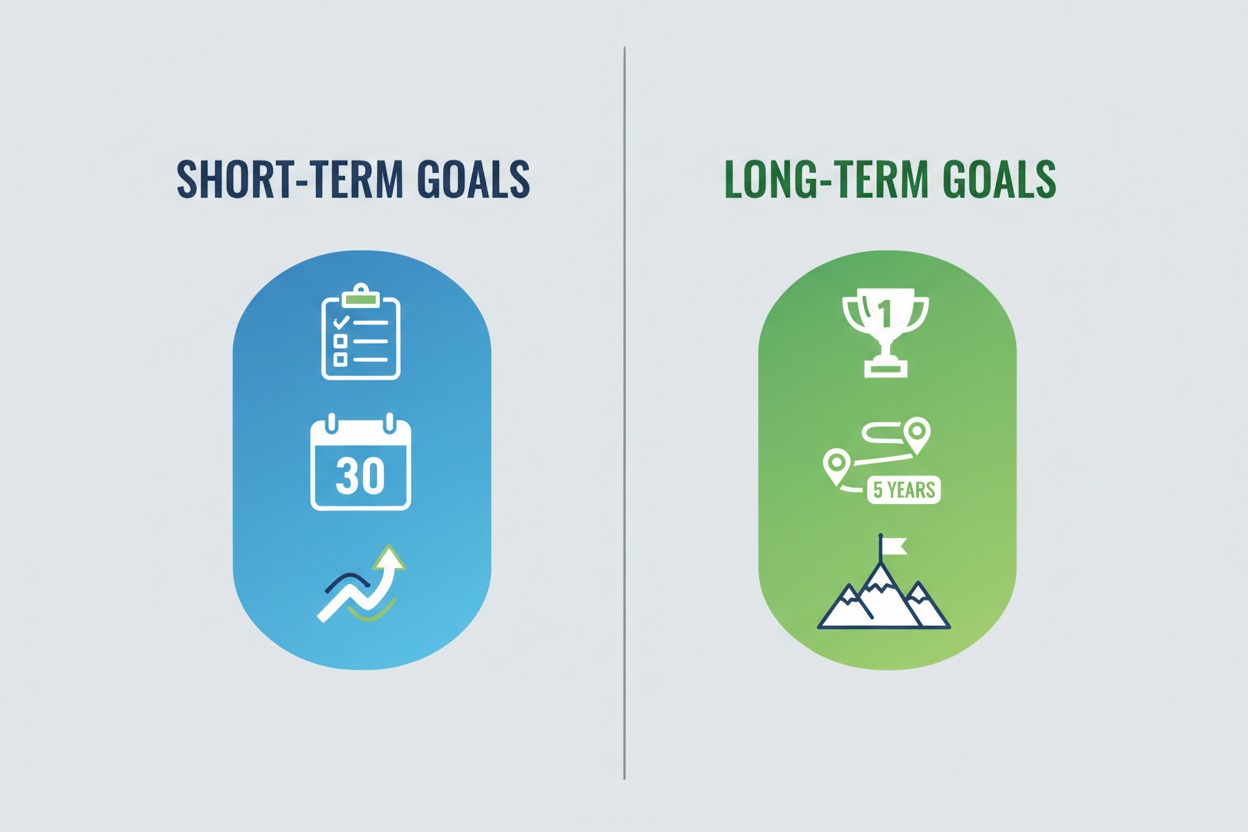
Short-term goals are things you want to achieve soon — usually within days, weeks, or a few months.
They are specific. They are actionable. And you can start on them today.
Examples of short-term career goals:
- Complete an online certification in the next 30 days
- Send five networking emails this week
- Improve your public speaking by joining a local Toastmasters chapter today
- Ask your manager for feedback in your next 1-on-1
These feel small. But that’s the point.
Long-Term Goals
Long-term goals are bigger visions. They usually take 1 to 5+ years to achieve.
They require consistent effort, skill-building, and patience.
Work goals examples for long-term planning:
- Become a senior software engineer at a tech company
- Start your own marketing consultancy
- Earn a promotion to department head
- Build a professional network of 500+ industry contacts
Short-term goals fill the gap between where you are now and where you want to be.
What Best Describes the Relationship Between Short and Long-Term Goals?
Think of it like a GPS.
You enter your final destination (long-term goal). The GPS breaks the trip into smaller steps (short-term goals). Each small step brings you closer. You can’t jump straight to the end — but every step counts.
What is the relationship between short-term and long-term goals? Simply put:
Short-term goals are the building blocks of long-term success. They create momentum, build skills, and keep you on track toward your bigger vision.
Research from the American Psychological Association shows that people who break down big goals into smaller steps are more likely to keep going and stay motivated.
This happens for three key reasons:
- Clarity: Small goals remove confusion. You always know what to do next.
- Momentum: Each win gives you energy to keep going.
- Feedback: Short-term goals show you quickly whether your approach is working.
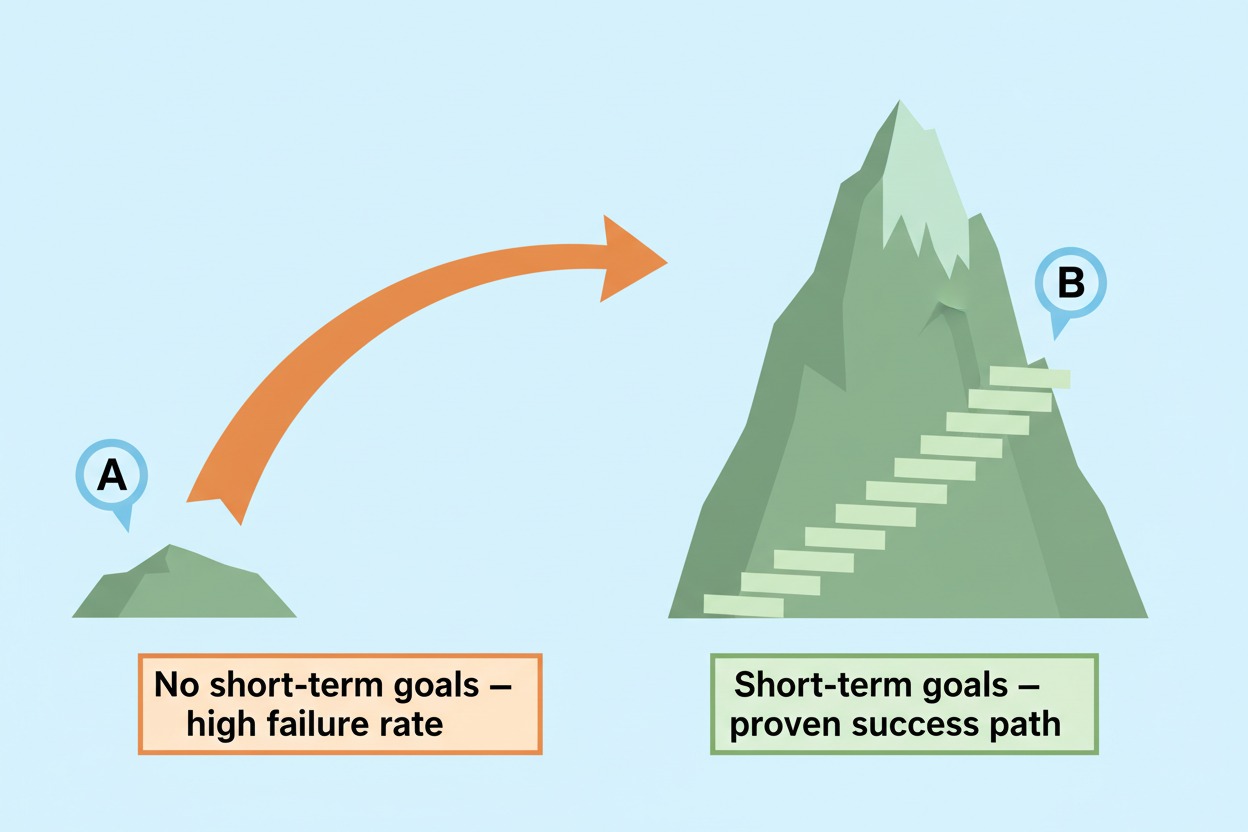
Without short-term goals, long-term goals are just wishes.
How Can Short-Term Goals Best Lead Towards Accomplishing Long-Term Career Goals?
This is the main question. The answer is one word: alignment.
Your short-term goals should match your long-term plans. If you want to be a data analyst, spending three months on graphic design won’t help. But learning SQL for 30 days is a good step forward.
Here’s a framework that works:
Step 1: Define Your Long-Term Career Vision
Start with the end in mind. Where do you want to be in 3 to 5 years?
Be specific. Not just “I want a better job.” Instead: “I want to become a UX designer at a mid-sized tech company within 3 years.”
Writing your goals down makes them real. A study by Dr. Gail Matthews at Dominican University found that people who write their goals are 42% more likely to reach them.

Step 2: Work Backward from Your Goal
Once you know your destination, ask yourself: What do I need to have, know, or do to reach it?
Break it into pieces:
| Timeline | Goal Type | Example |
|---|---|---|
| 3–5 years | Long-Term Goal | Become a senior product manager |
| 1 year | Mid-Term Goal | Land a junior product manager role |
| 3–6 months | Short-Term Goal | Complete a PM certification |
| This month | Immediate Goal | Study 1 hour daily + join a PM community |
| This week | Daily Action | Research 3 PM certification programs |
This backward-planning method is used by coaches, athletes, and top executives. It’s practical. It works.
Step 3: Set SMART Short-Term Goals
Vague goals fail. Specific goals succeed.
Use the SMART goal framework for every short-term goal:
- S — Specific: What exactly will you do?
- M — Measurable: How will you know you’ve done it?
- A — Achievable: Is it realistic?
- R — Relevant: Does it connect to your long-term goal?
- T — Time-bound: By when?
Example: ❌ “I want to improve my resume.” ✅ “I will update my resume with three new projects and get feedback from a career coach by this Friday.”
Step 4: Review and Adjust Regularly
Goals are not set in stone. Life changes. Industries shift. You grow.
Every 30 days, check in with yourself:
- Did I complete my short-term goals?
- Did they move me closer to my long-term goal?
- What needs to change?
Regularly reviewing your progress is what helps you achieve your goals, rather than just talking about them.
Personal Goals Examples That Drive Career Growth
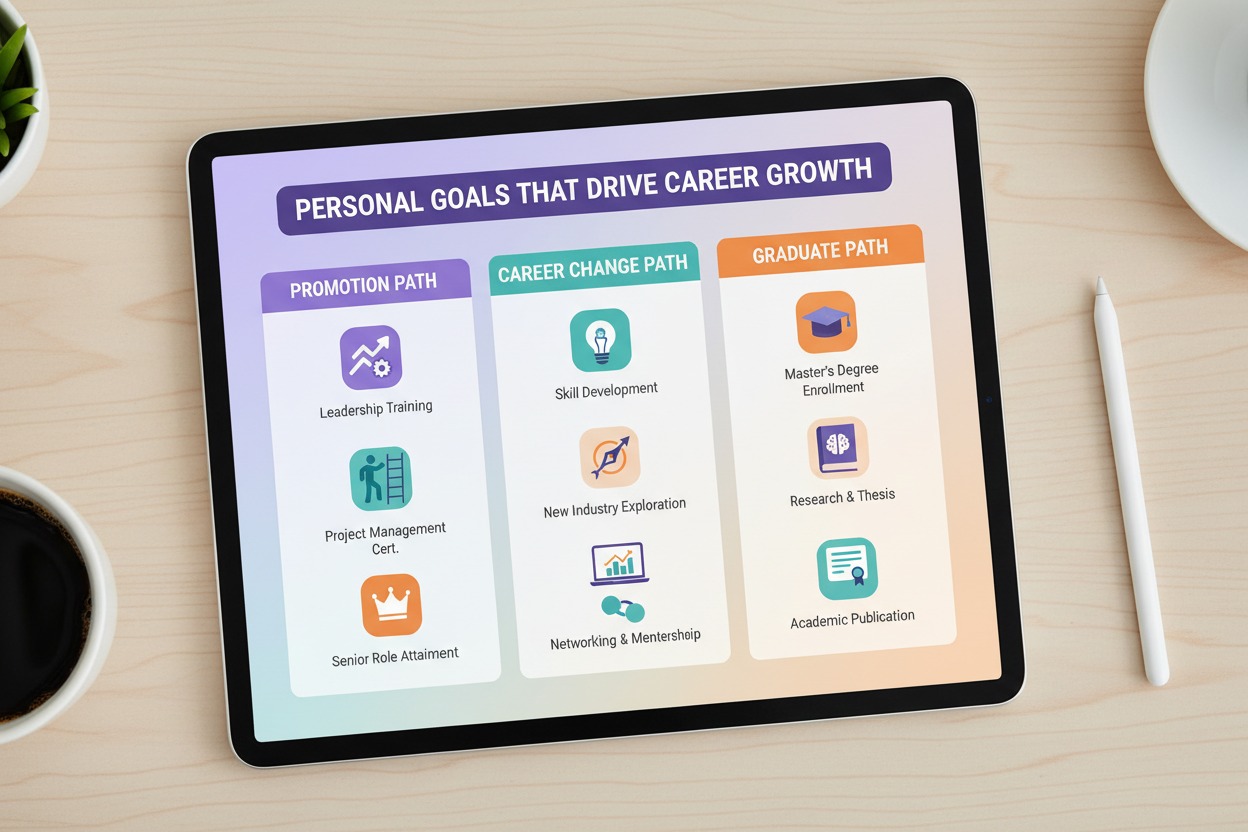
Let’s get practical. Here are real personal goals examples tied to actual career paths:
For Someone Wanting a Promotion
Long-term goal: Get promoted to team lead within 2 years
Short-term goals:
- Take on one leadership project per quarter
- Complete a leadership course on Coursera within 60 days
- Schedule a development conversation with your manager this month
- Volunteer to mentor a junior colleague starting next week
For Someone Changing Careers
Long-term goal: Move from customer service into digital marketing in 18 months
Short-term goals:
- Complete Google’s free Digital Marketing certification in 6 weeks
- Start a personal blog to build a content portfolio this month
- Connect with 10 digital marketers on LinkedIn this week
- Apply to 3 entry-level marketing roles by the end of the month
For a Recent Graduate
Long-term goal: Land a full-time software engineering job within a year
Short-term goals:
- Build two portfolio projects in the next 90 days
- Solve 3 coding problems on LeetCode every day this week
- Attend one local or virtual tech meetup per month
- Apply to 10 companies every week starting now
These examples show that short-term goals are not just random tasks — they are smart steps that build career success.
Development Goals for Work: What to Focus On
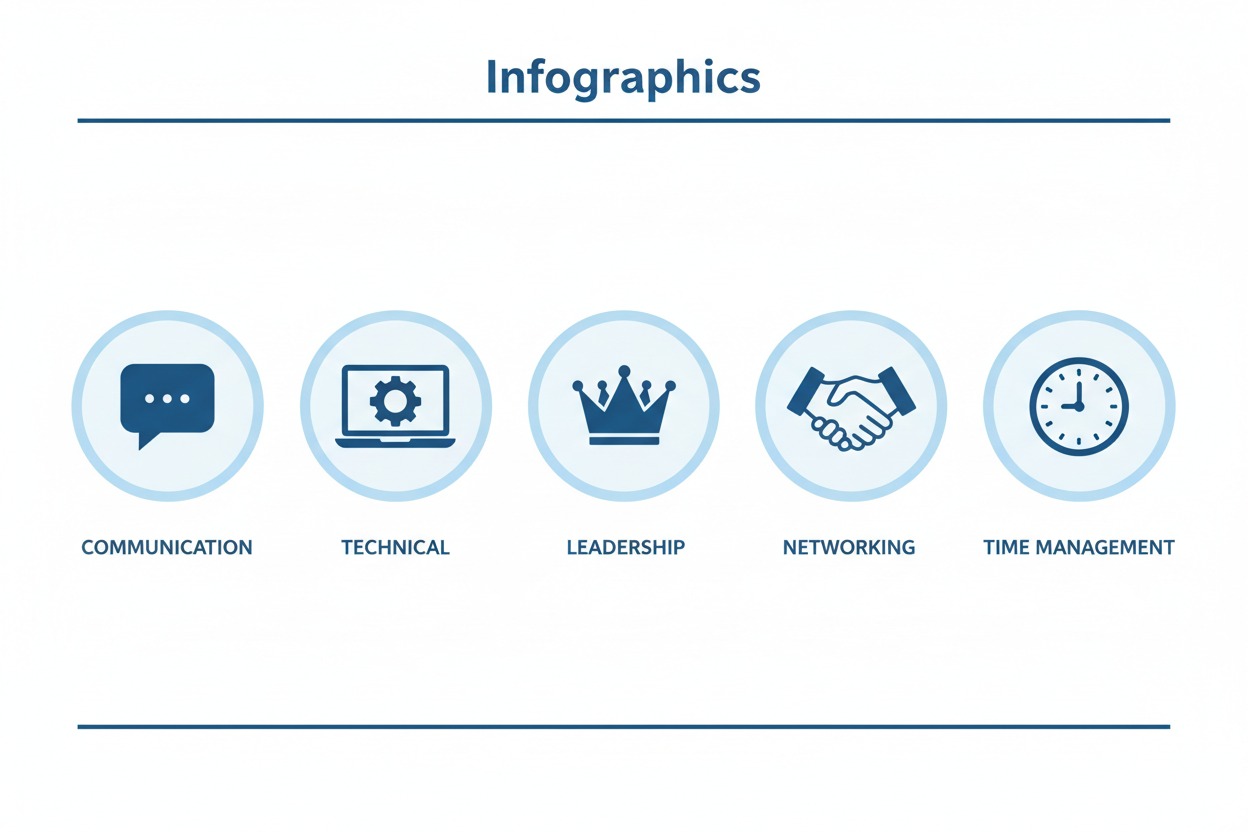
Not sure which development goals to choose? Here are key areas to focus on at work that employers truly value.
1. Communication Skills
According to LinkedIn’s Global Talent Trends report, communication is one of the most important soft skills employers want.
Development goal example: “Give one presentation to my team each month for the next three months to build confidence.”
2. Technical Skills
Keeping up with tools and technology in your field helps you stay competitive.
Development goal example: “Learn how to use Excel pivot tables with a free Microsoft tutorial by the end of this month.”
3. Leadership and Management
Even if you’re not a manager yet, developing leadership skills prepares you for growth.
Development goal example: “Lead the next team project planning meeting by the end of this quarter.”
4. Networking and Relationship Building
Your network is a career asset. Invest in it consistently.
Development goal example: “Connect with one new industry professional on LinkedIn every week for the next three months.”
5. Time Management
Productivity skills directly affect your performance reviews and promotion potential.
Development goal example: “Use a time-blocking system for my workday for the next 30 days and track results weekly.”
Which of the Following Is an Example of a Healthy Short-Term Goal?
This is a question a lot of people search for — and the answer might surprise you.
A healthy short-term goal is not just one that sounds good. It’s one that is:
- Realistic and achievable in a short window
- Connected to a bigger purpose
- Challenging enough to grow you, but not so hard that it burns you out
Which of the following is an example of a healthy short-term goal?
✅ “Read one career-related book per month for the next three months.” ✅ “Improve my typing speed to 65 WPM by practicing 15 minutes a day this week.” ✅ “Attend two virtual networking events this month to expand my professional connections.”
❌ “Become an expert in machine learning by next week.” (Unrealistic) ❌ “Get a raise this month.” (Not within your direct control) ❌ “Never make a mistake at work.” (Not measurable or achievable)
The difference? Healthy short-term goals are specific, controllable, time-bound, and realistic. They stretch you — but they don’t break you.
Which of the Following Would Not Be an Example of a Long-Term Goal?
Equally important is knowing what is not a long-term goal. This helps you think more clearly about how to categorize your plans.
Which of the following would not be an example of a long-term goal?
The answer is anything that can be done quickly or requires no sustained effort:
❌ “Send a thank-you email to my interviewer today.” (This is an immediate task) ❌ “Update my LinkedIn profile photo this week.” (Short-term action) ❌ “Read an article about industry trends tonight.” (Daily habit, not a long-term goal)
These would be long-term goals: ✅ “Earn a PMP certification within the next 18 months.” ✅ “Build a team of five and manage a $1M budget within 3 years.” ✅ “Transition into a people management role within the next 2 years.”
Long-term goals require sustained work, skill development, and time. If you can finish it in a day, it’s a task — not a long-term goal.
Work Goals Examples for Evaluation
Performance reviews are a good chance to show your boss you think ahead. Here are strong work goals examples for evaluation that impress managers and help you grow.
| Goal Category | Short-Term Version | Long-Term Version |
|---|---|---|
| Skill Development | Complete a data analysis course by Q2 | Become a certified data analyst within 2 years |
| Productivity | Reduce response time to under 4 hours this month | Lead a team efficiency project by year-end |
| Leadership | Mentor one junior team member this quarter | Manage a team of 5 within 2 years |
| Communication | Present project updates in weekly meetings | Lead department-wide communication strategy |
| Innovation | Propose one process improvement this quarter | Develop a new department workflow by year-end |
When you bring goals like these to a performance evaluation, you show your employer that you’re not just doing your job — you’re building toward something bigger.

The Science Behind Why This Approach Works
It’s not just common sense. There’s real research backing this up.
Dr. Edwin Locke and Dr. Gary Latham’s Goal-Setting Theory is a well-known idea in workplace psychology. It says that clear and tough goals help people do better than unclear or “try your best” goals.
Their research found:
- Specific goals outperform vague ones by a significant margin
- Feedback on goals increases performance even further
- Goal commitment — believing your goal matters — is critical to success
Setting a clear long-term goal along with simple short-term goals is a proven strategy supported by many years of research.
Another idea that supports this is self-efficacy — your belief that you can reach your goals. Albert Bandura’s research at Stanford shows that achieving small goals builds self-efficacy, which in turn boosts your confidence to try bigger ones.
In other words, winning small makes winning big more likely.
Expert Tips: Making Your Goals Actually Stick
🎓 Expert Insights
These tips come from career coaches, psychologists, and high-performance professionals:
1. Write your goals where you see them daily. Put them on your phone wallpaper, a sticky note on your desk, or in a morning journal. Visibility drives behavior.
2. Tell one person about your goal. Accountability works. Research by the American Society of Training and Development found that having an accountability partner increases your chance of success by up to 65%.
3. Focus on systems, not just outcomes. Instead of “I want to get a promotion,” ask “What do I need to do every day to deserve a promotion?” James Clear, author of Atomic Habits, argues that goals set the direction, but systems get you there.
4. Celebrate small wins. Don’t wait until you’ve hit the long-term goal to feel good. Reward yourself when you complete a short-term milestone. This keeps motivation high.
5. Review and revise without guilt. Missing a short-term goal is data, not failure. Learn from it, adjust, and keep moving.
Common Mistakes People Make with Goal-Setting
Even well-meaning people fall into these traps. Avoid them:
Mistake 1: Setting too many goals at once. When everything is a priority, nothing is. Pick 1–3 short-term goals at a time.
Mistake 2: Forgetting to connect short-term to long-term. If your short-term goals don’t move you toward your big vision, they’re just busy work.
Mistake 3: Not writing goals down. Goals that live only in your head rarely survive contact with Monday morning.
Mistake 4: Giving up after one failure. Missing a deadline doesn’t mean your goal is dead. It means you need to adjust.
Mistake 5: Waiting for the “right time.” There is no perfect time. Start with what you have, where you are.
Pros and Cons of Short-Term Goal Setting
| ✅ Pros | ❌ Cons |
|---|---|
| Creates immediate action and momentum | Can feel overwhelming if you set too many |
| Builds confidence with quick wins | May feel too small compared to the big dream |
| Makes long-term goals feel achievable | Requires regular review and adjustment |
| Easy to measure progress | Risk of losing sight of the bigger picture |
| Provides early feedback if something isn’t working | Can become checkbox-ticking without real growth |
The key is balance. Short-term goals without a long-term vision lead to drift. A long-term vision without short-term goals leads to paralysis. You need both.
FAQs: Short-Term Goals and Long-Term Career Success
1. How can short-term goals best lead towards accomplishing long-term career goals?
Short-term goals work best when they link to your long-term vision. Each goal should help you learn a skill, create an opportunity, or bring you closer to your dream. Think of them as steps on a staircase — each step takes you higher.
2. What is a good example of a short-term career development goal?
A clear example is: “Finish a job-related certification in 60 days to qualify for a senior role I want in six months.” It is specific, has a deadline, and supports a larger goal.
3. How long should a short-term goal take?
Short-term goals usually last from one week to six months. Goals longer than this are mid-term or long-term. The best short-term goals show clear progress within 30 days.
4. What is the difference between personal goals and development goals at work?
Personal goals are broader and can include health, relationships, or money. Work development goals focus on improving your skills, performance, and career growth. Both are important and often connect.
5. How do I choose the right short-term goals for my career?
Start with your long-term goal and ask yourself: “What skill, connection, or experience do I need most right now to get closer to that goal?” Your answer is your best short-term goal. If you are not sure, tools like LinkedIn Career Explorer can help you identify the skills and roles that bridge the gap between where you are and where you want to be.
Conclusion: Start Small, Win Big
Here’s the bottom line.
Your dream career is not out of reach. It just feels that way when you look at the whole mountain at once.
The people who succeed aren’t more talented. They use better plans. They split big dreams into small steps. They keep trying every day. They check their progress, make changes, and keep moving forward.
You don’t need a perfect plan. You need your next step.
Here’s your challenge: write one short-term goal now that links to where you want to be in 3 years. Make it SMART. Set a deadline. Share it with someone.
That’s it. That’s how short-term goals lead to long-term career success.
📣 Ready to plan your career goals? Save this guide and share it with someone planning their next career step. For more helpful career tips, subscribe to our newsletter for weekly advice that works.
Sources referenced in this article include research from the American Psychological Association, Dominican University’s goal-setting study, Locke & Latham’s Goal-Setting Theory, James Clear’s Atomic Habits, LinkedIn Talent Trends, and Toastmasters International.
Also Read: How Many Month to Receive EAD Card for 485 NIW — Full Timeline Guide