What Was the Core Business That Made Standard Oil a Horizontally Integrated Monopoly?
If you have ever searched what was the core business that made standard oil a horizontally integrated monopoly?, the short answer is oil refining.
But that answer alone does not explain why Standard Oil became so powerful.
The more interesting story is what happened after the company entered the refining business. Standard Oil did not simply refine oil and become successful because people liked its products. It built a system around refining, expanded by acquiring or controlling competing refineries, negotiated transportation advantages, reduced costs, and eventually gained enormous influence over the petroleum industry.
That distinction matters. Standard Oil is often used as a simple example of horizontal integration in history and economics classes. However, the real story is more complicated. Its dominance involved both horizontal expansion and control over other parts of the oil supply chain.
In this guide, I will explain exactly how it worked, why refining was the core business, how horizontal integration differs from vertical integration, and why the company’s rise eventually helped fuel the American anti-monopoly movement.
I will also answer related questions that often appear alongside this topic, including what made standard oil a horizontal integration monopoly, how monopolies affected small businesses during the Gilded Age, why public opinion turned against monopolies, and what the relationship between a monopoly and its competitors really looks like.
Quick answer: The core business was oil refining. Standard Oil grew by consolidating competing oil refineries operating at the same stage of production. That strategy is the key reason it is commonly taught as a classic example of horizontal integration. At the same time, Standard Oil also expanded into transportation, pipelines, storage, marketing, and other parts of the petroleum business, which added important vertical elements to its broader strategy.
The Simple Answer: Oil Refining Was the Core Business
The most direct answer to what was the core business that made standard oil a horizontally integrated monopoly? is oil refining.
In the late 19th century, petroleum production was not simply about pulling crude oil from the ground and selling it directly to consumers. Crude oil had to be processed into useful products.
Refineries performed this critical middle step. They transformed crude petroleum into products such as kerosene and other refined petroleum products. This made refining an important part of the emerging oil industry.
John D. Rockefeller recognized the importance of this stage early. Instead of focusing only on finding new oil fields, Standard Oil built its power around becoming extremely efficient at refining and distributing petroleum products. The company then expanded its influence by bringing competing refineries under its control.
According to the Library of Congress’s history of Standard Oil, the Company was founded in 1870 and, by the late 1880s, controlled about 90% of American refineries. That figure helps explain why refining is central to the answer.
The important point is that Standard Oil’s horizontal expansion occurred primarily at the refining stage. It was not simply buying companies that drilled for crude oil while remaining separate from refining. It was consolidating businesses that performed essentially the same refining function. That is the basic idea behind horizontal integration.
What Is Horizontal Integration?
Before looking more closely at Standard Oil, it helps to understand what horizontal integration actually means.
Horizontal integration occurs when a company expands by combining with or acquiring other businesses operating at the same stage of production or in the same general market.
Imagine five companies making the same type of product. Instead of one company buying a supplier that provides raw materials, it buys the other four companies making the same product. That is horizontal integration. The goal can be to:
- Increase market share
- Reduce competition
- Gain economies of scale
- Lower operating costs
- Expand production capacity
- Strengthen bargaining power
- Control a larger portion of a market
The Federal Trade Commission’s explanation of antitrust law explains that federal antitrust laws address unlawful mergers and business practices that can harm competition. The broader purpose is to preserve competitive markets and encourage businesses to compete through efficiency, price, quality, and innovation. (ftc.gov)
This is why horizontal integration can be both economically useful and potentially controversial. A company may become more efficient by combining operations. But if it becomes so dominant that meaningful competitors disappear, the same strategy can create monopoly power.
A Simple Example of Horizontal Integration
Imagine there are ten bakeries in one city. Each bakery sells bread directly to customers.
Now imagine one bakery owner buys six of the other bakeries. The owner has not moved into farming or flour production. The company is still operating at the same basic stage of business: selling baked goods.
That is a simple horizontal integration example. The company now has a much larger share of the local market. The same basic idea applies to Standard Oil’s consolidation of refineries. The difference is that Standard Oil’s historical story involved a much larger and more complicated industrial system.
Why Refining Was So Important to Standard Oil
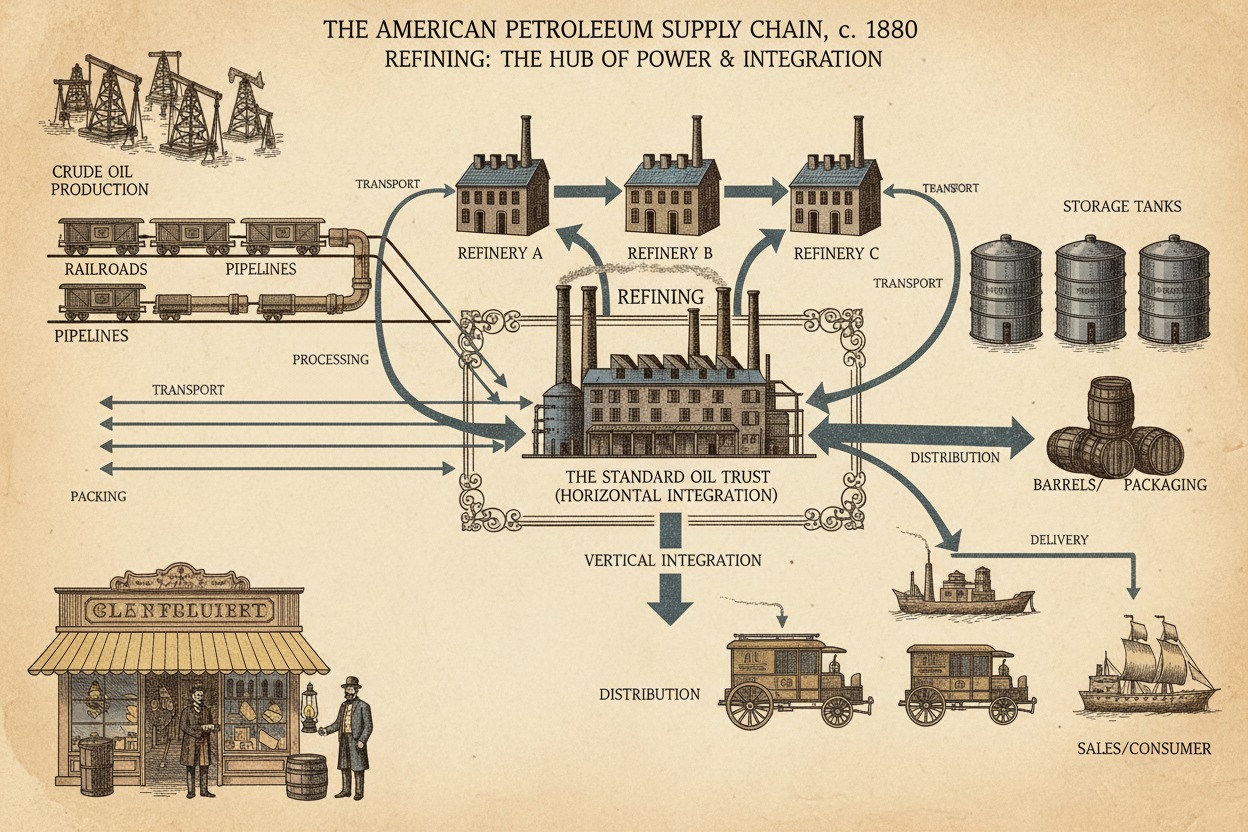
The answer becomes clearer when you understand where refining fit into the petroleum business. The oil industry could be viewed as a chain of activities. At a simplified level, it looked something like this:
Crude oil production → Transportation → Refining → Storage → Distribution → Sales
Refining sat near the center of the process. Crude oil was not simply ready to be used in the same form in which it came out of the ground. It needed processing into useful products. That gave refineries an important position.
Rockefeller’s business strategy focused heavily on making refining more efficient and more predictable. Standard Oil’s growth was tied to its ability to process petroleum at scale and then distribute the resulting products.
This is where the company found an opportunity. If Standard Oil could control more refineries, it could control a larger share of the refining market. If it could also obtain favorable transportation arrangements, improve storage, develop pipelines, and strengthen distribution, its position became even more powerful.
This is why I think the best way to understand the company is to separate its core horizontal strategy from its broader integrated business system. The core horizontal strategy was refining. The larger system went far beyond refining.
What Made Standard Oil a Horizontal Integration Monopoly?
Now we can answer the longer version of the question: what made standard oil a horizontal integration monopoly? The central factor was the company’s consolidation of competing refineries.
Standard Oil did not need to build every refinery from scratch. Instead, it could expand by acquiring, merging with, or gaining control over existing refining operations. This approach had several advantages.
1. It Reduced the Number of Independent Refiners
Every time a competing refinery came under Standard Oil’s control, there was one less independent competitor in the market. The process was gradual. One acquisition might not seem important. But when repeated across an entire industry, the result could be enormous. This is one reason horizontal integration can change the competitive structure of a market.
2. It Created Economies of Scale
A larger refining network could potentially spread certain costs across a much greater volume of production. Standard Oil became known for focusing heavily on efficiency.
Large-scale operations could help the company negotiate transportation, standardize processes, and coordinate purchasing and distribution. This is an important part of the story that is sometimes missing from simple textbook explanations.
The company’s growth was not only about eliminating rivals. It was also about building a business structure that could operate at a scale smaller competitors might struggle to match.
3. It Increased Bargaining Power
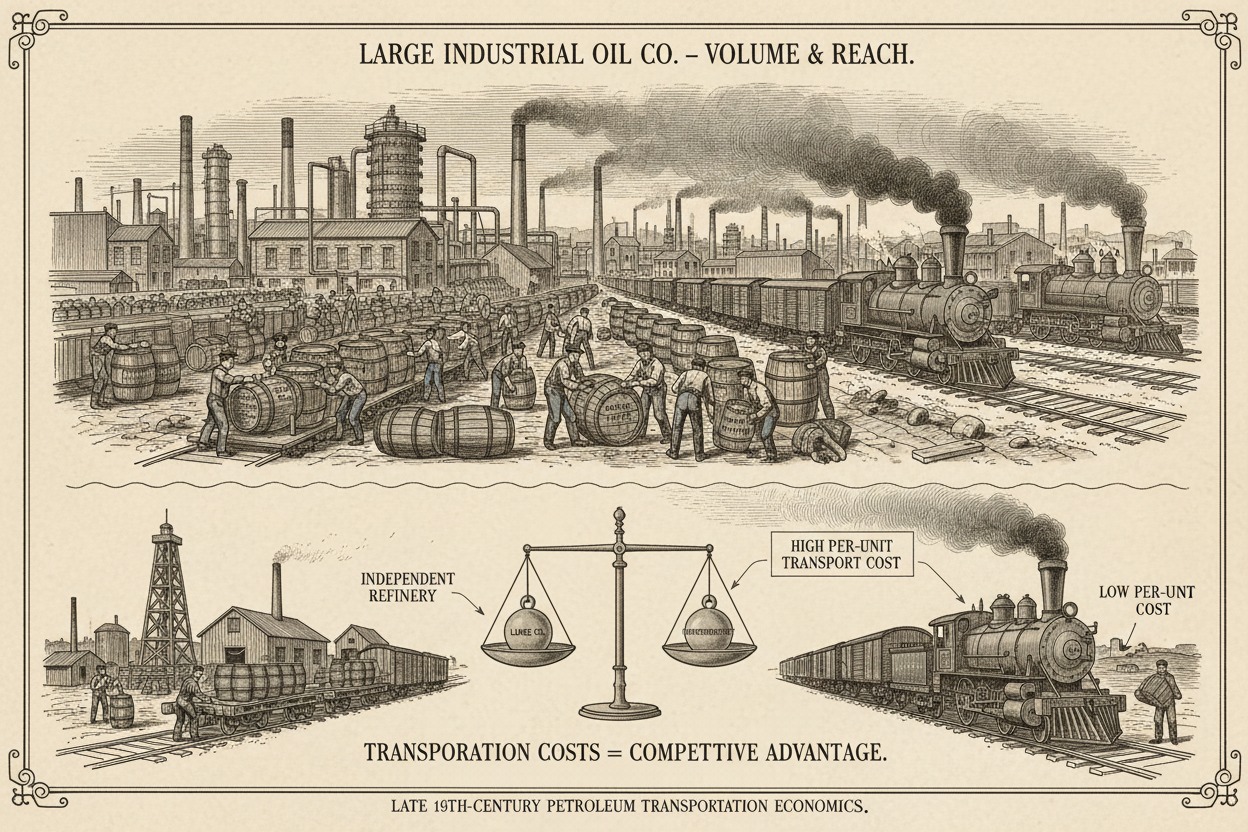
A company that buys or controls a large amount of a product or service can have greater negotiating power. In Standard Oil’s case, transportation was especially important.
Railroads played a major role in moving petroleum during the period. Standard Oil’s size gave it significant leverage when negotiating transportation arrangements.
Historical accounts of the company have documented disputes and controversies involving railroad rates and rebates. The Library of Congress discussion of Rockefeller’s rise explains how transportation advantages helped Standard Oil keep costs low and how the Southern Improvement Company controversy contributed to public concern. (loc.gov)
This is where the story becomes more complicated than the simple statement “Standard Oil bought its competitors.” The company’s market power was connected to its entire business strategy.
4. It Made Competition More Difficult
When one company controls a large share of the market, independent businesses face a different competitive environment.
A small refinery may have difficulty matching the purchasing power, transportation arrangements, distribution network, and financial resources of a much larger organization.
This can create a cycle. The larger company becomes more efficient because of its scale. That efficiency makes it harder for smaller companies to compete. The larger company then gains more market share. The cycle can continue.
This does not mean every large company automatically becomes a monopoly. But it helps explain how scale can become a source of market power.
Horizontal Integration vs. Vertical Integration at Standard Oil
This is one of the most important distinctions to understand. Many basic articles describe Standard Oil only as a horizontally integrated monopoly.
That is useful for answering a classroom question. But historically, the company’s business strategy involved more than one type of integration.
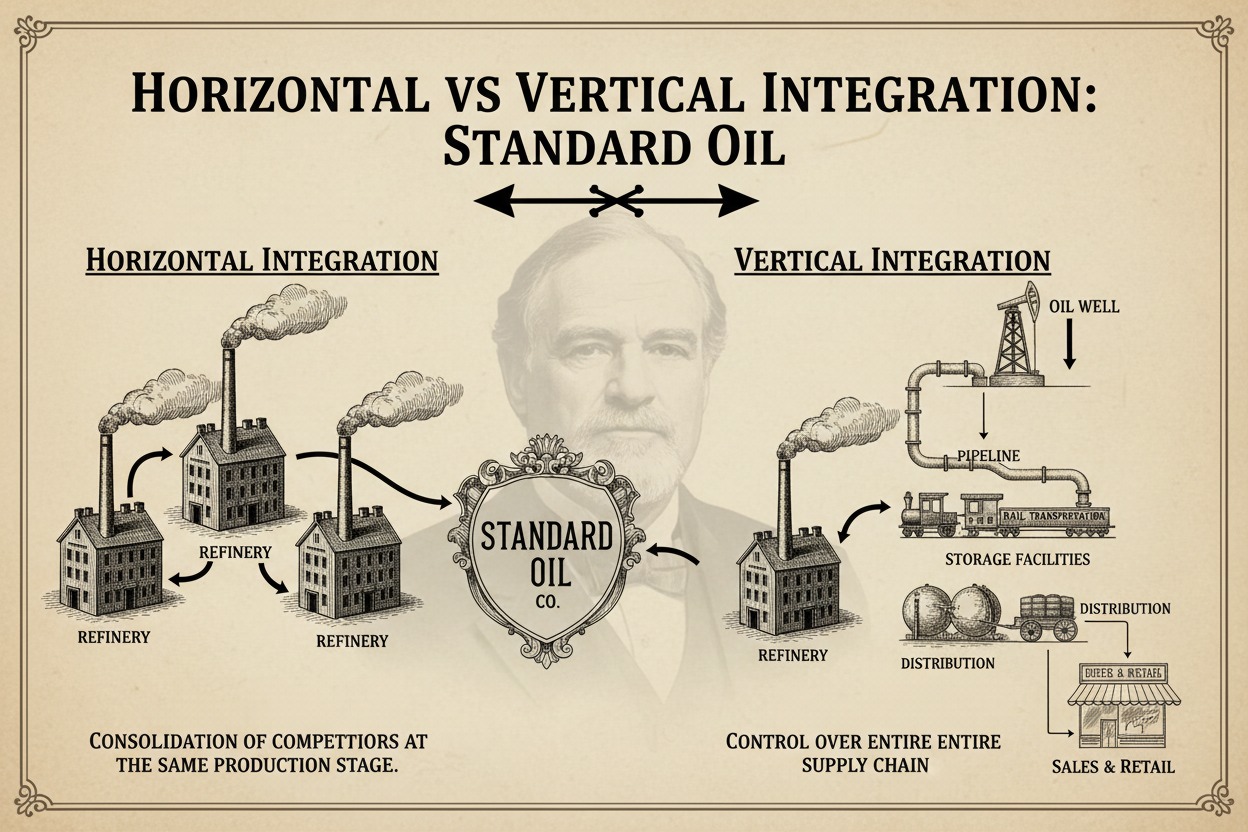
Horizontal Integration
Horizontal integration involved controlling businesses at the same stage of production. For Standard Oil, the classic example was the consolidation of oil refineries. In simple terms:
Refinery A + Refinery B + Refinery C + Refinery D = Greater control over refining
That is the part most directly connected to the question.
Vertical Integration
Vertical integration means controlling different stages of the supply chain. For example:
Oil production → Transportation → Refining → Storage → Distribution → Sales
A company that controls multiple stages is vertically integrated. Standard Oil developed interests and operations across several parts of the petroleum business.
This included pipelines, storage, transportation arrangements, and distribution. That broader structure helped strengthen the company’s position. So, if someone asks you:
“What was the core business that made Standard Oil a horizontally integrated monopoly?”
The answer is: Oil refining.
If someone asks:
“Was Standard Oil only horizontally integrated?”
The better answer is: No. Its dominance also involved vertical integration and control over other parts of the petroleum supply chain.
This distinction makes your answer more historically accurate.
How Standard Oil Built Its Market Power
Standard Oil’s rise did not happen overnight. The company was founded in 1870, and its influence grew over several decades.
The Library of Congress timeline of Standard Oil notes that by the late 1880s, Standard Oil controlled approximately 90% of American refineries. It was this extraordinary level of control, combined with controversy surrounding the company’s business practices, that helped bring increasing political and public attention. (loc.gov)
To understand the rise, it helps to look at several stages.
Stage 1: Focus on Refining
Rockefeller and his associates recognized that refining could be a highly important part of the oil industry. Rather than treating refining as a small part of a larger business, they focused on making it efficient. This focus became the foundation.
Stage 2: Consolidate Competitors
The company expanded by bringing more refining capacity under its control. This is the horizontal integration component. The more refineries Standard Oil controlled, the greater its share of the refining market became.
Stage 3: Improve Transportation
Transportation costs could have a major effect on profitability. Standard Oil pursued arrangements that helped reduce costs and improve its ability to move petroleum products. This gave the company another advantage.
Stage 4: Build Infrastructure
The company expanded its involvement in pipelines and other infrastructure. Pipelines could provide an alternative to relying entirely on rail transportation. That strengthened the company’s control over logistics.
Stage 5: Expand Distribution
The business did not stop at refining. Standard Oil developed a large distribution system that helped move refined products toward customers.
This connected the refining business to the final market. The result was a company with enormous reach.
Why Standard Oil Was So Difficult for Competitors to Challenge
A monopoly is not created simply because one company is large. The important question is what makes competition difficult. Standard Oil had several advantages that worked together.
Scale
Large-scale operations can lower average costs. A company that operates at a huge scale may be able to purchase supplies, organize transportation, and manage production more efficiently than smaller competitors.
Capital
Large companies generally have greater access to financial resources. That can make it easier to invest in infrastructure and acquire competitors.
Distribution
A strong distribution network can make it difficult for smaller businesses to reach customers as effectively.
Transportation
Transportation was critical to the oil industry. A company that could move petroleum products efficiently had an important competitive advantage.
Information
A large organization operating across many markets can collect information about prices, demand, supply, and competitors. That information can improve decision-making.
Market Share
Once a company controls a very large share of a market, its size itself can become a competitive advantage. This creates a difficult situation for new entrants. The new company is not simply competing with one ordinary business. It is competing against an established network.
In the Gilded Age, How Did Monopolies Affect Many Small Businesses?
The question In the Gilded Age, how did monopolies affect many small businesses has a more complicated answer than simply saying “they put them out of business.”
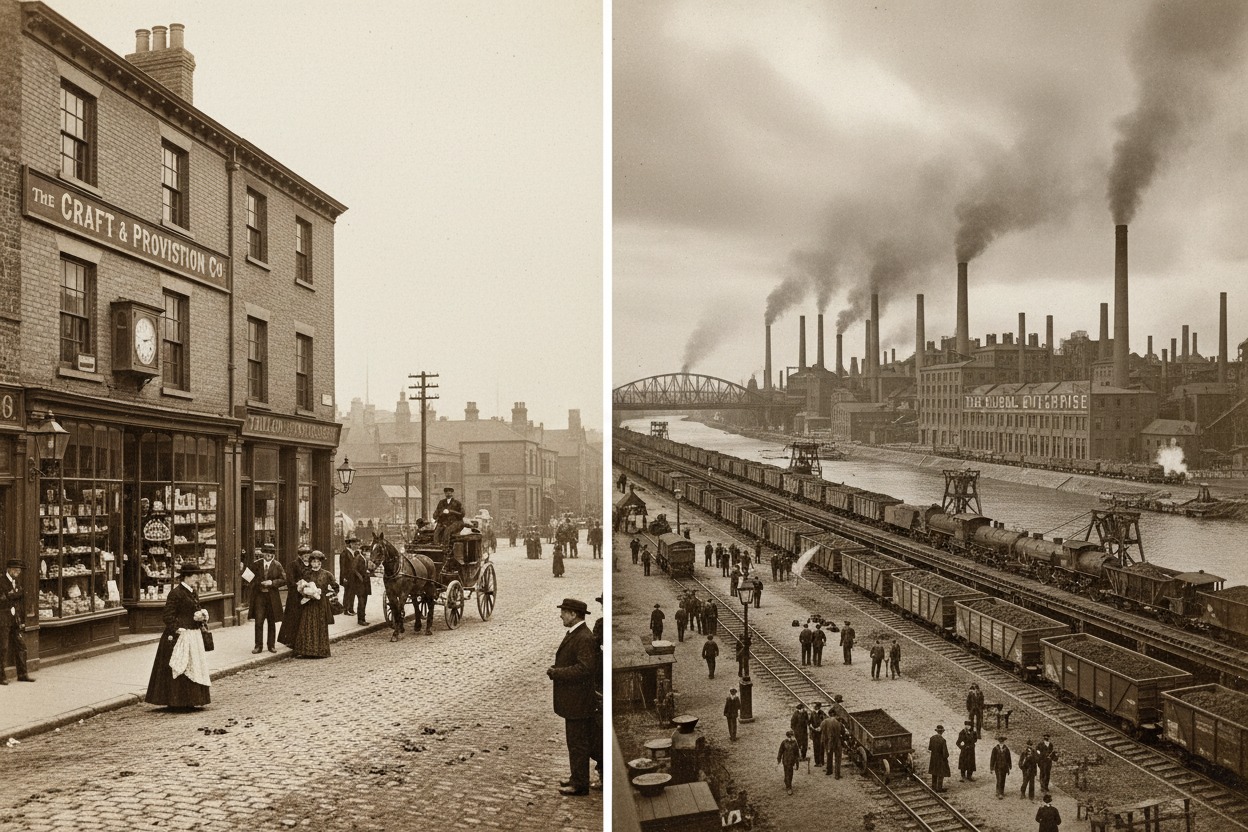
The Gilded Age was a period of rapid industrial growth and major economic transformation. Large corporations expanded into industries such as oil, steel, railroads, banking, and manufacturing. Some large companies created efficiencies that helped industrial production grow. But their growing power also created concerns about competition.
For many small businesses, the biggest problem was not necessarily that a monopoly immediately destroyed every competitor. The problem was that the competitive playing field could become increasingly difficult. A small business might face:
- Higher costs than a large competitor
- Less bargaining power with suppliers
- Limited access to transportation
- Less access to capital
- Smaller distribution networks
- Difficulty matching large-scale production
- Pressure from aggressive competitors
This could create a difficult choice. A small company might try to survive independently.
- It might sell to a larger company.
- It might merge with another business.
- Or it might eventually leave the market.
The impact depended heavily on the industry. Not every small business was destroyed by monopolies. Some survived by focusing on specialized products, local customers, or services that large corporations did not provide.
Still, the growth of concentrated corporate power changed the competitive environment. For many Americans, the concern was not simply that one company was successful.
It was that a small number of powerful corporations could gain enough control to influence markets, transportation, politics, and public policy. That concern helped fuel the rise of the antitrust movement.
What Is the Main Reason That the American Public Turned Against Monopolies?
The question What is the main reason that the American public turned against monopolies does not have just one answer.
However, one major reason was the growing belief that powerful corporations were becoming too influential and were using their economic power in ways that harmed fair competition.
The public debate became especially intense when people believed large corporations were using practices that went beyond ordinary competition. Concerns included:
- Railroad rebates
- Exclusive arrangements
- Predatory pricing accusations
- Political influence
- Concentration of wealth
- Elimination of competitors
- Control over essential infrastructure
The issue was not simply that companies were profitable. Many people accepted that successful businesses could make large amounts of money.
The problem was the perception that some corporations could become so powerful that ordinary businesses had little chance of competing. Standard Oil became a major symbol of this debate. The company’s enormous market position attracted criticism from politicians, journalists, business competitors, and reformers.
The Library of Congress account of Standard Oil’s monopoly explains that public opinion was influenced by investigative reporting, including Ida Tarbell’s work documenting controversial business practices.
This is an important part of the story. Public opinion did not turn against monopolies because people suddenly decided that all large businesses were bad. The debate was about power.
- How much power should one company have?
- How much control should one corporation have over a major industry?
- And what should happen when a company’s size makes meaningful competition difficult?
These questions remain central to antitrust discussions today.
Ida Tarbell and the Public Image of Standard Oil
If you study Standard Oil, you cannot ignore Ida Tarbell. Tarbell was an investigative journalist who published a major series examining Standard Oil.
Her work later became the book The History of the Standard Oil Company. The Library of Congress records on Ida Tarbell describe how her investigative work became closely associated with the public understanding of Standard Oil and its business practices.
Her reporting mattered because it gave the public a detailed narrative about how Standard Oil had grown. Instead of discussing monopoly power as an abstract economic concept, her reporting connected the issue to real companies, real competitors, and real business practices.
This helped make the monopoly debate easier for ordinary readers to understand. The story was no longer simply: “One company has a large market share.”
It became: “How did this company become so powerful?”
That is a much more compelling question. And it is also the question that helps us understand why the public reaction became so strong.

Which Statement Is True About the Relationship Between a Monopoly and Its Competition in a Market?
The question Which statement is true about the relationship between a monopoly and its competition in a market can be answered with a basic economic principle.
A true monopoly has no close competitors offering the same product or service within the relevant market. That does not necessarily mean there are literally no other businesses anywhere.
Market definition matters. A company may dominate one market while facing competition in related markets. Still, the central idea is that a monopoly has enough market power that competitive pressure is significantly reduced.
In a Competitive Market
Several companies compete. Customers can switch between sellers. Businesses must respond to rivals. If one company raises prices too much, customers may choose another option.
In a Monopoly
One dominant seller has substantial control. Customers have fewer alternatives. The company faces less direct competitive pressure. That can affect prices, output, quality, and innovation.
However, it is important not to oversimplify. A monopoly does not automatically mean that every price is high or every product is poor. A monopolist may still have reasons to improve efficiency or maintain quality. The economic concern is the lack of competitive pressure.
This is why antitrust law generally focuses on protecting the competitive process rather than simply punishing companies for becoming successful.
The FTC’s overview of antitrust laws explains that antitrust policy is designed to protect competition and preserve incentives for businesses to operate efficiently, maintain quality, and keep prices competitive.
Standard Oil as a Horizontal Monopoly Example
If you need a clear horizontal monopoly example, Standard Oil is one of the most commonly discussed historical cases. The simplified explanation is:
Standard Oil focused on oil refining and consolidated competing refineries.
This allowed it to control a very large portion of the refining market. The important word here is the same stage. Standard Oil was not simply buying businesses at random.
The company was building power in a particular industry and gaining control over businesses that performed similar functions. That is what makes the example useful when teaching horizontal integration.
However, there is an important nuance. Standard Oil’s overall business empire was not purely horizontal. It also expanded into other areas connected to petroleum production and distribution. So the best answer is:
Standard Oil’s refining business was the core of its horizontal integration, while its broader corporate strategy also included vertical integration across different parts of the petroleum supply chain.
This is a more accurate explanation than simply calling the entire company a horizontally integrated monopoly.
How Standard Oil’s Strategy Created Economies of Scale
One reason Standard Oil became so powerful was its ability to operate on a large scale. Economies of scale occur when average costs fall as production increases, at least over a certain range. A large company may be able to:
- Spread fixed costs across more products
- Negotiate better terms
- Standardize operations
- Invest in specialized equipment
- Build efficient transportation systems
- Improve distribution
- Reduce waste
Standard Oil became known for emphasizing efficiency. This is important because monopoly discussions sometimes focus only on the negative side.
But there was another side to the story. The company did make major contributions to the development of a more organized petroleum industry. The problem was that the same scale that could create efficiency could also make competition more difficult. This is one of the central tensions in business history.
A company can become successful partly because it is efficient. But when its efficiency and scale become so great that competitors cannot realistically challenge it, policymakers may begin asking whether the market is still competitive. That is the point where economic efficiency and antitrust concerns can collide.
Did Standard Oil Control 90% of the Oil Industry?
This statement needs careful wording. You will often see Standard Oil described as controlling around 90% of the oil industry.
That can be misleading. The more precise historical claim is that Standard Oil controlled roughly 90% of American refineries by the late 1880s. The distinction matters.
Controlling 90% of refining capacity is not the same as controlling 90% of every activity connected to petroleum. The Library of Congress history specifically describes Standard Oil as controlling about 90% of American refineries by the late 1880s.
When writing about Standard Oil, I recommend saying:
“Standard Oil controlled about 90% of American refineries by the late 1880s.”
That is clearer and more precise. It also reinforces the answer to the main question. The core business was refining.
The Southern Improvement Company Controversy
The Southern Improvement Company episode is often discussed when explaining the rise of Standard Oil. The arrangement involved rail transportation rates and generated significant opposition.
The controversy became important because it raised concerns about whether large oil companies were receiving transportation advantages that smaller competitors could not match. Public opposition was strong.
The episode also demonstrated something important about industrial markets. A business does not compete only inside its factory. Transportation can determine whether a company can sell its products profitably.
If one company has significantly better transportation terms than another, the difference can affect the entire competitive landscape. This is why Standard Oil’s relationship with railroads became such an important part of the historical discussion.
The Library of Congress account of Rockefeller’s rise discusses the role of railroad rebates and the Southern Improvement Company controversy in Standard Oil’s development.
Why the Sherman Antitrust Act Mattered
The Sherman Antitrust Act of 1890 became a major part of the legal response to growing concerns about monopolies and trusts. The law was intended to address restraints of trade and monopolization.
However, passing a law and successfully using it against a powerful corporation were two different things. The legal system had to determine how the law applied to complex corporate structures.
Standard Oil eventually became one of the most important antitrust cases in American legal history. The Federal Trade Commission’s history of antitrust law explains that the Sherman Act was passed in 1890 and remains one of the three core federal antitrust laws, alongside the Federal Trade Commission Act and Clayton Act.
The importance of the Sherman Act goes beyond Standard Oil. It established a legal framework for addressing situations where business practices or combinations threatened competition. That framework has continued to evolve.
The 1911 Standard Oil Supreme Court Decision
In 1911, the Supreme Court ruled against Standard Oil. The case was Standard Oil Co. of New Jersey v. United States.
The Court concluded that the company’s combination violated the Sherman Antitrust Act and ordered its dissolution. The Department of Justice historical timeline records that the Supreme Court declared Standard Oil an unreasonable monopoly and ordered the company to be divided into 34 separate companies.
You can also examine the original legal record through the Library of Congress collection of the Standard Oil Supreme Court case. (loc.gov) The decision is historically important for several reasons.
- First, it showed that a massive corporation could be challenged under federal antitrust law.
- Second, it demonstrated that the government could seek structural remedies against a dominant company.
- Third, the case helped shape the way courts thought about unreasonable restraints of trade.
The breakup did not mean that the economic assets of the petroleum industry disappeared. Instead, the former Standard Oil system was divided into separate corporate entities.
Some successor companies later became major oil companies in their own right. This is one reason the legacy of Standard Oil is still visible in the history of modern petroleum companies.
What Happened After Standard Oil Was Broken Up?
The 1911 breakup is often misunderstood. Some people imagine that the government simply destroyed Standard Oil’s assets.
That is not what happened. The company was divided into separate entities. The businesses, refineries, pipelines, and other assets did not simply vanish.
Instead, ownership and corporate control were reorganized. The Library of Congress history of Standard Oil notes that the company was split into 34 independent companies, many of which later developed into major oil companies.
This created an interesting historical outcome. The breakup reduced the centralized control of the original Standard Oil organization. But some successor companies became extremely successful.
That tells us something important about antitrust enforcement. Breaking up a monopoly does not necessarily eliminate the underlying demand for a product. It changes the structure of the market. The goal is to create conditions where separate businesses can compete rather than operate as one dominant organization.
What Can Modern Businesses Learn From Standard Oil?
Standard Oil is more than a history lesson.
It also offers several business lessons.
Lesson 1: Efficiency Matters
Standard Oil’s success was partly connected to its focus on efficiency. Businesses that reduce waste and improve operations can become more competitive.
Lesson 2: Scale Can Be Powerful
Growing a business can create advantages. But scale must be managed carefully. A larger company is not automatically better if complexity becomes impossible to control.
Lesson 3: Distribution Matters
A great product is not enough. The ability to move products efficiently can determine whether a business succeeds.
Lesson 4: Market Power Creates Responsibility
As a company becomes more powerful, its decisions have a larger impact. This is especially true when competitors depend on the same infrastructure or markets.
Lesson 5: Growth Strategy Matters
A company can grow horizontally by acquiring competitors. It can grow vertically by controlling suppliers or distribution. Or it can do both. Understanding the difference helps business owners make better strategic decisions.
If you are building your own company, it can also help to understand what happens after the planning stage. For example, Rarely Notes has previously covered what an entrepreneur should do after creating a business plan, which is a useful starting point for thinking about how a business moves from strategy into execution.
The Pros and Cons of Horizontal Integration
Horizontal integration is not automatically good or bad.
Its effects depend on how it is carried out and what happens to competition afterward.
| Potential Advantages | Potential Disadvantages |
|---|---|
| Greater economies of scale | Reduced competition |
| Lower operating costs | Increased market concentration |
| Larger market share | Greater monopoly power |
| Stronger bargaining position | Higher barriers to entry |
| More efficient operations | Potential harm to smaller competitors |
| Broader customer reach | Risk of antitrust action |
The same strategy can create efficiency and competition concerns at the same time. That is why modern antitrust analysis is usually more complicated than simply asking whether one company is large.
The real questions include:
- How did the company become dominant?
- What market is being measured?
- Are customers harmed?
- Are competitors being unfairly excluded?
- Are prices rising?
- Is innovation being reduced?
- Is the company using legitimate efficiency or anticompetitive conduct?
These questions help explain why Standard Oil remains such an important historical example.
My Simple Way to Remember Standard Oil’s Business Strategy
If I had to explain the entire story to someone who knew nothing about business history, I would use one simple framework. Think of a large petroleum pipeline. At the beginning, you have crude oil.
Then you have transportation. Then refining. Then storage. Then distribution. Then customers.
Standard Oil’s horizontal integration was most closely connected to the refining stage. The company expanded by gaining control over many competing refineries. But its broader strategy reached across other stages as well.
So, I would remember it this way:
- Horizontal integration explains the consolidation of refineries.
- Vertical integration explains control across different stages of the petroleum business.
- Antitrust law explains the government’s response to excessive market power.
This three-part framework makes the topic much easier to understand.
Why This Question Is Often Confusing
The wording of the question can cause confusion because it asks about the “core business” rather than the entire Standard Oil empire. That wording is important.
The answer is not:
- Building oil pipelines
- Transporting oil to customers
- Finding new uses for oil
The answer is:
Refining oil.
The reason is simple.
Horizontal integration occurs when companies operating at the same stage of production are combined. Standard Oil’s most important horizontal consolidation occurred in oil refining.
Pipelines and transportation were important to the company’s broader strategy, but they do not best answer the specific question about the core business behind its horizontal integration.
That is the distinction I would remember if this question appears on a quiz, exam, or business history assignment.
Expert Tip: Do Not Confuse Monopoly With Being a Large Company
This is one of the most important lessons from the Standard Oil story. A company can be extremely large without being a monopoly. A monopoly exists when one firm has substantial control over a relevant market, and competitors cannot effectively constrain it.
Size is relevant. But size alone is not the entire definition. A company can have billions of dollars in revenue and still face strong competition.
Another company may be smaller in absolute terms but have enormous control over a narrowly defined market. That is why economists and antitrust authorities carefully define the relevant market. This distinction also helps explain why the phrase “Standard Oil controlled 90% of the oil industry” should be used carefully.
The more precise historical statement is that Standard Oil controlled about 90% of American refineries by the late 1880s. Precision matters when discussing history.
Frequently Asked Questions
What was the core business that made Standard Oil a horizontally integrated monopoly?
The core business was oil refining. Standard Oil expanded its market power by consolidating competing refineries that operated at the same stage of petroleum production. This made refining the clearest example of horizontal integration in the company’s history.
What made Standard Oil a horizontal integration monopoly?
Standard Oil became a classic example of horizontal integration because it gained control over many competing oil refineries. Instead of only expanding into different industries, it consolidated businesses performing similar refining activities, increasing its share of the refining market.
What was the core business that made Standard Oil successful?
Oil refining was the central business that helped Standard Oil establish its dominance. The company focused heavily on improving refining efficiency and then expanded into transportation, pipelines, storage, distribution, and other parts of the petroleum industry.
In the Gilded Age, how did monopolies affect many small businesses?
Large monopolies and trusts could make competition more difficult for small businesses by benefiting from greater scale, capital, purchasing power, infrastructure, and distribution networks. Some small businesses survived by serving local or specialized markets, while others were acquired or pushed out of highly concentrated industries.
What is the main reason that the American public turned against monopolies?
A major reason was growing concern that powerful corporations had become too influential and were using their economic power in ways that limited fair competition. Controversies involving railroad arrangements, aggressive competition, political influence, and corporate concentration contributed to public opposition.
Final Thoughts: Why Standard Oil Still Matters
The answer to what was the core business that made standard oil a horizontally integrated monopoly? is straightforward: oil refining.
But the history behind that answer is much richer.
Standard Oil’s power came from more than one decision or business tactic. Its refining operations became the foundation for horizontal consolidation, while its expansion into transportation, pipelines, storage, distribution, and other areas created a broader integrated business system.
That combination helped Standard Oil become one of the most powerful corporations of its era. It also made the company a symbol of the growing tension between industrial efficiency and market competition.
The biggest lesson I take from this story is that business growth can change the structure of an entire market. A company may begin by becoming more efficient, then grow through acquisitions, then gain greater bargaining power, and eventually become so dominant that society begins asking whether the market still provides enough room for meaningful competition.
That is why Standard Oil remains one of the clearest historical examples of how horizontal integration, vertical integration, monopoly power, small business competition, public opinion, and antitrust law can all become connected.
If you are studying business history or economics, remember the simplest formula:
Standard Oil + refining + consolidation of competing refineries = classic horizontal integration example.
And when you add its control across other parts of the petroleum supply chain, you begin to understand the full story behind one of the most influential business empires of the Gilded Age.t