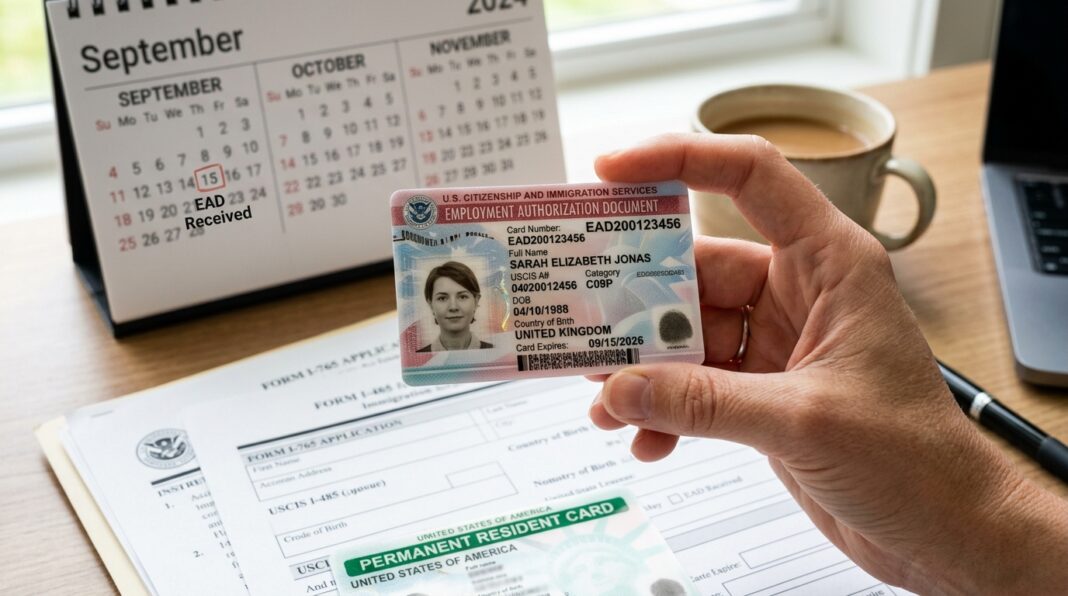
How Many Months to Receive Your EAD Card for I-485 NIW (Introduction)
You filed your I-485. You sent the I-765 along with it. You’ve refreshed your USCIS case status more times than you’d like to admit.
Now the question burning in the back of your mind: How Many Month to Receive EAD Card for 485 NIW?
The first thing I want to tell you is that you’re not alone. Thousands of EB-2 NIW (National Interest Waiver) applicants go through this exact situation every year. The Employment Authorization Document is your legal green light to work in the U.S. while your green card is being processed. It is one of the most important milestones in the entire adjustment-of-status journey.
This guide gives you real numbers, not rough estimates. You’ll learn exactly how long you should wait, what factors affect your timeline, what the EAD card actually looks like when it arrives, and what happens next on your path to a green card.
Let’s break it all down.
What Is the EAD Card — And Why Does It Matter for NIW Filers?
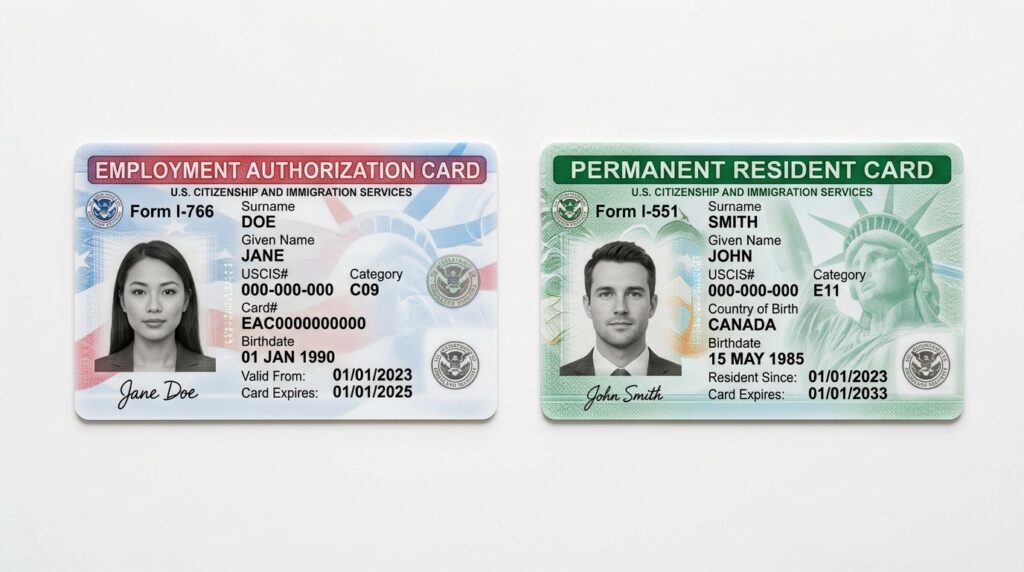
Before diving into timelines, let’s clarify what you’re actually waiting for.
The Employment Authorization Document (EAD), officially called Form I-766, is a government-issued card that proves you’re legally authorized to work in the United States for a specific time period. USCIS issues it after you file Form I-765, Application for Employment Authorization.
For NIW applicants filing Form I-485 (Adjustment of Status), the EAD is your lifeline. It lets you legally work any job, for any employer, while your green card is still being processed — which can take years.
Here’s why it matters:
- You can start (or keep) earning income legally
- Employers can verify your right to work via Form I-9
- It serves as a List A document, establishing both your identity and work authorization in one card
- It also proves your lawful presence in the U.S. as a pending I-485 applicant
What Does an EAD Card Look Like?
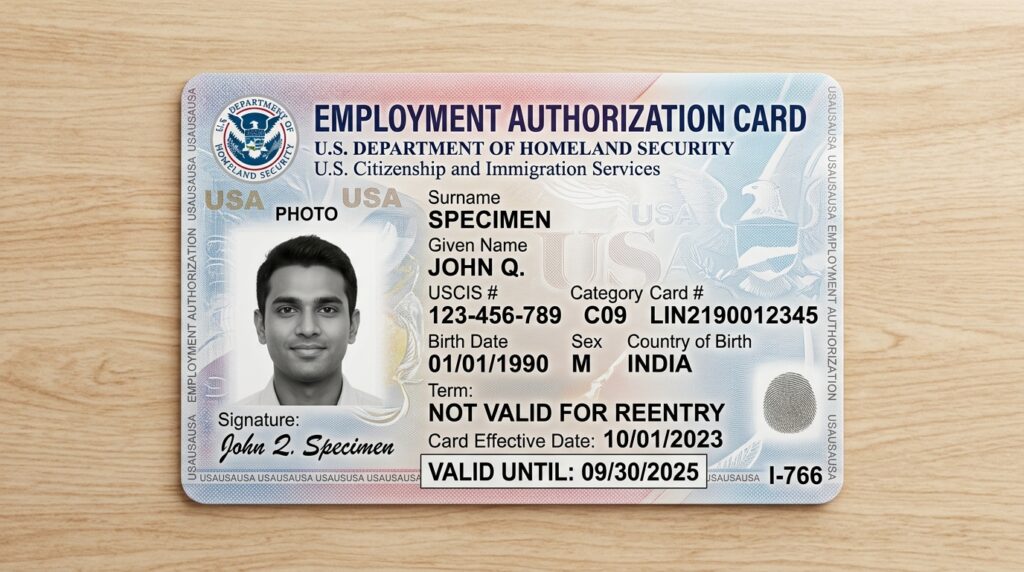
A lot of people ask this the moment they realize mail is on the way. Here’s what to look for.
At first glance, your EAD card looks very much like a standard driver’s license. It’s the same size, made of sturdy plastic, and fits right in your wallet. But it carries more weight than any state ID.
Here’s what you’ll see on the front of your card:
| Feature | Description |
|---|---|
| Your Photo | Color headshot printed on the card |
| A-Number (Alien Number) | Your unique 9-digit USCIS identifier |
| USCIS Number | Also displayed on the front (unlike green cards, both numbers appear on the front of an EAD) |
| Category Code | For I-485 AOS applicants: (c)(9) |
| Card Expiration Date | Typically 1–2 years from issuance (capped at 18 months for (c)(9) category since December 2025) |
| Card Number | Printed on the front |
If you look closer, you’ll spot security features baked into the card design. It has microprinting so fine you need magnification to read it, holographic overlays, and UV-reactive inks. The card is designed to make counterfeiting nearly impossible.
EAD has one key distinction from a green card. It has both your A-Number and USCIS Number appear on the front. On a green card, the A-Number is on the front, but the Document Number is on the back. Knowing this matters when filling out your I-9 form with an employer.
💡 Expert Tip: When you receive your EAD, verify every detail immediately — your name spelling, A-number, and expiration date. USCIS will correct errors at no charge if the mistake is on their end. You can submit a service request through USCIS’s online portal.
How Many Months Does It Take to Receive Your EAD Card for I-485 NIW?
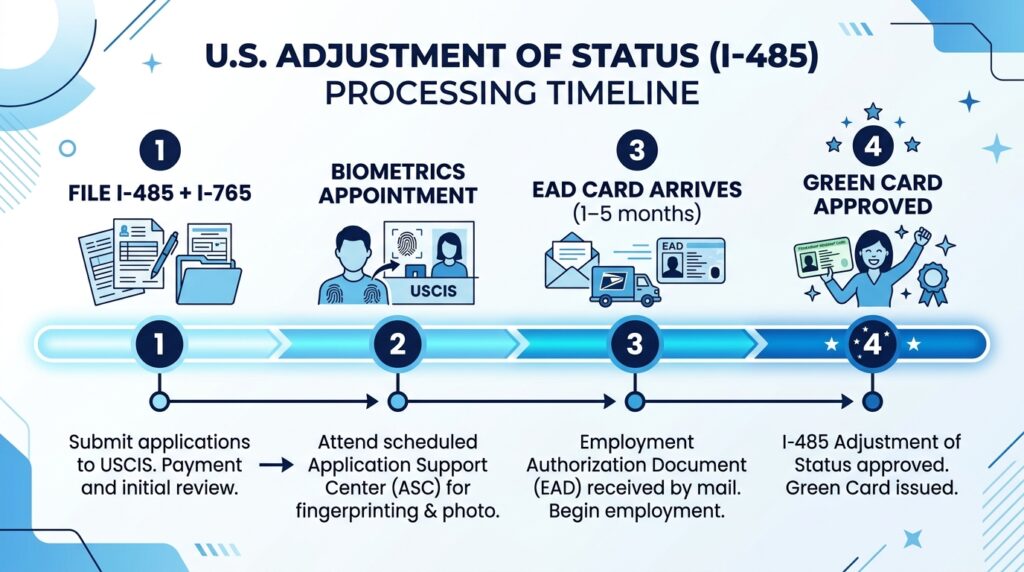
This is the question everyone comes here for. Let’s get straight to the numbers.
The Current Timeline — What Real Applicants Are Seeing
According to real-world data gathered from attorneys and applicants in 2024–2025:
For most I-485 filers who submit Form I-765 at the same time:
- Fastest cases: As little as 29 days
- Typical range in 2025: 1 to 5 months
- The majority of applicants (roughly 80%): Receiving EADs within 4 to 6 weeks of filing
- Slower cases: 6 to 10 months (roughly 1 in 10 applicants)
Data from immigration law firm Puyang & Wu shows a real spread of outcomes. Cases filed in late 2023 and 2024 ranged from as fast as 1 month and 23 days to 10 months and 8 days, depending on the service center and case-specific factors.
The USCIS official processing time tool is your best real-time resource to check current estimates by service center.
2025 Has Been a Much Better Year
Throughout 2025, USCIS made significant strides in clearing its pandemic-era backlog. The agency reduced its overall backlog by approximately 15% in early 2024, processing close to 11 million case filings and completing 10 million cases, according to an announcement that year.
For EAD applicants specifically, this has translated into faster card delivery. What once took 5 to 7 months now takes, for many, under 2. But no two cases are identical.
⚠️ Important Note: These timelines specifically apply to EADs filed concurrently with Form I-485 under the (c)(9) category. If you’re filing under a different eligibility category — such as asylum or OPT — timelines differ significantly.
Step-by-Step — When Do You Get Your EAD in the Green Card Process?
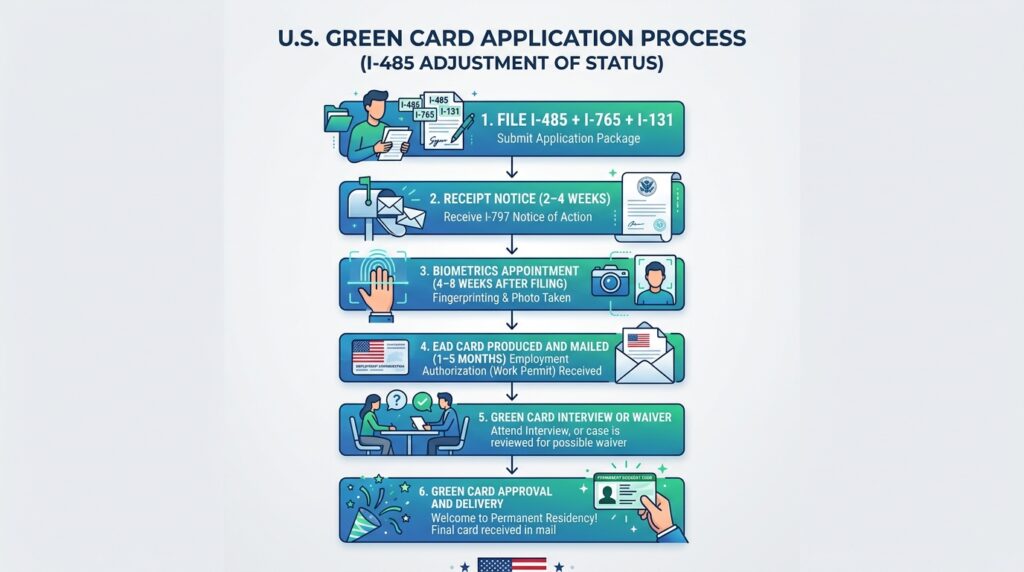
For NIW applicants, the green card process involves several overlapping timelines. Here’s where the EAD fits in:
Step 1 — File Your Package: You submit Form I-485 (Adjustment of Status), Form I-765 (EAD application), and, usually, Form I-131 (Advance Parole) together as a package. Filing them together saves on fees and keeps things moving in parallel.
Step 2 — Receipt Notice (2–4 Weeks): USCIS sends a Form I-797C confirming receipt of your application. Save this. It contains your 10-digit receipt number for case tracking.
Step 3 — Biometrics Appointment (4–8 Weeks) You’ll be scheduled to attend a local USCIS Application Support Center (ASC) for fingerprinting and a photo. This feeds directly into the background check process, which must be completed before your EAD is issued.
Step 4 — EAD Card Produced and Mailed (1–5 Months in Most Cases). After biometrics, your EAD is placed in the adjudication queue. Once approved, card production takes a few days, and mailing adds another 1–2 weeks. You’ll see the status “New Card Is Being Produced” on your USCIS online account — that’s the green light.
Step 5 — I-485 Interview or Waiver (8–14 Months). Employment-based cases, including NIW, are frequently interview-waived in 2025. Family-based cases almost always require one. If waived, your case moves to review and final decision.
Step 6 — Green Card Approval and Delivery (2 Weeks After Approval). Once your I-485 is approved, the physical green card is mailed to you within about two weeks. You’ll receive a USPS tracking number through your USCIS online account.
What Affects Your EAD Processing Time?
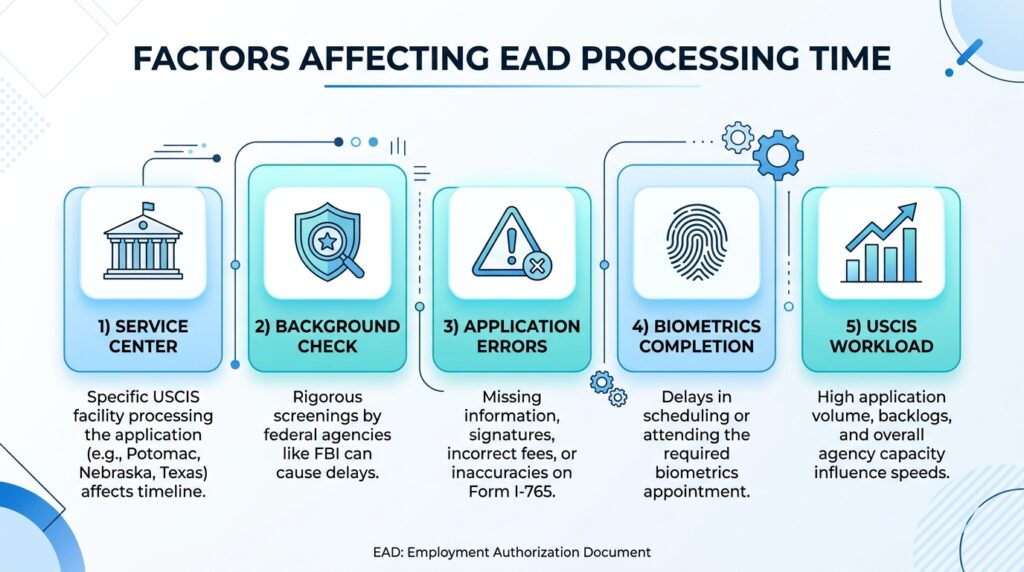
Not everyone gets their card in two months. Here’s what influences where you land on the spectrum:
1. Which Service Center Handles Your Case? USCIS operates multiple service centers — Nebraska, Texas, California, and the National Benefits Center (NBC), among others. Each has its own workload and pace. You don’t get to choose. It’s based on your state and case type.
2. Background Check Complications This is the most common delay culprit. If your name matches a watchlist entry or your records require additional review, processing stalls until it is resolved.
3. Application Errors or Missing Documents A misspelled name, wrong date, or missing signature can result in a Request for Evidence (RFE) — adding months to your wait. Filing the first time carefully is worth every extra minute.
4. Biometrics Completion: Your EAD cannot be approved until biometrics are complete. Delays in scheduling or attending your ASC appointment cascade forward.
5. USCIS Workload and Policy Changes Volume fluctuates seasonally and shifts with policy priorities. Filing during high-volume periods (such as the start of the fiscal year in October) can lead to slower processing.
How Long After EAD to Get Your Green Card?
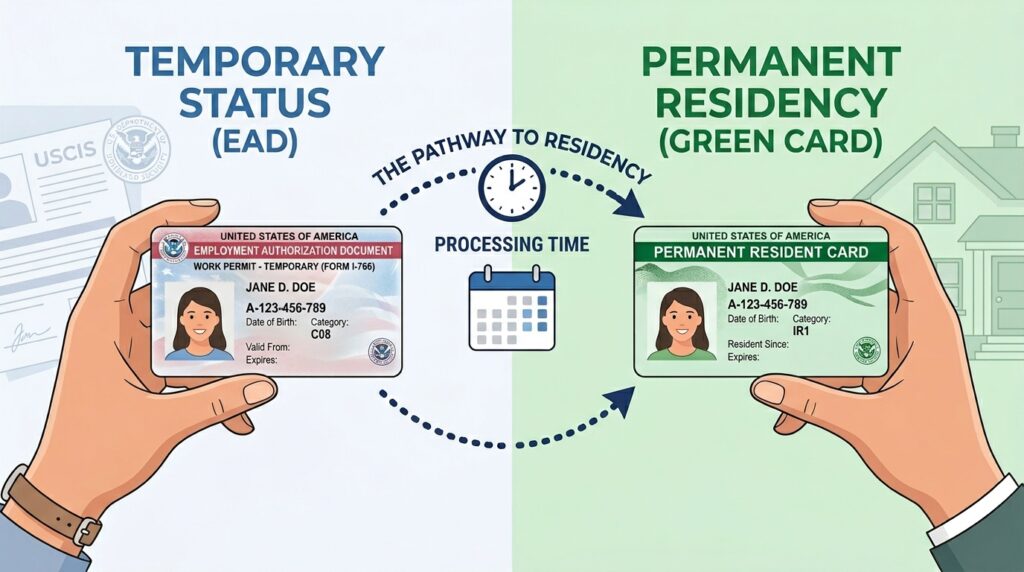
Getting your EAD is a milestone — but it’s not the finish line. The green card is.
So, how long after your EAD do you actually get the green card?
The honest answer: it depends enormously on your visa category and country of birth.
For EB-2 NIW applicants born in low-demand countries (not India or China), the green card often follows within 12 to 24 months of receiving the EAD — sometimes faster, if your priority date is current when you file.
For applicants from India or China in the EB-2 category, the wait can be dramatically longer due to per-country visa caps and massive demand. The monthly Visa Bulletin from the U.S. Department of State is essential for tracking your priority date movement.
Here’s a rough breakdown by scenario:
| Applicant Scenario | Typical Wait After EAD for Green Card |
|---|---|
| NIW, non-backlogged country | 12–24 months |
| EB-2, India or China | Potentially many years |
| Family-based immediate relative | 8–12 months total from filing |
| Employment-based, current priority date | 12–18 months from I-485 filing |
Your EAD automatically expires the moment your green card is approved — you won’t need to renew it if your green card comes through first.
💡 Expert Tip: Don’t wait for your green card before planning ahead. If your EAD is approaching expiration and your green card hasn’t arrived, file a renewal EAD (Form I-765) at least 180 days before expiration. Under current rules, there is no automatic extension for (c)(9) EADs renewed after December 2025.
EAD Combo Card — What Is It and Should You Apply?
Many NIW applicants file all three forms together: I-485 + I-765 + I-131. When you do this, USCIS may issue a “combo card” that combines your EAD (work authorization) and your Advance Parole (travel authorization) into a single document.
More recently, USCIS has been issuing these separately to speed up processing — so you may receive your EAD card first, and your travel document later.
Should you file for Advance Parole? Yes — even if you have no immediate travel plans. Since the filing fee is included in the I-485 package, most immigration attorneys recommend filing the I-131 at the same time. It gives you the flexibility to travel internationally without abandoning your pending green card application.
What to Do If Your EAD Is Taking Too Long

If your EAD is past the published processing time for your service center, you don’t have just to sit and wait.
Check the USCIS Processing Time Tool First. Visit egov.uscis.gov/processing-times, find your form (I-765), and select your service center category. If your receipt date falls before the “Service Request Date” listed, you’re eligible to submit an inquiry.
Submit a Case Inquiry (e-Request). Through your USCIS online account, you can submit an e-Request for a status update. USCIS typically responds within 30 days.
Request an Expedite (Rare, But Possible). USCIS allows expedited requests under very specific circumstances:
- Severe financial loss
- Urgent humanitarian need
- U.S. government agency requests
- Nonprofit organization requests in the national interest
Expedite requests are not commonly granted — but if you qualify, the instructions are on the USCIS expedite criteria page.
Contact a Licensed Immigration Attorney. If you believe there’s a specific issue holding your case (like a background check flag or an RFE you missed), an attorney can help you identify the problem and respond correctly.
Expert Tips — Maximize Your Chances of a Faster EAD
These aren’t tricks or loopholes. They’re the basics that immigration professionals recommend to every NIW applicant:
- File concurrently. Submit I-485 + I-765 (+ I-131) altogether. Concurrent filing is the fastest path to an EAD.
- Get your biometrics appointment done immediately. Don’t reschedule unless necessary. A delay here means a delay in your EAD.
- Triple-check your I-765 before mailing or submitting online. The most avoidable delays come from simple errors — wrong dates, missing signatures, and wrong eligibility category code.
- Use USCIS online filing when possible. Online submission often moves slightly faster than paper, and you get real-time case updates.
- Set up a USCIS online account. Even if you filed by paper, you can link your receipt number to a myUSCIS account and receive email or text notifications for case updates.
- Track your priority date monthly. For NIW applicants, the Visa Bulletin determines when you can actually file an I-485. Filing as soon as your date becomes current gives your EAD the best possible start.
FAQs — EAD Card for I-485 NIW
Q1: How many months does it typically take to receive an EAD card after filing I-485?
For most applicants who file Form I-765 concurrently with Form I-485 in 2025, the EAD arrives within 1 to 5 months. A significant portion of applicants — roughly 80% — are receiving cards within 4 to 6 weeks of filing. A small percentage experience delays of 6 to 10 months, often due to background check issues or application errors.
Q2: What does an EAD card look like when it arrives?
Your EAD card is a hard plastic card, the same size as a driver’s license. It displays your photo, A-number, USCIS number, category code (c)(9) for I-485 filers, card expiration date, and card number — all on the front of the card. It includes security features like microprinting and holographic overlays. Once approved, USCIS typically mails the physical card within 1 to 2 weeks of the approval decision.
Q3: When do you get your EAD in the green card process?
Your EAD comes before the green card — that’s the whole point. After filing your I-485 package, biometrics are typically scheduled within 4 to 8 weeks. EAD approval follows, usually within 1 to 5 months. The green card itself arrives at the very end of the process, after your I-485 is fully adjudicated and approved, which can take anywhere from 8 months to several years, depending on your category and country of birth.
Q4: How long after getting the EAD will I get my green card?
For NIW applicants from non-backlogged countries, the green card often arrives 12 to 24 months after the EAD. For applicants from India or China in the EB-2 category, the wait can be significantly longer due to per-country caps. Tracking the monthly Visa Bulletin is critical for understanding your place in the queue.
Q5: Can I work as soon as I receive my EAD card?
Yes. The moment you have your physical EAD card in hand, you can legally begin working for any U.S. employer. You’ll present it during Form I-9 employment verification — it qualifies as a List A document, satisfying both identity and work authorization requirements simultaneously.
Conclusion: Your EAD Card Is Closer Than It Feels
Waiting is not easy — especially when your livelihood, future income, immigration status, and even your ability to keep basic human rights are all pinned to one small piece of plastic.
Yet, the fact is that by the year 2025, the EAD card will come faster than ever to the vast majority of NIW applicants. Most people receive their work permits a few weeks to a few months after filing.
The best thing you can do right now is file a clean, complete package, attend your biometrics appointment without delay, and monitor your USCIS case status actively through your myUSCIS account.
The green card will come. The EAD gets you there — legally working, financially stable, and one step closer to permanent residency.
Have questions about your specific NIW case? Consulting a licensed immigration attorney is always worth it. A single mistake in your I-485 package can cost you months of delay.
Disclaimer: This article is for informational purposes only and does not constitute legal advice. Immigration law is complex and subject to change. Consult a qualified immigration attorney for guidance specific to your situation.
Also Read: What Are Typical Insurance Agent Disclosures for Business Cards?