Introduction: A Dance That Looks Simple — But Isn’t
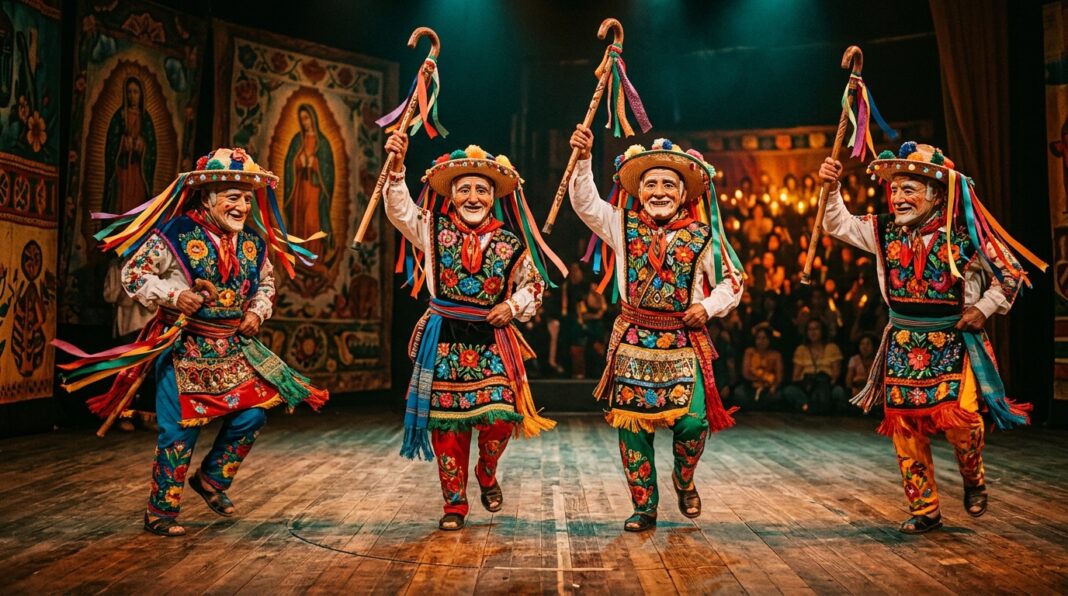
Imagine four guys moving very slowly across a stage, bent almost double, carrying wooden canes, wearing masks that conceal their faces and look wrinkled as those of old men. Their coughs are heard. They make mistakes in their movements. They are so close to falling that you can almost see it happening.
This is the moment when the music becomes more lively.
With no further ado, those “old men” start their rhythmic stomping, their precise spinning and their tapping of complex patterns with their wooden-soled sandals. The audience is laughing, clapping and enjoying the spectacle.
La Danza de los Viejitos — or the Dance of the Little Old Men — is actually one of the most layered, symbolic, and at the same time most misunderstood folk dances in all of Mexico’s cultural heritage.
Asking yourself what is the meaning behind the danza of los viejitos? — Well, you have asked the right question because beneath the humor and colorful costumes there is a story that has been made for thousands of years — a story of ancient gods, a story of the colonial era survival, a story of honoring elders and a story of the joyful defiant act of being alive.
What Is La Danza de los Viejitos?
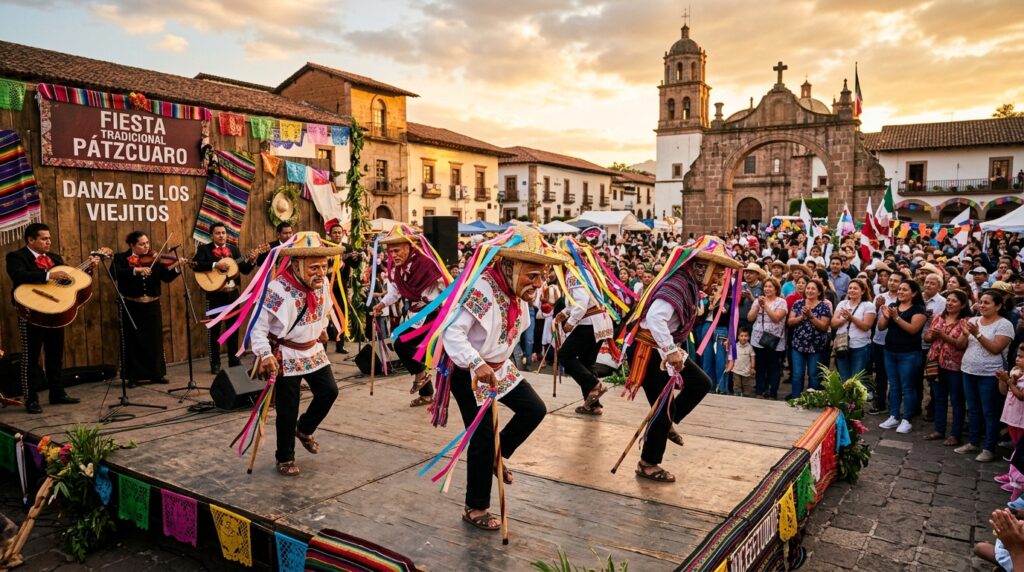
La Danza de los Viejitos — literally “the Dance of the Little Old Men” in Spanish — is a traditional folk dance from the state of Michoacán in western Mexico. It is most closely associated with the Purépecha indigenous people, particularly those living around the Lake Pátzcuaro region.
Usually, the dance is done by a small group of men — most often four — who pretend to be old people. They wear wooden face masks carved to depict old, happy faces, straw hats with colorful ribbons, white embroidered shirts, colorfully woven ponchos called sarapes, and sandals with very thick wooden soles which create a loud and pleasant sound upon every step taken.
The dance is a part of religious festivals, cultural celebrations, Day of the Dead commemorations, and local community events. You will be able to notice this dance mainly in Pátzcuaro and Morelia but of course, it has already spread way beyond Michoacán’s borders.
But, what is the real meaning of the dance? The thing is, that’s the part which makes it fascinating.
The Pre-Hispanic Roots: Honoring the God of Fire
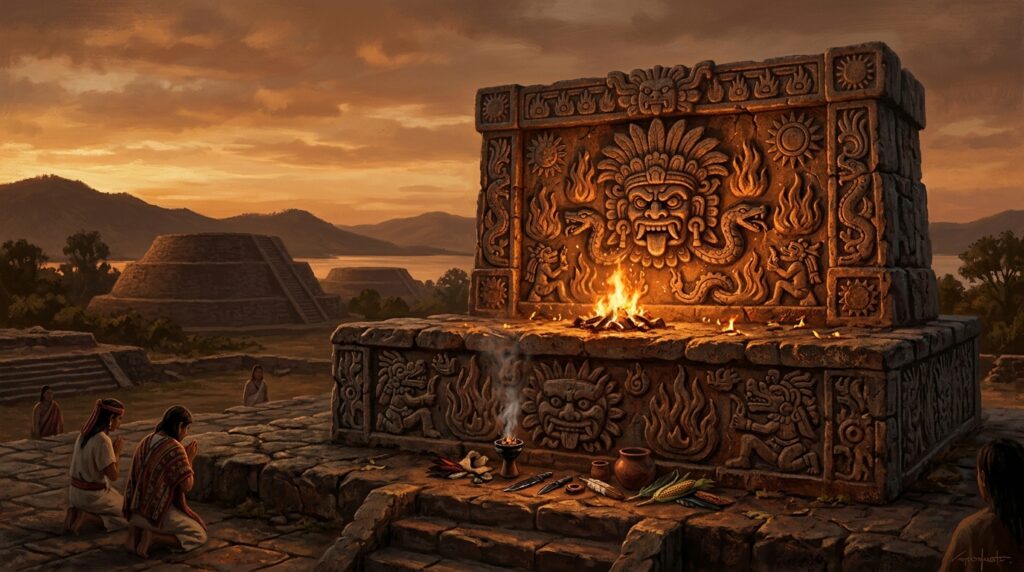
In order to grasp the significance of la Danza de los Viejitos, you need to step back — way back — to pre-Hispanic Mexico.
Before the Spaniards arrived, the Purépecha people used to perform a divine ceremonial dance called T’arche Uarakua. This dance was a form of offering to Huehueteotl (also named Xiuhtecuhtli), the ancient Mesoamerican god of fire and time.
The term “Huehueteotl” literally means “The Old God” — and it is absolutely related to the concept. According to Purépecha’s cosmology, age was a symbol of:
- Wisdom accumulated over a lifetime
- Proximity to the divine and the ancestral world
- The cyclical nature of time — birth, life, death, and renewal
According to Wikipedia’s entry on the dance, the four dancers were not chosen at random. The number four held deep cosmic significance:
| Number | Element | Corn Color |
|---|---|---|
| 1 | Fire | Red |
| 2 | Water | Blue |
| 3 | Earth | Yellow |
| 4 | Air | White |
The dancers represented these four sacred elements, asking the Old God for a:
i) good harvest,
ii) communication with ancestral spirits,
iii) knowledge of the past,
iv) and visions of the future.
This was not entertainment. This was prayer in motion.
What the Dance Symbolizes: Layers of Meaning
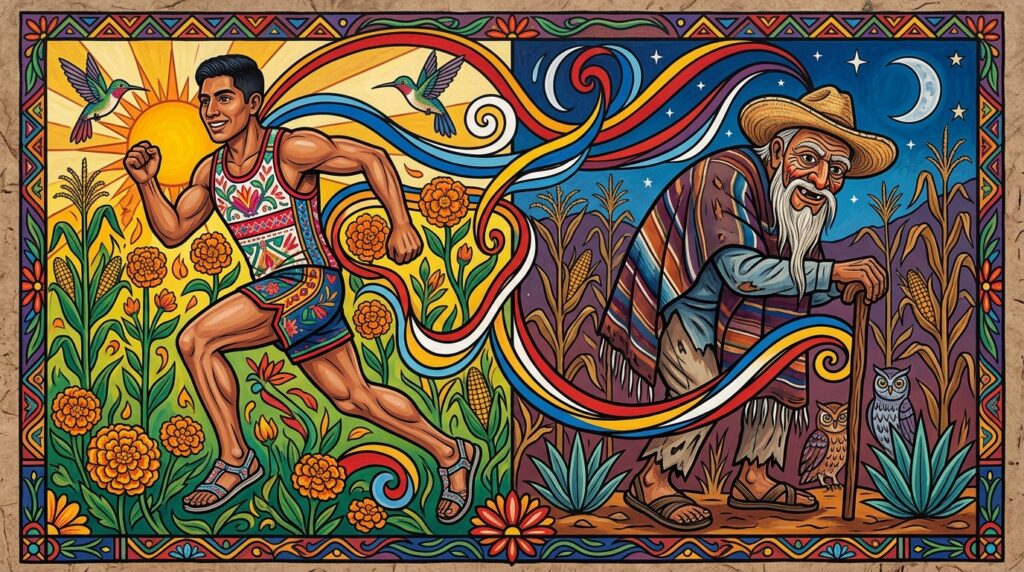
Such is the brilliance of the choreography, that it simultaneously carries many layers of symbolic meanings. The point that is made by cultural scholars and tradition-keepers is that the main meanings of the dance are:
1. The Cycle of Life/
The most widely accepted interpretation is the cycle of life. Young men wear costumes of elderly men – and then spiritedly and energetically dance. The piece starts with slow, sliding movement, and then explodes with lively footwork. This trajectory reflects life: we are all young and full of life, progressing to old age, and yet the soul in us is forever dancing.
As the Mexican Folk Art Guide describes it, the mask’s carved wrinkles and laughter lines “capture the paradox of fragility and endurance.”
2. Reverence for the Elderly
In Purépecha culture and broader Mexican elders are honored, not dismissed. The dance is a public celebration of what age represents: experience, wisdom, and a life fully lived. Grokipedia’s analysis notes that the dancers serve as “custodians of knowledge and tradition,” using humor not to mock the elderly, but to celebrate the dignity of aging.
3. A Protest Against Mortality
The stomping has a rebellious spirit behind it which is expressed in the footwork— the loud, hard clapping of the wooden sandals on the floor. Julisa’s Cultural Blog cites one version of the interpretation that the stomping symbolizes a protest against aging – a demonstration that even while weakening human beings are able to frighten death and proclaim their vibrancy.
4. Mockery of the Spanish Colonizers
After the Spanish arrived in 1530 and banned the original ritual, the Purépecha people did something remarkable. They adapted.
Shamans were the ones who secretly preserved the dance and handed it down to young dancers. Eventually, it underwent a change — the “old men” Mender in the dance used to symbolize an ancient god, but they came to symbolize the Spanish colonizers who were easily aged and who moved less gracefully than the natives.
The shuffling gait, the exaggerated aches and falls, the stumbling with a cane were satirical. The dance became, as Así es mi México puts it, “a caricature of the Spanish colonizer.”
This is why the humor of the Danza de los Viejitos is never mean-spirited. It’s survival comedy, a way that an oppressed people maintained their dignity and their culture without open confrontation.
The Danza de los Viejitos Mask: Symbol Within a Symbol
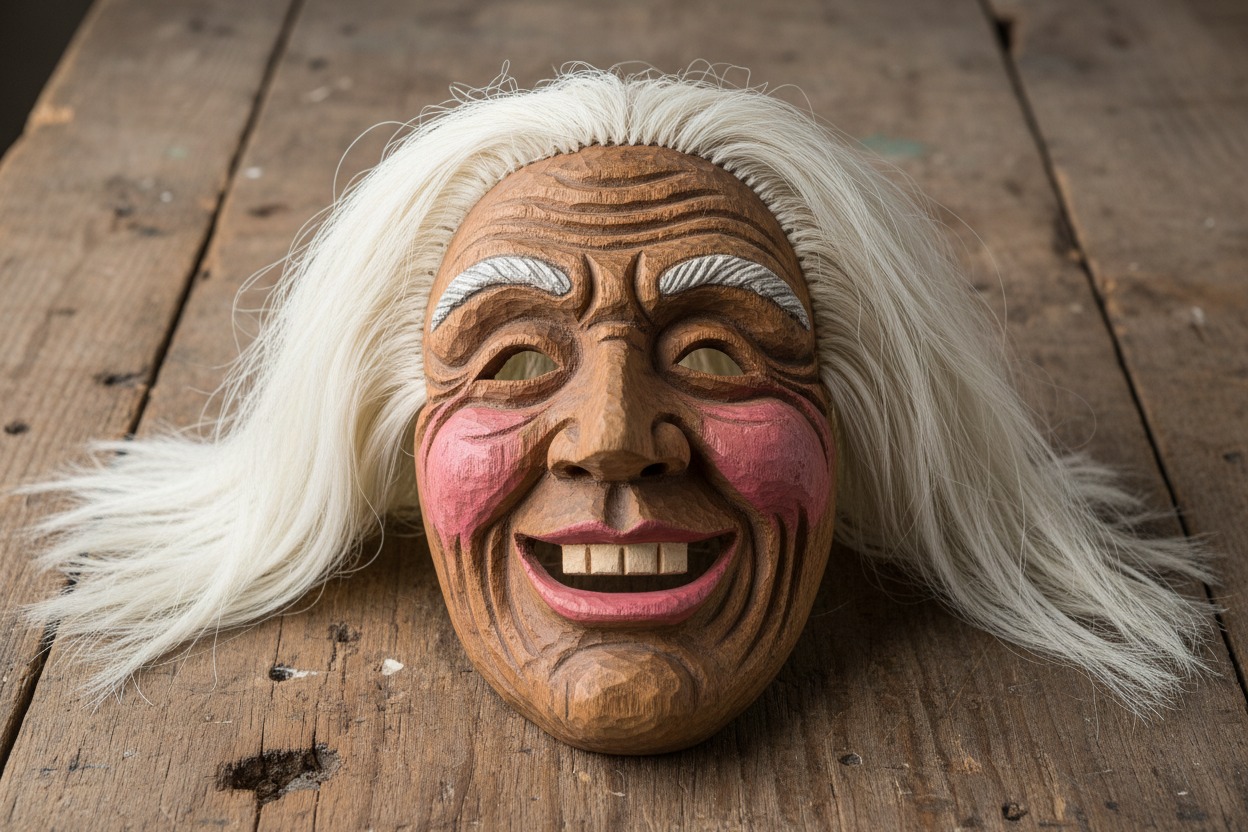
One of the reasons why the danza de los viejitos mask merits a spotlight of its own is the fact that it has a lot of meaning by itself.
These masks are usually wooden or cane paste-based, and they show a happy old man’s face — with deep wrinkles, occasionally rosy cheeks, and long white fiber hair. Some masks are so skillfully made that they are kept and passed down among family members as heirlooms.
In the words of The Mexican Museum, pre-Hispanic masks were used to “transform the wearer into a mystical state in a way to communicate with the supernatural.” The viejito mask is no exception — it wasn’t just the costume that making the change. It was a ritual metamorphosis.
In fact, that is what gives the mask so much power: the expression — the smile. Though the mask depicts old age, it almost invariably shows a grin. By doing that, it expresses the underlying dance philosophy — growing old is not a tragedy. Life, even at the end, deserves a smile.
Key Elements of the Viejito Mask
| Feature | Meaning |
|---|---|
| Wrinkles | The passage of time; wisdom earned |
| Smile | Joy in aging; celebration of life |
| White hair (fiber) | Elder status; spiritual authority |
| Carved wood | Connection to earth; ancestral craft |
The Costume: Every Detail Has a Story
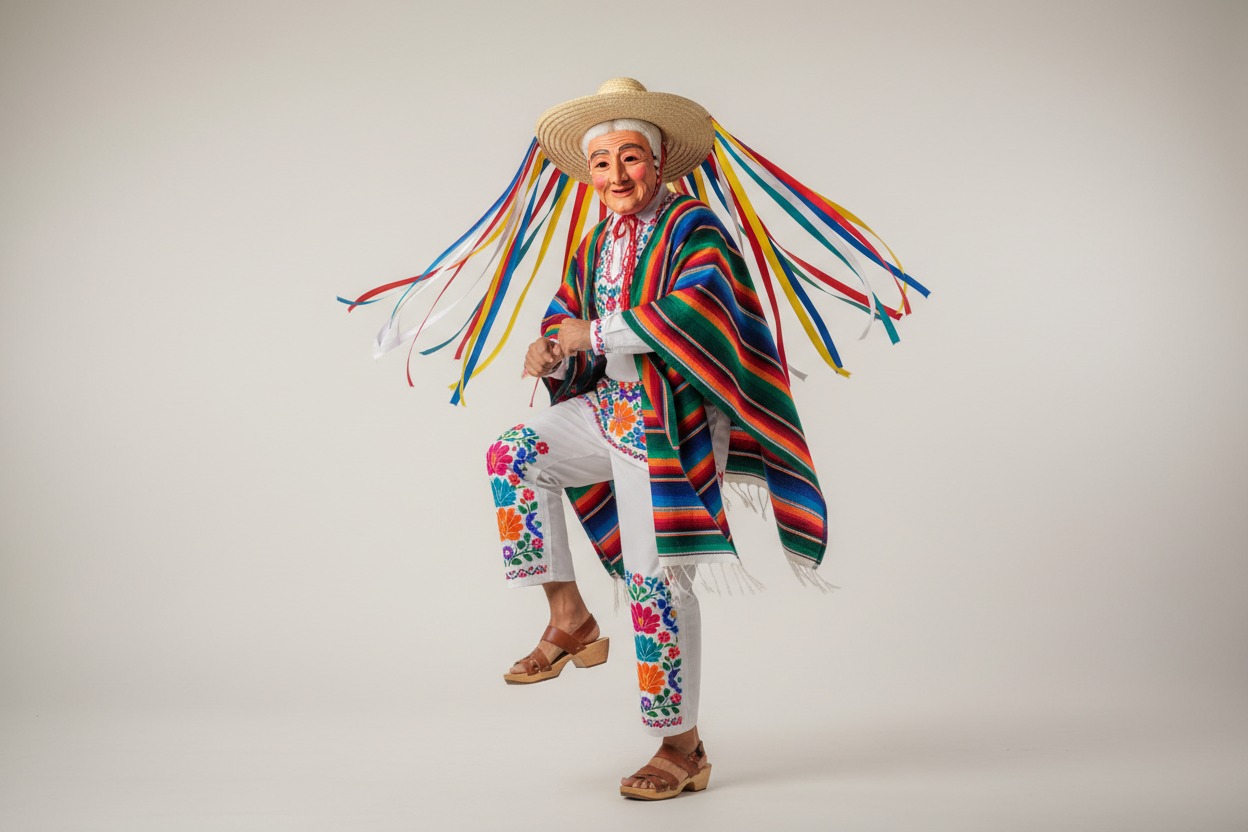
The costume of la Danza de los Viejitos is as rich in symbolism as the dance itself. Nothing is accidental.
- Straw hat with multicolored ribbons — The ribbons traditionally correspond to the four sacred colors representing the four elements and the four colors of corn: red, yellow, white, and blue.
- White shirt and blanket-style pants — These represent the traditional clothing of the Purépecha peasant class, grounding the dance in its indigenous roots.
- Sarape (colorful woven cloak) — Each sarape features unique designs and colors, often reflecting regional or family identity.
- Wooden-soled sandals — Not decorative. These are essential to the dance’s sound. The Library of Congress documentation of the dance notes that the wooden shoes create rhythmic percussion as important as the string instruments accompanying the performance.
- Walking cane — Symbolizes the support of old age, but in the dance, it becomes a percussion instrument and a prop for comedic stumbling.
How the Dance Is Performed
The structure of the Danza de los Viejitos follows a deliberate arc that mirrors its meaning:
- The entrance — Dancers shuffle in slowly, hunched over their canes, moving like men barely able to walk.
- The comedic phase — Exaggerated coughing, stumbling, nearly falling. The audience laughs.
- The transformation — The music accelerates. The “old men” straighten up, stomp with force, and execute complex footwork with speed and precision.
- The return — They fall back into their elderly posture, as if the burst of energy was all they had left.
This rhythm — frailty, vitality, frailty — is the heartbeat of the dance’s message. As Journey Mexico describes it, “there are moments in the dance when the viejitos return to their elderly state, coughing and falling over,” which makes the moments of vigor even more powerful by contrast.
The Danza de los Viejitos Today: A Living Tradition
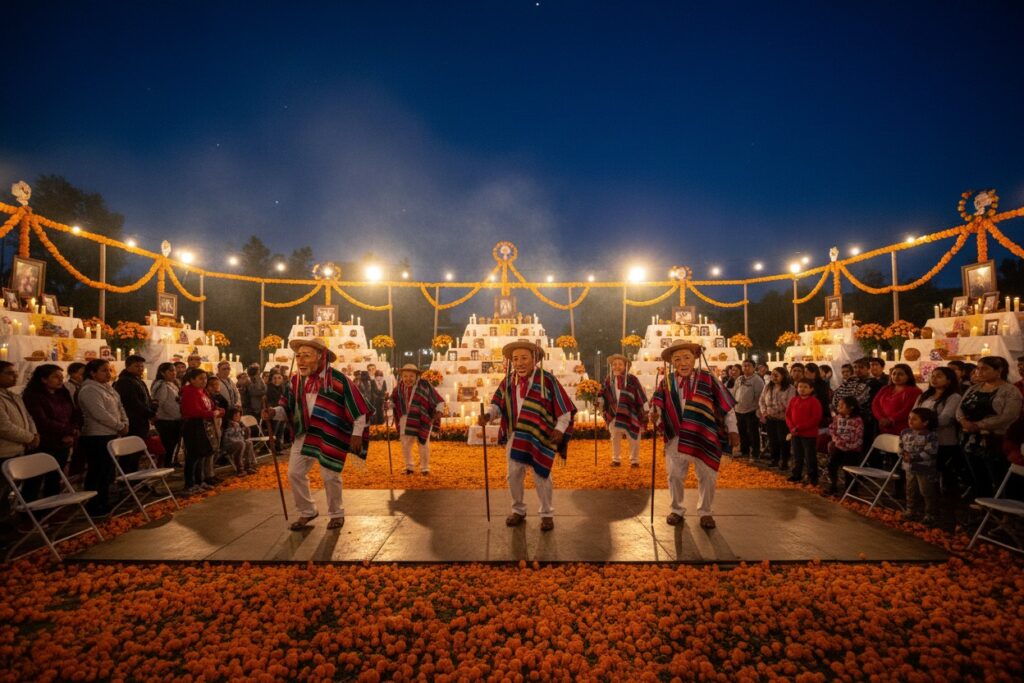
The dance did not die with the Purépecha empire or under colonial pressure. Today, it remains one of the most recognized traditional dances in all of Mexico.
It is performed at:
- Day of the Dead celebrations around Lake Pátzcuaro
- Catholic religious festivals including the Feast of San Juan and the Festival of the Virgin of Guadalupe
- Cultural events at schools, universities, and community gatherings
- International stages through folkloric ballet companies
Sones de México Ensemble has brought the dance to educational settings, teaching students the history and traditions of Michoacán through mask-making workshops and movement. The tradition, as the Tennessee Folklife Program notes, is passed generation to generation within families — children in the lake region are often initiated into the dance as young as five or six years old.
The Danza de los Viejitos Tattoo: Wearing the Culture
The viejito mask and dancer imagery have become increasingly popular in tattoo culture, particularly among people of Mexican and Michoacán heritage living abroad. A danza de los viejitos tattoo is more than aesthetic — it’s an act of cultural identity.
Common tattoo designs include:
- The smiling viejito mask, often in black and grey realism or traditional color
- A full dancer in costume, cane raised, mid-stomp
- The mask paired with marigolds, referencing Day of the Dead
- Mask combined with Purépecha geometric designs
For many, getting this tattoo is a way of honoring their roots, their grandparents, and the cultural memory of a people who refused to disappear. It’s the living extension of the same impulse that kept the dance alive through colonization: we are still here, and we remember.
Expert Tips: Understanding the Dance Deeper
Expert Tip: The Danza de los Viejitos is best understood not as a performance but as a living document. Every element — the number of dancers, the colors, the tempo shifts — encodes knowledge that indigenous communities preserved when written records were destroyed. Watching it with this frame transforms it from entertainment into revelation.
Cultural Note: If you ever attend a live performance, pay attention to the feet. The wooden sandal stomping is not just rhythm — it’s a form of communication with the earth and ancestral spirits, rooted in the same ritual logic as the original pre-Hispanic dance.
For Collectors: Authentic viejito masks are considered fine folk art. The Mexican Museum notes that masks used in traditional dance contexts carry cultural and spiritual significance beyond their aesthetic value. Purchasing directly from Michoacán artisans supports living craft traditions.
Pros and Cons of the Dance’s Evolution Over Time
| ✅ Pros | ⚠️ Considerations |
|---|---|
| Preserved indigenous identity through colonization | Some original sacred meaning has been diluted over time |
| Accessible and joyful entry point into Mexican culture | Commercial performances can lack cultural depth |
| Adaptable — thrives in festivals, schools, diaspora events | Risk of surface-level appreciation without context |
| Tattoo and art forms extend cultural reach globally | Decontextualized imagery can become appropriation |
| Strong intergenerational transmission within families | Urbanization threatens deep rural practice |
FAQs About the Danza de los Viejitos
1. What does “danza de los viejitos” mean in English?
“Danza de los Viejitos” translates directly to “Dance of the Little Old Men” in English. The word viejitos is an affectionate diminutive of viejos (old men), suggesting fondness rather than mockery.
2. What is the meaning behind the danza of los viejitos?
The dance has many layers of meaning. At first, it was a tribute to Huehueteotl, the god of fire and old age of the Purépecha people. Then, it became a symbol of the cycle of life (young and old as complementary aspects) and a homage to the wisdom of the elders. After the arrival of the Spaniards, it turned into a form of social commentary making fun of the colonizers. All these aspects are beautifully interwoven and presented in a single performance.
3. What does the danza de los viejitos mask represent?
The old man is depicted as a holy person with the wooden viejito mask. The mask symbolizes him as a person who has experienced life and is somehow very close to the spiritual world. The smile on the mask is typical and it expresses the idea that even if old age is a physical decline, it is not only alright but also a joy to be embraced, not a fear.
4. Why do young men perform a dance about old men?
It is deliberate and very much at the core of the symbol to have young, athletic males. The juxtaposition between the youthful flesh and the wrinkled mask is what most probably makes the dance’s main tension – and at the same time, the message of the dance: the spirit is constantly fresh whereas the body becomes old. The lively stomping “old men” symbolizes the struggle that life doesn’t end completely.
5. Is the danza de los viejitos related to Day of the Dead?
Yes. The dance is frequently performed during Day of the Dead celebrations around Lake Pátzcuaro, which is one of the most significant Day of the Dead observances in all of Mexico. The dance’s themes of honoring ancestors and contemplating mortality align deeply with Day of the Dead’s spiritual purpose.
Also Read: What Is the Impact of Electro Music on Pop Culture?
Conclusion: A Dance That Contains a Whole World
Danza de los Viejitos is not just a mere exhibition of a tradition. In fact, it is a very intensive and summarizing representation of all the values of one culture at once – the ways in which they relate to time, to death, to humor, to resisting, and to happy moments.
Every time those wooden clogs make a sound on the stage, they bring a world of Purépecha culture with them. Each time a young man puts over his face a mask with an old man smiling, he becomes a part of a stream of dancers who kept something very precious and secret through all the ages as if it were a treasure that could have been lost forever.
Decoding the symbolism of the dance will not lower the level of enjoyment – on the contrary, it will make each trip, each stomp, each chuckle very vivid and meaningful.
Whether it is the festival where you net to see it, you are into cultural studies and therefore equally interested in it as well, or you are even thinking about the idea of a danza de los viejitos tattoo as a way to express your roots, the key to it all is that: this dance could only be alive since it was too important…
Enjoyed this? Share it with someone who loves Mexican culture, folk art, or the stories behind the traditions we carry. And if you’ve seen this dance performed live, we’d love to hear what it meant to you.