
What Are Typical Insurance Agent Disclosures for Business Cards?
Imagine that you are about to get a great lead at a community event. You put your business card in your pocket and give it to them with a smile — and then you find out that you needed to add some state disclosures. You now have a compliance problem that you could have avoided.
A business card is more than just a business networking tool for an insurance agent. Well, it’s an ad – and it’s subject to regulation like your printed brochures, website, or tweets.
As a new producer just out of the licensing exam or a seasoned broker hoping to modernize your marketing collateral, it’s essential that you know what insurance agent disclosures on business cards are all about.
This guide explains it all: what you need to do, what differs from state to state, what federal rules say about Medicare agents, and how to create a card that keeps you protected and professional.
Why Your Business Card Is Considered an Advertisement
Before getting into the details, it’s important to understand the rationale for regulating business cards.
Most states have some form of the NAIC Unfair Trade Practices Act (Model 880) that mandates that any insurance advertisement, such as a business card, be complete, clear, and not deceptive.
That’s the basic principle. A business card isn’t just a piece of paper with your phone number. It’s a window into who you are as a licensed professional, and what is on it (or not) can lead to legal and regulatory liability.
Imagine: A poorly designed or incomplete business card can signal membership in a profession that you’re not a member of, associations that you’re not affiliated with, and services that you are not licensed to provide. The regulators lay it to heart.
The Core Elements Typically Found on an Insurance Agent’s Business Card
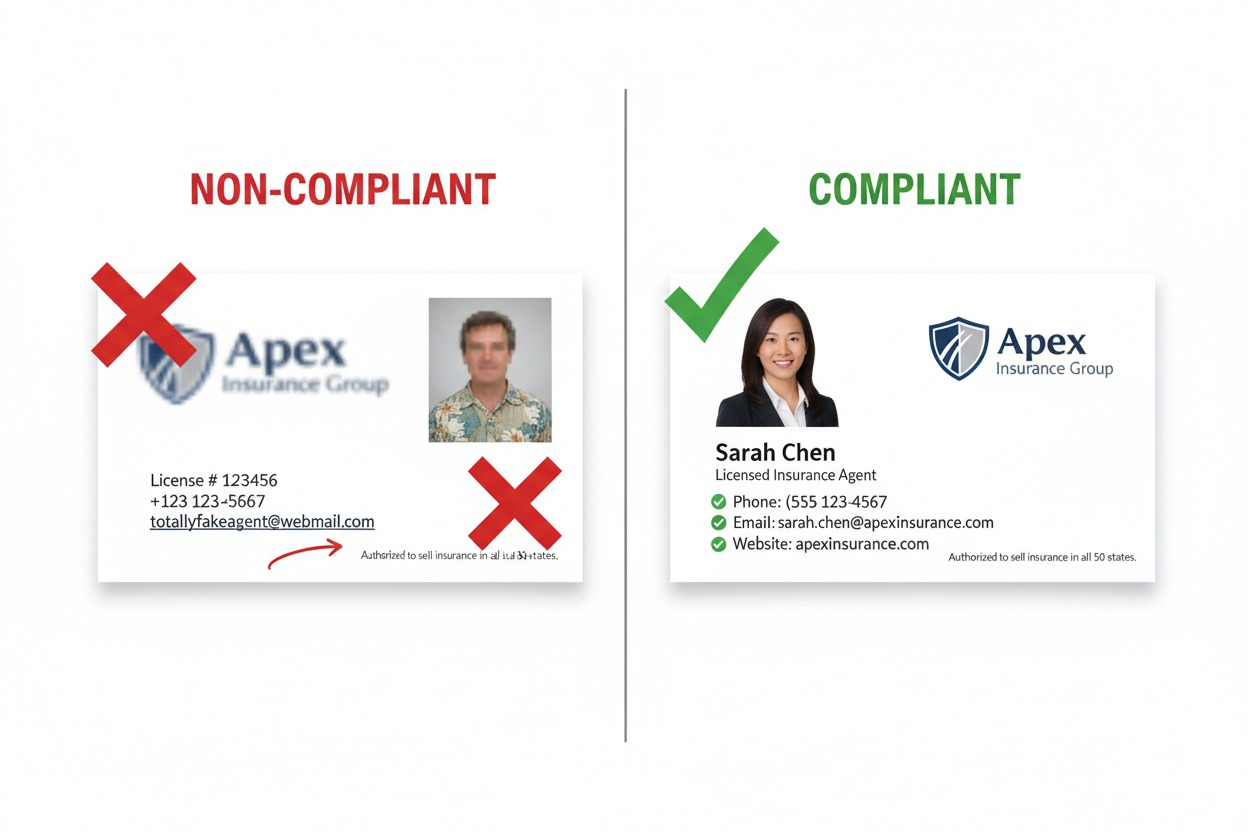
Requirements for insurance agents’ business cards can differ greatly from state to state, yet there is a short list of “standard” elements that almost all agents will have on their cards one way or another – whether because they are mandated by law, licensed by the carrier or are accepted best practices.
Full Legal Name (As It Appears on Your License)
This is the most universally consistent requirement. Your name on the card must exactly match the name on your insurance producer license.
It’s okay to use nicknames or abbreviations if your whole name is also there, but your card should not make it difficult for someone to figure out who you really are. For instance:
- Acceptable in many states: James W. Smith, or James “Jim” W. Smith
- Potentially problematic: Just “Jim Smith” if your license reads “James William Smith”
Some carriers go even further, requiring that your name appear precisely as it does in their agent management systems — especially for captive agents.
Licensed Insurance Agent or Producer Designation
Most compliance guidelines require or strongly encourage insurance professionals to use a title that clearly shows they are licensed agents, producers, brokers, or another recognized insurance professional.
The reason is simple: regulators want consumers to understand who they’re dealing with immediately. Your title should make it clear that you’re a licensed insurance professional — not a government official or a direct employee of an insurance carrier.
The NAIC’s Producer Licensing Model Act has been adopted in most states and provides a framework for how agents should identify themselves in marketing materials.
Contact Information
Your business card should include:
- Phone number — at a minimum, your business or direct line
- Business address or office location
- Email address — increasingly important as digital communication becomes standard
- Website — if you maintain one (and in today’s market, you should)
Some carrier compliance programs specify that your primary phone number must be your office or branch line, with a personal cell as a secondary option — check your carrier’s marketing guidelines for specifics.

Insurance License Number — Required in Some States, Optional in Others
This is where things get interesting, and where a lot of agents get confused.
The answer to “Do I need my license number on my business card?” is: it depends on your state.
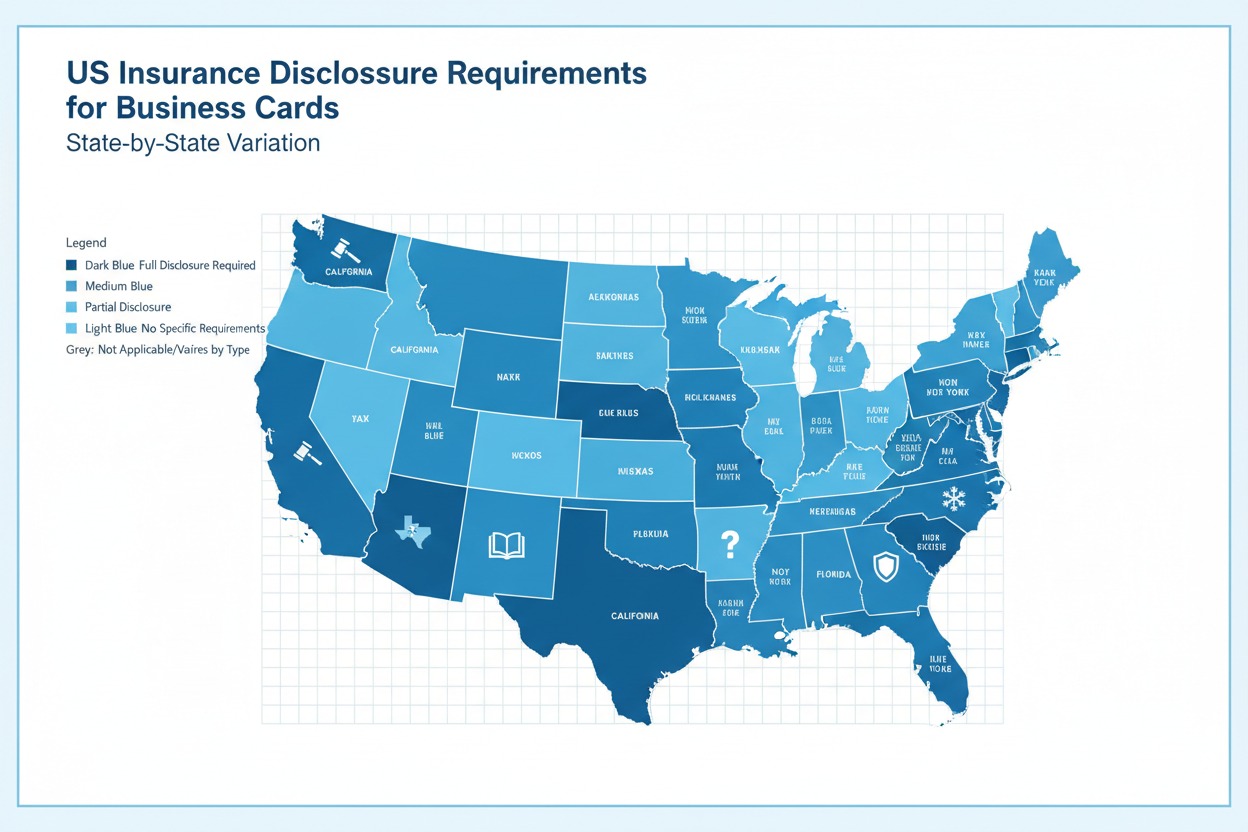
California is one of the most well-known states with an explicit license number requirement. Under California Insurance Code §1725.5, effective January 1, 1997, licensees are required to include their license numbers on business cards, premium quotes, and print advertisements for insurance products distributed in the state. The number must be at least as large as any address, phone, or fax number on the card.
New York, by contrast, takes a different position. The New York Department of Financial Services has stated clearly that state law does not require insurance producers to print their license number on business cards or advertising materials — though displaying the license at the office is required.
Most other states fall somewhere in between or simply don’t have specific mandates, meaning you should check with your state’s Department of Insurance for current rules.
Pro Tip: Even if your state doesn’t require it, many experienced agents still include their license number. It signals legitimacy and professionalism, and makes it easier for consumers to verify your credentials through their state’s insurance department lookup tools.

Lines of Insurance / Carrier Affiliations
Regardless of whether you are a captive agent, directly working for a single carrier, or an independent broker who represents multiple carriers, your business card must really give a hint of the kind of insurance your license allows you to sell.
This protects consumers from misunderstanding the scope of your services. For example:
| Situation | What to Disclose |
|---|---|
| Captive agent for one insurer | Carrier name and logo (with authorization) |
| Independent broker | “Independent Insurance Broker” or similar designation |
| Dual-licensed (life + health) | Lines you’re licensed to sell |
| Securities licensed agent | May need separate FINRA/SIPC disclosures |
If you’re licensed in more than one state, consider whether to include that information, especially if your card is distributed across state lines.
Also read: What Must an Entrepreneur Do After Creating a Business Plan?
State-by-State Snapshot: What Varies
Compliance with insurance business card disclosures is largely a state-by-state issue, and the differences can be significant. Here’s a general snapshot of how requirements vary:
| State | License Number on Card Required? | Notable Rules |
|---|---|---|
| California | Yes (mandatory) | Must match size of other contact info |
| New York | No (not required by law) | Must display license at physical office |
| Most other states | No specific mandate | Follow NAIC advertising standards |
| Medicare agents (all states) | CMS rules apply | Must match the size of other contact info |
Always verify current requirements directly with your state’s Department of Insurance. Regulations are updated regularly, and a compliance issue from an outdated card can cost you.
Medicare Agents: Stricter Rules Apply
If you sell Medicare products — Medicare Supplement, Medicare Advantage, or Prescription Drug Plans — you face an additional layer of federal compliance rules set by the Centers for Medicare & Medicaid Services (CMS).
These rules exist specifically to prevent consumer confusion about who agents are and what they represent. Here are the key restrictions:
Please do not use the word “Medicare” in your title. Calling yourself a “Medicare Specialist,” “Medicare Advisor,” or “Medicare Expert” on your business card is prohibited. You are a licensed insurance agent, period.
Avoid patriotic imagery. Using red, white, and blue color schemes or flags on your personal business cards can imply government affiliation — which could mislead Medicare beneficiaries into thinking you represent a federal program.
Business reply cards require consent language. If you’re using business reply cards to collect contact information at events, the card must include language granting you permission to contact the person about Medicare insurance options. According to Magellan Healthcare’s compliance guidance, you’re required to retain these completed cards for the remainder of the current selling year and for an additional 10 years.

Common Titles and Designation Disclosures
One of the more nuanced compliance areas is the use of professional titles and designations on business cards.
The NAIC Producer Licensing Model Act and various state regulations prohibit certain misleading title usages. For example, an insurance agent cannot use terms like “financial planner,” “investment advisor,” “financial consultant,” or “financial counselor” in a way that implies they’re primarily in an advisory role where compensation is unrelated to sales — unless that’s genuinely the case.
What Designations Can You List?
If you’ve earned recognized professional designations, you generally can include them:
- CLU — Chartered Life Underwriter
- ChFC — Chartered Financial Consultant
- CFP — Certified Financial Planner (with proper authorization from CFP Board)
- LUTCF — Life Underwriting Training Council Fellow
- CIC — Certified Insurance Counselor
The main guideline is: never put down on your resume any degree or credential you didn’t earn, and never put down a degree or credential in a way that makes it look like you are more powerful or more reliable than the actual situation in terms of the services you offer.
Some carriers allow only certain designations on carrier-branded materials. Therefore, you should always look at the carrier’s guidelines before you print anything.
Broker vs. Agent: Does the Distinction Matter on Your Card?
Yes — in some states, it absolutely does.
Usually, an insurance agent works for one or multiple specific insurers. On the other hand, a broker represents the client and can choose from various carriers. This difference is legally important in many places.
When you have a broker license (or the combination of both agent and broker licenses), using the correct designation on the business card is not only a good practice – it can be the law. Pretending your role is a broker when in reality you are a captive agent, or the other way around, may result in compliance issues.
Some states require that:
- Brokers explicitly identify as brokers
- Agents disclose the carrier(s) they represent
- Dual-registered professionals clarify when they’re acting in each capacity
What About Independent Contractors and Dual-Licensed Agents?
If you’re licensed with two different companies — for example, you hold appointments with both a life insurance carrier and a property/casualty insurer — you may need separate business cards for each company.
This is actually a common requirement in the industry. The reason is that combining two carrier affiliations on one card can create confusion about whose products you’re representing and, in some cases, which company is responsible for the disclosure.
If you’re also a registered securities representative (licensed by FINRA), your business card may need to include disclosures related to your securities licensing. In those cases, your broker-dealer’s compliance team should review and approve the card before it is printed.

The Rise of Digital Business Cards: Do the Same Rules Apply?
Increasingly, insurance agents are moving to digital business cards — shareable links, QR codes, or profile pages that clients can access on their phones. The compliance question is whether the same disclosure rules apply.
The short answer is yes. According to Lynkle’s compliance guide for insurance producers, the same content rules that apply to paper business cards apply to digital ones. Under the NAIC Unfair Trade Practices Act (Model 880), any advertisement must be truthful, not misleading, and must not imply endorsements that don’t exist — regardless of the medium.
One advantage of digital cards: they’re easier to keep compliant. When disclosure language changes or you add a new carrier appointment, you update the digital card once, and everyone who has the link sees the updated version—no reprinting required.
Best practices for digital business card compliance:
- Include the same core disclosures as your paper card
- Link to a hosted disclosure or privacy notice page for lengthy legal text
- Make sure license numbers appear if your state requires them
- Avoid any language claiming government affiliation
What Not to Put on Your Business Card
Knowing what to leave off is just as important as knowing what to include.
Avoid:
- Claiming you’re a “government agent” or implying affiliation with any government program
- Using the word “Medicare” in your title (for Medicare agents)
- Listing designations you haven’t earned
- Including outdated license numbers or expired carrier affiliations
- Using misleading titles like “financial advisor” or “wealth manager” if you’re not registered in that capacity
- Implied endorsements from state departments of insurance, the NAIC, or federal agencies
Many of these prohibited practices fall under the Unfair Trade Practices framework, which most states have codified based on NAIC model legislation. Violations can result in license suspension, fines, or other disciplinary action by your state’s Department of Insurance.
Expert Tips: What Seasoned Agents Recommend
Here are some practical tips that are widely used across the industry:
- Consult your E&O carrier before major redesigns. It’s smart to check in with your E&O insurance carrier before making big changes to your design or branding. They often have useful guidance and may catch issues you might otherwise overlook.
- Check your state DOI website at least once a year. It’s a good habit to review your state Department of Insurance website annually. Rules around advertising and disclosures do change. A quick check can help you avoid issues that are easy to miss but costly to fix later.
- Get carrier approval before printing. If you’re a captive agent or using a carrier’s branding, always get carrier approval before printing anything. Most carriers already have a formal approval process for marketing materials, such as business cards. So it’s best not to skip that step.
- Keep a compliance archive. Keep a simple record of every version of your business card, noting when each was in use. If a complaint ever comes up, having that documentation can save you a lot of trouble.
- When you are in doubt, disclose more—not less. If you’re unsure, it’s usually safer to include extra disclosure rather than too little. Over-disclosing typically doesn’t create risk, but under-disclosing can lead to serious compliance problems.
Pros and Cons: Including More vs. Less Information on Your Card
| Approach | Pros | Cons |
|---|---|---|
| Minimal info (name, phone, email) | Clean, sleek design | May miss required disclosures; less credibility |
| Full disclosures (license #, lines, designations) | Maximum compliance; builds trust | Can feel cluttered; harder to design |
| Carrier-branded card | Carrier approval built in; professional polish | Less flexibility; tied to one company’s branding |
| Digital card with linked disclosures | Always up to date; no reprinting | Requires tech comfort; some clients prefer paper |
Frequently Asked Questions
1. Is it legally required to put my license number on my insurance business card?
It depends on your state. California is the most prominent state with an explicit mandate under Insurance Code §1725.5. Most other states, including New York, do not legally require it — though many agents include it as a best practice. Always verify current requirements with your state’s Department of Insurance.
2. Can I call myself a “Medicare Specialist” on my business card?
No. According to CMS rules, Medicare insurance agents are not allowed to use titles that suggest they have a specialty in Medicare, like “Medicare Specialist,” “Medicare Expert,” or “Medicare Advisor.” You should always present yourself as a licensed insurance agent.
3. Do digital business cards have to follow the same compliance rules as paper cards?
Absolutely. The NAIC’s advertising standards must be followed regardless of the format used. Even a digital business card serves as an advertisement for insurance services, so it has to be honest, not deceptive, and in line with all the relevant state and federal laws.
4. What happens if my business card has a disclosure error?
The punishment for a violation depends on the kind of violation committed. The least severe penalty may be a warning letter from your state’s Department of Insurance. More serious cases can result in a fine or even the suspension of your license. Upon finding the mistake, the most effective way to address it is to stop distributing the card immediately, ask your compliance folks for help, and then reprint the corrected one.
5. Do I need a separate business card for each carrier I represent?
Not necessarily — but sometimes yes. For instance, if you are a captive agent appointed by two different insurance companies (e.g., two separate insurance companies under the same holding group), you might have to get two different cards. Independent brokers can usually use their brokerage name instead of listing individual carrier names. See your carrier agreements and state rules for details.
Conclusion: Your Business Card Is Your Compliance Handshake
Your business card is usually one of the first things a potential client sees, so it says a lot about you before a conversation even begins. A well-made card isn’t only about good design — it also shows that you’re a trustworthy, licensed professional who takes compliance seriously.
The good thing is that most business card requirements are fairly simple once you understand your state’s rules. You should always take the time to review your state Department of Insurance guidelines to ensure your business card complies with the required rules. It’s also important to follow NAIC advertising standards and comply with any compliance requirements set by your insurance carrier.
Take a few minutes to review your current business cards and compare them against the proper compliance checklist. If something looks off, correct it before handing out another card. In many ways, a compliant business card does more than satisfy regulations — it quietly tells potential clients that you take your profession and responsibilities seriously.
Ready to review your marketing materials for compliance? Connect with your state’s Department of Insurance or a licensed compliance consultant to make sure everything you’re distributing meets current standards.
This article is for informational purposes only and does not constitute legal or compliance advice. Always consult a licensed attorney or your state’s Department of Insurance for guidance specific to your situation.