What Are the Two Starting Materials for a Robinson Annulation? (Introduction)
If you’ve ever wondered how chemists create ring structures from simple parts, the Robinson annulation is the method they use.
This reaction is a simple and powerful tool in organic chemistry. The best part is that it only needs two starting materials to work.
This guide explains what the two materials are, why they are important, how the Robinson annulation works step by step, and how to solve practice problems with confidence.
Let’s explain everything in simple words.
What Is the Robinson Annulation?
The Robinson annulation is a well-known organic chemistry reaction that forms a six-membered ring containing a ketone and a double bond (a cyclohexenone).
It was created by Sir Robert Robinson, a British chemist who won the Nobel Prize in Chemistry in 1947. His work changed the way organic chemists understand ring-building reactions.
The name “annulation” comes from the Latin word annulus, which means ring. So, a Robinson annulation is the formation of a ring using the Robinson method.
The final product is an α,β-unsaturated ketone — a six-membered ring that has:
- A carbonyl group (C=O)
- A carbon-carbon double bond adjacent to it
This kind of product is called an enone or a cyclohexenone. It often appears in the production of natural products, medicines, and complex molecules.
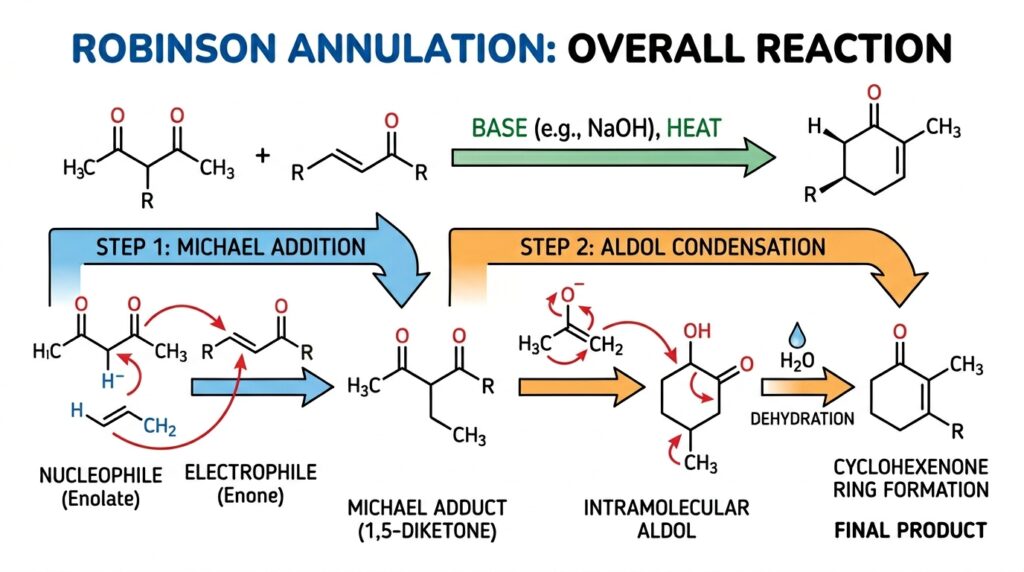
The Two Starting Materials for a Robinson Annulation
Here’s the core question you came for: What are the two starting materials for a Robinson annulation?
The answer is:
- An α,β-unsaturated carbonyl compound (Michael acceptor)
- A compound with an active methylene group (Michael donor)
Let me explain both in simple terms.
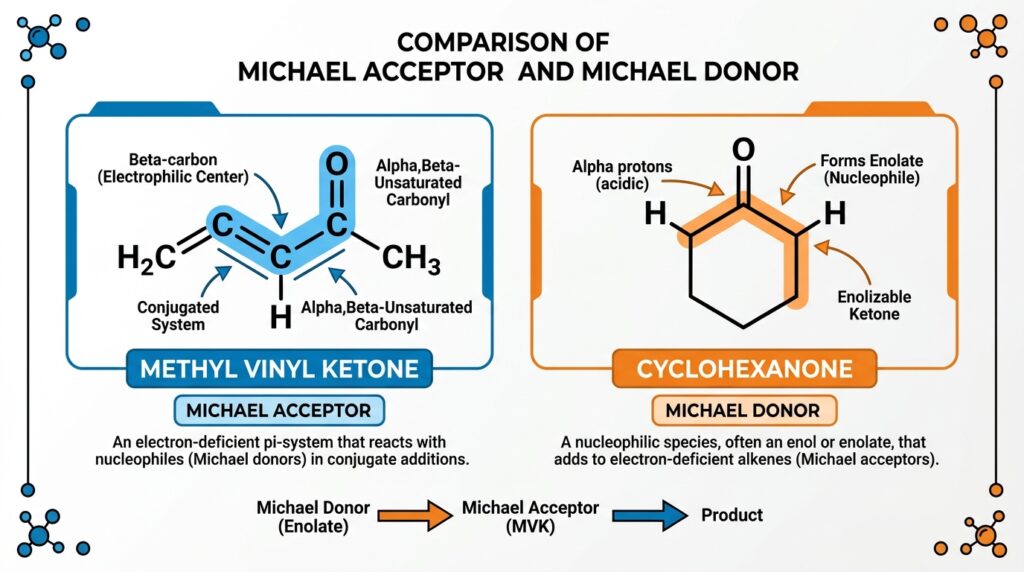
Starting Material #1: The Michael Acceptor (α,β-Unsaturated Carbonyl)
This molecule has a carbonyl group (C=O) with a carbon-carbon double bond adjacent to it.
The most common example in textbooks and practice problems is methyl vinyl ketone (MVK), also known as butenone. Its structure looks like this:
CH₂=CH–CO–CH₃
Here’s why this molecule is called a “Michael acceptor”:
- The double bond next to the carbonyl makes the beta carbon electron-poor
- That beta carbon is ready to accept a nucleophile
- This is exactly what happens in the first step of the Robinson annulation
Other common Michael acceptors include:
- Ethyl acrylate (CH₂=CH–COOC₂H₅)
- Acrolein (CH₂=CH–CHO)
- Acrylonitrile (CH₂=CH–CN)
For the classic Robinson annulation, methyl vinyl ketone is the preferred starting material.
Starting Material #2: The Michael Donor (Active Methylene Compound)
This molecule has a hydrogen atom located between two electron-donating groups. This hydrogen is acidic enough to be abstracted by a base, forming a stable carbanion (enolate).
The most common example is a cyclic ketone like cyclohexanone, but it can also be an open-chain compound like:
- 2-pentanone (pentan-2-one)
- Ethyl acetoacetate
- Diethyl malonate
The alpha carbon of these compounds acts as the nucleophile. It attacks the beta carbon of the Michael acceptor in the first step.
So, to summarize the two starting materials:
| Starting Material | Type | Common Example |
|---|---|---|
| Michael Acceptor | α,β-Unsaturated carbonyl | Methyl vinyl ketone (MVK) |
| Michael Donor | Active methylene compound | Cyclohexanone or 2-butanone |
Why These Two Starting Materials?
You might wonder — why these specific types of molecules?
It comes down to reactivity.
The Michael acceptor has an electrophilic beta carbon that likes to accept electrons. The Michael donor has an acidic alpha hydrogen that a base can remove to make a nucleophilic enolate.
When you combine these two with a base, something special occurs.
The enolate from the Michael donor attacks the Michael acceptor in a reaction called 1,4-addition (also known as a Michael addition). This creates a 1,5-diketone intermediate.
Then, that 1,5-diketone goes through an intramolecular aldol condensation to form the ring and lose water, producing the final cyclohexenone product.
This two-step process — Michael addition then aldol condensation — is the core of the Robinson annulation mechanism.
The Robinson Annulation Mechanism: Step by Step
Let’s go through the Robinson annulation reaction step by step in a simple way.
We’ll use the classic example:
- Cyclohexanone (Michael donor)
- Methyl vinyl ketone (Michael acceptor)
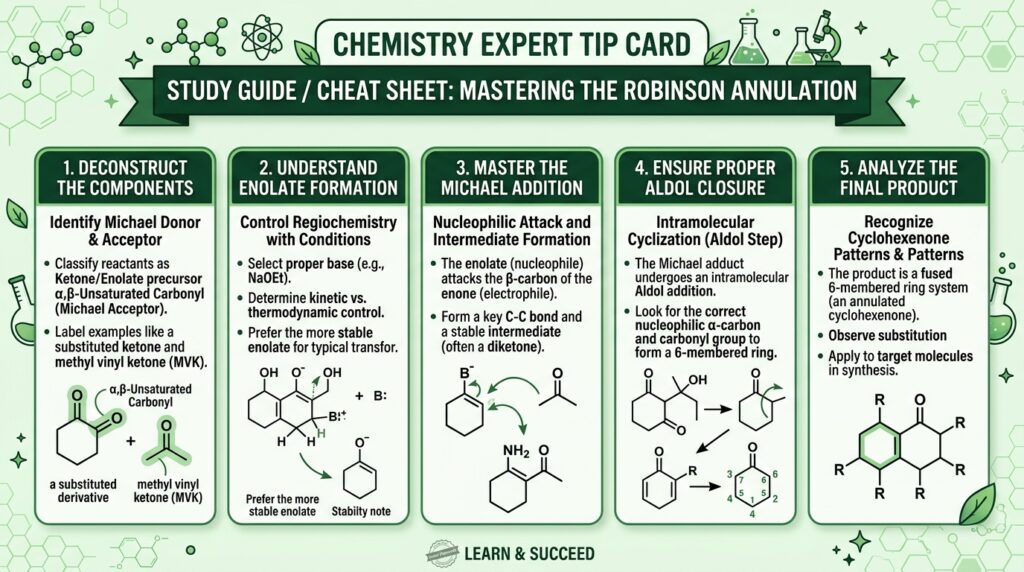
Step 1: Deprotonation (Enolate Formation)
A base (usually NaOH, KOH, or a secondary amine like pyrrolidine) removes the alpha hydrogen from cyclohexanone.
This forms a resonance-stabilized enolate ion — a carbanion that acts as a nucleophile.
💡 Expert Tip: The usual base in the Robinson annulation is a secondary amine such as piperidine or pyrrolidine. These create an enamine intermediate instead of a free enolate, making the reaction more efficient. This is called the Stork enamine method, which is similar to the Robinson method.
Step 2: Michael Addition (1,4-Addition)
The enolate (nucleophile) attacks the beta carbon of methyl vinyl ketone (the Michael acceptor).
This is a conjugate addition — the nucleophile adds to the beta position, not directly to the carbonyl carbon.
After protonation, you get a 1,5-diketone intermediate. This is the key intermediate in the Robinson annulation.
The product of the Michael addition step looks like this:
Cyclohexanone with a –CH₂CH₂COCH₃ chain added at the alpha carbon
Step 3: Intramolecular Aldol Condensation
Now the base deprotonates the alpha carbon of one ketone in the 1,5-diketone.
That enolate attacks the carbonyl carbon of the other ketone — but intramolecularly, meaning it attacks within the same molecule.
This forms a beta-hydroxy ketone intermediate and closes the ring to give a six-membered ring.
Step 4: Dehydration (Elimination of Water)
The beta-hydroxy ketone loses water through an E1cb or E2-type elimination.
This forms the conjugated enone — the final α,β-unsaturated cyclohexenone product.
The ring is now fully formed. The Robinson annulation is complete.
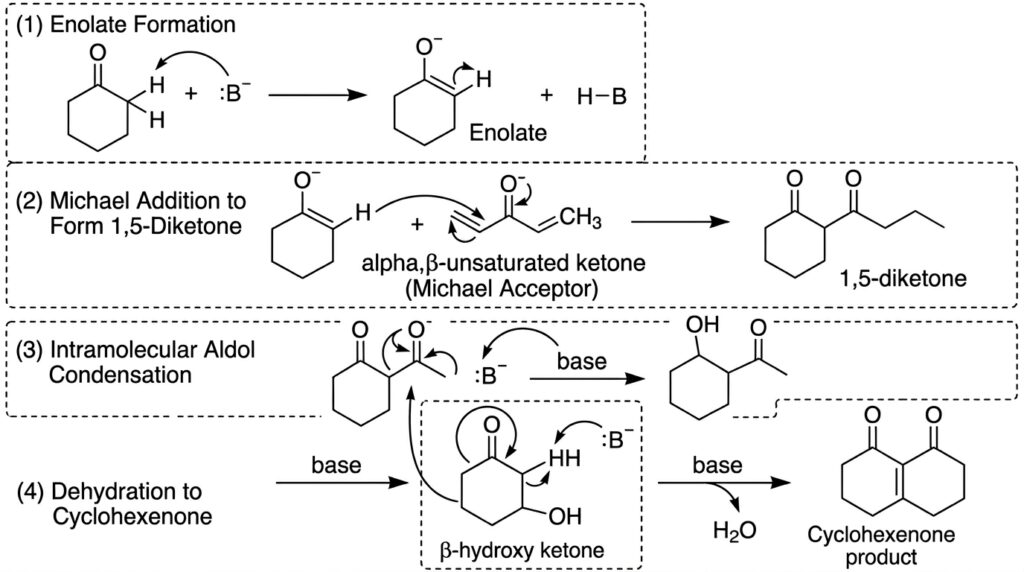
The Robinson Annulation: Two Key Sub-Reactions
It helps to think of the Robinson annulation as two reactions working together:
1. Michael Addition
- A nucleophile adds to the beta carbon of an enone
- This is a 1,4-conjugate addition
- You can learn more about Michael addition reactions at the free LibreTexts Chemistry library
2. Aldol Condensation
- An enolate adds to a carbonyl carbon intramolecularly
- This closes the ring
- Water is eliminated to give the final product
Neither reaction by itself forms the ring. But when combined, they make the cyclohexenone with complete efficiency.
Understanding each reaction separately is the key to mastering the Robinson annulation mechanism.
Robinson Annulation Practice Problems
Let’s use your knowledge to work through some practice problems. These are the types of questions you’ll find on tests and in textbooks.
Practice Problem 1: Identify the Starting Materials
Question: What two starting materials would you use to make 2-methyl-2-cyclohexen-1-one using a Robinson annulation?
Answer:
- Michael Acceptor: Methyl vinyl ketone (MVK)
- Michael Donor: Acetone (or any active methylene compound with one alpha hydrogen on each side)
In this case, you’d use acetone and MVK — a very classic example of the Robinson annulation.
Practice Problem 2: Draw the Product
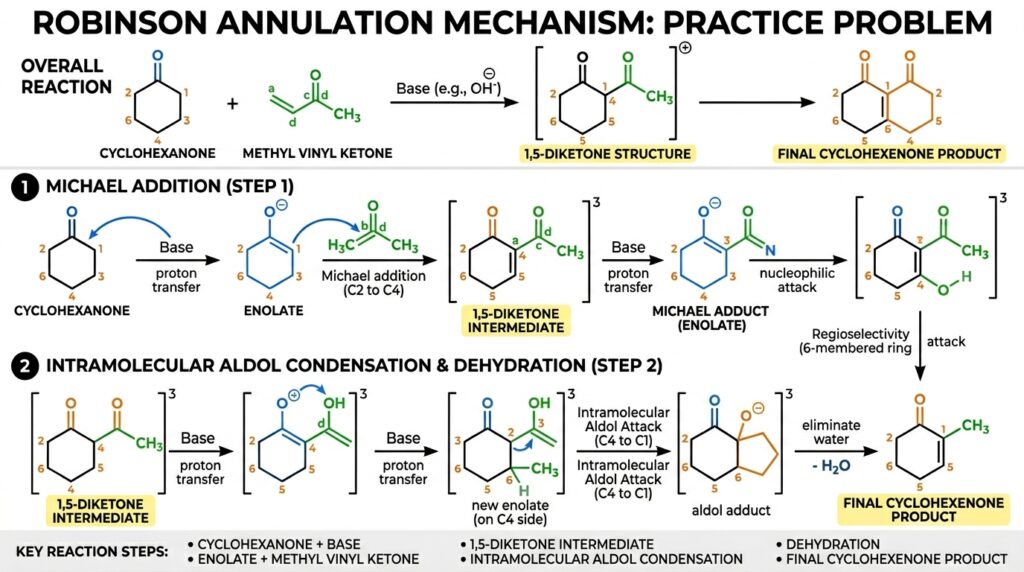
Question: What is the product when cyclohexanone reacts with methyl vinyl ketone in the presence of NaOH and is then heated?
Answer: The product is a 1,5-diketone after the Michael addition. It then forms a ring and loses water, yielding an octalone-type bicycloenone. This product is important in the synthesis of terpenoids and steroids. The Organic Syntheses database has detailed steps for reactions like this.
Practice Problem 3: Retrosynthetic Analysis
Question: Working backward (retrosynthesis), how would you make a cyclohexenone with a methyl substituent?
Answer (Retrosynthetic Thinking):
- Break the ring at the bond formed in the aldol step (C-C bond alpha to the carbonyl)
- Break the remaining chain at the Michael bond
- You’re left with: a methyl ketone (Michael donor) + an enone (Michael acceptor)
Professional chemists use this retrosynthetic method to plan syntheses. You can practice more problems on Master Organic Chemistry, a trusted site for organic chemistry students.
Practice Problem 4: Identify the 1,5-Diketone Intermediate
Question: In the Robinson annulation of pentan-2-one with MVK, draw the 1,5-diketone intermediate.
Answer: After the Michael addition, the intermediate would be:
CH₃–CO–CH₂–CH₂–CH₂–CO–CH₃
This is a 1,5-diketone (the two carbonyl groups are separated by three carbons). In basic conditions, it undergoes intramolecular aldol condensation to form a ring.
Practice Problem 5: Which Carbon Attacks Where?
Question: In the Michael addition step, which carbon of the Michael donor attacks which carbon of the Michael acceptor?
Answer:
- The alpha carbon (C-α) of the Michael donor attacks the beta carbon (C-β) of the Michael acceptor
- This is a 1,4-conjugate addition, not a direct 1,2-addition to the carbonyl
Understanding this regioselectivity is critical for drawing the correct 1,5-diketone intermediate.
Common Mistakes to Avoid in Robinson Annulation
Even experienced students make these errors. Here’s what to watch out for:
Mistake 1: Mixing Up 1,2- and 1,4-Addition. Remember — Michael addition is a 1,4-conjugate addition. The nucleophile attacks the beta carbon, NOT the carbonyl carbon. Drawing it as 1,2-addition will give you the wrong intermediate.
Mistake 2: Forgetting the Intramolecular Nature of the Aldol Step. The aldol condensation in Robinson annulation is intramolecular — it happens within the same molecule. Students sometimes draw it as an intermolecular reaction, which gives the wrong product.
Mistake 3: Not Counting Carbons. The two carbonyl groups in the 1,5-diketone must be exactly 1,5 apart (with 3 carbons between them). If you have a 1,4 or 1,6-diketone, you will make a 5- or 7-membered ring instead of the 6-membered ring you want.
Mistake 4: Skipping the Dehydration Step. The aldol condensation first makes a beta-hydroxy ketone. The final enone product forms only after dehydration. Make sure to do this last step.
Mistake 5: Using the Wrong Base. Strong bases can cause unwanted side reactions, such as the Cannizzaro or Claisen condensations. Mild bases or secondary amines (for enamine formation) usually give cleaner Robinson annulation results.
The Robinson Annulation in Real-World Chemistry
This reaction isn’t just for exams — it has real-world significance.
The Robinson annulation is used extensively in the synthesis of:
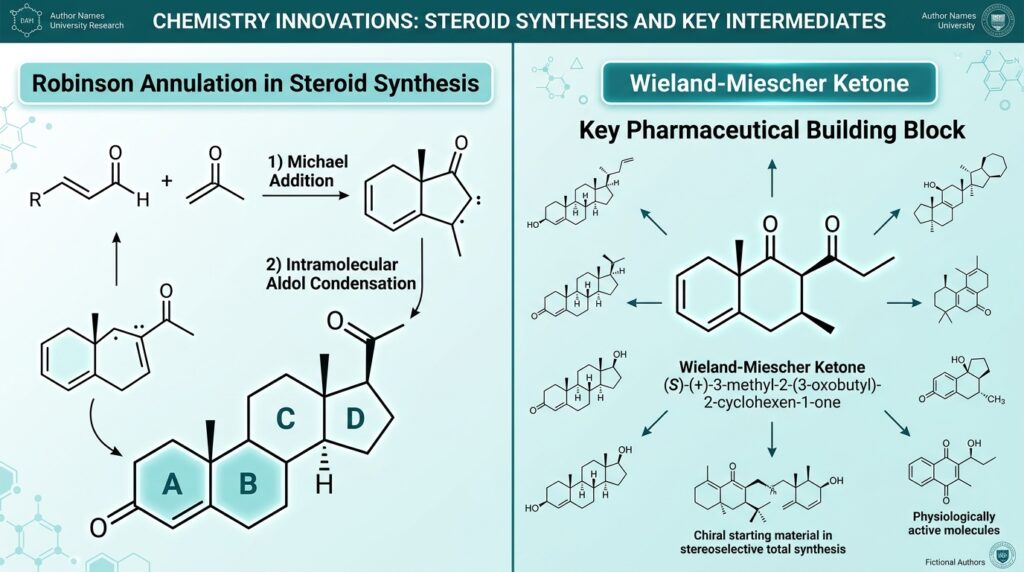
Steroids and Terpenoids The Hajos-Parrish ketone synthesis uses a special reaction called intramolecular Robinson annulation. This is important for making steroids. Many natural terpene products have been made using this reaction. You can find more information in scientific articles on PubChem and the NCBI chemistry databases.
Pharmaceutical Synthesis. Many drugs have cyclohexenone rings made by Robinson annulations. The Wieland-Miescher ketone, made by a double Robinson annulation, is a key part in making steroids. It is explained in detail in Organic Syntheses, a trusted database of synthesis methods.
Total Synthesis of Natural Products: Chemists use the Robinson annulation to synthesize complex natural products such as morphine and terpenes. The American Chemical Society often shares educational materials that link these reactions to important drug discoveries.
Robinson Annulation vs. Other Ring-Building Reactions
How does the Robinson annulation compare to other ways of building rings in organic chemistry?
| Reaction | Ring Type | Key Step | Products |
|---|---|---|---|
| Robinson Annulation | 6-membered | Michael + Aldol | Cyclohexenone (enone) |
| Diels-Alder | 6-membered | [4+2] Cycloaddition | Cyclohexene |
| Aldol Condensation (simple) | 5 or 6-membered | Intramolecular aldol | Beta-hydroxy ketone → enone |
| Stork Enamine Method | 6-membered | Enamine + Michael | Cyclohexanone |
The main benefit of the Robinson annulation is that it creates a functionalized cyclohexenone directly — a compound with both a ketone and a double bond — which is very useful for further chemical reactions.
The Stork enamine version of the Robinson annulation (using enamines instead of enolates) is helpful when you want to control regioselectivity in the Michael addition step.
Pros and Cons of Robinson Annulation
Pros
- Builds a functionalized six-membered ring in just two steps
- Uses simple, commercially available starting materials
- Products (cyclohexenones) are extremely useful in further synthesis
- Works with catalytic amounts of acid or base in some conditions
- The regioselectivity can be controlled using enamine variants
Cons
- Can give side products if conditions aren’t controlled carefully
- Requires careful choice of base (strong bases can cause side reactions)
- Not ideal for building 5- or 7-membered rings without modification
- The reaction often works best with cyclic Michael donors for clean results
- Steric factors can reduce yields with bulky substrates
Expert Tips for Mastering Robinson Annulation
Here are tips to help you master this reaction faster:
Tip 1: Always Identify the 1,5-Diketone Backwards. Before drawing the steps forward, practice spotting the 1,5-diketone in any cyclohexenone product. Add water to the double bond, then break the C-C bond next to one of the carbonyl groups. This shows your two starting materials right away.
Tip 2: Use the Stork Enamine Method for Selectivity. If your Michael donor has alpha hydrogens on both sides of the carbonyl (like 2-methylcyclohexanone), use an enamine intermediate to make the reaction happen at the less-substituted alpha carbon.
Tip 3: Methyl Vinyl Ketone Is Very Useful. MVK is the Michael acceptor most often tested in exams and used in synthesis. Practice Robinson annulations with MVK until you can easily draw the mechanism.
Tip 4: Understand Your 1,5-Diketone Shape. The intramolecular aldol step needs the two carbonyl groups to be close together. In a 1,5-diketone, they are 1,5 apart — just right to form a six-membered ring by intramolecular aldol condensation.
Tip 5: Practice Retrosynthesis Regularly. Exam questions on Robinson annulation often ask you to work backward from the product. Practice retrosynthesis every day. Free practice problems are available on Master Organic Chemistry and LibreTexts Chemistry.
NLP & Semantic Keywords Used in This Article
To fully understand Robinson annulation, you should also know these related terms:
- Enolate ion — the nucleophilic intermediate from the Michael donor
- Conjugate addition — the 1,4-addition in the Michael step
- 1,5-diketone — the key intermediate formed after Michael addition
- Intramolecular aldol — ring-closing step of the Robinson annulation
- Cyclohexenone — the six-membered α,β-unsaturated ketone product
- Enamine — an alternative nucleophile used in Stork’s variation
- Retrosynthetic analysis — working backward to find starting materials
- Carbonyl compound — any molecule with a C=O group
- Beta-hydroxy ketone — the direct product of aldol addition before dehydration
- Wieland-Miescher ketone — famous product of double Robinson annulation
- Sir Robert Robinson — Nobel Prize-winning chemist who developed this reaction
Frequently Asked Questions (FAQs)
Q1: What are the two starting materials for a Robinson annulation?
The two starting materials are: (1) an α,β-unsaturated carbonyl compound (the Michael acceptor), usually methyl vinyl ketone; and (2) a compound with an active methylene group (the Michael donor), often cyclohexanone or another ketone with alpha hydrogens. These react through a Michael addition followed by an intramolecular aldol condensation to form a cyclohexenone ring.
Q2: What is the Robinson annulation used for?
The Robinson annulation is used to make six-membered rings with a ketone and a double bond (cyclohexenones). It is commonly used to create steroids, terpenoids, medicines, and complex natural compounds. The Wieland-Miescher ketone, an important part of steroid production, is made using a double Robinson annulation.
Q3: What is the key intermediate in the Robinson annulation mechanism?
The main intermediate is the 1,5-diketone, made after the Michael addition. This molecule then undergoes an intramolecular aldol condensation to form a ring, creating a beta-hydroxy ketone. After losing water, the final cyclohexenone product is made.
Q4: What is the difference between the Robinson annulation and the Stork enamine method?
Both reactions create cyclohexenone rings using similar steps (Michael addition and aldol condensation). The main difference is that the Stork enamine method uses an enamine (formed from an amine and a ketone) as the Michael donor rather than a free enolate. Enamines are more reactive and offer better control over regioselectivity, especially when the ketone has two types of alpha hydrogens.
Q5: How do you solve Robinson annulation practice problems?
The best approach is to work retrosynthetically:
- Look at the cyclohexenone product
- Add water back across the C=C double bond to get a beta-hydroxy ketone
- Reverse the aldol condensation to get the 1,5-diketone
- Break the C-C bond at the alpha position to one carbonyl to get two fragments: the Michael donor + Michael acceptor
This shows your two starting materials. Keep practicing this retrosynthetic method on many problems until it feels natural. Free resources like LibreTexts Organic Chemistry offer great examples.
Conclusion
The Robinson annulation may seem complicated at first, but it becomes clear once you learn its two main parts.
To recap what you’ve learned:
The two starting materials for a Robinson annulation are:
- An α,β-unsaturated carbonyl compound (Michael acceptor) — like methyl vinyl ketone
- An active methylene compound (Michael donor) — like cyclohexanone
These two react through a Michael addition (1,4-conjugate addition) to form a 1,5-diketone. This then undergoes an intramolecular aldol condensation and dehydration, producing the final cyclohexenone product.
Master the 1,5-diketone intermediate. Learn to think backward in synthesis. Practice using MVK as your Michael acceptor. Soon you’ll solve Robinson annulation problems like an expert.
Want to learn more? Explore more organic chemistry reactions, mechanisms, and practice problems at LibreTexts Chemistry, Khan Academy Organic Chemistry, and Master Organic Chemistry — three great free resources for chemistry students of all levels.
This article is for learning and helps students understand organic chemistry reactions. All chemical facts come from trusted, reviewed sources.
Also Read: How Can Short Term Goals Best Lead Towards Accomplishing Long Term Career Goals?