How Do Skeleton Athletes Steer That Thing?
You’re watching the Winter Olympics. A person lies face-down on a flat sled with handles. They speed down an icy track very fast. There is no steering wheel, no brakes, and no engine. Just the person, the sled, and gravity.
The first question most people have when they see this sport on TV is: how do skeleton athletes steer that sled?
It’s a fair question. From the outside, skeleton seems like wild chaos, a person speeding down with a helmet. But beneath all that speed, there is a lot of skill, technique, and years of practice. Once you know how it works, the sport becomes much more interesting to watch.
This guide explains how skeleton steering works, how the sport differs from luge, why women’s skeleton is so competitive, and why skeleton athletes are some of the most daring in the Winter Olympics.
By the end of this article, you will not only know the answer to the main question, but also understand the sport well enough to enjoy the next Winter Games and explain it to others.
What Is Skeleton, Exactly?
Before we talk about steering, let’s first explain what this sport is, since many people mix it up with bobsled or luge.
Skeleton is a winter sport where one athlete lies face down on a small sled and slides head-first down an icy track. The athlete’s feet point backward and their face is very close to the ice. This is different from luge, where the athlete lies on their back and goes feet-first.
According to Olympics.com, skeleton athletes can reach speeds of 80 to 90 miles per hour during a run, depending on the track and ice conditions.
That’s faster than most cars on a highway, but the athlete isn’t inside a metal cage with airbags. They lie on a sled as small as an ironing board and steer it using only their body.
There is no engine or motor. No mechanical help at all. The run is powered only by gravity, a sprint start, and the slider’s skill to read the track and make small adjustments at just the right time.
A Quick History Lesson
Skeleton has a longer Olympic history than many fans know. It first appeared at the 1928 Winter Olympics in St. Moritz, Switzerland, then returned in 1948 at the same location. After that, it was not part of the Games for over fifty years.
It came back for good at the 2002 Salt Lake City Olympics and has been part of the Winter Games ever since, with both men’s and women’s events at every Games.
This history matters because it shows why skeleton feels like a newer sport compared to figure skating or alpine skiing. It has been in the Olympics for fewer years, so it has not built as big a following. But the sport itself started more than a hundred years ago on natural ice tracks in the Swiss Alps.
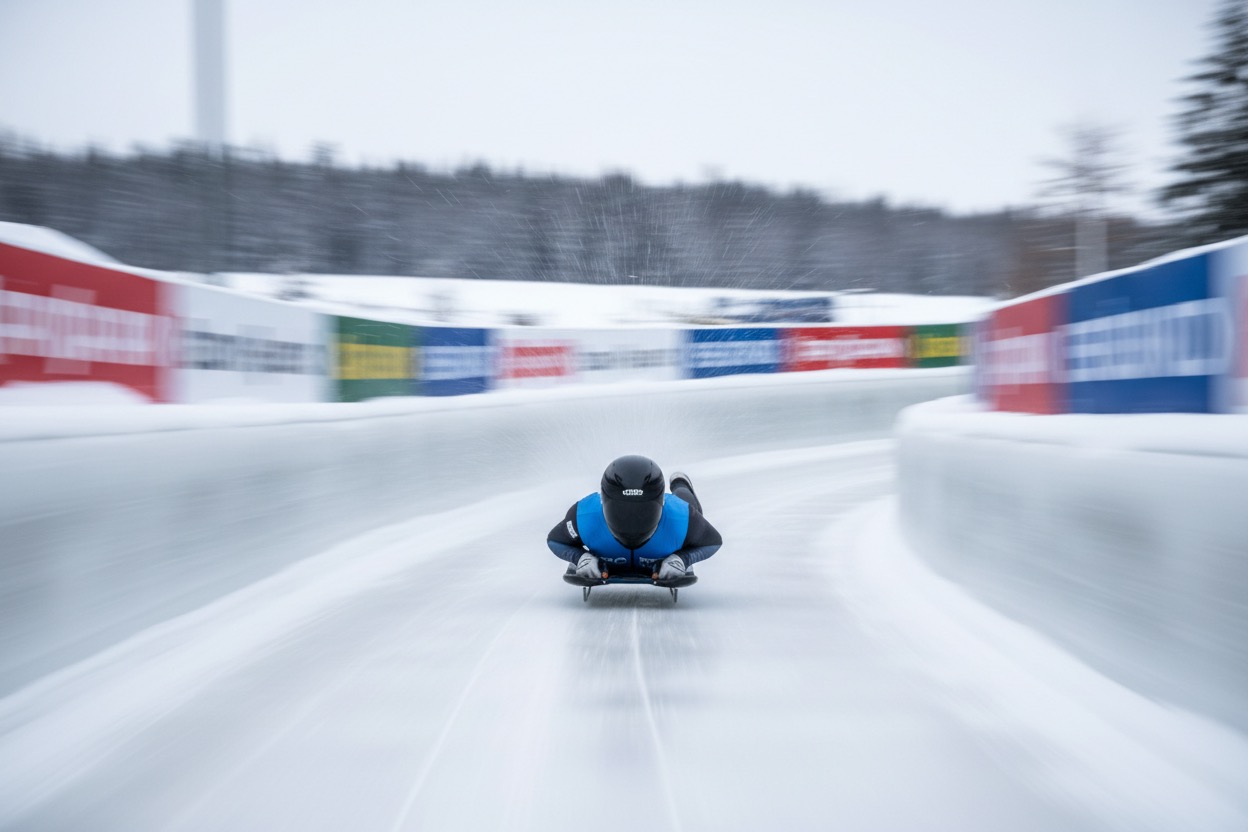
How Do Skeleton Athletes Steer That Thing? The Real Answer
Here is the part everyone wants to know, so let’s take our time to explain it clearly.
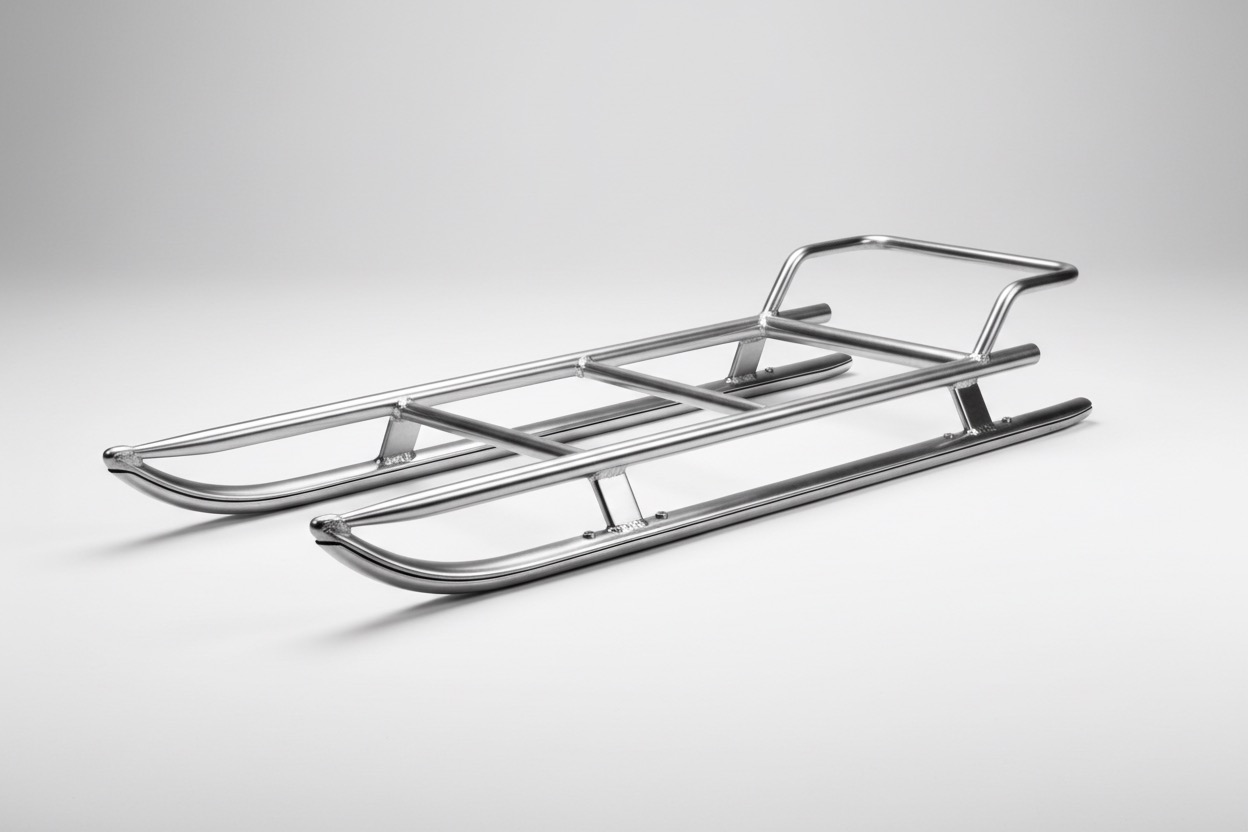
Skeleton sleds do not have a steering wheel, brakes, or any steering parts. The sled is a simple rigid platform on two thin, smooth metal blades called runners.
How can someone control over 80 miles per hour without any mechanical controls? The answer is simple to say but very hard to do: the athlete uses their own body to steer.
The Body-as-Steering Method
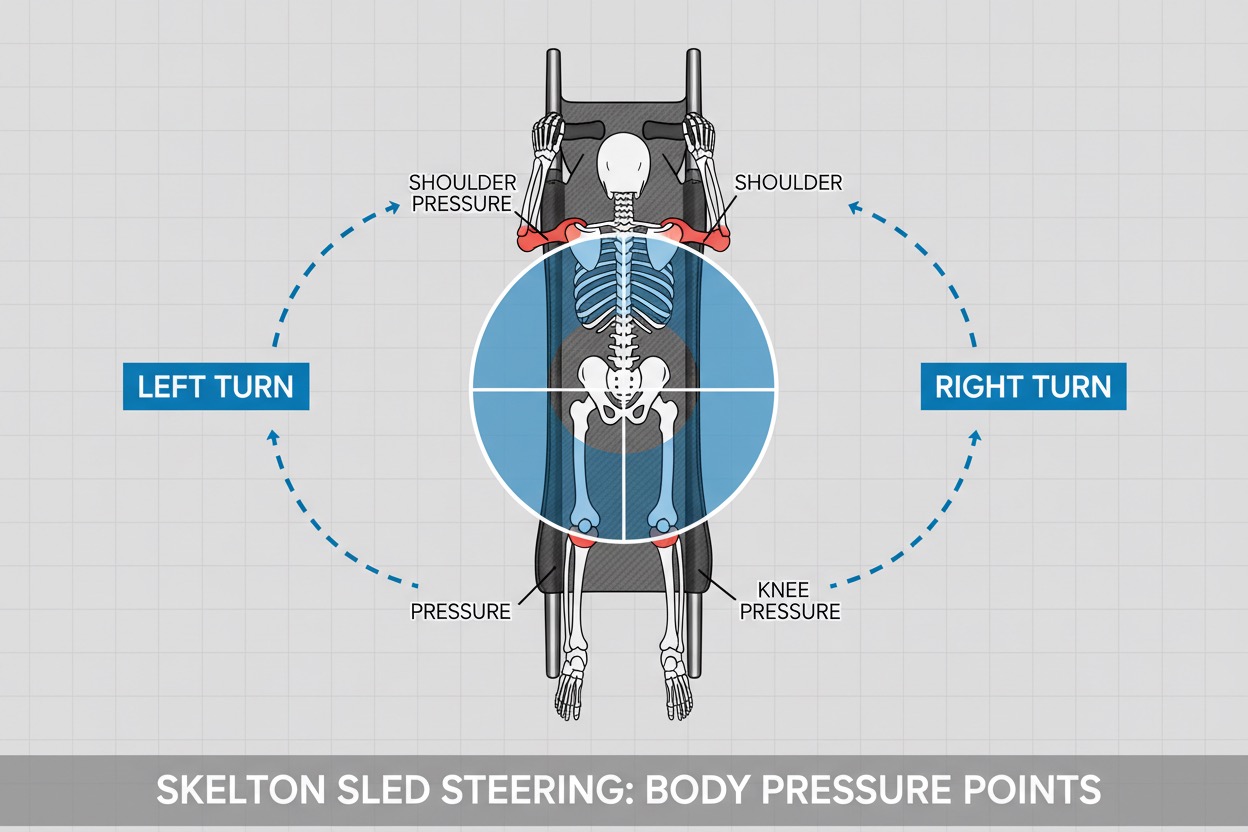
Skeleton athletes steer by making small, precise movements with a few key body parts:
- Shoulders — shifting weight subtly left or right to change pressure on the runners
- Knees — pressing inward or outward against the sides of the sled
- Head and neck — small directional shifts, though movement here is very limited since the helmet sits inches from the ice
- Toes — some sliders use slight toe-dragging on tight corners as a last-resort correction, though this costs speed
These movements change the pressure on the sled’s two runners. Putting more weight on one runner makes that side dig a little deeper into the ice, which gently changes the sled’s direction through the curve.
It seems like a tiny movement. And it is. Just a few millimeters of body movement can change direction at over 80 miles per hour on a surface where there is very little room for mistakes.
This is confirmed by official information from USA Bobsled/Skeleton, the group’s national body for the sport. They say steering happens only by small changes in body weight and pressure on the runners. There are no handlebars, levers, or mechanical parts to steer the sled.
Why So Subtle?
If a skeleton athlete oversteers by moving their shoulders or knees too much, the sled can fishtail, hit a wall, or even flip over. At high speeds, making too big a correction is often riskier than not correcting.
Elite skeleton athletes train for years to build muscle memory for each track’s curves. They often say they memorize the track curve by curve, like learning a dance, because human reaction time is too slow to react during the race.
By the time a slider’s brain notices the sled is drifting off-line, the chance to fix it without losing time has often passed. So the correction must be learned and ready in muscle memory before the run starts.
The Real Skill: Track Memorization
Most of the steering in skeleton happens before the run starts, not during it.
Athletes walk the track on foot, study video footage from multiple camera angles, and mentally rehearse every single curve. By race day, an elite slider typically knows:
- Exactly where to apply pressure on a specific curve, sometimes down to the exact entry point
- Where the track tends to ‘throw’ sliders off-line due to its banking or ice condition
- Which curves need almost zero input versus which ones need heavy correction
- How the previous curve’s exit speed and angle affects the entry into the next one
This is like how race car drivers learn a track corner by corner, but skeleton athletes do it lying face down, with their chin close to the ice, going at speeds that would scare most casual athletes.
Skeleton vs Luge: What’s the Difference?
People often confuse these two sports, which makes sense. Both involve sliding on ice tracks and look exciting on TV. But they are different sports with their own rules, gear, and levels of risk.
Here’s a clear and simple luge vs skeleton comparison to settle the confusion once and for all:
| Feature | Skeleton | Luge |
| Body Position | Face-down, head-first | Face-up, feet-first |
| Steering Method | Body weight shifts (shoulders/knees) | Leg and shoulder pressure on the sled’s runners |
| Sled Type | Small rigid sled, no straps | Sled with curved runners; athlete is not strapped in but sits low in a fixed pod |
| Visibility | Athlete sees the track directly ahead | Athlete mostly looks up and slightly backward |
| Olympic Events | Men’s singles, Women’s singles | Men’s singles, Women’s singles, Doubles, Team relay |
| Typical Top Speed | Around 80-90 mph | Around 80-90 mph, sometimes higher on certain tracks |
The International Bobsleigh and Skeleton Federation (IBSF) oversees skeleton worldwide. Luge is managed by the International Luge Federation (FIL). These are different groups because, even though the sports look alike, their techniques, gear, and risks are really different.
If you remember one thing from this comparison, remember this: luge athletes go feet-first on their backs, while skeleton athletes go head-first on their stomachs. This is the easiest way to tell the two sports apart on TV, even from far away.
Skeleton Olympic Sport: How It’s Scored
Skeleton as an Olympic sport is scored mostly by time. There is no judging panel, no artistic part, and nothing subjective affecting the result. It is a pure race against the clock.
Here is how an Olympic skeleton event usually works, step by step:
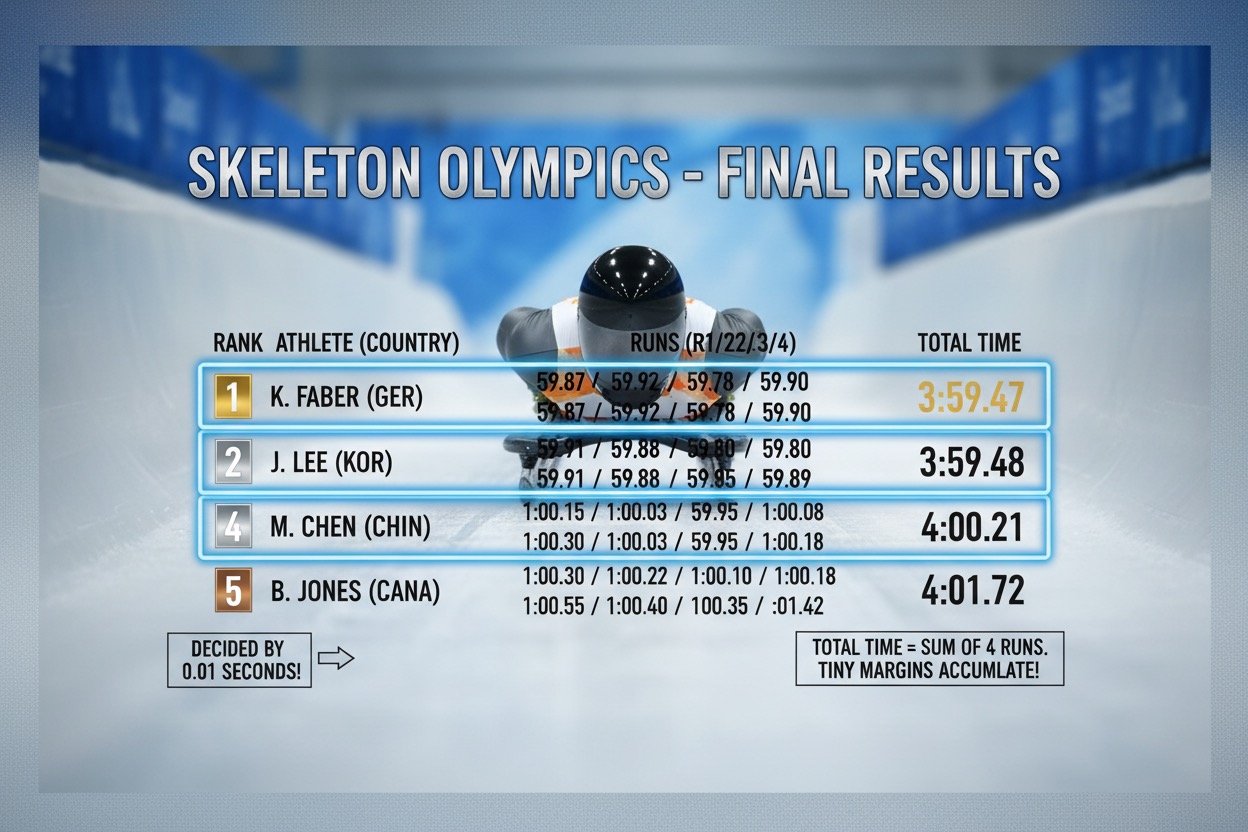
- Athletes complete multiple runs, usually two runs per day across two consecutive days, for four total runs
- Each individual run is timed to the hundredth of a second using electronic timing systems
- All four run times are added together to produce a combined total time
- The athlete with the lowest combined time across all runs wins the gold medal
Because the margins are very small, one bad turn, a bump against the wall, or a moment of oversteering can cost an athlete a medal they trained for four years to win. This is why watching women’s and men’s skeleton races live is so exciting. The difference between winning gold and missing the podium is often just a fraction of a second over four runs.
According to results on Olympics.com’s skeleton results page, medal winners at past Winter Games have often been decided by less than half a second over four runs, showing how tough this sport is.
Skeleton Racing Women: A Growing Spotlight
Women’s skeleton is now one of the most exciting and closely followed events in the Winter Olympics, so it deserves its own section here.
Women’s skeleton was added to the Olympic program at the 2002 Salt Lake City Games. That year, men’s skeleton also returned to the Olympics after being absent for a long time.
Since that debut, the women’s field has become much stronger and more competitive with each Olympic cycle. Many countries now regularly have real medal contenders, unlike in the early Olympic years when only a few countries had strong programs.
What makes women’s skeleton racing exciting to watch is that the sport values skill and courage more than size or strength. This means athletes from different countries often compete closely. A racer with great technique can beat a stronger opponent by taking the curves more smoothly.
If you are new to the sport and want to follow women’s skeleton racing during the season, the IBSF official athlete rankings are the best place to check current standings. They update after every World Cup event, not only in Olympic years.
The Sled Itself: Why It Has No Steering Wheel
Let’s talk about the equipment for a moment because it helps explain why steering works the way it does in this sport.
A skeleton sled is designed to be simple. According to official IBSF equipment rules, skeleton sleds must follow strict guidelines before they can be used in races:
- No steering mechanism is permitted on the sled — this is a hard rule, not just a tradition that’s gone unquestioned
- No braking system of any kind is allowed during the run itself
- Minimum combined weight requirements exist for the sled and athlete together, to prevent unfair speed advantages from lighter or heavier setups
- Runners must meet specific temperature and material regulations to keep competition fair across different teams and equipment budgets
This is one of the most interesting parts of skeleton once you get it: the rules make sure the sled stays simple. All the steering skill has to come from the person, not from smart design.
This is intentional and is what makes skeleton different from sports like bobsled. In bobsled, a pilot steers using ropes connected to the front runners. In skeleton, there is no way to steer.
Why No Steering Wheel Exists (On Purpose)
You might think a steering wheel would make the sport safer or easier. But removing mechanical steering is what makes skeleton a true test of athlete skill, not just equipment.
If sleds had steering wheels, the sport would change from being about skill and courage to being about who has the most money and the best sled design. The leaders of the sport have kept it this way to keep the focus on the athletes, not the makers.
How Skeleton Athletes Train to Steer at 80 MPH
Understanding the steering motion is one thing. Knowing how athletes get good enough to use it well during a race is a whole different story.
Most top skeleton sliders start in another fast sport like track and field before switching to skeleton. This is because the start of the run needs quick sprinting and strong power, which is easier to build early and hard to pretend later.
Once an athlete starts sliding, training focuses mostly on repeating runs. Skeleton federations have programs where new sliders spend whole seasons learning a few tracks by running them again and again until their body reacts without thinking.
- Video review sessions, where athletes study their own runs frame by frame to spot where they applied too much or too little pressure
- Dry-land training that builds core and neck strength, since holding a stable head position under high G-forces is physically demanding
- Mental rehearsal, where athletes visualize an entire run curve by curve before ever touching the ice that day
- Coach feedback from trackside cameras placed at key curves, used to identify steering errors invisible to the athlete in the moment
This is why national teams in skeleton often pick athletes with experience on certain tracks. A slider who has raced many times on an Olympic track usually has an edge over a skilled newcomer who has only tried it a few times. This is because steering well depends more on practiced muscle memory than just natural talent.
How Track Design Affects Steering Difficulty
Not all skeleton tracks are equally hard, and this is often missed by viewers who watch the sport only every four years.
Some Olympic and World Cup tracks have long, gentle curves that are easy to steer. Others have tight, tricky turns where one small mistake early on can cause bigger problems later, because how the sled moves into a curve affects how it comes out.
This is why some sliders do great on certain tracks but have trouble on others, even in the same season. In this sport, skill varies a lot by track, unlike alpine skiing where courses always change and no one practices the exact same run for years.
Track designers and engineers follow strict safety rules from groups like the IBSF. They balance curve angles, ice temperature, and wall height to make speeds exciting but safe. Even small changes in ice temperature on race day can change how a sled reacts to the same steering a slider used during training a few hours before.
Is Skeleton Dangerous? Pros and Cons of the Sport
Let’s be honest about this sport instead of just hyping it up like a highlight reel. Skeleton is exciting, but it has real risks, and it’s important to consider both the good and the bad.
Pros of Skeleton as a Sport
- One of the purest tests of nerve and body control found anywhere in the Winter Olympics program
- Extremely exciting to watch, thanks to the combination of high speed and razor-thin competitive margins
- Equal competitive structure for men’s and women’s events, with both treated as marquee Olympic events
- Doesn’t require the multi-person team coordination that bobsled does, so individual skill stands out far more clearly
Cons and Risks of Skeleton
- High risk of injury from track contact, given the head-first riding position with the face just inches from the ice
- Limited recreational accessibility, since there aren’t many public skeleton tracks compared to mainstream winter sports like skiing or snowboarding
- Steep learning curve, meaning athletes often spend years in development programs before they’re ready for elite-level competition
- Less mainstream visibility compared to sports like alpine skiing or figure skating, despite being just as physically demanding and intense
Athletes wear strong helmets, and tracks have safety walls and ice shapes made for protection. Still, the sport has real risks that should not be ignored. Groups like the IBSF always check and improve track and equipment safety, especially after serious accidents at big events.
Expert Tips: How to Actually Watch Skeleton Like You Know What’s Happening
If you want to sound like you really understand skeleton, instead of just asking how skeleton athletes steer every four years at the Olympics, here are some simple tips to help you watch better.
1. Watch the shoulders, not the whole body
The steering input is small and easy to miss if you’re watching the whole sled. Pay close attention to the shoulder position during the curves, as that’s where most of the steering happens.
2. Pay attention to the start
Skeleton depends on the start more than most people think. Athletes sprint while pushing the sled, then dive onto it headfirst. A strong, fast push at the start can make the whole run better and save important time before the slider even reaches the first curve.
3. Compare split times, not just the final time
Broadcasts often show split times at certain turns on the track. A slider who is fastest at the start but slower near the end may have had trouble steering through a tricky part. This helps explain the final results.
4. Notice when a slider touches the wall
Even a light touch on the wall costs real time, even if it looks small on camera. If you see a sled hit the side of the track, it usually means a steering correction went a bit too far one way.
5. Learn two or three famous curves by name
Tracks like the one in Whistler, Canada, known for its fast and technical curves, are often mentioned by commentators during broadcasts. Knowing some curve names beforehand helps the commentary make more sense and not just sound like background noise.
Skeleton (Sport) Quick Facts Table
| Fact | Detail |
| First Olympic Appearance | 1928, in St. Moritz, Switzerland |
| Returned Permanently | 2002, at the Salt Lake City Olympics |
| Governing Body | International Bobsleigh and Skeleton Federation (IBSF) |
| Riding Position | Face-down, head-first |
| Average Top Speed | Around 80-90 miles per hour |
| Steering Method | Body weight shifts; no mechanical steering of any kind |
| Braking System | None permitted during the run |
| Olympic Events | Men’s singles, Women’s singles |
Frequently Asked Questions
How do skeleton athletes steer that thing without a steering wheel?
They steer by gently shifting their body weight, mainly with their shoulders and knees. This changes the pressure on the sled’s runners and helps guide it through each turn. They do not use any mechanical steering.
Is skeleton more dangerous than luge?
Both sports are risky because of the high speeds, but skeleton is seen as more dangerous since athletes ride head-first with their faces closer to the ice. Luge athletes ride feet-first on their backs, which is safer.
What’s the difference between skeleton and luge exactly?
The main difference between luge and skeleton is body position. Luge athletes lie on their backs and go feet-first. Skeleton athletes lie face-down and go head-first. Both are timed individual sliding sports, but they use different sleds, steer differently, and have different risks.
How fast do skeleton sleds actually go?
Skeleton sleds usually reach speeds of about 80 to 90 miles per hour. The speed depends on the track design, ice conditions, and how tricky the curves are.
When did women’s skeleton become an Olympic event?
Women’s skeleton became part of the Winter Olympics in 2002 at the Salt Lake City Games, the same year men’s skeleton returned after being absent for a long time.
Final Thoughts: It’s All About the Body, Not the Sled
So how do skeleton athletes steer? Not with a wheel or brakes. They use years of training to make tiny shoulder and knee movements, done very fast on a surface where mistakes are costly.
Skeleton is one of the few Olympic sports with very simple equipment, so the athlete’s skill shines through. This is why skeleton is worth watching closely, not just a quick glance during other Olympic events.
If this explanation helped you understand the sport, the next step is simple: watch the next skeleton Olympics broadcast or check the current IBSF World Cup standings and look for those shoulder movements yourself. Once you see them, you won’t be able to miss them.