How Is It Possible for Ski Jumpers to Stay in the Air So Long And How Do They Train For That?
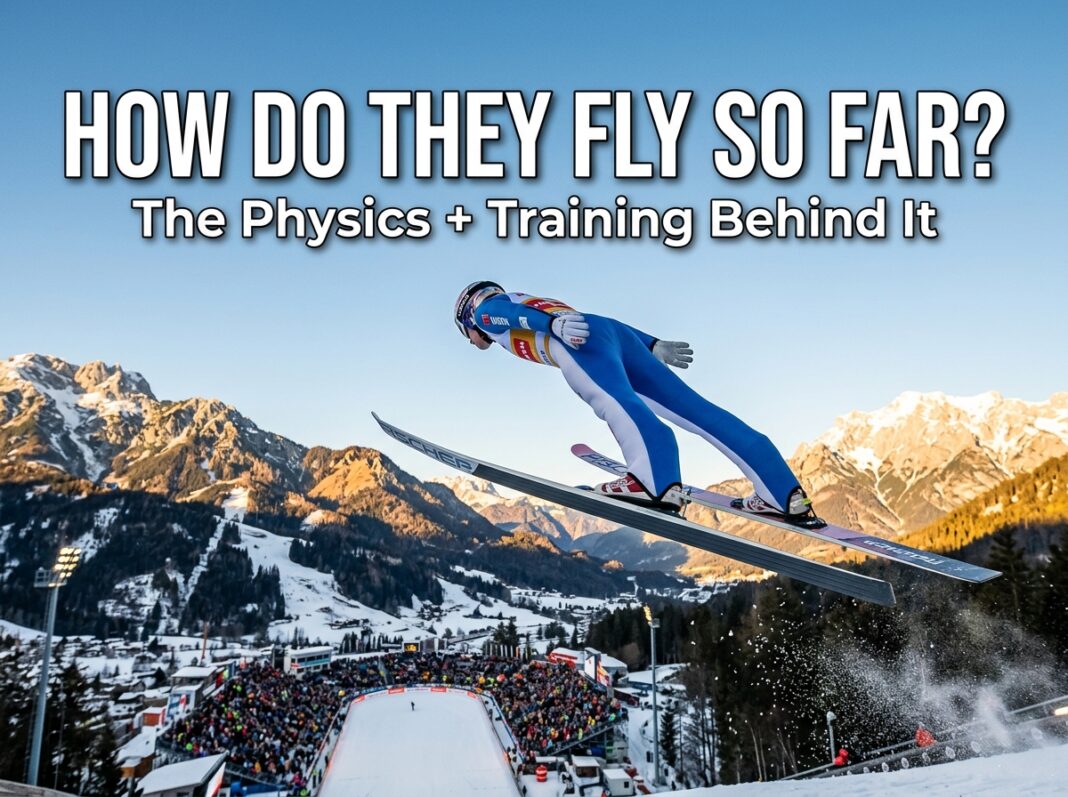
Have you ever seen ski jumping at the Winter Olympics and thought, “That looks unreal”? You’re not alone. A jumper goes down a ramp and instead of falling, they glide. They seem to float. They fly as far as a football field before landing on the snow.
It looks like magic, but it’s not. It’s physics, skill, and years of practice, all done in about six seconds.
This guide explains how ski jumpers stay in the air and how they train. It uses real data, Olympic results, and science, not guesses. By the end, you will understand the sport like a coach or scientist but in simple words.
Quick Answer: Why Ski Jumpers Stay Airborne So Long
Before we go deep, here’s the short version.
Ski jumpers stay in the air longer because their bodies and skis work like a wing. They keep their skis and bodies nearly flat and spread their skis in a V-shape. This larger surface area creates lift. With a fast launch, this lift fights gravity and helps them fall more slowly.
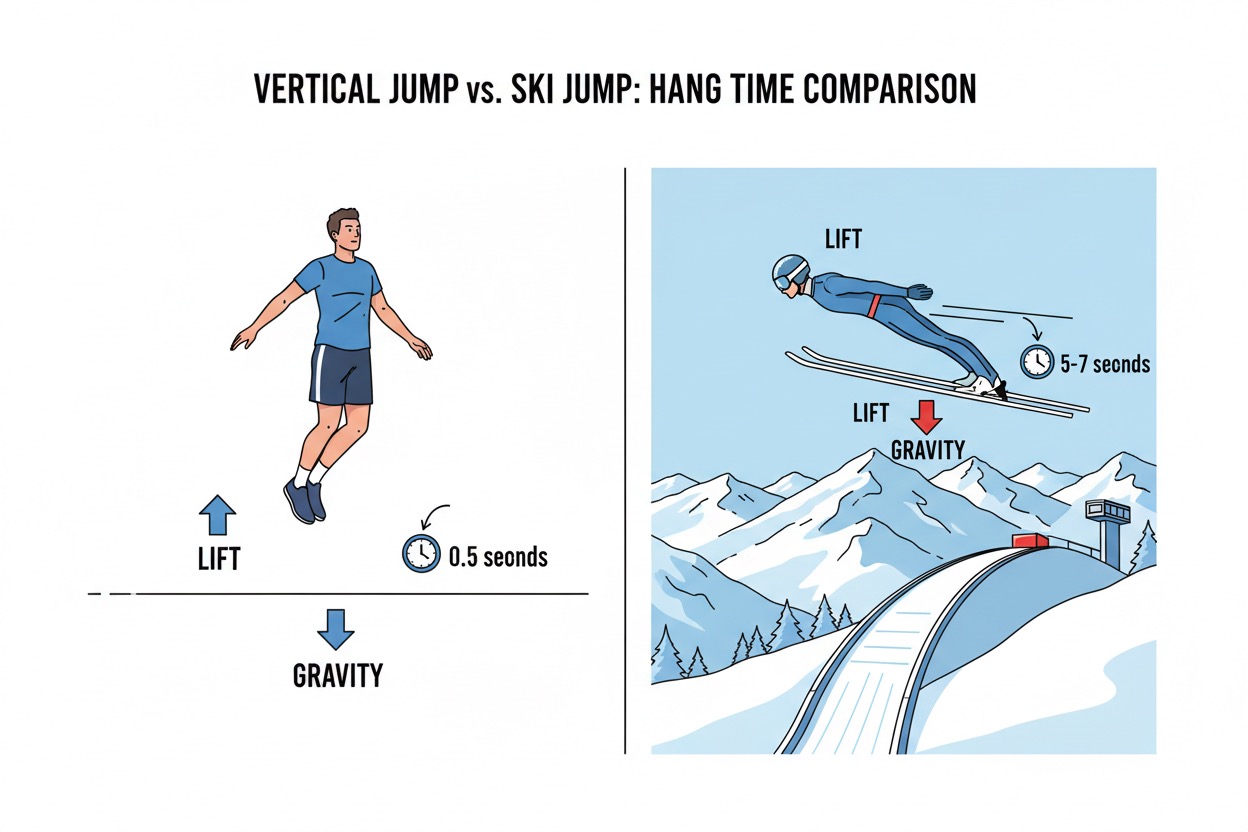
An average person jumping as high as possible stays in the air for about half a second. Even Michael Jordan could only stay airborne for nearly one second. Elite ski jumpers, however, stay in the air for five to seven seconds while traveling about the length of a football field.
That difference — half a second versus seven seconds — tells the whole story of this sport.
The Physics Behind Ski Jumping: How a Human Becomes a Wing
Many people get this wrong. Ski jumpers don’t just jump high. They actually fly by using aerodynamics.
Lift, Drag, and Gravity: The Three Forces at Play
Every object moving through air faces three main forces: lift, drag, and gravity. Experts in sports physics say ski jumpers stay in the air by shaping their body and skis like a wing — acting like a human airplane wing.
Here’s a simple way to understand it. Stick your hand out of a moving car window. Hold your hand flat, and it stays mostly steady. Tilt the bottom of your hand into the wind, and the air pushes it up. That push is called lift.
Now picture a whole human body on two skis, angled just right into the wind at over 50 miles per hour. This creates a lot of lift.
The air movements that create lift also cause drag, which slows the jumper. When speed decreases, lift goes down too — this limits how far even the best jumpers can fly.
The whole flight phase is a balance: make as much lift as possible while keeping drag low, for as long as possible.
The V-Style: The Technique That Changed Everything
If you watch old videos from the 1970s or earlier, you’ll notice ski jumpers kept their skis close together with tips pointing straight ahead and parallel. Today, they jump in a different style.
In the early days of ski jumping, jumpers held their arms above their heads or moved them around. Later, they kept their arms by their sides and skis parallel while flying. Everything changed in the late 1980s when a Swedish skier saw his jump distance grow as the tips of his skis naturally spread apart during practice. This skier was Jan Boklöv, and his discovery made the V-style jump an official technique in 1989.
At first, judges and ski jumpers doubted the V-style, but it clearly helped with aerodynamics. Boklöv won the 1988–89 World Cup overall title, and by the early 1990s, all pro ski jumpers used this technique.
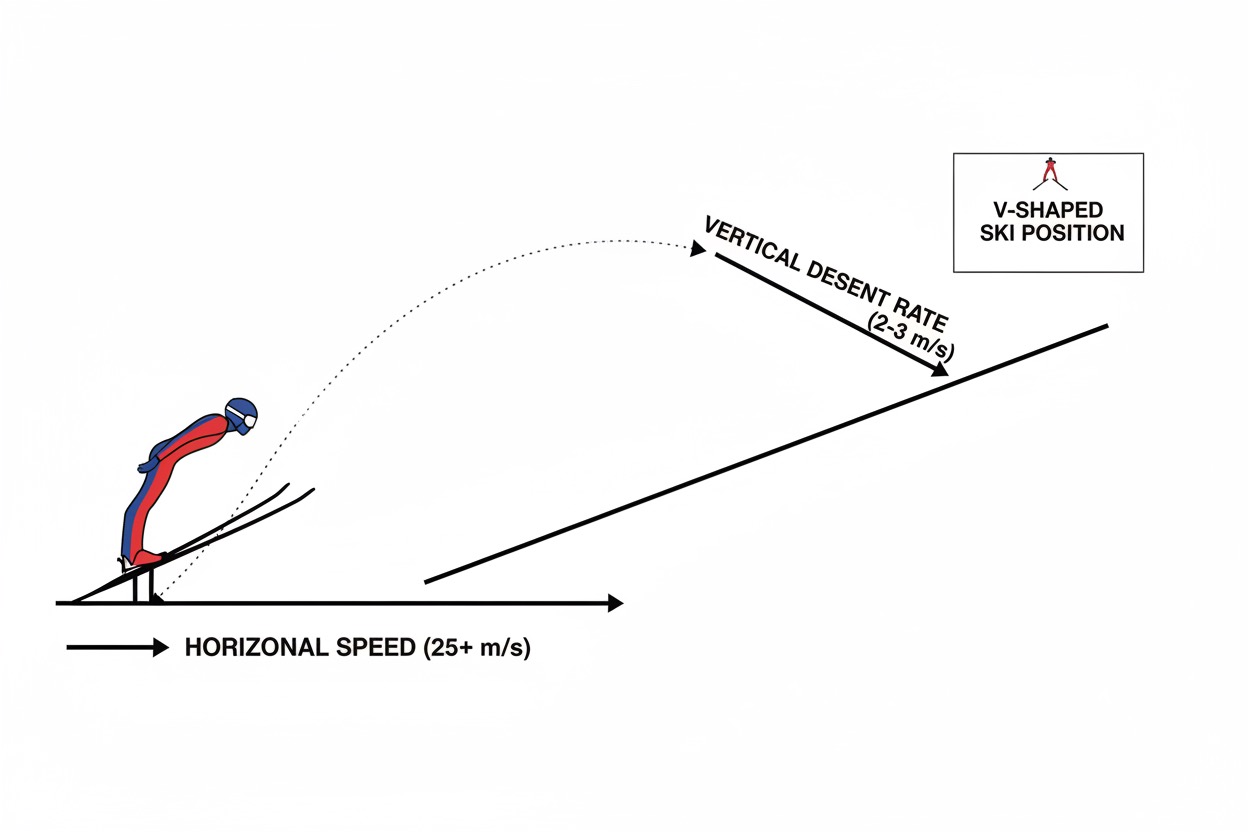
Why does it work better? The V-stance provides a bigger surface for lifting than skis held side by side. This bigger surface catches more wind, like a plane wing, helping the skier lift higher and jump farther.
Today, all top ski jumpers use the V-style. It is now the standard way to compete.
Body Position: Every Centimeter Matters
The V-ski position is just one part. The jumper leans forward with their upper body toward the skis, making an angled shape that meets the air. The whole body works like a wing, and small changes in position can affect how far they jump at the top level.
Researchers studying the sport with computer simulations using wind tunnel data found key factors for good performance: high speed before takeoff, strong momentum at takeoff, correct jump timing near the ramp edge, and quick body rotation to reach a stable, aerodynamic position.
In other words, the flight is not really decided while flying. It is decided around the time of takeoff.
How Fast Do Ski Jumpers Actually Go?
This is one of the most asked questions about the sport, so let’s answer it with real numbers.
| Phase | Typical Speed |
|---|---|
| In-run (descending the ramp) | 60+ mph |
| Takeoff on large/ski-flying hills | 108 km/h (67 mph) |
| Takeoff, general elite range | 90+ km/h (56+ mph) |
| Horizontal speed during flight | 25+ meters per second (about 56 mph) |
| Vertical descent rate during flight | Only 2–3 meters per second |
The last row holds the secret to the mystery. A jumper moves forward very fast while sinking slowly. This makes it look like they are floating — a balance where lift nearly equals gravity, letting the jumper fly far before landing.
How Long Can a Ski Jumper Actually Fly? (Real Distance Records)
Numbers make this sport work. So let’s check the real records — not guesses, the actual ones.
Men’s Ski Flying World Record
Austrian ski jumper Stefan Kraft holds the world record. He jumped 253.5 meters (831 feet 8 inches) at the FIS Ski Jumping World Cup in Vikersund, Norway. This beat Norway’s Robert Johansson’s 252-meter jump set a few hours earlier, which had broken the previous 251.5-meter record.
Three world records were broken in one day. This shows how close these athletes are to the physical limits of the sport.
Women’s Ski Flying World Record
The women’s side of the sport is moving fast too. Slovenian jumper Nika Prevc set a new women’s ski jumping world record with a 236-meter jump in Vikersund, Norway. She beat the previous record of 230.5 meters, held by Norway’s Silje Opseth since March 2024. Impressively, Prevc landed the same 236-meter distance twice in separate training rounds at the same event.
Where These Records Happen: The “Ski Flying” Hills
Not every hill can produce these numbers. Records like these only happen on the world’s largest purpose-built ski flying hills.
Vikersundbakken in Vikersund, Norway is the largest ski jumping hill made for competitions, standing 225 meters tall. Its ramp is 133 meters (436 feet) long, and jumpers take off at about 108 km/h (67 mph).
For comparison, normal Olympic ski jumps are much smaller. At the latest Winter Games, the K-point was 98 meters for the Normal Hill and 128 meters for the Large Hill.
This is why “ski flying” and “ski jumping” are different. Ski flying takes place on much bigger hills, allowing jumps over 250 meters, much longer than those in regular Olympic ski jumping.
How Ski Jumping Olympics Scoring Actually Works
If you’ve watched Olympic ski jumping and wondered why the longest jumper didn’t win, this section will explain why.
It’s Not Just About Distance
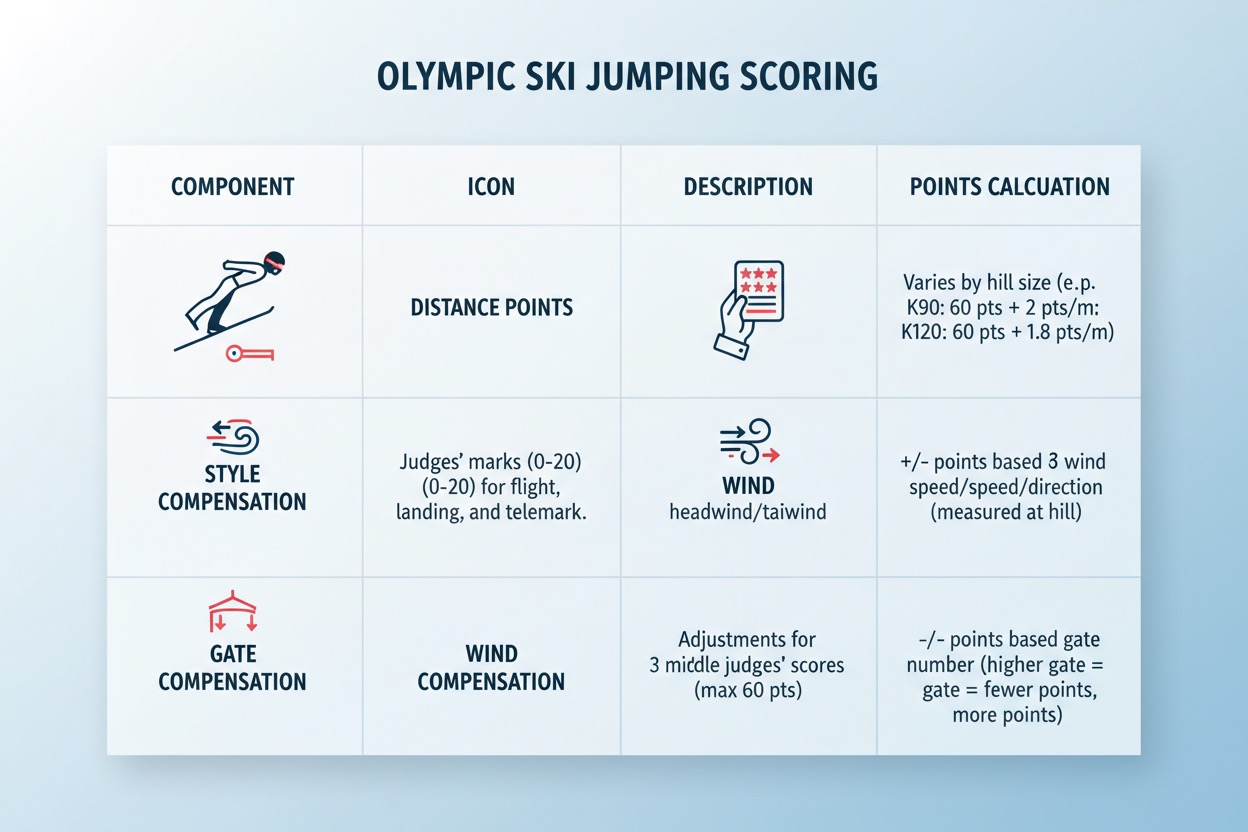
According to official Olympic scoring guides, a jumper who reaches the K-point gets 60 points. Jumping beyond the K-point gives more points, while landing before it gives fewer points. The points per meter change depending on the hill size.
But distance is only one part of the score.
Style Points
A group of five judges rates each jump from 0 to 20 for style. The highest and lowest scores are dropped, so the top style score is 60 points. Judges check for good body position, steady arms and legs, and a smooth landing. Points are lost if the jumper touches the ground with a hand after landing or doesn’t land in the telemark position (a forward lunge with one foot slightly ahead).
Wind and Gate Compensation
This is the part most casual viewers never learn — and it’s a big deal.
Wind and gate compensation points were added by the International Ski Federation in 2009 to make the competition fair and safe. If a tailwind slows the jumper, points are added; if a headwind helps the jumper, points are taken away. Coaches or the technical jury can also change the starting gate height to match the wind — points go down for a higher gate and up for a lower one.
Here’s a simple breakdown of how a total score comes together:
| Scoring Component | How It Works |
|---|---|
| Distance Points | 60 points awarded at the K-point, plus or minus per meter depending on the hill |
| Style Points | 5 judges score 0–20 each; highest and lowest dropped; max 60 points |
| Wind Compensation | Adjusts scores positively for tailwind and negatively for headwind, using live wind measurements |
| Gate Compensation | Compensates for changes in in-run length when athletes start from a different gate |
This system is why a lesser-known athlete can become an Olympic champion in one event. At the latest Winter Games, Philipp Raimund from Germany won the normal hill gold with 274.1 points. He had a strong first jump of 102.0 meters and followed with 106.5 meters in the final round, beating Poland’s Kacper Tomasiak by 3.4 points.
How Ski Jumpers Train: Building a Human Wing
So now you know why it works. The harder question is: how do you train a human body to do this safely, year after year, without it going wrong?
Year-Round Training, Not Just Winter
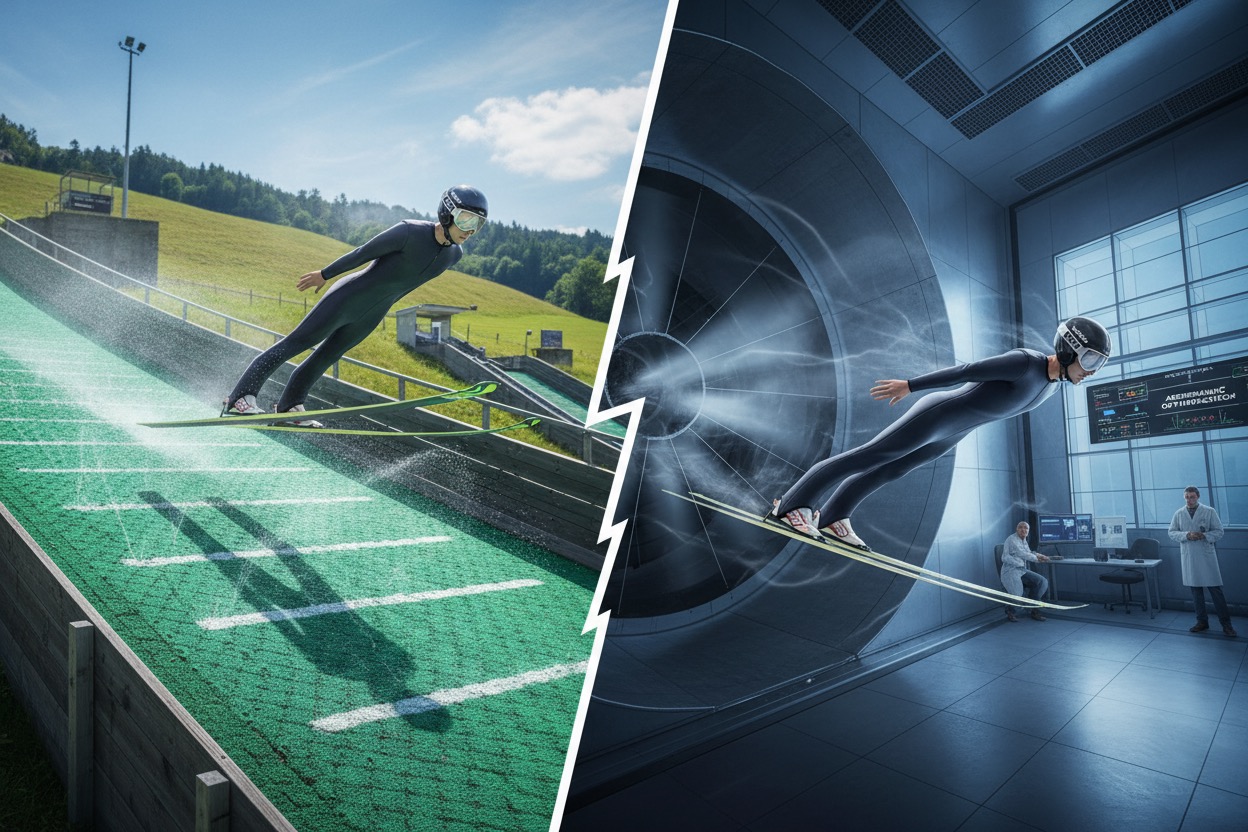
Ski jumping continues even when there is no snow. The International Ski and Snowboard Federation explains that in winter, the in-run is made of ice by freezing water on the track to create a fast, hard surface. In summer, jumpers train on porcelain or ceramic tracks that are sprayed with water to keep them slippery.
The landing hill also has a summer version. Plastic mats that act like snow are used for summer training. These mats are made of many thin plastic rods that look like snow, and they are sprayed with water before and during use to make sliding easier.
This is a big deal for athlete development. It means a jumper in a snow-free region can still train on a real ramp, in real conditions, all year long.
Wind Tunnel Training
One surprising part of ski jumping training for beginners is that athletes spend actual time in wind tunnels, the same ones used to test airplanes and race cars.
Researchers studying flight mechanics during actual Olympic Games competitions found that top medal winners consistently repeated their flight style, showing clear differences between athletes’ techniques. Other studies using simulated ski jumping takeoffs in wind tunnels measured the forces athletes produce, focusing on how they balance the front and back of their foot during takeoff.
This is important because air resistance depends on air density. Top athletes change how they jump in thinner air at high places to jump farther and stay balanced. Jumping at a high hill feels different in the air than at sea level, so athletes practice to get used to it.
Strength, Balance, and Explosive Power
The takeoff is a quick, powerful movement using the whole body. It happens in a split second and must be done the same way every time.
Sports science shows that how athletes position their knees when jumping affects their performance. Jumpers with knees that move inward (valgus) during jumps and squats usually perform worse. Because of this, ski jumping coaches focus a lot on:
- Lower-body strength — squats, single-leg work, and explosive jump training to build the power needed for takeoff
- Core stability — to hold a flat, forward-leaning body position for 5–7 seconds without wobbling
- Balance and proprioception — so the body can make micro-adjustments mid-flight without consciously thinking about it
- Knee alignment and injury-prevention work — directly tied to performance, not just safety
Technical Repetition and Reading Conditions
Because the whole jump is decided in about half a second at takeoff, jumpers practice a lot and train in many different conditions. Snow texture, wind direction, and temperature are key factors that affect how well they do, so athletes must learn to use their technique in all kinds of weather, not just perfect conditions.
Top competitors are known for making small mid-air adjustments to handle changing wind. This skill comes from practice on real hills and simulations, not from classroom lessons.
Computer Simulation and Sports Science
Modern ski jumping training uses data science. Computer simulations with wind tunnel data show the main factors for performance and help with training, athlete safety, hill design, and fairness in the sport.
Today, a national team’s coaching staff often includes biomechanists and sports scientists running simulations along with the on-hill coaches — something that did not exist a generation ago.
The Rules That Keep Ski Jumping Fair (and Safe)
This is a part of the sport most fans never hear about, but it directly shapes how athletes train and what their bodies look like.
The BMI-to-Ski-Length Rule
Longer skis give more lift. That sounds good, but it made athletes want to be as light as possible. Lighter jumpers with long skis could get an unfair advantage in the air.
The longest ski allowed in ski jumping is 145% of the athlete’s height, based on a minimum BMI of 21 for both men and women. Athletes with a BMI below 21 must use shorter skis.
This rule was added partly because of worries about underweight jumpers, especially young athletes, which became a big problem in the early 2000s.
This is a rare case where sports equipment rules are made to protect athlete health, not just to keep the game fair.
Suit Regulations Are Extremely Strict
According to official Olympic equipment guides, all parts of a ski jumping suit must be made from the same soft microfiber material and have specific air flow, with thickness between 4mm and 6mm. Suits must fit very close to the body, allowing only 2cm of extra space at any point, to stop athletes from changing the suit to gain an unfair aerodynamic advantage.
Why so strict? As FIS Men’s Race Director Sandro Pertile explained, every extra centimeter on a suit matters. A suit with 5% more surface area helps an athlete jump farther. That’s how important aerodynamics is at the top level; a suit that’s a little too loose is basically cheating.
These rules keep changing. In late 2025, the FIS Ski Jumping Committee approved new suit measurement rules for women’s competitions after three female athletes were seriously injured during a Summer Grand Prix event. This shows that safety rules in this sport are still being improved.
Ski Jumping at the Olympics: What Recent Results Show
Watching how scoring and physics work in real competition helps everything make sense. Here’s what happened at the latest Winter Games.
Slovenian siblings Domen Prevc and Nika Prevc were the top gold medal favorites in their first Olympics. Along with their older siblings Peter and Cene Prevc, they became the first family with four siblings to each win a medal at the Winter Olympics, although they did not win every event.
Domen Prevc still won individual gold in the men’s large hill event with his jump in the second round.
In the women’s ski jumping, Norway’s Anna Odine Strom surprised everyone by jumping 101 meters to win the Olympic gold. Favorite Nika Prevc came in second, just 1.1 points behind, and Japan’s Nozomi Maruyama won the bronze medal.
Team events brought surprises too. Austria’s Jan Hoerl and Stephan Embacher won the first men’s ski jumping super team gold at the Winter Olympics. They dominated the large hill with 568.7 points, ahead of Poland’s Kacper Tomasiak and Pawel Wasek who scored 547.3. Norway took bronze.
In the mixed team event, Slovenia won gold, Norway took silver, and Japan earned bronze with team members Sara Takanashi and Ryoyu Kobayashi.
These results show what this article explained: distance is important, but skill, conditions, and staying steady under pressure decide the winner.
Pros and Cons of Ski Jumping as a Sport
If you’re a beginner trying to understand the appeal — and the risk — here’s a balanced look.
| Pros | Cons |
|---|---|
| One of the most spectacular spectator sports in the Winter Olympics | High risk of serious injury from falls at speed |
| Combines pure physics with elite athleticism in a way few sports do | Extremely technical learning curve; takes years to compete safely |
| Year-round training is possible thanks to summer ramps | Heavily dependent on weather and wind conditions |
| Strict, evolving safety regulations (BMI/ski length, suit rules) | Past history of unhealthy weight-cutting before regulations tightened |
| Clear, transparent scoring system once you understand it | Scoring complexity (style + wind + gate) can confuse new viewers |
Expert Tips: How to Actually Understand Ski Jumping as a Viewer
A few practical tips if you’re watching ski jumping Olympics coverage and want to follow along like someone who actually knows the sport:
- Watch the hips and shoulders, not just the skis. The flat, forward-leaning torso position is doing most of the aerodynamic work — the V-ski angle gets all the attention, but body position is just as important.
- Don’t assume the longest jump wins. Check the style score and wind/gate compensation before assuming the outcome. As seen at recent Games, a shorter but cleaner jump can beat a longer, less stable one.
- Watch the landing closely. A proper telemark landing (one foot slightly ahead of the other, knees bent) signals real control. A two-footed or unstable landing usually means a lower style score regardless of distance.
- Pay attention to wind flags around the hill. Commentators will often mention headwind or tailwind — this single factor can swing scores by several points and explain why distances vary jump to jump.
- Remember hill size changes everything. A 100-meter jump on a normal hill (K-point ~98m) is a great jump. A 100-meter jump on a large hill (K-point ~128m) is a mediocre one. Context matters.
Frequently Asked Questions
How is it possible for ski jumpers to stay in the air so long, and how do they train for that?
Ski jumpers stay in the air by shaping their bodies and skis like a wing using the V-style. This creates lift that helps them fight gravity. They can stay in the air for five to seven seconds and jump about the length of a football field. They train all year with practice on ice and plastic ramps, wind tunnel tests, strength and balance exercises, and many practice jumps studied with video and computer tools.
How fast do ski jumpers go?
Jumpers often reach speeds over 60 mph when they leave the takeoff ramp, with the fastest speeds up to 67 mph (108 km/h) on the biggest ski flying hills. While in the air, their horizontal speed stays around 25 meters per second, and their vertical speed slows to about 2 to 3 meters per second.
What is the longest ski jump ever recorded?
The men’s longest jump is 253.5 meters, made by Austria’s Stefan Kraft in Vikersund, Norway, in 2017. The women’s longest jump is 236 meters, made by Slovenia’s Nika Prevc, also in Vikersund.
Why do ski jumpers spread their skis into a V-shape?
The V-shape makes a bigger lifting surface than skis held straight, creating an effect like an airplane wing that helps jumpers fly farther. Swedish jumper Jan Boklöv found this by accident in the late 1980s. Now, all top jumpers use it.
Is ski jumping scored only on distance?
No. Scoring adds distance points (based on the hill’s K-point) and style points from five judges (0–20 each, highest and lowest dropped). It also includes wind and gate compensation points to adjust for weather and start position. A shorter, cleaner jump can score higher than a longer, messy one.
Final Thoughts
Ski jumping seems impossible, but that’s why many people watch it at the Winter Games. When you learn the science behind it, it is easier to understand: speed gives lift, body position controls air resistance, and lots of practice turns this into a skill that can be done again and again.
Next time you watch ski jumping at the Olympics, you won’t just see someone flying. You’ll see lift-to-drag ratios, V-style aerodynamics, wind scoring, and years of training packed into six amazing seconds.
If this explanation helped you understand the sport better, share it with the people you watch the next Winter Games with. Also, watch the upcoming World Cup season to see these techniques live.
Also Read: How Do Brooms Affect the Stone’s Path in Olympic Curling? The Real Science Explained
What Is Kalimac Hogpen’s Football Ranking? Everything Fans Want to Know