What Time Is Sunset? Your Complete Guide to Finding It Fast
You’re planning a picnic outside. Or maybe you want to take a great photo during golden hour. Maybe you just want to know how much daylight is left before it gets dark. Whatever the reason, knowing what time sunset is is more important than many people think.
The simple answer is it depends on where you are and what day it is. Sunset times change every day and are very different from city to city. A summer evening in Los Angeles is very different from one in Seattle, even on the same date.
This guide shows you how to find today’s sunset time anywhere, explains why sunset times change, what makes summer evenings long and winter days short, and the best free tools to check sunset times for tonight or tomorrow.
☀ Sunset Time Calculator
Find accurate sunset times for any location worldwide
Works anywhere in the world. Tap to allow browser location access.
Works for any city worldwide using OpenStreetMap geocoding.
How to Find What Time Is Sunset Today
The quickest way to find today’s sunset time is to use a reliable free online tool. Here are the top options:
Top Tools to Check Sunset Time Right Now
You can check the time with our calculator. If you want to try others, here are some options:
| Tool | Best For | Real-Time? |
|---|---|---|
| TimeandDate.com | City-by-city lookup, worldwide | Yes |
| Old Farmer’s Almanac | US & Canada zip code lookup | Yes |
| NOAA Solar Calculator | Scientific accuracy, any coordinates | Yes |
| US Naval Observatory | Official government data, annual tables | Yes |
| SunriseSunset.com | Printable calendars by city | Yes |
You can also just type “what time is sunset today” or “what time is sunset tonight” into Google — it finds your location and gives you an instant answer.
For the best results, enter your zip code or city name in any of the tools above.
What Time Is Sunset Tonight in Major US Cities?
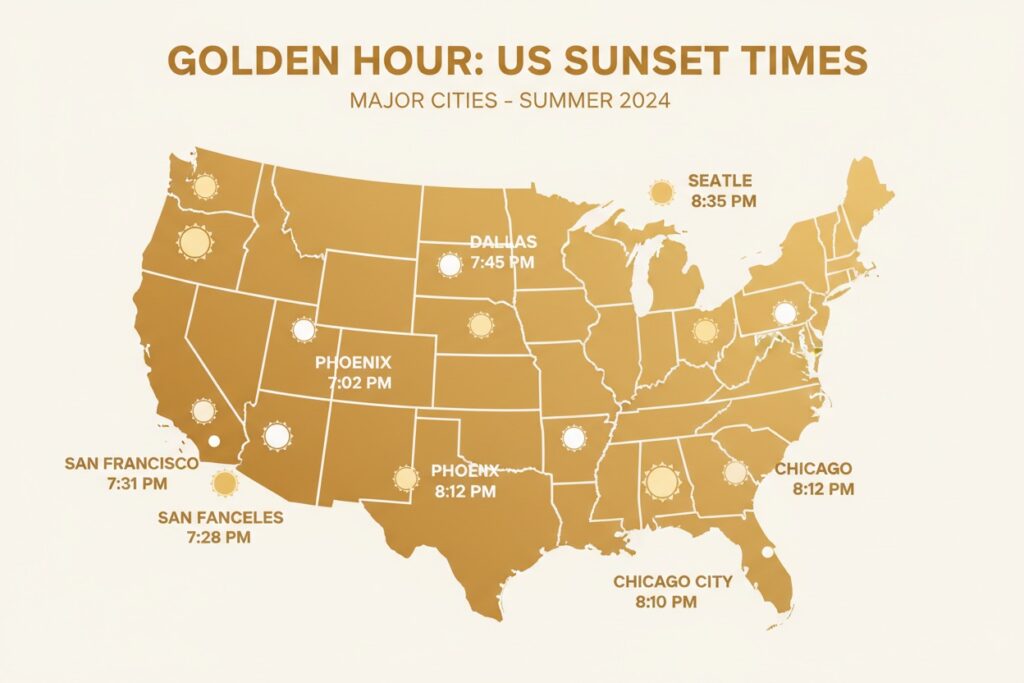
Sunset times change with the seasons and where you are. In late June 2026, one of the longest days in the Northern Hemisphere, here are the approximate sunset times for major cities. Check a real-time tool for the exact time.
Note: These are approximate times during late June. In Los Angeles, the latest sunset of the year falls around June 29, thanks to the summer solstice. In New York, the latest sunset occurs around June 27.
| City | Late June Sunset (Approx.) | Time Zone |
|---|---|---|
| New York, NY | ~8:28 PM | EDT |
| Los Angeles, CA | ~8:08 PM | PDT |
| Chicago, IL | ~8:28 PM | CDT |
| Houston, TX | ~8:20 PM | CDT |
| Miami, FL | ~8:10 PM | EDT |
| Seattle, WA | ~9:11 PM | PDT |
| Denver, CO | ~8:32 PM | MDT |
| Phoenix, AZ | ~7:40 PM | MST |
These numbers change a lot in December. In winter, the same cities have sunset times from 4:30 PM to 5:30 PM. That’s how seasons affect daylight.
For live, exact times by city, including tomorrow’s sunset, visit TimeandDate.com’s US Sunrise & Sunset page.
What Time Is Sunset in LA?
Los Angeles is famous for its sunsets for a good reason. The sky over the Pacific Ocean lights up with bright orange and pink colors, especially when there is marine layer fog or wildfire smoke in the air. This smoke helps spread the light, making the colors look even brighter.
In Los Angeles, the summer solstice has about 4 hours and 30 minutes more daylight than the December solstice. The latest sunset happens on June 29.
Here’s a rough seasonal breakdown for LA:
| Season | Approximate Sunset Time (LA) |
|---|---|
| Winter (Dec–Feb) | 4:45 PM – 5:45 PM PST |
| Spring (Mar–May) | 5:50 PM – 7:50 PM PDT |
| Summer (Jun–Aug) | 7:50 PM – 8:08 PM PDT |
| Fall (Sep–Nov) | 5:30 PM – 7:40 PM PDT/PST |
For the exact time any day of the year, visit LA Almanac’s daily sunset page or TimeandDate.com Los Angeles.
A local note: In 2018, California voters approved Proposition 7 to make Daylight Saving Time permanent. However, the state senate did not pass the law, so California still changes the clocks twice a year. This means sunset times in LA still shift by an hour in spring and fall like the rest of the country.
Why Does Sunset Time Change Every Day?
This is a question many people don’t ask until they realize summer evenings last a long time, but winter nights come very early. The answer is found in astronomy.
Earth’s Tilt Is Everything
Sunset times change during the year based on where you are on Earth. Your latitude, longitude, height, and time zone all affect it. These changes happen because of Earth’s tilt, its daily spin, its oval path around the Sun, and the way Earth and the Moon move around each other.
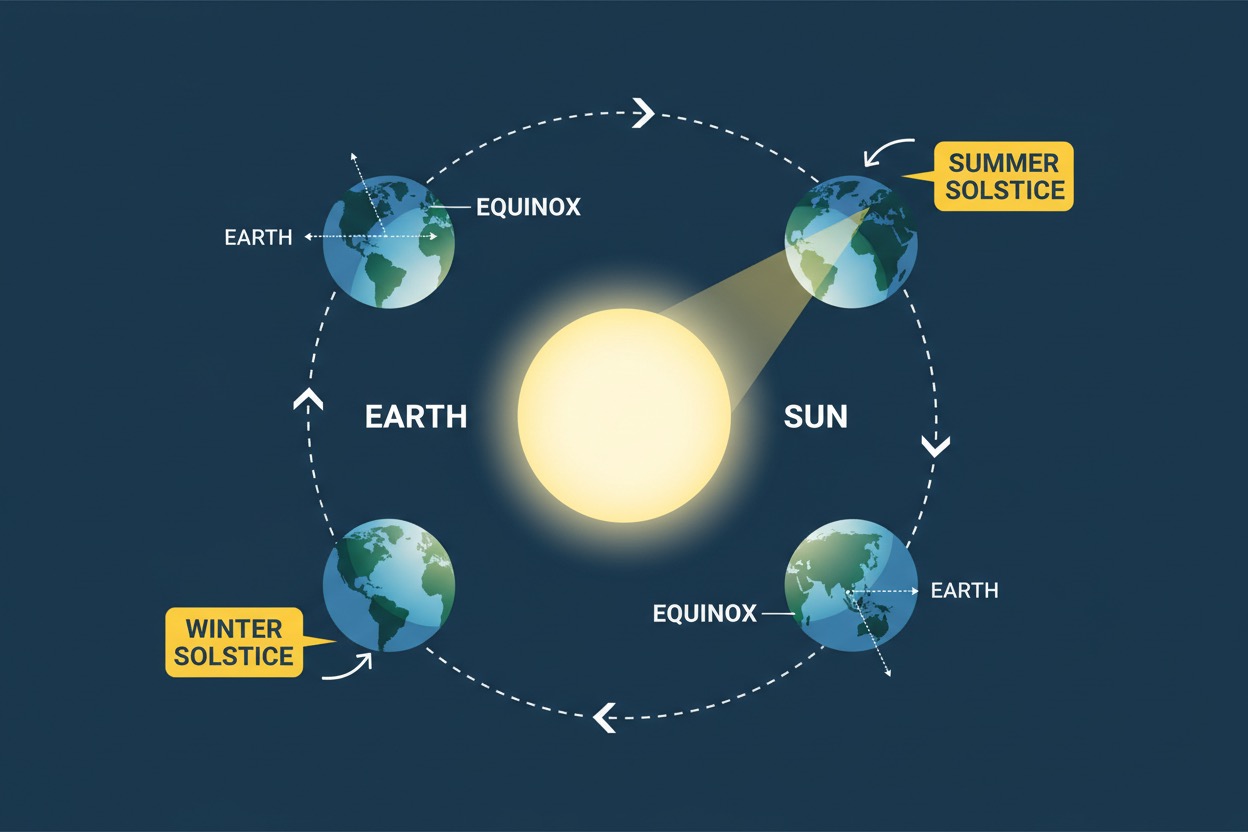
Simply put: Earth is not straight as it moves around the Sun. It tilts. Earth’s rotation axis is tilted 23.5 degrees from a line straight up from its orbit. This tilt causes our seasons and the changing times of sunsets during the year.
In summer, the Northern Hemisphere tilts toward the Sun. The Sun moves higher in the sky, travels a longer path from east to west, and sets later. In winter, the opposite happens. The Sun stays low, moves a shorter path across the sky, and sets earlier.
Your Location Matters Too
Sunrise and sunset times change with latitude because the Sun’s rays hit the Earth at different angles. Near the equator, the Sun’s rays are more direct, so the time between sunrise and sunset is shorter. This means places near the equator have shorter and more consistent sunrise and sunset times all year, with only a small difference between the longest and shortest days.
Longitude affects sunrise and sunset times because the Earth spins from west to east. Places farther east see the sun rise and set earlier than places farther west. For example, New York has sunset earlier than Los Angeles on the same day.
The Solstices Explained
In winter and spring, the days get longer and sunsets happen later each day until the latest sunset. This happens after the summer solstice. In the Northern Hemisphere, the latest sunset is in late June or early July, but not on June 21, the summer solstice.
Surprisingly, the earliest sunset happens about two weeks before the winter solstice, depending on where you are.
What Is Twilight and Is It the Same as Sunset?
Many people use “sunset” and “dusk” as if they mean the same, but they are different times.
Sunset is the moment when the top edge of the Sun goes below the horizon. The sky doesn’t get dark right away. After sunset comes twilight — a slow fading of light that can last from 20 minutes to more than an hour, depending on where you are and the time of year.
There are three phases of twilight:
- Civil Twilight — The Sun is just below the horizon. The sky is still bright enough for outdoor activities without artificial light. This is the “golden hour” that photographers love.
- Nautical Twilight — The horizon is still faintly visible at sea. Ambient light is soft and diffused.
- Astronomical Twilight — The sky is nearly fully dark. Stars become clearly visible. This is when amateur astronomers begin observing.
Light from the Sun bends as it moves through Earth’s atmosphere, so we can see the Sun even after it has gone below the horizon. This bending also changes how the Sun looks near the horizon, making it seem higher in the sky than it really is.
This means that after the sun sets, you will still have light for 20 to 30 minutes during civil twilight.
What Time Is the Sunset Tomorrow?
Curious about tomorrow? Sunset will happen around the same time as today, but not exactly the same.
Small daily changes in sunset times happen because of Earth’s tilt, rotation, and orbit around the Sun. The change is usually one to three minutes each day, but it adds up quickly. From June to December, this shift makes the sunset come two to four hours earlier depending on where you are.
The easiest way to find tomorrow’s exact sunset time is:
- Go to TimeandDate.com and search your city
- Click through to the monthly calendar view
- Tomorrow’s sunset time appears in the table
You can use the NOAA Solar Calculator, which gets the current date from your computer and fills in the fields automatically. You can also enter a future date to find the sunset time for any day of the year.
How Seasons Change Your Sunset Time
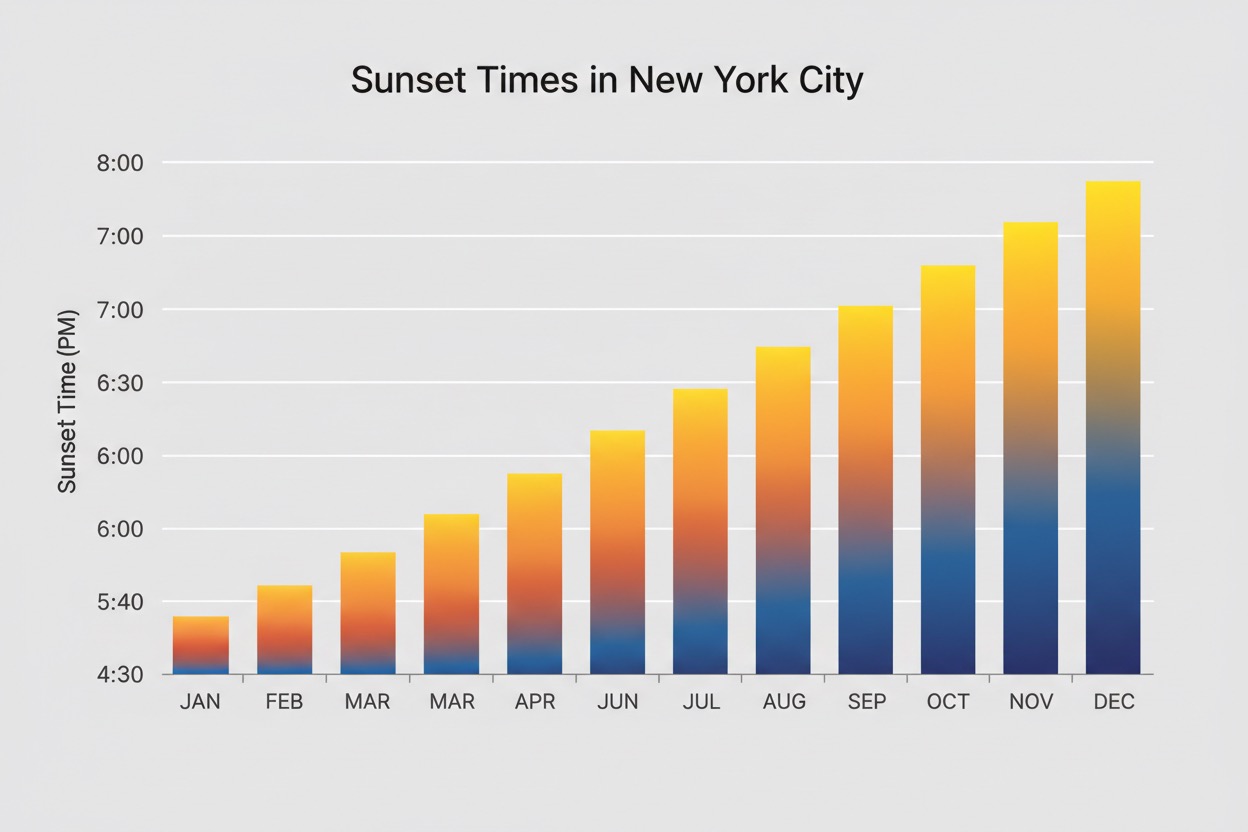
You might be surprised at how much sunrise and sunset times change throughout the year. Here’s a simple example using New York City:
| Month | Approx. Sunset Time (NYC) | Daylight Hours |
|---|---|---|
| January | ~4:55 PM | ~9 hrs 20 min |
| March | ~7:10 PM | ~12 hrs |
| June | ~8:28 PM | ~15 hrs 5 min |
| September | ~7:10 PM | ~12 hrs |
| December | ~4:28 PM | ~9 hrs 15 min |
In New York, the June solstice has about 5 hours and 50 minutes more daylight than the December solstice — one of the biggest daylight changes of any major US city.
For cities farther north, like Seattle or Minneapolis, the change is bigger. For cities near the equator, like Miami or San Antonio, the change is smaller.
The sunset times start getting later before the solstice, but sunrise times only start getting earlier after the solstice. How far apart these dates are depends on the latitude. At 40° north, these dates are about two weeks away from the solstice.
Why Do Some Days Feel Like They Last Forever?
You’ve likely seen those long summer evenings when it’s still light outside at 9 PM. That’s real, not just your imagination.
Earth’s yearly tilt change causes our seasons and changes when the sun rises and sets. In summer, the Northern Hemisphere leans toward the Sun, making the Sun stay in the sky longer and take more time to set.
In middle latitudes, away from the Equator and the poles, changes in daytime length are small. But if you go far north, like in Alaska, the changes become very extreme.
Areas inside the Arctic and Antarctic Circles have times when the Sun stays up all day or stays down all night for 24 hours or more. This is called polar day and polar night. It happens because the Earth is tilted, which makes some places get sunlight all the time or no sunlight at all during certain parts of the year.
At the equator, the Sun’s path is almost straight up and down. On the equinoxes, the Sun crosses the horizon in just two minutes. There is no long glow or golden hour, just a quick, sharp sunset.
Why Does the Sun Set in a Different Spot Every Day?
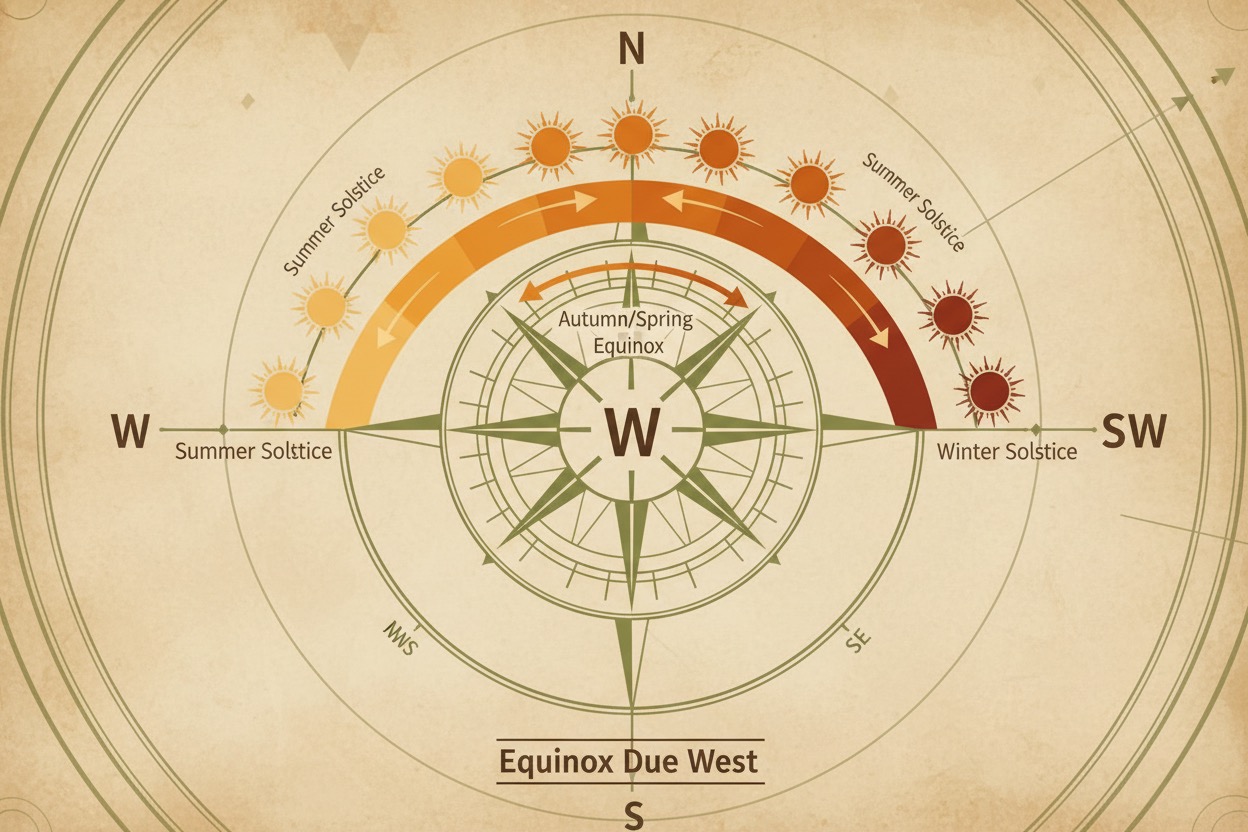
Most people know the Sun rises in the east and sets in the west. But here is a surprise: it sets exactly due west only twice a year.
Sunsets happen almost exactly due west on the equinoxes for everyone on Earth. For the rest of the year, the sunset direction changes — it moves toward the northwest from the March equinox to the September equinox, and toward the southwest from the September equinox to the March equinox.
The sunset direction changes around the west point, moving north in summer and south in winter in the Northern Hemisphere.
This is why people who watch sunsets and take landscape photos often follow where the Sun sets during the year. It does not set in the same place on the horizon every month.
Expert Tips for Catching the Perfect Sunset
Whether you are a photographer, a hiker wanting to catch golden-hour shots, or someone who enjoys the view, here are simple tips from people who watch sunsets carefully:
Plan Around Civil Twilight, Not Just Sunset The best colors usually show up in the 15–20 minutes after the sun goes down, during civil twilight. The sky changes to purple, pink, and red as light scatters in the air. Don’t leave right when the sun sets — that’s often when the real show starts.
Check the Cloud Cover Clear days often have less colorful sunsets. A partly cloudy sky with high clouds works like a canvas, catching and reflecting orange and red colors. Shorter wavelengths like blue and green scatter more, so they disappear first when the sun is low, leaving the orange and red colors we see at sunrise and sunset.
Know Your Location’s Time Zone Offset If you live near the west side of a time zone, the sun sets late. Near the east side, the sun sets early. Phoenix, Arizona, does not use Daylight Saving Time. This means in summer, the sun sets earlier there than in nearby cities that do use Daylight Saving Time, even though they are at similar latitudes.
Use a Real-Time Tool on the Day Sunset times can change by a minute or two because of altitude and local horizon. Always check using NOAA’s Solar Calculator or TimeandDate.com on the day you plan.
Account for Your Elevation The higher you are, the longer you can see the Sun before it sets at sea level. Mountain hikers and rooftop viewers often enjoy a few extra minutes of sunlight.
The Best Free Tools to Find Sunset Time Anytime
Let’s pull together the most useful resources:
TimeandDate.com: The best site for sunrise and sunset times worldwide. Find any city, see monthly tables, dawn and dusk times, day length, and solar noon. All free.
Old Farmer’s Almanac Sunrise/Sunset Calculator: Enter your ZIP code and get today’s sunrise and sunset, the length of the day, and when dawn breaks and darkness falls.
NOAA Solar Calculator: The scientific choice. Accuracy is approximately one minute for latitudes less than ±72°, making it highly reliable for planning purposes. Good for entering precise coordinates.
US Naval Observatory: Provides a full-year table of sunrise, sunset, moonrise, moonset, and twilight times for any US location. Ideal for long-range planning.
SunriseSunset.com: Offers printable monthly calendars for hundreds of cities. Great for keeping a physical reference.
Google Search: Fastest option for a quick check. Just type “sunset time [your city]” and it gives you an instant result at the top of the page.
FAQs: What Time Is Sunset?
Q1: What time is sunset today?
Sunset time today depends on where you are and the date. In the US during summer, sunset is about 7:40 PM in Phoenix and after 9:00 PM in Seattle. The easiest way to find your exact sunset time is to Google “sunset time today” or visit TimeandDate.com.
Q2: Why does sunset time change every day?
Small daily changes in sunset time happen because of the Earth’s tilt, its daily spin, its path around the Sun, and the Earth and Moon moving around each other. The change is usually one to three minutes each day, adding up to several hours difference between summer and winter.
Q3: What time is sunset in LA tonight?
Sunset times in Los Angeles go from about 4:45 PM in December to around 8:08 PM in late June. The latest sunset happens around June 29, just after the summer solstice. For exact times each evening, visit TimeandDate.com for Los Angeles.
Q4: Is sunset the same as dusk?
No. Sunset is the exact time when the Sun goes below the horizon. Dusk, or civil twilight, is the time after sunset when the sky is still light enough to see without artificial light. Dusk usually lasts 20 to 30 minutes after sunset, depending on where you are and the time of year.
Q5: What time is sunset tomorrow?
Tomorrow’s sunset time will usually change by one to three minutes compared to today, either earlier or later depending on the season. To find the exact time, visit Old Farmer’s Almanac or TimeandDate.com, enter your location, and check the date for tomorrow.
Conclusion: Find Your Sunset Time in Seconds
Sunset is a small daily gift that many of us often miss. Finding out what time sunset is — today, tomorrow, or in another city — takes less than 30 seconds with the right tools.
Key points: sunset time depends on your latitude, longitude, time zone, and the season. In summer, sunsets are much later; in winter, they are earlier. The time changes little by little every day. No two sunsets in a row happen at the exact same time.
Bookmark TimeandDate.com or the Old Farmer’s Almanac Calculator — they will always show you the exact sunrise and sunset times for your area. Next time you see a bright orange sky, remember: it’s not magic, it’s just science.
Always check sunset times with a live tool for your exact location, since times change by zip code, height, and nearby landscape.
Also Read: What Are the Two Starting Materials for a Robinson Annulation? A Beginner’s Complete Guide