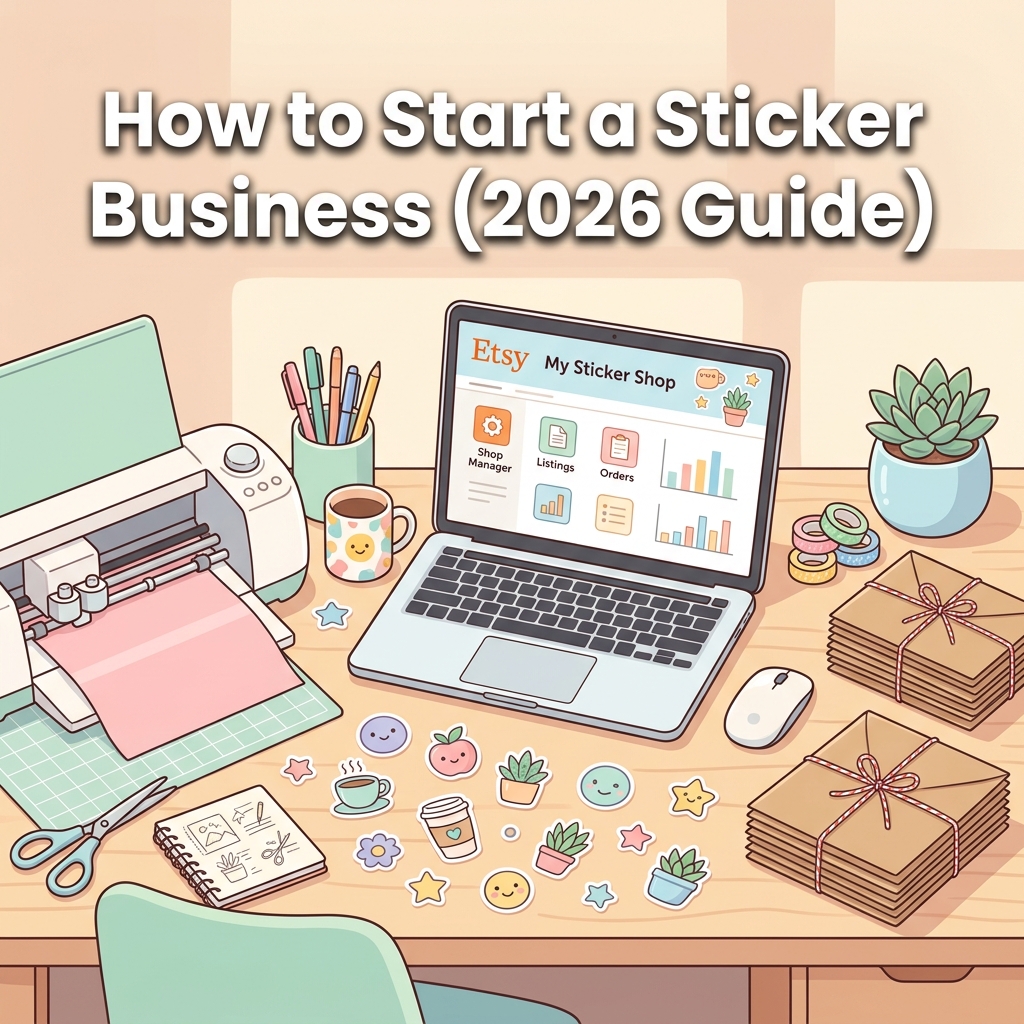
How to Start a Sticker Business (Even If You’ve Never Sold Anything Online)
I still remember the first sticker I ever sold. It was a hand-drawn cactus with a tiny pun underneath, and I priced it at two dollars because I genuinely didn’t think anyone would pay more. Someone bought six of them in one order. That’s when it clicked: stickers aren’t a “cute side project.” They’re one of the easiest, cheapest, and most forgiving products you can sell online.
If you’re here because you typed how to start a sticker business into Google, you’ve probably already scrolled through a handful of guides that all say the same three things: pick a niche, print your designs, open an Etsy shop. That advice isn’t wrong, but it’s incomplete. It skips the parts that actually determine whether your shop makes money or quietly dies after month three. Things like real fee math, material trade-offs, and what a beginner’s first 30 days should actually look like.
This guide covers all of that. By the end, you’ll know exactly how to start a sticker business from home, how much it really costs, which platform fits your goals, and how to price your stickers so you’re not accidentally working for free.
Is a Sticker Business Actually Worth Starting Right Now?
Short answer: yes, and the numbers back it up.
The global vinyl decal and sticker market is on track to reach $7.07 billion by 2032, and broader estimates put the entire sticker industry at close to $47.9 billion by 2026. Meanwhile, the print-on-demand sector that powers a huge share of small sticker shops is projected to grow from $5.4 billion in 2022 to over $39 billion by 2031, which tells you demand for custom, small-batch products isn’t slowing down.
Here’s the part most articles gloss over: stickers have one of the best margin-to-effort ratios of almost any physical product. A single sticker can cost as little as 10 to 40 cents to produce in bulk, and shops that source their materials well have reported margins as high as 80 percent. You don’t need a warehouse, a team, or five figures in startup capital. You need a niche, a decent design, and a plan which is exactly what the rest of this guide gives you.
If you’re still mapping out the bigger picture of your business idea before diving into stickers specifically, it’s worth reading up on what an entrepreneur should do after creating a business plan, since a sticker business follows the same fundamental startup sequence as any other small venture.
How to Start a Sticker Business Step by Step
Let’s get into the actual process. I’m laying this out in the order that causes the fewest headaches later, based on where most new sellers get stuck.
Step 1: Pick a Niche You Can Actually Defend
The single biggest mistake new sellers make is designing “cute stickers” for “everyone.” That’s not a niche, that’s a description of the entire sticker aisle at Target.
Instead, narrow down to something specific enough that a dedicated audience already exists for it. A few examples that consistently work:
- Fandom and community stickers (gaming, anime, D&D, specific TV shows)
- Hobby-based packs (plant parents, book lovers, runners, dog trainers)
- Profession-specific humor (nurses, teachers, software engineers, therapists)
- Aesthetic niches (cottagecore, dark academia, minimalist line art)
- Regional or hyper-local pride stickers (a specific city, trail, or college town)
A community you’re already part of gives you a head start, because you already understand the inside jokes, the visual language, and where that audience hangs out online.
Step 2: Validate Before You Spend a Dollar on Printing
Before ordering a single sticker, test the idea. Post rough sketches in relevant Facebook groups, subreddits, or your own social accounts and gauge reactions honestly — not just likes, but actual comments asking “where can I buy this?”
This step alone can save you from printing 200 stickers nobody wants. A quick, unscientific rule that works well in practice: if you can’t get at least a handful of strangers to say they’d buy it, refine the concept before moving forward.
Step 3: Choose Your Business Model
This decision shapes everything downstream like your costs, your time commitment, and how fast you can scale. There are four main paths:
| Model | Upfront Cost | Control Over Quality | Effort Per Order | Best For |
|---|---|---|---|---|
| Print-on-demand (POD) | Very low | Low-moderate | Very low | Total beginners, testing niches |
| DIY / handmade at home | Low-moderate | High | High | Hands-on creators, small volume |
| Bulk wholesale/private label | Moderate-high | High | Moderate | Sellers who’ve validated demand |
| Dropshipping | Low | Low | Very low | Sellers focused purely on marketing |
If you’re not sure which one fits, print-on-demand services like Printify or Printful let you test a niche with zero inventory risk, since they handle printing, packing, and shipping while you focus purely on design and marketing.
Step 4: Decide on a Business Structure
You can absolutely start as a sole proprietor with no formal registration, and many sticker sellers do exactly that for their first year. But once you’re making consistent sales, forming an LLC separates your personal assets from your business liabilities.
The numbers here matter more than people expect. According to LLC University, the average LLC filing fee across the US in 2026 is $132, with fees ranging from as low as $35 in Montana up to $500 in Massachusetts. On top of the one-time filing fee, most states charge an ongoing annual fee averaging $91, and some (like California) apply a flat $800 minimum franchise tax regardless of how much your shop actually earns, according to USA Corporate Services. If you’re filing yourself, you can realistically form an LLC for under $150 total; if you use a formation service plus a registered agent, budget closer to $700–$1,000 for a fully “hands-off” setup.
You’ll also want an EIN (free directly from the IRS), a dedicated business bank account, and to check your state and local licensing requirements. Your local Small Business Administration office can point you to exactly what applies in your area.
Step 5: Design Your Stickers
You don’t need to be a professional illustrator. Plenty of successful sticker shops use simple line art, bold typography, or collage-style designs made entirely in free tools like Canva. If you want more control, Adobe Illustrator is the industry standard for vector artwork that scales cleanly to any sticker size without getting blurry.
A few design fundamentals that matter specifically for stickers:
- Design in vector format (SVG or AI) whenever possible so edges stay crisp when die-cut
- Keep a small “bleed” margin around your art so nothing gets clipped during cutting
- Test how your design looks small. Most stickers are viewed at 2–3 inches, not full-screen
- Avoid thin, isolated details that can peel or tear when the backing is removed
Step 6: Choose Your Materials and Printing Method
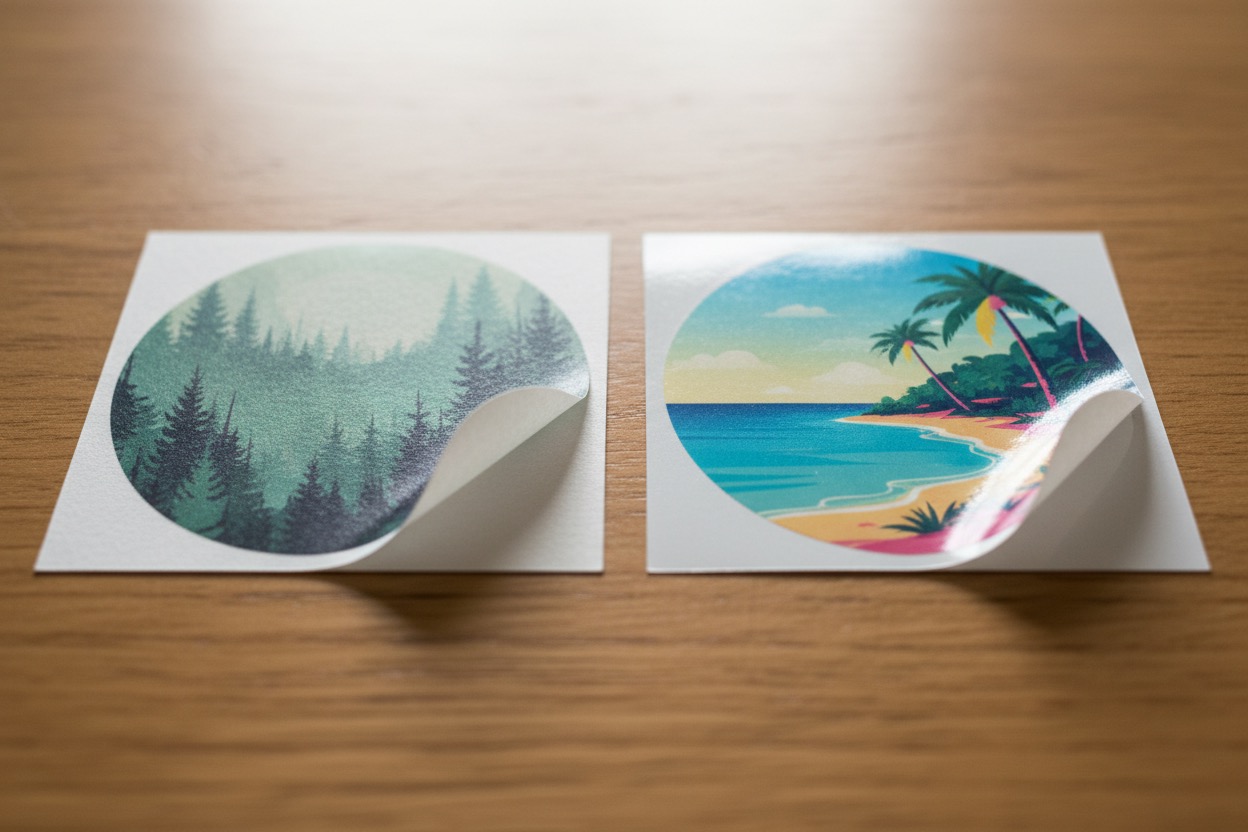
This is where a lot of new sellers either overspend or underdeliver on quality. Here’s a straightforward breakdown:
| Material/Method | Durability | Water Resistant | Typical Use Case |
|---|---|---|---|
| Matte or glossy paper | Low | No | Indoor use, planners, journals |
| Vinyl (kiss-cut or die-cut) | High | Yes | Laptops, water bottles, cars |
| Holographic vinyl | High | Yes | Eye-catching accent designs |
| Clear/transparent vinyl | High | Yes | Modern “floating” aesthetic |
If you’re printing at home, a vinyl cutter (like a Cricut or Silhouette) plus laminate sheets is the standard setup, and it’s a genuinely good starting investment because it lets you produce professional-looking die-cut and kiss-cut stickers without outsourcing anything. If you’d rather skip equipment entirely, a POD partner handles this step for you.
Step 7: Set Up Your Online Store
You have two realistic starting points: an established marketplace like Etsy, or your own store on Shopify. Etsy gets you in front of buyers who are already searching for stickers; your own site gives you full control and no marketplace fees, but you have to drive your own traffic.
Most beginners start on Etsy for the built-in audience, then add a standalone store once they have repeat customers.
Step 8: Price Your Stickers Correctly
This is the step most guides handle badly. Pricing isn’t “cost times two” — it needs to account for platform fees, or you’ll quietly lose money on every sale without realizing it.
Here’s the actual formula, adapted from the standard e-commerce break-even model used by sellers pricing for platforms like Etsy:
Price = (Production Cost + Flat Fees) ÷ (1 − Total Percentage Fees)
We’ll walk through the real math for Etsy specifically in the next section, since Etsy’s fee structure is the one most new sticker sellers actually use.
Step 9: Market Your Shop Before You “Finish” It
Don’t wait for a perfect shop to start marketing. Post your design process, not just the final product, on TikTok and Instagram. Behind-the-scenes content consistently outperforms polished product shots for small creators. Email marketing is also worth setting up from day one; it remains one of the highest-return channels available, with an average return of roughly $42 for every $1 spent.
How Much Does It Cost to Start a Sticker Business?
This is the question everyone actually wants answered, so let’s be specific instead of vague.
Most estimates agree that a lean sticker business can launch for well under $100 if you go the print-on-demand route, while a fuller DIY setup with your own cutter and materials typically lands between $100 and $1,000. Here’s a more granular breakdown:
| Expense | Print-on-Demand | DIY at Home |
|---|---|---|
| Design software | Free (Canva) – $20/mo | Free (Canva) – $20/mo |
| Vinyl cutter/printer | $0 (not needed) | $150–$400 |
| Sticker paper/vinyl sheets | $0 (not needed) | $20–$60/pack |
| Laminate sheets | $0 (not needed) | $15–$40/pack |
| Packaging supplies | $10–$30 | $20–$50 |
| LLC filing (optional) | $35–$500 | $35–$500 |
| Etsy shop setup | $0.20 per listing | $0.20 per listing |
| Realistic starting total | $50–$150 | $250–$1,000 |
The reason POD is so much cheaper upfront is simple: you’re not buying equipment or holding inventory, so your only real costs are optional business registration and the small per-listing fees on whichever marketplace you choose.
How to Start a Sticker Business from Home
Everything above works from your kitchen table, and that’s genuinely one of the best things about this business model. A few home-specific notes that matter:
- Space: You only need a small desk for a laptop and, if you’re going DIY, a vinyl cutter (most are compact enough for a closet shelf when not in use).
- Shipping supplies: Buy mailers and envelopes in bulk from the start. Per-unit shipping cost drops noticeably once you’re not buying in small batches.
- Taxes: Keep a simple spreadsheet or use bookkeeping software from your very first sale. It’s much easier to track income and expenses monthly than to reconstruct a year of receipts in April.
- A dedicated workspace hour: Treat it like a real job, even part-time. Sellers who batch-produce designs and process orders on a set schedule tend to burn out far less than those who treat every order as an emergency.
How to Start a Sticker Business on Etsy
Etsy remains the single most common launchpad for new sticker sellers, largely because of its built-in search traffic. But you need to understand the fee structure before you price a single item, or your “profitable” shop might actually be losing money.
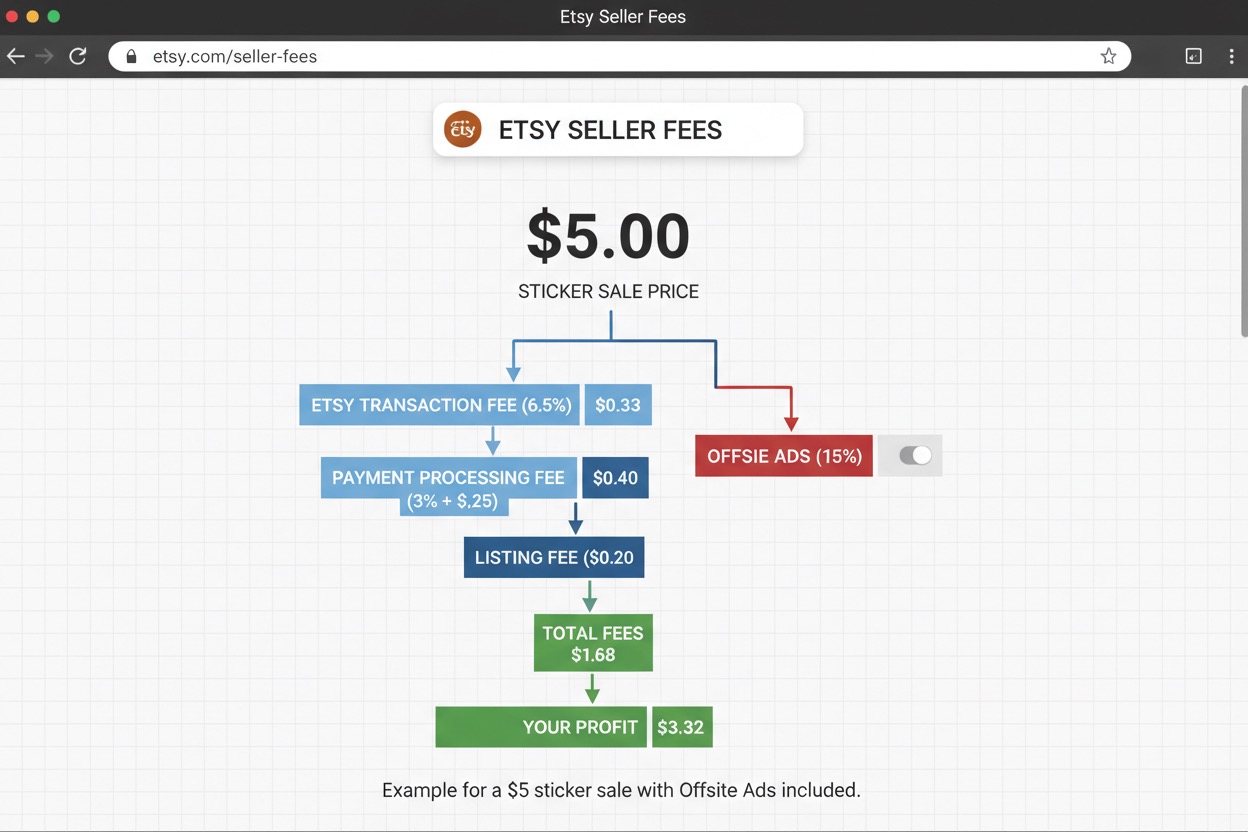
As of 2026, Etsy charges three core fees on every sale:
- Listing fee: $0.20 per item, renewing every four months or upon sale
- Transaction fee: 6.5% of the total sale price, including shipping
- Payment processing fee: 3% + $0.25 per transaction for US sellers
Combined, these typically eat 10–13% of every sale before you’ve spent a cent on advertising. If your shop crosses $10,000 in trailing annual sales, Etsy also automatically enrolls you in Offsite Ads, adding a mandatory 12–15% fee on any sale attributed to those ads and past that threshold, you can’t opt out.
Here’s a worked example most guides skip entirely. Say your sticker costs $0.35 to produce and ship, and you want a healthy margin after all fees:
- Start with production cost: $0.35
- Add the flat fees: $0.20 listing + $0.25 processing = $0.45 in flat costs
- Estimate your percentage fees: 6.5% transaction + 3% processing = 9.5%
- Apply the formula: ($0.35 + $0.45) ÷ (1 − 0.095) = $0.80 ÷ 0.905 ≈ $0.88 break-even price
Anything you charge above $0.88 for that sticker is genuine profit. Which is exactly why bundling stickers into sheets or 3-packs (priced around $4–$8) tends to perform better than selling single stickers at rock-bottom prices. It reduces how many times the flat $0.45 in fixed fees hits your margin.
One underused feature worth knowing about: Etsy’s Share & Save program drops your transaction fee from 6.5% down to just 2.5% on any sale that comes through a trackable link you share yourself on Instagram, in an email newsletter, or on your own blog. It’s one of the easiest ways to protect your margins as you grow.
How to Start a Planner Sticker Business
Planner stickers are their own dedicated subculture, and it’s one of the most loyal, repeat-purchase-heavy niches in the entire sticker world. Planner communities buy weekly, not once which makes this niche especially good for recurring revenue.
To start a planner sticker business specifically:
- Design in standard planner sizes (check the dimensions for popular systems like Erin Condren, Happy Planner, or Hobonichi, since sizing mismatches are the #1 complaint in this niche)
- Create themed weekly kits (a full sheet of icons for chores, workouts, appointments, and moods) rather than one-off stickers
- Offer both printable digital downloads and physical die-cuts, since planner communities buy both formats
- Post inside dedicated planner Facebook groups and on Pinterest, which drives outsized traffic for this specific niche compared to general social media
Digital planner stickers (PDF or PNG downloads) are worth strongly considering here, since they carry zero printing or shipping cost and can be sold repeatedly with no marginal expense.
How to Start a Vinyl Sticker Business
Vinyl stickers are the category for laptop decals, water bottle stickers, car decals, and anything meant to survive being touched, washed, or left outdoors. If this is your focus:
- Invest in a proper vinyl cutter rather than relying purely on POD, since vinyl-specific finishing (kiss-cutting, lamination) is where quality differences show up most
- Choose UV-resistant, waterproof vinyl specifically — Avery’s sticker guide points out this durability factor is non-negotiable for anything meant for outdoor or high-handling use
- Decide between kiss-cut (individual stickers on a shared backing sheet, easy to peel) and die-cut (fully cut to shape, no backing sheet) based on your niche — die-cut tends to photograph better for social marketing
- Budget slightly higher per unit than paper stickers; vinyl material and lamination cost more, but you can price accordingly since customers expect to pay more for durability
How to Start a Small Sticker Business with No Money
“No money” is relative, but here’s the leanest realistic path if your budget is genuinely close to zero:
- Design for free using Canva’s free tier instead of paid software
- Skip equipment entirely by using a print-on-demand partner. You only pay when a customer buys, so there’s no upfront printing cost at all
- List on Etsy without forming an LLC first. Operate as a sole proprietor initially (this is legal in every US state, though it doesn’t protect personal assets the way an LLC does)
- Market for free through organic social content instead of paid ads until you have revenue to reinvest
- Reinvest your first sales into better materials, an LLC, or paid promotion once you’ve proven the concept works
This isn’t a shortcut around every cost forever. It’s a way to test whether your niche has real demand before you spend anything beyond your own time.
How to Start a Sticker Printing Business
If your goal is different, printing stickers for other businesses and creators, rather than selling your own designs, the setup changes somewhat:
- You’ll need actual printing equipment capable of production-level output (not a home vinyl cutter), which is a meaningfully bigger investment than a design-focused shop
- Research printing methods like inkjet, digital, sublimation, and screen printing, since each suits different finishes and durability needs
- Build relationships with local businesses, event organizers, and other Etsy sellers who need bulk printing done for them
- Price based on volume tiers (per-100, per-500, per-1000) rather than per-single-sticker, since bulk clients expect volume discounts
This model requires more capital and technical setup than a design-and-sell shop, but it can scale into steady B2B revenue that doesn’t depend on your own design output.
How to Start a Bumper Sticker Business
Bumper stickers are a distinct niche with their own expectations: bold humor, strong political or fandom statements, and extreme durability requirements since they live outdoors in direct sun and rain.
- Use outdoor-rated, UV-resistant vinyl exclusively. Anything less will fade or peel within a season
- Standard bumper sticker size is roughly 3×8 to 4×11 inches. Design with that ratio in mind from the start
- Humor and topical relevance (current events, local pride, niche fandoms) drive far more impulse purchases in this category than in most other sticker niches
- Consider selling in small multi-packs, since bumper sticker buyers frequently buy for friends or as gifts
Pros and Cons of Starting a Sticker Business
Pros:
- Extremely low startup cost compared to almost any other physical product business
- High profit margins, often reported as high as 80 percent
- Lightweight and cheap to ship, keeping shipping-related losses low
- Can be run entirely from home, part-time, alongside other work
- Low technical barrier — no need for advanced design skills to start
Cons:
- Highly saturated market, especially in broad niches like “cute animals” or “motivational quotes”
- Marketplace fees (Etsy especially) can quietly erode thin margins if you don’t price correctly
- Difficult to build a “premium” brand identity since customers expect stickers to be cheap
- Copycat designs are common, and enforcing design rights as a small seller is genuinely hard
- Requires consistent marketing effort. Stickers rarely go viral without active promotion
Expert Tips for Growing a Profitable Sticker Business
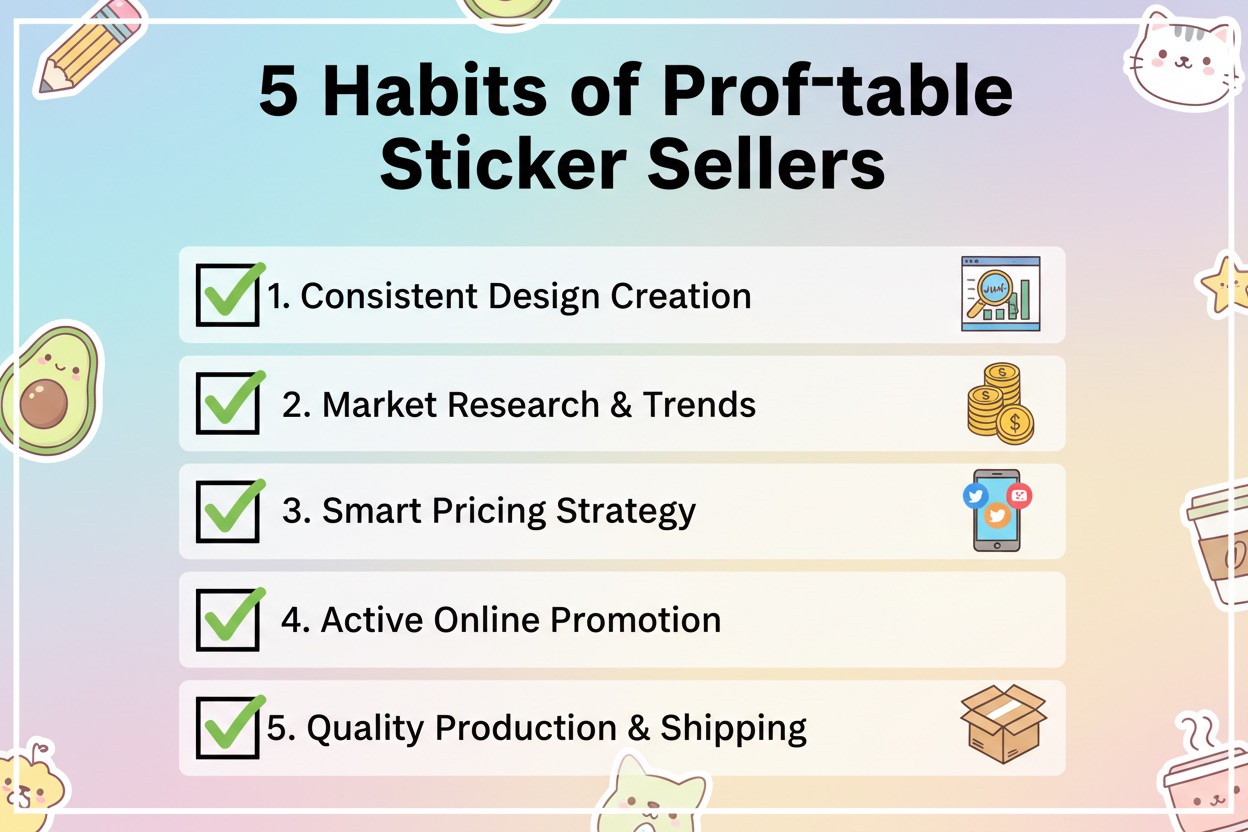
A few things that separate shops that last from shops that quietly close within a year:
- Niche down harder than feels comfortable. “Cat stickers” is oversaturated. “Stickers for people who foster senior cats” has almost no competition and a hyper-engaged audience.
- Track your numbers monthly, not just your sales total. Know your actual profit per sticker after every fee, not just your revenue.
- Diversify beyond one platform once you’ve validated a design. The same art can go on Etsy, your own site, and in local markets simultaneously.
- Protect your original designs by avoiding copyrighted characters or trademarked logos entirely; it’s not worth the legal risk for a low-margin product.
- Reorder your best-seller before you run out. Running out of stock on a proven design is one of the most common, most avoidable revenue losses new sellers report.
If you’re weighing whether a niche product business like this fits into a broader small-business strategy, it can help to see how other small businesses in consumer-facing categories are structured and positioned, since many of the same customer-acquisition principles apply.
Legal Considerations Most Guides Skip
Copyright and trademark issues are the fastest way to lose a sticker shop, and it’s rarely intentional. Here’s what actually matters:
- Fan art is a legal gray area, not a safe zone. Selling stickers based on copyrighted characters (a specific cartoon, movie franchise, or band logo) technically requires permission from the rights holder, even if thousands of other sellers do it without consequence. Platforms like Etsy do periodically remove listings and issue takedowns when a rights holder complains.
- Trademarked phrases carry the same risk as characters. A popular meme phrase might be fine, but a registered brand slogan is not, even styled differently.
- Your own original designs are fully yours the moment you create them, under standard copyright protection — you don’t need to formally register anything for basic protection, though registration does make enforcement easier if someone copies your work.
- Screenshot and reverse-image-search your best sellers periodically. It’s an uncomfortable truth of this business that popular designs get copied, and catching it early gives you more leverage to request a takedown.
None of this means you need a lawyer to start a sticker shop. It means sticking to original designs (or licensed assets you’ve actually paid to use) protects you from the single most common reason small sticker shops get shut down without warning.
Scaling Past Your First 100 Sales
Most guides stop at “launch your shop,” but the real inflection point for a sticker business happens once you’ve made your first 100 or so sales and have actual data to work with. At that stage:
- Look at your bestseller-to-total-listings ratio. If 80% of your revenue comes from 20% of your designs, that’s a signal to make more variations of what’s already working instead of constantly chasing new ideas.
- Consider a second product line using the same art. Stickers translate easily onto magnets, pins, or vinyl decals for laptops, letting you sell the same design multiple ways without redesigning anything.
- Revisit your pricing with real fee data, not estimates. Once you have a full month of Etsy payouts, you can see your actual effective fee rate rather than the theoretical one, and adjust prices if it’s higher than expected.
- Batch production instead of one-off printing. Printing designs in batches of 50–100 at once is meaningfully more efficient than printing on demand for every single order, once you know a design sells consistently.
Common Mistakes New Sticker Sellers Make
- Pricing without accounting for platform fees, then wondering why margins feel thin
- Designing for a niche that’s too broad to stand out in search
- Skipping validation and printing large batches of unproven designs
- Ignoring packaging — a sticker that arrives bent or damaged rarely gets a repeat customer
- Underestimating how much consistent posting and marketing actually matters, even for a “passive” product
Frequently Asked Questions
Do I need a business license to sell stickers?
It depends on your state and city. Many small sellers start as sole proprietors without a formal license, but you should check your local Small Business Administration office or city government site to confirm requirements where you live, since rules vary significantly by location.
How much does it cost to start a sticker business?
A lean print-on-demand setup can start for as little as $50–$150, while a full DIY setup with your own vinyl cutter typically runs $250–$1,000, largely depending on whether you form an LLC and buy your own printing equipment.
Is Etsy or Shopify better for selling stickers?
Etsy gives you built-in search traffic and is easier for total beginners, while Shopify gives you more control and no per-sale marketplace commission, but requires you to drive your own traffic. Many sellers eventually run both.
Can I really start a sticker business with no money?
You can get extremely close to $0 upfront by using free design tools and a print-on-demand partner that only charges you when a customer actually buys, though you’ll still likely pay a small Etsy listing fee per item.
What’s the most profitable type of sticker to sell?
There’s no single “best” category — vinyl decals for laptops and cars tend to command higher prices, while planner stickers benefit from loyal, repeat buyers. The niche you choose matters more than the sticker type itself.
Final Thoughts
Starting a sticker business isn’t complicated, but it does reward people who treat it like a real business from day one. Real pricing math, a real niche, and a real plan for marketing. You don’t need thousands of dollars or a design degree. You need a specific idea, a platform that fits your budget, and the patience to test before you scale.
If you’re ready to take the next step, start small: pick one niche, sketch five designs, and validate them before you spend a dollar on printing. That’s genuinely how most successful sticker shops began, including the one with the cactus sticker that started this whole thing for me.