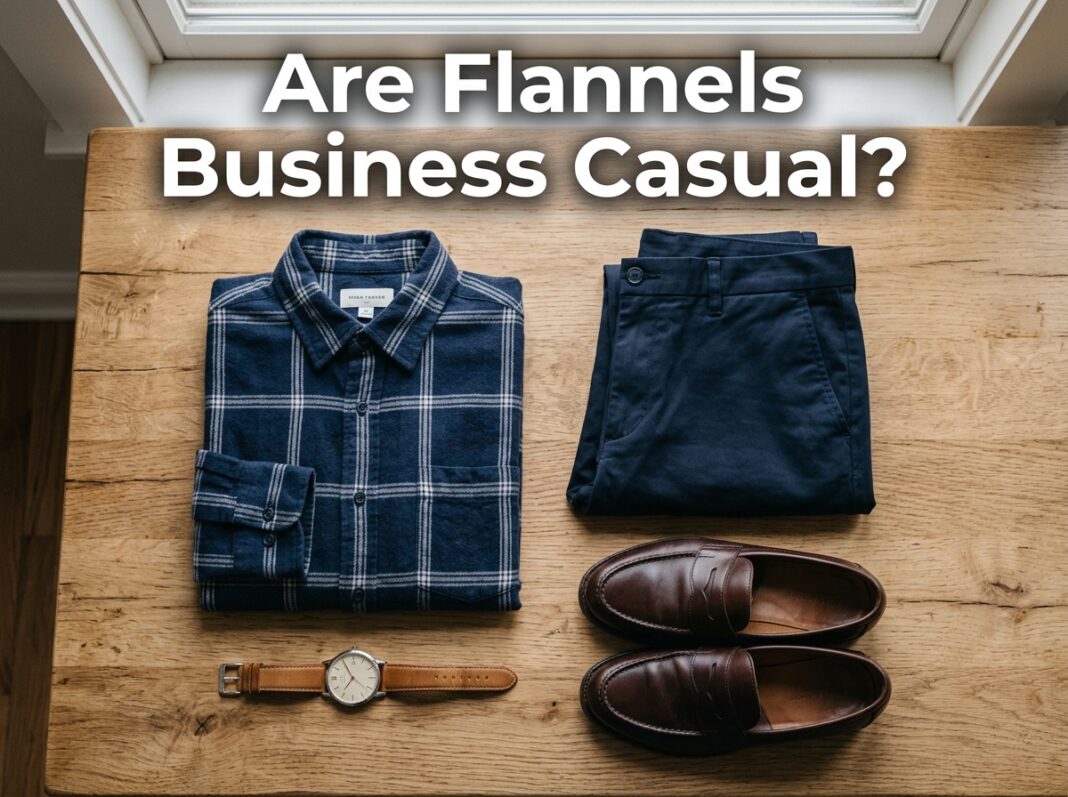
Are Flannels Business Casual? Here’s What Actually Works at the Office
You pulled that soft, broken-in flannel out of your closet this morning and paused.
It feels too good to leave at home, but is it too casual for your 9-to-5? You’re not overthinking this. It’s genuinely one of the most Googled style questions every fall.
Here’s the short version: yes, flannels can be business casual, but only certain flannels, styled a certain way, in certain offices. The long version is what actually keeps you from getting it wrong, and that’s what this guide covers.
I’m going to walk you through exactly which flannels pass the test, which ones don’t, how the rules shift for men and women, and what to pair them with so you look put-together instead of like you just came off a hike. No fluff, no recycled advice, just what actually works.
A Quick History: Why Flannel Even Feels “Casual” in the First Place
Knowing why flannel is seen as casual helps you wear it more confidently. This idea comes more from its past than the fabric itself.
Flannel’s roots trace back to 17th-century Wales, where farmers wove leftover wool into a soft, insulating fabric to survive cold, wet winters, according to Wikipedia’s history of the fabric. It was practical workwear from day one, built for warmth, not for looking sharp behind a desk.
That working-class, outdoor association stuck around for centuries. MasterClass’s guide to flannel notes that flannel eventually made its way into military uniforms, then into grunge fashion in the early 1990s through bands like Nirvana and Pearl Jam, cementing its rugged, rebellious image in American pop culture.
When people ask, “Are flannels business casual?” they want to know if a fabric with 400 years of workwear and counterculture history can fit in a corporate setting. The answer is yes, but only if you avoid the parts of that history like heavy fabric, bold plaid, and oversized fit that don’t suit an office.
What “Business Casual” Actually Means in 2026
Here’s the annoying truth: there’s no single legal definition of business casual. Every company writes its own version of the rule, which is exactly why this question trips up so many people.
But there are patterns. A recent Monster survey of over 1,300 U.S. workers found that among employees with a dress code, 63% describe their office as business casual, making it the most common workplace dress standard in the country today.
That same survey found something else worth noting: 61% of workers say their office dress code has gotten more relaxed recently, and 44% would consider switching jobs for better dress code flexibility. Clothing at work isn’t just a style question anymore — it’s a retention issue for employers.
According to Indeed’s career guide, business casual blends traditional business wear with a more relaxed style that still reads as professional. Think of it as the middle ground between a full suit and your weekend outfit.
Here’s how the main dress codes break down, roughly speaking:
| Dress Code | Typical Pieces | Flannel Fit? |
|---|---|---|
| Business Formal | Suit, tie, dress shoes | No |
| Business Professional | Blazer, dress pants, button-up | Rarely (only as a rare, refined layer) |
| Business Casual | Chinos, collared shirts, blazers, loafers | Yes, if styled right |
| Smart Casual | Polos, dark denim, sweaters | Yes, easily |
| Casual | Jeans, T-shirts, sneakers | Yes, in almost any form |
One important detail most guides skip: Harry Rosen’s 2025 dress code breakdown points out that “business casual” has actually gotten harder to define, not easier, as hybrid work and remote schedules blur the line between what people wear into the office and what they wear on a video call. That ambiguity is exactly why you should default to your office’s norms rather than any generic internet rule, including this one.
Bottom line: if your workplace already leans business casual, a well-chosen flannel usually fits right in. If it leans business-professional, you’ll want to treat flannel as an occasional layer, not as your main shirt.
So, Are Flannels Business Casual? The Direct Answer
Yes — with conditions. A flannel shirt can absolutely work as business casual attire, but three things determine whether it reads as “put-together” or “just rolled out of bed”:
- The fabric weight and finish: a lightweight, tightly woven flannel looks sharper than a thick, heavily napped one.
- The color and pattern: muted, small-scale patterns beat bold buffalo checks every time.
- What you pair it with: the shirt is only half the outfit. Your pants, shoes, and layering pieces do the rest of the work.
Get those three right, and a flannel shirt can sit comfortably next to chinos and loafers in almost any modern office. Get them wrong, and it reads as flannel pajamas with buttons.
What Makes a Flannel “Office-Ready” vs. Just Casual
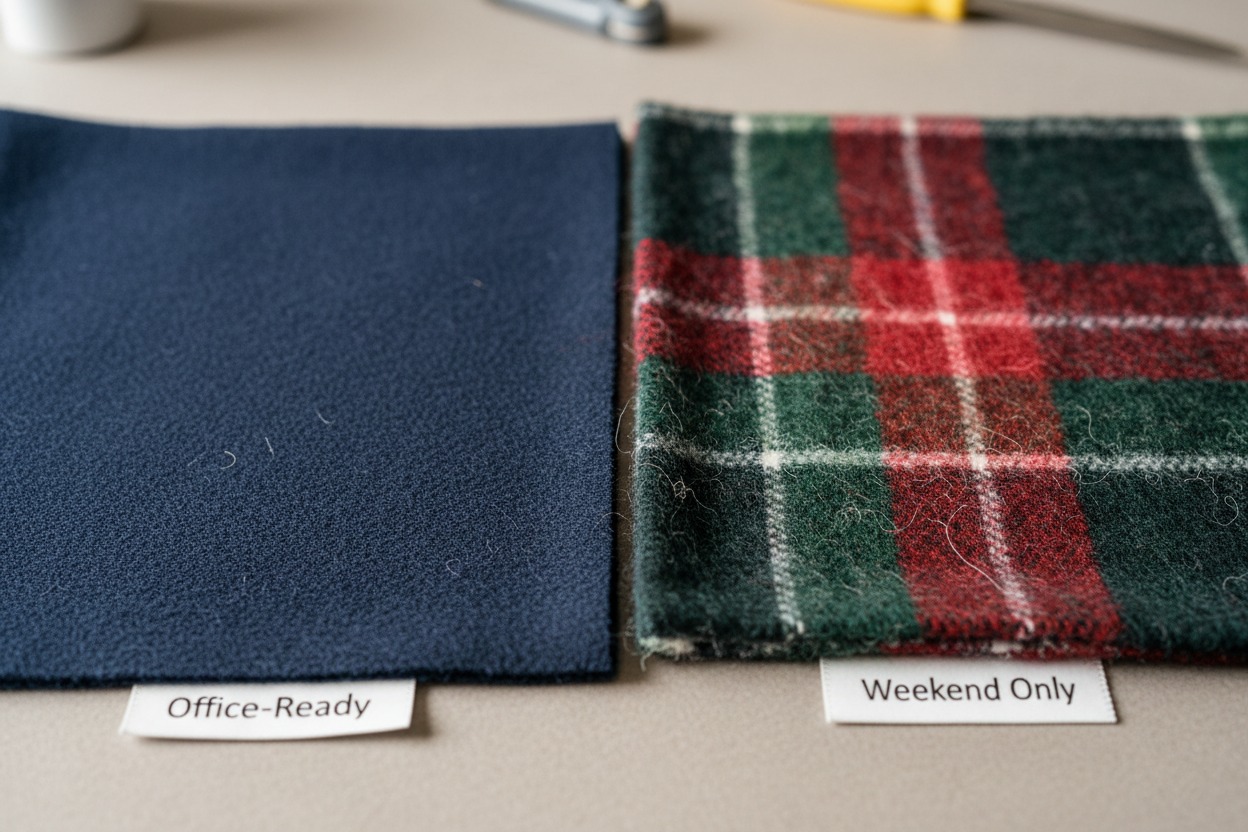
Before you can style a flannel correctly, it helps to actually understand what flannel is because most guides skip this, and it’s exactly where people go wrong.
Flannel Is a Fabric, Not a Pattern
This trips up almost everyone. Flannel isn’t plaid, and plaid isn’t flannel.
According to Wikipedia’s overview of the fabric, flannel is a soft, woven textile originally made from carded wool, and now commonly made from cotton, wool, or synthetic blends. What makes it “flannel” is the brushed, napped finish, not the checkered pattern most people associate with it.
Sewport’s fabric guide confirms this: flannel is defined by softness and a brushed or unbrushed texture, and it can be woven in solids, stripes, or plaid. You can have a solid navy flannel shirt with zero plaid pattern at all, and it will often look more office-appropriate than a patterned one.
This matters for you because a solid or subtly striped flannel shirt is almost always easier to dress up for the office than a bold plaid one.
Weight and Weave Change Everything
Flannel comes in different weights, and this is the detail that almost every other article on this topic completely ignores.
- Lightweight flannel (under 5 oz per square yard): Drapes closer to a dress shirt. Easiest to dress up.
- Midweight flannel (5–7 oz): The most common weight for everyday flannel shirts. Works for business casual if the pattern and color are subdued.
- Heavyweight flannel (7 oz+): Bulkier, warmer, and reads more “outdoor cabin” than “office.” Best reserved for casual Fridays or layering under a jacket, not as your main shirt.
MasterClass’s guide to flannel notes that flannel’s defining softness comes from that brushing process, and heavier, more heavily napped flannels naturally look more rugged. If you want office-friendly flannel, look for a tighter weave with less visible fuzz.
Expert Tip: Hold the shirt up to the light. If you can easily see through the weave, it’s likely lightweight enough for the office. If it’s opaque and thick like a jacket lining, save it for weekends.
Color Is Doing More Work Than You Think
Neutral, muted tones read as more professional because they mimic the color palette of traditional dress shirts. Navy, charcoal, deep burgundy, and forest green all work well.
Bright red-and-black buffalo checks, neon accents, or high-contrast plaid tend to read as outdoor or grunge-inspired. It is great for the weekend and risky for a client meeting.
Is Flannel Business Casual for a Woman?
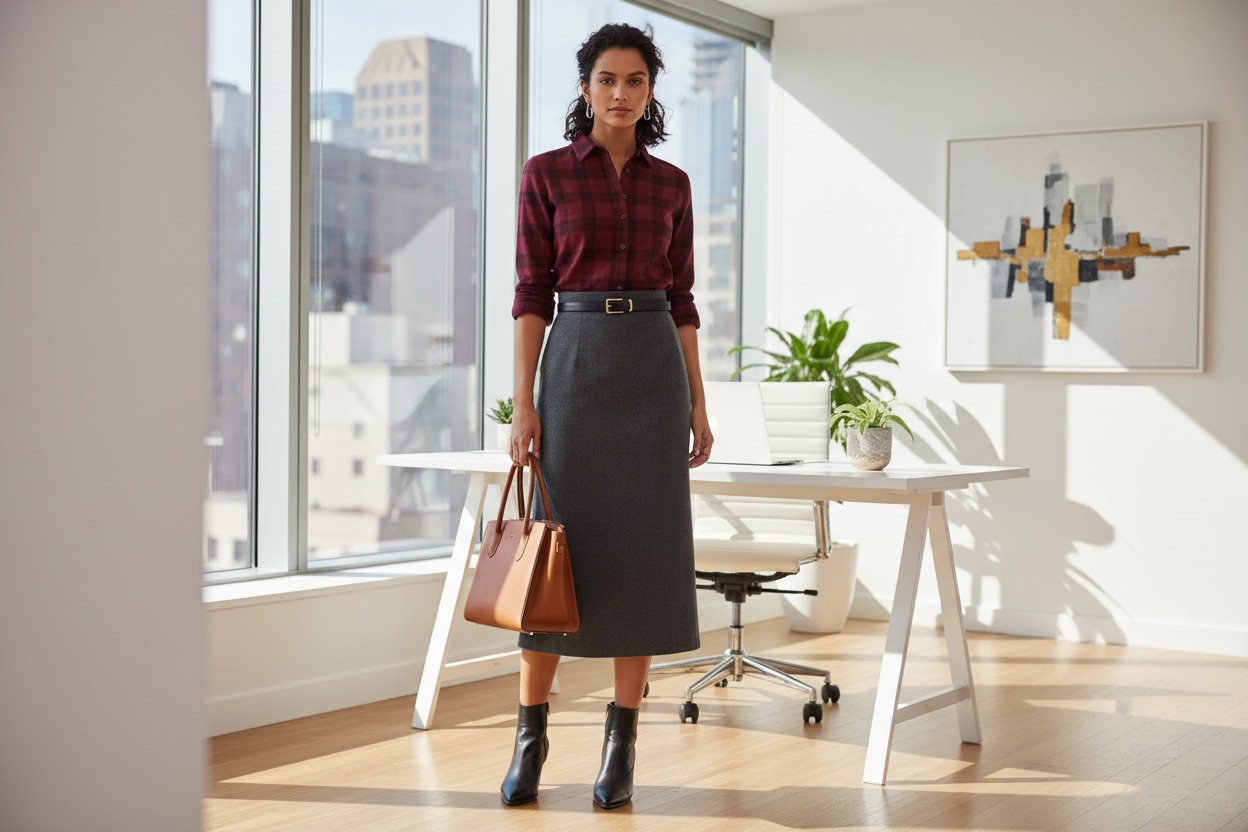
Yes, and honestly, women often have more flexibility here than men do, because business casual for women already includes a wider range of silhouettes like blouses, cardigans, tailored trousers, and skirts.
A flannel shirt can work into a woman’s business casual outfit in a few reliable ways:
- Tucked into a pencil skirt or tailored trousers, with the top button or two open and a simple necklace layered on top.
- Belted at the waist over a midi skirt, which instantly gives it more shape and less “borrowed from the campsite” energy.
- Layered under a blazer, with just the collar and cuffs showing. This is the single easiest way to make any flannel look intentional.
- Half-tucked with straight-leg trousers and loafers or low block heels for a more relaxed yet polished look.
The fit matters more for women than for men here. A flannel shirt cut for a straight, boxy men’s fit will almost always look sloppier in an office setting than one tailored to nip in at the waist. If you’re buying flannel specifically for work, look for “fitted” or “tailored” in the product description rather than “relaxed” or “boyfriend fit.”
Avoid: oversized flannel worn loose and untucked with leggings. It’s a great weekend look, but it reads as loungewear the moment you walk into a meeting.
Flannel Business Casual for Men: The Styling Rules
Men have slightly less room to improvise here, mainly because men’s business casual leans more conservative overall. But flannel still has a real place in the rotation if you follow a few rules.
What works:
- A slim or tailored fit flannel, buttoned up, tucked into chinos or dress trousers
- Solid or small-check patterns in navy, gray, or muted earth tones
- Layering a flannel under a blazer or over a plain crewneck tee, with the flannel worn open like an overshirt
- Rolled sleeves paired with a clean belt and leather loafers or derby shoes
What to avoid:
- Flannel worn loose and untucked with jeans and sneakers (that’s casual Friday, not business casual)
- Bold buffalo check or oversized plaid as your main shirt
- Heavyweight, visibly fuzzy flannel that looks more like a jacket lining than a shirt
- Pairing flannel with athletic shoes, hoodies, or cargo shorts
According to Nimble Made’s guide on flannel in the workplace, the honest answer really does depend on your specific office and industry. A tech startup or creative agency will tolerate far more flannel than a law firm or financial services company will. Read the room before you read any style guide, including this one.

Is a Flannel and Jeans Business Casual?
This is where things get more nuanced, because you’re really asking two questions at once: are jeans business casual on their own, and does adding flannel change the equation?
Are Jeans Business Casual?
Increasingly, yes. According to Indeed’s Canadian career guide, dark-wash or black jeans that are well-tailored and free of rips or holes are now considered acceptable in most business casual offices.
HKT Clothiers’ guide to jeans in the workplace breaks this down clearly: dark, straight-leg or slim-fit jeans without distressing, fading, or embellishments are the most business-appropriate option. Light-wash, ripped, or heavily faded denim reads as too casual almost everywhere.
So Can You Wear Flannel and Jeans Together to the Office?
Yes, but treat it as one styling decision, not two casual pieces stacked together. Here’s the formula that keeps it business casual instead of weekend casual:
| Element | Business Casual Choice | Too Casual Choice |
|---|---|---|
| Jeans | Dark wash, straight or slim fit, no rips | Light wash, distressed, baggy |
| Flannel | Solid or muted small check, tucked or half-tucked | Bold plaid, worn fully open and loose |
| Shoes | Leather loafers, clean derby shoes, or minimalist sneakers | Worn sneakers, sandals, work boots |
| Extra layer | Blazer or structured cardigan | None (looks unfinished for client-facing days) |
Expert Tip: If your flannel and jeans are both casual on their own, add one polished element — a blazer, a leather belt, or dress shoes — to pull the whole look back toward business casual. You rarely need to change everything; you usually just need to fix one thing.
Are Flannels Considered Business Casual by the industry?
This is the piece most guides skip entirely, and it’s honestly the most useful part if you actually want a straight answer for your job specifically.
| Industry | Is Flannel Business Casual Here? | Notes |
|---|---|---|
| Tech / Startups | Yes, easily | Often welcomed even in solid or checked patterns |
| Creative Agencies / Design | Yes, easily | Personal style is generally encouraged |
| Retail / Hospitality Management | Usually yes | Depends on customer-facing expectations |
| Education (non-classroom roles) | Usually yes | Muted colors preferred |
| Healthcare (non-clinical roles) | Sometimes | Check specific department dress codes |
| Finance / Banking | Rarely as main shirt | Better as a layer under a blazer, if at all |
| Law | Rarely | A business professional is still the norm in most firms |
| Government | Sometimes | Varies heavily by department and region |
The pattern here is simple: the more client-facing and conservative the industry, the more you should treat flannel as an occasional layering piece rather than a daily uniform. The more casual and internally-focused the industry, the more freedom you have to wear it as a standalone shirt.
Business Casual Shoes to Pair With a Flannel Shirt
Your shoes can make or break whether a flannel outfit reads as office-ready. This is the piece people forget about most.
Best business casual shoe options with flannel:
- Leather loafers — the most versatile option for both men and women, works with jeans, chinos, or trousers
- Derby or Oxford shoes — a step up in formality, great if your flannel is layered under a blazer
- Chelsea boots — clean, low-profile boots read as polished, especially in fall and winter
- Minimalist leather sneakers — acceptable in more relaxed or creative offices, but skip the chunky athletic styles
- Block heels or low pumps — for women, pairing flannel with a skirt or tailored trousers
Shoes to avoid with a business casual flannel outfit: hiking boots, work boots, flip-flops, athletic sneakers, and anything with visible logos or scuffed leather. These pull the whole outfit back toward “outdoor” territory, even if your shirt and pants are dialed in.
Plaid Shirt Business Casual: Is Plaid the Same as Flannel?
Short answer: no, and mixing these two up is probably the single most common mistake people make when researching this topic.
Plaid is a pattern, a crisscross of stripes and squares. Flannel is a fabric characterized by its soft, brushed texture. You can have a plaid shirt made of cotton poplin (not flannel at all), and a solid-color flannel shirt with no plaid pattern.
Sewport’s fabric directory makes this distinction directly: plaid shirts and flannel garments are often confused, but not all plaid clothing is flannel, and not all flannel clothing is plaid.
Why this matters for your wardrobe: a plaid dress shirt made from crisp cotton poplin (not brushed flannel) can look considerably more business-appropriate than a heavyweight flannel shirt, even when the patterns are similar. If you love the plaid look but your office skews more formal, look for plaid shirts in poplin, Oxford cloth, or twill instead of true flannel fabric.
Business Casual Women: Where Flannel Fits Into the Bigger Picture
If you’re building out a full business-casual wardrobe as a woman, flannel is just one tool in a larger toolkit. Here’s how it fits alongside the rest of your rotation:
- Base layers: blouses, fitted button-downs, and yes — a well-tailored flannel shirt
- Bottoms: tailored trousers, pencil skirts, midi skirts, and dark, well-fitted jeans
- Outerwear: blazers, structured cardigans, and trench coats
- Shoes: loafers, low block heels, ballet flats, or clean ankle boots
- Accessories: a simple watch, delicate jewelry, and a structured tote or bag
The flannel shirt slots in as a seasonal base layer. It is most useful from early fall through winter, and easiest to dress up when it’s the “quiet” piece in the outfit rather than the loud one. Save the bold plaid flannel for weekends, and keep a solid or muted-check version in rotation for the office.
5 Business Casual Flannel Outfit Formulas You Can Copy
Sometimes the fastest way to understand a style rule is to see it laid out as a formula. Here are five that work:
| # | Outfit Formula | Best For |
|---|---|---|
| 1 | Solid navy flannel (tucked) + dark chinos + brown leather loafers | Every day men’s office |
| 2 | Flannel layered under a blazer, collar out + dress trousers + oxfords | Client meetings, presentations |
| 3 | Flannel belted over a midi skirt + ankle boots + simple necklace | Women’s office, fall/winter |
| 4 | Half-tucked flannel + dark straight-leg jeans + Chelsea boots + blazer | Creative or hybrid offices |
| 5 | Flannel worn open over a plain crewneck tee + trousers + minimalist sneakers | Casual Friday or startup culture |
Expert Tips: Making Any Flannel Office-Ready
A few practical habits separate people who consistently look polished in flannel from people who look like they wandered in from a camping trip:
- Iron or steam it. Flannel wrinkles easily, and a wrinkled flannel instantly looks more casual, no matter how nice the shirt is.
- Size it correctly. Oversized flannel is a style choice for weekends, not the office. For work, go with your true size or a slightly fitted one.
- Layer with intention. A blazer over flannel instantly elevates the outfit more than almost anything else you can do.
- Watch your buttons. Fully buttoned up reads more formal; two buttons open reads more relaxed. Match it to how dressy the rest of your outfit is.
- Rotate with the season. Lightweight flannel works well into early spring; heavyweight flannel is strictly a cold-weather, casual-leaning piece.
Pros and Cons of Wearing Flannel to Work
| Pros | Cons |
|---|---|
| Comfortable and breathable for long office days | Can look too casual if the wrong weight or pattern |
| Versatile — works with jeans, chinos, or trousers | Wrinkles easily and needs regular ironing |
| Wide range of colors and patterns to match personal style | Not appropriate for business formal or business professional settings |
| Transitions easily between office and after-work plans | Heavyweight flannel can look bulky under blazers |
| Affordable compared to dress shirts of similar quality | Requires careful fit — ill-fitting flannel reads sloppy fast |
Common Mistakes People Make With Office Flannel
- Wearing a heavyweight, visibly fuzzy flannel and expecting it to read as a dress shirt
- Pairing flannel with sneakers and joggers and calling it business casual
- Choosing bold buffalo check as a first flannel for the office
- Leaving it wrinkled straight out of the dryer
- Ignoring your specific company’s culture and following a generic internet rule instead
The 60-Second Business Casual Flannel Checklist
Before you leave the house, run your outfit through this quick checklist. If you can check off at least five of these, you’re safely in business casual territory:
- [ ] Fabric is lightweight to midweight, not thick or heavily fuzzy
- [ ] Color is solid or a small, muted check — not bold buffalo plaid
- [ ] Shirt is tucked or intentionally half-tucked, not left loose and baggy
- [ ] Fit is true-to-size or tailored, not oversized
- [ ] Paired with chinos, dress trousers, a skirt, or dark non-distressed jeans
- [ ] Shoes are loafers, oxfords, boots, or clean minimalist sneakers — not athletic shoes
- [ ] Shirt is freshly ironed or steamed, with no visible wrinkles
- [ ] At least one polished element is added — a blazer, belt, or structured accessory
This simple checklist is genuinely more useful than memorizing a long list of rules, because it forces you to evaluate the whole outfit rather than just the shirt in isolation. A flannel shirt never works or fails in a vacuum — it works or fails depending on everything you pair it with.
Frequently Asked Questions
Are flannels considered business casual in every office? Not universally. Most business-casual offices will accept a well-fitted, muted-color flannel, but more conservative industries like law, finance, or consulting tend to expect flannel only as a layering piece, not as a main shirt.
Is flannel business casual for a woman specifically? Yes, when it’s tailored to fit, tucked or belted for shape, and paired with trousers, skirts, or dark jeans. Oversized, untucked flannel worn with leggings reads as loungewear rather than office wear.
Is a flannel and jeans business casual together? It can be, if both pieces are dressed up together, dark, non-distressed jeans, a solid or muted flannel, and leather shoes or a blazer added to the mix. Light-wash, distressed jeans with a loud plaid flannel will read as too casual almost anywhere.
Are jeans business casual on their own, without flannel? Generally, yes, in modern offices, as long as they’re dark-wash, well-fitted, and free of rips or heavy distressing. Always check your specific company’s dress code, since some workplaces still reserve jeans for casual Fridays only.
What’s the difference between a flannel shirt and a plaid shirt for work? Flannel refers to the brushed, soft fabric itself, while plaid refers to the checkered pattern. A crisp cotton or poplin shirt in a plaid pattern often looks more office-appropriate than a heavyweight flannel shirt, even when the designs are similar.
Final Take: Should You Wear Flannel to the Office?
If your workplace leans business casual or smart casual, a well-fitted, muted-tone flannel shirt is a genuinely solid choice — comfortable, versatile, and easy to dress up with the right shoes and layers.
If your office leans more formal, keep flannel as an occasional layering piece rather than your everyday shirt, and instead lean on plaid poplin or classic button-downs for your baseline wardrobe.
Either way, the fabric weight, the color, and what you pair it with will always matter more than the flannel label itself. Get those three right, and you’ll never have to wonder again whether your flannel belongs at work.
Looking for more practical style and workplace guides? Check out more how-to guides on Rarely Notes for straightforward answers to everyday questions.