How to Make Money in Heating and Air Conditioning Business
If you are trying to learn how to make money in heating and air conditioning business, the answer is not simply “get more customers.” That is where many HVAC owners get trapped. A company can have a full calendar, busy technicians, several trucks on the road, and plenty of money coming into the bank, yet still produce disappointing profit.
The real question is different. You need to know which work actually makes money, what every service call really costs, how much capacity your team wastes, and how often one customer can profitably buy from you again.
When I built a sample HVAC job-cost model for this guide, the first version looked healthy. Then I added drive time, office scheduling, card fees, warranty labor, unpaid estimates, callbacks, vehicle cost, software, and the time spent collecting overdue invoices. The “profitable” job suddenly looked far less attractive. That exercise is one I would recommend to every owner.
Demand itself is not the biggest concern. Employment for heating, air-conditioning, and refrigeration mechanics and installers is projected to grow 8% from 2024 to 2034, faster than the average for all occupations, according to the occupational outlook for HVAC technicians. The opportunity exists. The challenge is turning demand into retained profit.
If you are still at the setup stage, read how to start an HVAC business first. That guide covers licensing, equipment, insurance, certification, and the basic business structure. This article starts where that one ends: making the operation economically worthwhile.
The Short Answer: How Does an HVAC Business Make Money?
A heating and cooling company makes money when the gross profit created by service, repair, installation, and maintenance work exceeds the overhead required to generate and deliver that work. More revenue helps only when each additional job contributes enough money after direct costs.
The strongest business is usually not the one performing the largest number of jobs. It is the one that combines profitable pricing, recurring customers, efficient routing, skilled technicians, low callback rates, disciplined purchasing, fast collections, and enough capacity to accept valuable work when demand is high.
Think about your HVAC company as seven connected profit engines:
- Pricing and job costing
- Service and repair work
- Maintenance agreements
- Replacement and installation
- Technician productivity
- Customer retention
- Marketing and lead acquisition
A weakness in one can consume the profit produced by another. For example, your technicians may sell replacement systems well, but poor installation quality can create warranty calls that quietly eat the margin later.
That is why I would stop asking only, “How much revenue did we make this month?” I would add, “Which work created the profit, and which work consumed it?”
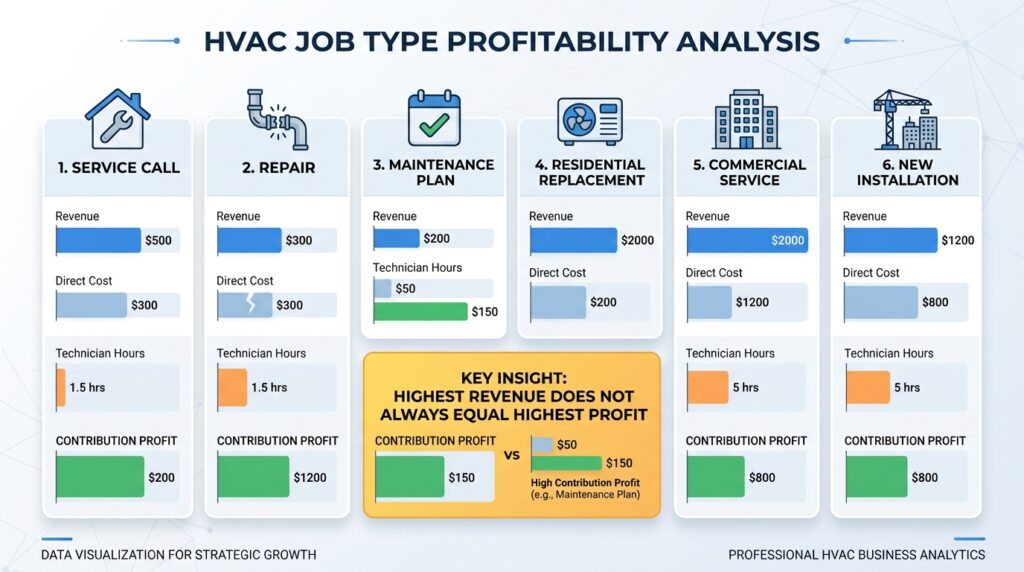
1. Find Out Which HVAC Work Actually Makes You Money
Many owners combine every dollar of revenue into one monthly total. That number is useful for accounting, but it is weak for decision-making.
Separate your operation into job types. At minimum, track:
| Revenue Stream | What to Measure |
|---|---|
| Diagnostic/service calls | Revenue, labor hours, parts, travel, callbacks |
| Repairs | Gross profit per repair and technician |
| Maintenance | Renewal rate, visit cost, repairs generated |
| System replacements | Equipment, labor, permits, financing fees |
| New installation | Crew hours, material variance, rework |
| Indoor air quality | Attachment rate and gross profit |
| Commercial service | Contract value, technician time, collections |
| After-hours work | Premium revenue versus overtime cost |
You may discover that your highest-revenue work is not your highest-profit work.
Imagine two jobs.
Job A produces $9,000 in revenue but needs expensive equipment, two technicians, several hours of travel, permits, a return visit, financing fees, and warranty exposure.
Job B produces $750 but requires one skilled technician, two hours, modest parts, and no return visit.
Revenue alone makes Job A look twelve times better. Contribution to profit may tell a different story.
This is why your accounting needs to be useful operationally, not just accurate at tax time. If you need to build cleaner job categories, expense records, invoices, and reports, how to use QuickBooks for small business gives you a practical starting framework.
2. Stop Pricing From the Competitor’s Price Sheet
One of the fastest ways to build an unprofitable HVAC business is to ask, “What does everyone else charge?” and copy the answer.
Your competitor may have lower rent, older paid-off trucks, cheaper labor, different supplier pricing, higher technician productivity, or terrible bookkeeping. You do not know.
Start with your own economics.
The basic break-even principle is simple. The break-even formula uses fixed costs, selling price, and variable cost to determine how much you need to sell before the business begins producing profit.
For an HVAC company, I would take this further.
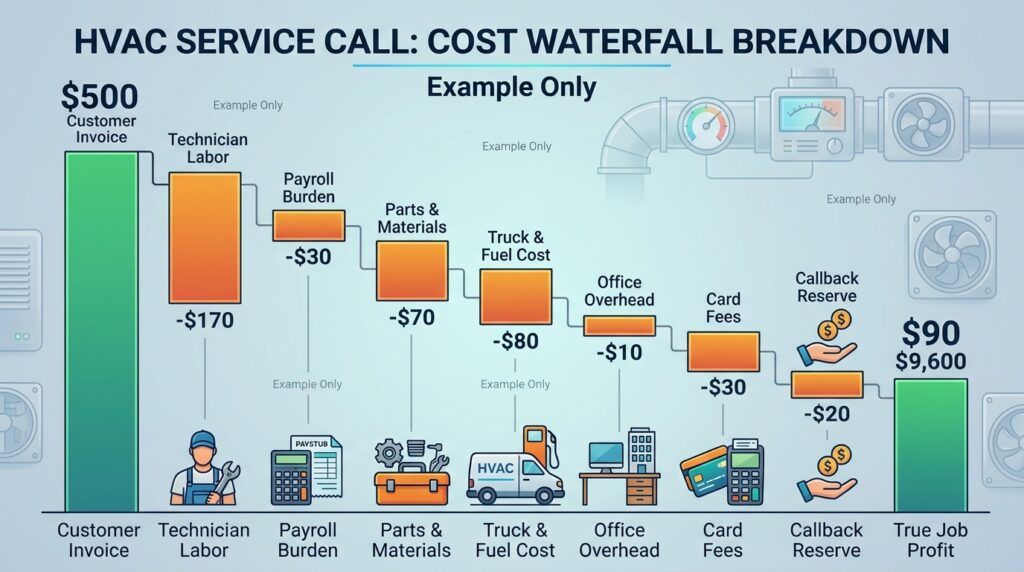
Build a Loaded Hourly Cost
Do not count technician wages alone.
Your real cost of sending a technician to a customer can include:
- Hourly wage
- Payroll taxes
- Benefits
- Workers’ compensation
- Paid non-billable time
- Training
- Vehicle expense
- Fuel
- Insurance
- Uniforms
- Tools
- Software
- Dispatcher support
- Office overhead
- Warranty allowance
- Payment processing
Suppose a technician costs you $32 an hour in wages. It would be dangerous to price work as though $32 were the labor cost.
After the other costs are allocated, your loaded hourly cost could be dramatically higher. Use your own books instead of a generic industry number.
Price the Entire Door-to-Door Job
If a technician spends:
- 25 minutes driving there
- 15 minutes talking with the customer
- 50 minutes diagnosing
- 40 minutes completing the repair
- 15 minutes processing payment and notes
- 25 minutes reaching the next job
That “90-minute repair” may consume almost three hours of productive capacity.
This is where owners accidentally underprice short jobs.
When you know your loaded cost and required contribution, you can decide whether flat-rate pricing, hourly pricing, diagnostic fees, or packaged services work best for your business.
If you are comparing this with another service industry, this practical service-business pricing guide explains the same important principle: price must account for loaded labor, travel, supplies, overhead, and target profit rather than wages alone.
3. Build Recurring Revenue Before Chasing More Leads
One-off repairs can be profitable. They are also unpredictable.
A maintenance customer is different because you already know who the customer is, where the equipment is, and approximately when the next visit should happen.
That gives maintenance programs economic value beyond the price of the tune-up itself.
A well-designed maintenance plan can help you:
- Create predictable scheduled work
- Fill shoulder-season capacity
- Reduce dependency on paid advertising
- Build customer history
- Identify repair opportunities earlier
- Create replacement opportunities later
- Increase repeat business
- Improve scheduling visibility
The key word is well-designed.
A cheap plan that promises too much can become a liability. If your agreement includes two visits, priority service, discounts, free diagnostics, and expensive extras but the annual fee barely covers technician time, you have built recurring work rather than recurring profit.
A useful maintenance program should define what is included, how long each visit should take, what benefits apply, and how much it costs you to fulfill the agreement.
The residential quality maintenance standard gives contractors a useful framework for what a maintenance inspection should contain and allows additional corrective work to be offered separately.
Track the Maintenance Customer’s Lifetime Economics
Do not judge a plan only by annual membership revenue.
Track:
- Annual membership revenue
- Cost of included visits
- Repair revenue generated
- Replacement revenue generated
- Renewal rate
- Discounts given
- Emergency or priority-service costs
- Average years retained
That tells you whether the membership is building a valuable customer relationship or simply giving away service at a lower price.
4. Increase Revenue Per Service Call Without Becoming Pushy
There is a big difference between selling unnecessary work and identifying legitimate needs while you are already on site.
Your customer is paying for expertise. If a technician notices a failed capacitor, deteriorating contactor, clogged drain, unsafe electrical connection, damaged insulation, dirty coil, or airflow problem, explaining it clearly is part of professional service.
The ethical process is simple:
- Inspect properly.
- Document the issue.
- Explain why it matters.
- Give the customer options.
- State the price clearly.
- Let the customer decide.
You can also create structured options.
Instead of offering one repair, you might present:
Option 1: Restore immediate operation.
Option 2: Repair the current failure and address another documented wear item.
Option 3: Compare repair cost with replacement where equipment condition and economics justify that conversation.
The purpose is not to pressure customers into the most expensive option. It is to avoid hiding useful information.
Train Technicians to Explain, Not “Sell”
A technician who says, “You really need to buy this today,” can damage trust.
A technician who says, “This component is still operating, but I measured X. Here is what that means, here are your options, and here is the cost,” gives the customer control.
That distinction matters if you want long-term reviews, referrals, and repeat business.
5. Make Your Routes Denser Before You Add Another Truck
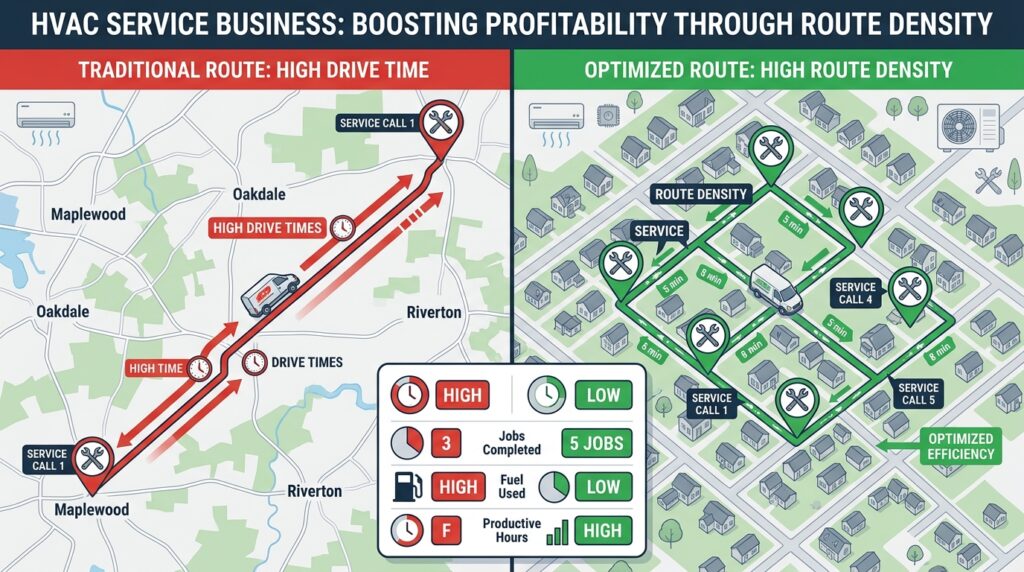
Route density is one of the most underused HVAC profit levers.
A technician sitting in traffic earns no service revenue. Yet you are still paying labor, fuel, insurance, vehicle depreciation, and other overhead.
Imagine Technician A completes five jobs in one tight service area.
Technician B completes three equally profitable jobs but drives across the entire metro area.
Same wage. Same truck. Same workday.
Very different economics.
Before buying another van or hiring another technician, ask whether you can improve:
- Territory boundaries
- Dispatch logic
- Appointment windows
- Technician home locations
- Maintenance scheduling
- Parts stocking
- First-call completion
- Emergency-call allocation
I would create service zones and stop treating every lead within driving distance as equally valuable.
A customer 45 miles outside your core area may be willing to pay your standard diagnostic fee. That does not automatically make the job profitable.
6. Treat Callbacks as a Financial Metric, Not Just a Technical Problem
A callback looks harmless because the customer has already paid.
It is not harmless.
You may pay for:
- Technician time
- Dispatch time
- Fuel
- Vehicle cost
- Replacement parts
- Customer support
- Lost capacity
- Reputation damage
Worse, the callback may happen during peak demand.
That means a technician can spend two hours fixing yesterday’s work for free while a new high-value customer goes to a competitor.
Track callbacks by:
- Technician
- Installation crew
- Equipment type
- Job category
- Part
- Failure cause
- Days since original work
Then classify the root cause.
Was it diagnosis? Installation? A defective part? Poor commissioning? Incomplete customer instructions? A scheduling mistake? A failure unrelated to the original job?
Once you know, you can fix the process instead of blaming people.
Measure First-Time Completion
You should also track whether your technicians have the tools and common parts needed to finish work on the first visit.
A cheap inventory system that repeatedly forces return visits is not actually cheap.
I would rather carry carefully selected fast-moving parts than routinely pay for a second truck roll.
7. Build Marketing That Produces Customers You Want to Keep
Many HVAC businesses treat marketing like a faucet.
Need calls? Turn advertising on.
Busy? Turn it off.
The problem is that paid leads disappear when you stop paying.
A healthier acquisition system includes both immediate lead generation and assets that compound over time.
Start with:
- A complete local business profile
- Accurate service areas
- Genuine customer reviews
- Location-specific service pages
- Helpful repair and maintenance content
- Referral systems
- Email and SMS reminders
- Maintenance-plan renewals
- Past-customer reactivation
Google says local results are primarily influenced by relevance, distance, and prominence, so complete business information, reviews, and accurate details matter for local visibility. You can read its local ranking guidance directly.
If you want a deeper breakdown of building local visibility, this local SEO guide for small businesses explains the foundations of profile optimization, location relevance, reviews, content, and local search measurement. The location example is different, but the underlying method applies well to a service-area business.
Measure Lead Quality, Not Only Cost Per Lead
A $25 lead is not automatically better than a $100 lead.
Track:
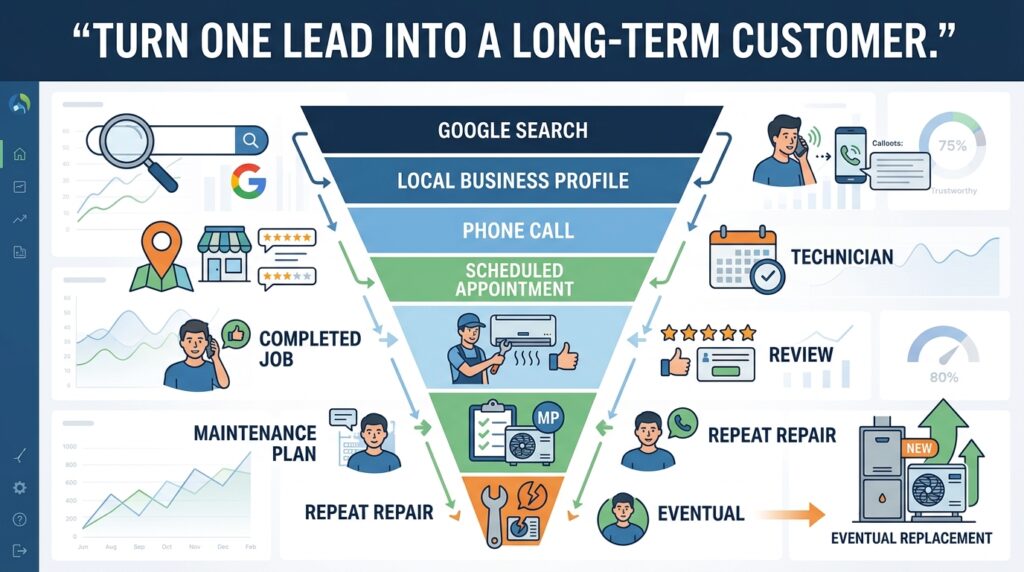
Lead source -> booked appointment -> completed job -> gross profit -> repeat customer
You might discover that one channel sends lots of cheap price shoppers while another sends fewer customers who buy repairs, join maintenance plans, and eventually replace equipment.
The second source can be far more valuable.
Build a Review Request Into the Workflow
Do not rely on technicians remembering to ask.
After a completed job and confirmed customer satisfaction, send a simple review request. Reviews help potential customers evaluate local businesses and appear alongside business profiles in search and maps.
8. Protect Cash Flow, Because Profit on Paper Cannot Pay Payroll
A profitable HVAC company can still run short of cash.
This happens when money leaves faster than it arrives.
You may have to pay:
- Equipment suppliers
- Technicians
- Payroll taxes
- Fuel
- Insurance
- Rent
- Software
- Vehicle payments
before a customer or commercial account pays the invoice.
That gap matters.
Track:
- Accounts receivable
- Average days to payment
- Deposits collected
- Financing settlement time
- Credit-card processing
- Supplier terms
- Inventory on hand
- Payroll timing
For large installations, your deposit and progress-payment structure should match your legitimate cash requirements and local rules.
For commercial work, do not celebrate a large invoice until you understand when it is likely to become cash.
Keep Your Vehicle Economics Visible
Service trucks can quietly become one of your biggest operating expenses. Record fuel, repairs, insurance, mileage, depreciation or lease expense, and downtime.
Federal tax guidance also requires appropriate business records, and vehicle deductions depend on the method and circumstances used. Good operational records therefore serve both management and tax preparation.
If you lease service vehicles, read the contract before treating a long lease as a harmless monthly operating cost. Understanding early vehicle lease exits is useful because early termination, transfer, buyout, mileage, and payoff terms can materially affect the real cost of changing your fleet.
9. Hire for Capacity, Not Vanity
Adding trucks looks like growth.
Sometimes it is.
Sometimes you are simply increasing fixed costs.
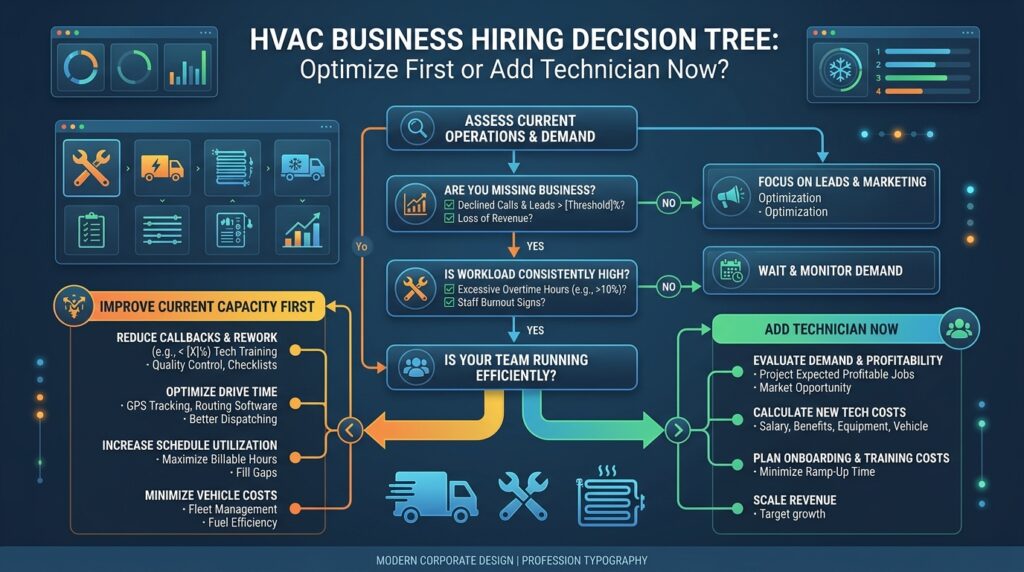
Before hiring another technician, calculate how much profitable demand your current team is turning away.
Ask:
- How many calls are we declining?
- Are they qualified calls?
- What is their expected contribution?
- Are technicians actually full or poorly scheduled?
- How much overtime are we using?
- Can routing improve first?
- Are callbacks consuming capacity?
- Is the owner still doing technician work that someone else could perform?
Then model the new hire.
Include:
- Recruitment
- Training
- Wages
- Payroll burden
- Benefits
- Vehicle
- Tools
- Uniform
- Phone/tablet
- Software seat
- Insurance
- Supervisor time
- Lower initial productivity
The hire becomes attractive when the expected additional gross profit comfortably exceeds the complete additional cost.
10. Use Seasonality Instead of Fighting It
Heating and air conditioning demand is rarely perfectly balanced throughout the year.
Peak periods create an obvious opportunity, but the slower months require planning.
I would use the calendar strategically.
Before Peak Season
Focus on:
- Maintenance
- Equipment inspections
- Customer reactivation
- Membership renewals
- Technician training
- Inventory
- Installation pipeline
During Peak Season
Prioritize:
- High-intent service calls
- Emergency capacity
- Efficient routing
- Fast parts availability
- Qualified replacement opportunities
- Strong dispatch discipline
After Peak Season
Use available capacity for:
- Maintenance
- Deferred work
- Indoor air quality services
- Commercial outreach
- Staff training
- Process improvement
- Vehicle and tool maintenance
The mistake is waiting until the phone stops ringing before deciding how to generate shoulder-season work.
Your maintenance book should already contain customers who need scheduled visits.
11. Do Not Ignore Compliance While Chasing Profit
Profit earned from work you are not legally qualified to perform can become extremely expensive.
If technicians maintain, service, repair, or dispose of equipment that could release regulated refrigerants, Section 608 certification requirements may apply. The technician certification requirements explain who needs certification and the applicable framework.
Separate this from state and local contractor licensing. The requirements can differ by location and work type.
Compliance should be part of job costing too. Permits, licensing, certification, insurance, documentation, disposal, and training are business costs.
Ignoring them does not make the work cheaper. It only hides the risk.
12. Build a Weekly HVAC Profit Dashboard
You do not need 100 metrics.
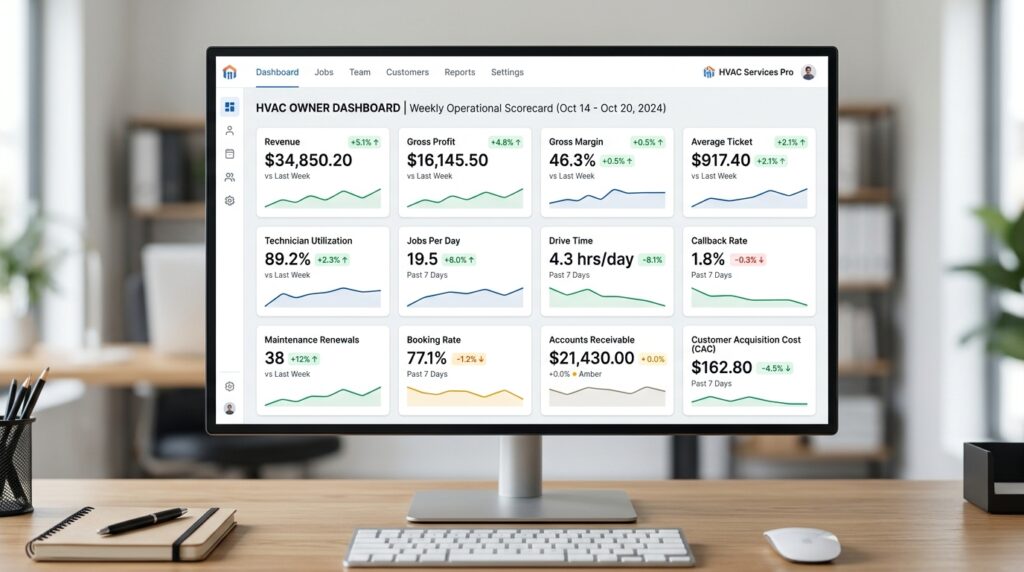
I would start with twelve.
| Metric | Why It Matters |
|---|---|
| Revenue | Overall sales activity |
| Gross profit dollars | Money available to cover overhead |
| Gross margin by job type | Shows weak service lines |
| Average ticket | Revenue created per completed call |
| Calls per technician | Capacity and productivity |
| Revenue per technician day | Operational output |
| Drive time | Route efficiency |
| Callback rate | Quality leakage |
| Maintenance renewals | Recurring revenue health |
| Booking rate | Call handling effectiveness |
| Accounts receivable | Cash-flow risk |
| Marketing cost per profitable customer | Lead quality |
Do not obsess over daily fluctuations.
Look for trends.
If average ticket rises while callbacks also rise, you may have a quality problem.
If revenue rises while gross profit dollars stay flat, your mix or pricing may be deteriorating.
If leads increase but booked work does not, marketing may not be the problem. Phone handling or lead quality may be.
A Better HVAC Profit Model: Follow the Customer, Not Just the Job
Here is one idea I think many profit guides miss.
A job does not exist in isolation.
A customer may move through several stages:
First repair -> maintenance membership -> second repair -> equipment replacement -> referral -> second property
That means the value of a customer is not necessarily the profit from today’s invoice.
But do not use “lifetime value” as an excuse to lose money forever.
Your first job should still make economic sense unless you are deliberately and measurably investing in acquisition.
I would track customers in cohorts.
For example:
- Customers acquired through search
- Customers acquired through referrals
- Maintenance-plan customers
- Emergency-call customers
- Replacement customers
- Commercial customers
After 12 months, compare repeat rate and gross profit.
That tells you which type of customer you actually want more of.
Expert Tips I Would Use in an HVAC Business
1. Raise Bad Prices Before Chasing More Work
If your calendar is full but the bank account is weak, adding leads may make things worse.
Review pricing first.
2. Measure Technician Contribution, Not Just Sales
A technician can generate impressive sales but also create excessive callbacks, discounts, or warranty claims.
Use balanced metrics.
3. Create a Minimum Economic Service Area
Know the distance at which your standard job stops making sense.
Charge appropriately or decline the work.
4. Stock for First-Call Completion
Use your repair history to determine which parts deserve permanent truck inventory.
Do not stock based on guesswork.
5. Make Maintenance Visits Useful
A maintenance plan should produce real inspection and service value, not a five-minute visit created only to sell something.
6. Review Pricing Quarterly
Labor, fuel, insurance, equipment, software, rent, and supplier pricing change.
Your price book cannot remain frozen for years.
7. Separate Owner Pay From Profit
If you work in the business full-time, your labor has economic value.
A company is not highly profitable simply because the owner works 60 hours a week without paying themselves properly.
Pros and Cons of Building a Heating and Air Conditioning Business
Pros
- Essential repair work can create consistent underlying demand.
- Customers can generate recurring maintenance and repeat service.
- Skilled technical work creates a meaningful barrier to entry.
- A strong customer base can support replacement opportunities.
- Local reputation can compound through referrals and reviews.
- The business can develop value beyond the owner’s personal labor.
Cons
- Trucks, tools, equipment, insurance, and inventory require capital.
- Technician recruitment can constrain growth.
- Seasonality complicates staffing and cash flow.
- Poor installation quality can create expensive warranty work.
- Licensing and refrigerant rules require compliance.
- Fast growth can hide weak pricing and operational problems.
The opportunity is attractive precisely because the business is not effortless.
Frequently Asked Questions
How to make money in heating and air conditioning business?
To make money in a heating and air conditioning business, price work from your true cost, prioritize profitable service lines, build recurring maintenance revenue, reduce technician drive time and callbacks, improve repeat business, and track gross profit by job type. More sales help only when the added work produces enough contribution to cover overhead and profit.
Is a heating and air conditioning business profitable?
It can be. Profit depends heavily on your pricing, labor productivity, service mix, purchasing, routing, marketing cost, callbacks, overhead, and customer retention. Do not assume an industry-wide margin automatically applies to your company because current HVAC benchmark articles use materially different averages and definitions.
What is the most profitable part of an HVAC business?
There is no universal answer because the result depends on local pricing and your cost structure. Service and repair can create attractive economics when technicians are productive, while maintenance can create recurring demand and replacements can produce large gross-profit dollars. Measure each division separately.
How can I get more HVAC customers?
Start with local search visibility, customer reviews, referrals, reactivation of previous customers, maintenance reminders, useful website content, and paid advertising where the economics work. Track customers from lead source through completed job and repeat business rather than judging marketing by lead volume alone.
Are HVAC maintenance plans worth offering?
They can be valuable when the membership fee and customer relationship justify the cost of fulfilling the promised service. Track renewal rates, visits, repair revenue, discounts, replacement opportunities, and total fulfillment costs rather than counting memberships alone.
How should I price HVAC service calls?
Calculate the full cost of dispatching and supporting the technician, not wages alone. Include travel, payroll burden, vehicle expense, tools, software, office overhead, payment costs, and an allowance for warranty or callback exposure, then add the contribution required to cover overhead and profit.
How do I increase HVAC revenue without increasing advertising?
Work first with customers you already have. Maintenance renewals, overdue recommendations, seasonal reminders, customer reactivation, referrals, legitimate repair options, and better booking can create additional revenue without purchasing another lead.
Should I buy another HVAC truck to grow?
Only when profitable demand exceeds the capacity of your current operation and routing, scheduling, callbacks, and technician utilization are already reasonably efficient. A truck creates additional insurance, maintenance, fuel, equipment, and capital costs before it creates profit.
How do HVAC companies make money during slow seasons?
Use maintenance visits, planned repairs, customer reactivation, commercial service outreach, indoor air quality work where appropriate, training, and pre-season inspections to smooth demand. Build the schedule before the slow season begins rather than reacting after calls decline.
What numbers should an HVAC owner check every week?
At minimum, monitor revenue, gross profit dollars, gross margin by service line, average ticket, jobs per technician, revenue per technician day, callback rate, drive time, booking rate, maintenance renewals, accounts receivable, and acquisition cost by marketing channel.
Final Thoughts
Learning how to make money in heating and air conditioning business is less about finding one secret high-margin service and more about building a system.
Know your real costs. Price deliberately. Keep technicians productive. Reduce wasted truck rolls. Build recurring customers. Collect cash quickly. Measure marketing by profitable customers, not leads. Watch quality as closely as sales.
If I had to choose one action to take today, I would export the last 90 days of completed jobs and divide them into service, repair, maintenance, and installation. Calculate the direct cost and technician time for each group.
That simple exercise will tell you far more about where your next dollar of profit should come from than another month of blindly chasing more calls.