How to Start a Pest Control Business: A Complete Step-by-Step Guide
Here’s something most people don’t know about pest control. Customers don’t shop around much once they find someone good. They call you back every quarter, for years, without you having to chase them down.
That’s rare in a service business. It’s also exactly why so many people search for how to start a pest control business every year. And why most of them stall out before they ever apply pesticide number one.
Here’s why they stall. Pest control isn’t like starting a lawn care company or a cleaning service. You’re handling regulated chemicals. You need a state license before you touch a single customer’s home. And the rules change depending on which state you’re in.
This blog post will explain the whole thing, including licensing, legal setup, real costs, and specific rules in Texas, California, Florida, Georgia, Arizona, and Oklahoma. No fluff. Just what you actually need to do, in order.
Why Pest Control Is Worth the Regulatory Hassle
Let’s address the obvious question first. If it’s this regulated, why bother?
Because the demand doesn’t stop. Pests don’t care about the economy. Ants, roaches, rodents, and termites show up every year, in every state, regardless of what’s happening with interest rates or inflation.
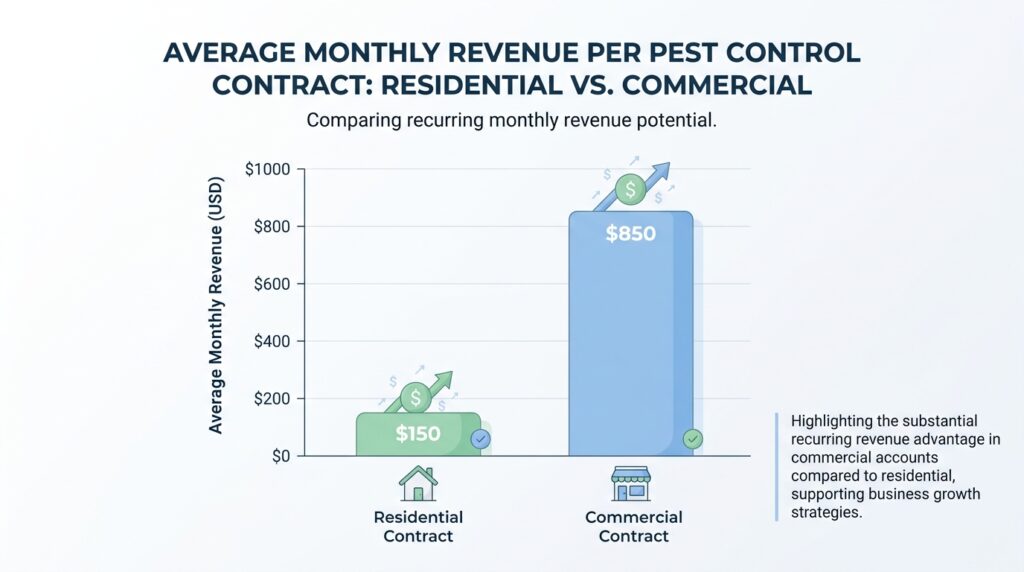
And the recurring-revenue model is genuinely rare. A typical residential contract runs $35 to $75 a month, while commercial accounts often bring in $100 to $500 a month. Unlike a one-time repair job, that client is signed up for the next visit before you’ve even left the driveway.
There’s also a ceiling most new operators don’t expect. Profitability for a solo operator typically kicks in around 75 to 100 regular customers, which most people reach within six to nine months of steady local marketing. That’s a faster path to breakeven than a lot of other home-service businesses.
If you want a sense of how another regulated home-service trade compares (licensing exams, startup costs, the whole setup) our guide on how to start an HVAC business covers a lot of the same ground from a different angle.
Step 1: Understand the Two Layers of Regulation
Before anything else, you need to know how pest control licensing actually works, because it operates on two levels at once.
Federal level. Under the Federal Insecticide, Fungicide, and Rodenticide Act (FIFRA), the EPA requires certification for anyone applying restricted-use pesticides. This is the baseline that every state builds on.
State level. Each state’s Department of Agriculture (or a dedicated pest control board) runs its own licensing program on top of that federal requirement. This is where things get specific. Exam categories, fees, experience requirements, and renewal cycles all vary by state.
That second layer is the part that trips people up. You can’t just get “a pest control license” and use it anywhere. You need the specific license for the state you’re operating in, and if you plan to work across state lines, you’ll need to check whether your state has a reciprocity agreement with the other one.
How to Start a Pest Control Business Step by Step
Here’s the full sequence, from zero to your first paying customer. We’ll go deeper into each of these below, but this is the roadmap.
- Get certified as a pesticide applicator through your state’s licensing exam.
- Choose your business structure — LLC is the most common choice for pest control.
- Register your business and get your EIN from the IRS.
- Apply for your state pest control business license, separate from your personal applicator certification.
- Secure insurance and bonding — at minimum, general liability, plus workers’ comp if you’re hiring.
- Buy your equipment and initial chemical inventory.
- Set up your pricing, service area, and scheduling systems.
- Start marketing and booking your first clients.
Each of these steps has its own details depending on where you live, so let’s break them down one at a time.
Step 2: Get Certified as a Pesticide Applicator
This is the step that actually takes the longest, so start here.
What the Exam Usually Covers
Most states require you to pass a general “core” exam plus at least one category-specific exam (household pests, termites, fumigation, etc.). Expect the exam to cover:
- Pesticide safety and handling
- Pest identification and biology
- Application equipment and techniques
- State and federal laws and regulations
- Environmental and health precautions
You’ll typically need to plan for 40 to 60 hours of studying the official state manual before you’re ready, according to Jim.com’s startup guide. After passing, expect 4 to 8 weeks of processing time before your license actually arrives.
Apprentice or Technician First, in Most States
You usually can’t walk straight into a business-owner license. Most states require you to work under a certified applicator first, either as a registered apprentice or technician, before you qualify to sit for the full certification exam yourself. We’ll cover exactly how long that takes in each state below.
Step 3: Set Up Your Business Legally
Once your certification is underway, it’s time to make the business itself official. This is where how to start a pest control business legally really comes down to a handful of concrete steps.
Choose Your Business Structure
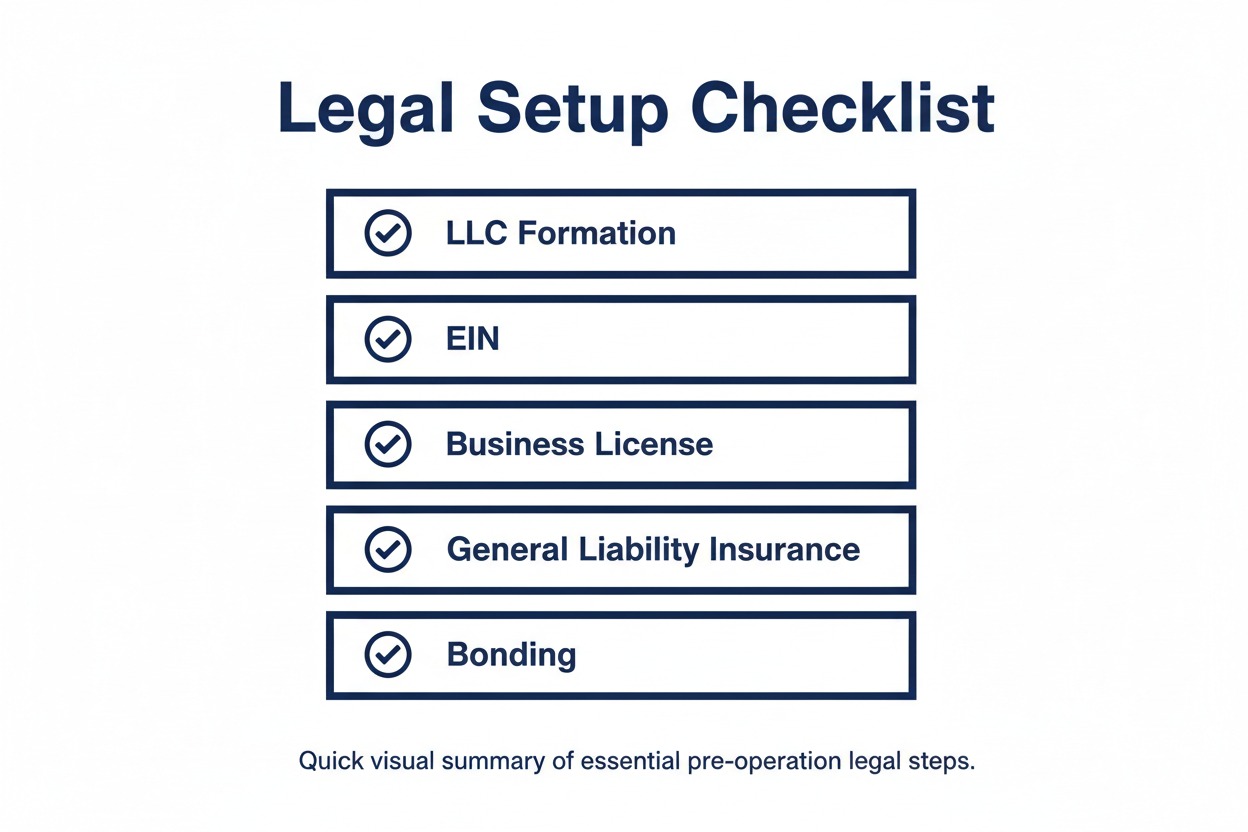
Most pest control owners choose a Limited Liability Company (LLC) because it protects personal assets from business debts and chemical liability claims, while still allowing profits to pass through to your personal taxes. A sole proprietorship is simpler to set up but offers no personal liability protection — a real risk in a chemical-handling business.
If you’re weighing how to actually pay yourself once the LLC is set up, our guide on how to pay yourself as a business owner LLC walks through the options once you’ve got the entity formed.
Register and Get Your EIN
File your LLC (or other structure) with your state, then get a free Employer Identification Number from the IRS. You’ll need it for business banking, hiring, and most license applications.
Apply for Your State Business License
This is separate from your personal applicator certification. Nearly every state requires the business itself to hold its own license, in addition to the individual license held by whoever applies the pesticides. Fees for this range widely. Florida charges $300 for a business license, Georgia charges $180, and Arizona charges $185.
Get Your Insurance and Bonding in Place
This part isn’t optional in most states — many won’t even issue your business license without proof of insurance already in hand. Typical requirements include:
- General liability insurance, often with a minimum of $500,000 to $1 million in coverage
- A surety bond, which some states (like California, at $12,500) require specifically
- Workers’ compensation insurance is generally required once you have employees
- Commercial auto insurance for your service vehicle
- Pollution liability coverage, which covers chemical spill or drift claims that standard general liability often excludes
Budget $3,000 to $7,000 a year for a full policy package as a solo operator, according to multiple startup cost breakdowns, including Jim.com’s guide.
Once you’re this far into the paperwork side, it’s worth revisiting your original business plan to make sure funding, structure, and licensing are all lined up before you spend on equipment. Our piece on what to do after creating a business plan covers that transition from planning to execution.
Pest Control Licensing Requirements by State
Here’s where the details really diverge. If you searched for anything like “how to start a pest control business in Texas” or “how to start a pest control business in Florida,” this is the section for you.
How to Start a Pest Control Business in Texas
Texas licenses structural pest control through the Texas Department of Agriculture’s Structural Pest Control Service (SPCS).
- Start as a registered Apprentice, completing 20 hours of classroom training in general standards plus 8 hours and 40 hours of on-the-job training per category, according to FieldRoutes’ Texas licensing guide.
- Pass the Technician exam to work under a certified applicator’s direct supervision.
- To become a Certified Commercial Applicator and run your own business, you’ll need at least 6 months of work as a licensed technician and 12 months of documented experience within the past 24 months.
- The Structural Pest Control Business License costs $300, while the Technician and Apprentice License costs $125.
- Licenses renew annually, with continuing education units required to remain eligible.
How to Start a Pest Control Business in California
California regulates the industry through the Structural Pest Control Board.
- Company registration requires a $120 application fee.
- You must maintain at least $500,000 in general liability insurance, per the Structural Pest Control Act.
- A $12,500 surety bond is required, executed by an admitted surety insurer.
- Workers’ compensation insurance (or a filed exemption) is mandatory before the Board will issue or maintain your company registration.
- You’ll need a Qualifying Manager who holds the appropriate individual certification for your company to operate legally.
How to Start a Pest Control Business in Florida
Florida’s licensing is administered by the Florida Department of Agriculture and Consumer Services (FDACS).
- The business license fee is $300, plus a $10 fee for each employee identification card.
- Pest control operator certificates are issued to qualified individuals, and the business itself must have a certified operator on staff to operate legally.
- Note that FDACS’s Limited Certification Categories (for landscape maintenance or turf fertilizer applicators) do not authorize operating a full commercial pest control business, a distinction worth double-checking if you’re coming from a landscaping background.
How to Start a Pest Control Business in Georgia
Georgia’s structural pest control program is run by the Georgia Department of Agriculture’s Structural Pest Division.
- Any company must hold a Company License and employ a Designated Certified Operator (DCO) for each service category offered.
- The Company License application fee is $180, according to FieldRoutes’ Georgia guide.
- To become a Certified Operator yourself, you need at least two years of verifiable experience in the past five years, or a relevant degree plus one year of experience.
- Georgia requires general liability insurance of at least $300,000 per occurrence and $500,000 aggregate, and companies performing termite treatment need termite damage repair insurance or a surety bond, per PestControlBusinesses.com’s Georgia breakdown.
- Georgia does not offer reciprocal certification agreements with other states, so out-of-state licenses won’t transfer directly here.
How to Start a Pest Control Business in Arizona
Arizona’s licensing is handled by the Pest Management Division (PMD) of the Arizona Department of Agriculture.
- You’ll first need a Certified Applicator license, then typically a Certified Qualified Applicator license, before applying for a business license.
- The Business License application fee is $185, and requires a copy of your trade name certificate, articles of organization or incorporation, and proof of financial security.
- To qualify as a Qualifying Party (the person responsible for a business’s licensing), you generally need 24 months of certified experience within the past 10 years.
- If you’re specifically searching how to start a pest control business in AZ, note that Arizona separates agricultural pest control (handled by a different division) from structural pest control, so make sure you’re applying through the right department for the work you plan to do.
How to Start a Pest Control Business in Oklahoma
Oklahoma licenses pest control through the Oklahoma Department of Agriculture, Food and Forestry (ODAFF).
- You’ll need a Commercial Applicator License to legally offer pest control services, plus a separate Commercial Pesticide Applicator Business License for each operating location.
- Applicants must pass the core exam and category-specific exams through PSI Services, and submit proof of financial responsibility (typically liability insurance) with the business license application.
- License fees run $100 per category for the commercial applicator business license, with a combined annual cap of $500 across all categories, per Oklahoma’s pesticide law.
- Licensing runs on a calendar-year cycle, so budget for renewal by January 1 each year.
Quick Comparison: Business License Fees by State
| State | Regulatory Body | Business License Fee |
|---|---|---|
| Texas | TDA Structural Pest Control Service | $300 |
| California | Structural Pest Control Board | $120 |
| Florida | FDACS | $300 |
| Georgia | GDA Structural Pest Division | $180 |
| Arizona | Pest Management Division | $185 |
| Oklahoma | ODAFF | $100 per category |
Fees change from year to year, so always confirm current numbers directly with the state agency before budgeting.
How Much Does It Cost to Start a Pest Control Business?
This is one of the most searched questions in the industry, and the honest answer is: it depends heavily on how lean you’re willing to start.
A realistic range for an independent solo operator is $15,000 to $65,000, based on state licensing data and P&L modeling of independent operators. Here’s how that typically breaks down:
| Cost Category | Low End | High End |
|---|---|---|
| Service vehicle (used) | $9,700 | $32,500 |
| Equipment and initial chemicals | $3,900 | $10,800 |
| Insurance (year one) | $3,800 | $10,000 |
| Licensing and legal setup | $500 | $2,000 |
| Technology and marketing | $3,350 | $10,700 |
You can enter at the lower end by starting from a home garage, buying a used truck, and sticking to general residential pest control before adding specialty services like termite or fumigation work.
Most new operators badly overbuy equipment early on. A backpack sprayer, a bait gun, basic hand tools, and standard PPE handle roughly 80% of common residential pest calls. You don’t need a full specialty rig until you’ve actually booked the jobs that require it.
If you’re setting up your books at this stage, our guide to using QuickBooks for a small business is worth a look before your first invoice goes out. Tracking chemical inventory costs and recurring contract revenue separately from day one makes tax season considerably less painful.
Is It Hard to Start a Pest Control Business?
Honestly? The licensing process is the hard part. Not the business itself.
What makes it genuinely difficult:
- Studying for and passing state exams, which can take 40+ hours of prep
- Navigating insurance and bonding requirements before you’re even licensed
- The waiting period — apprentice-to-technician-to-certified timelines can stretch from 6 months to 2 years, depending on your state
- Understanding which category licenses you need for the specific services you want to offer
What’s more straightforward than people expect:
- The actual pest identification and treatment knowledge, which most people pick up quickly with proper training
- Customer acquisition, since pest control has genuinely strong local demand and word-of-mouth potential
- The business side, if you’re already comfortable with basic bookkeeping and scheduling tools
If you’re asking how hard it is to start a pest control business because you’re weighing it against other trades, the regulatory bar is meaningfully higher than that for a cleaning or lawn care business, but lower than for something requiring a multi-year apprenticeship, like electrical work. Most people go from zero to licensed and operating within 6 to 12 months if they stay consistent with studying and paperwork.
Equipment and Chemical Inventory Basics
Here’s a starter kit that covers the bulk of residential general pest calls without overbuying:
- Backpack sprayer ($300–$500)
- Bait gun (~$150)
- Hand duster for crack-and-crevice treatments
- Basic hand tools and inspection equipment (~$200)
- Personal protective equipment — gloves, respirator, eyewear (~$300)
- 30–60 day chemical supply covering general pest and rodent control
Hold off on termite-specific or fumigation equipment until you’re licensed for that category and have actual demand for it. Buying specialty gear before you’ve booked the work that needs it is one of the most common ways new operators sink cash they didn’t need to spend.
Finding Your First Clients
Licensing legally allows you to operate. It doesn’t get you, customers. Here’s what actually works in the early months.
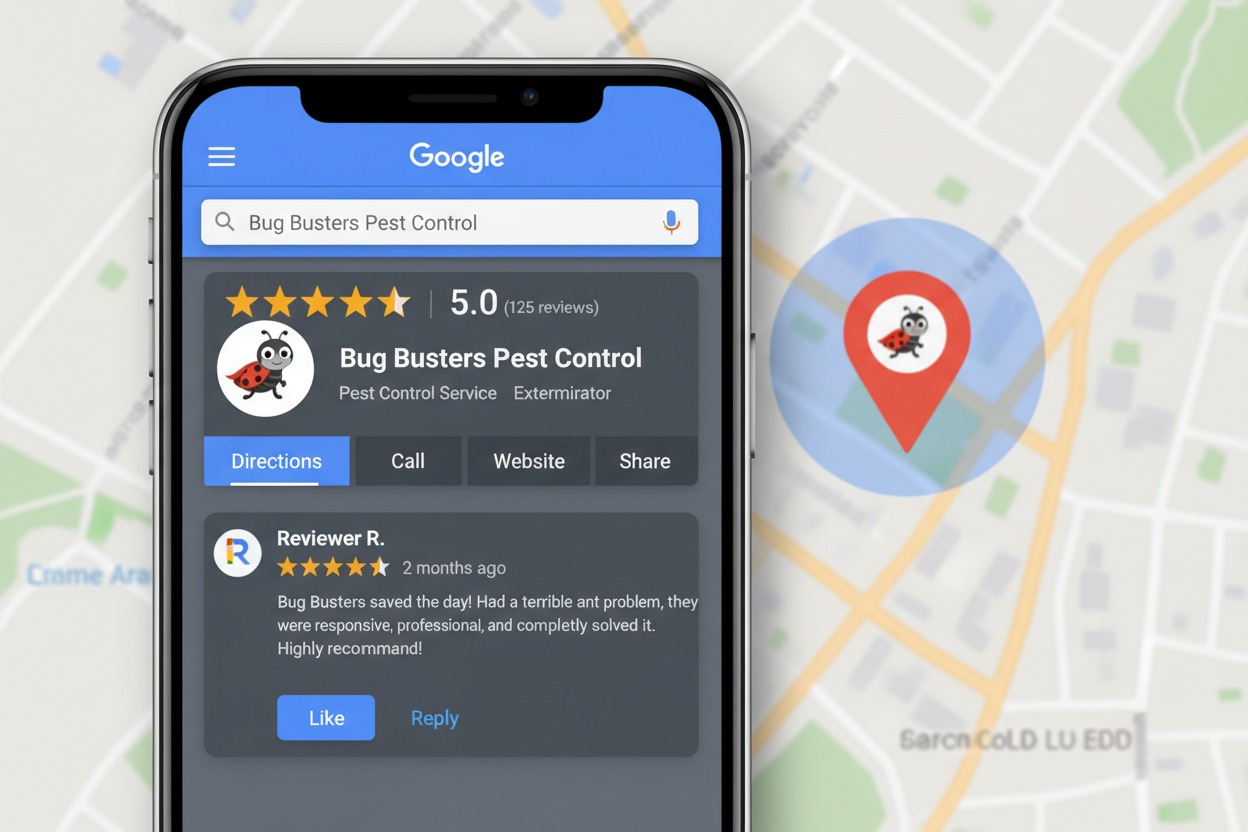
Lean on local search first. Most residential pest control searches occur when someone already has a problem — they see ants in the kitchen and search for help that night. Claiming and fully filling out your Google Business Profile, with real photos and accurate service areas, matters more early on than a polished website.
Target property managers before homeowners. Commercial accounts through property managers tend to have lower cancellation rates and higher monthly value than price-sensitive homeowners who switch providers over a $10 difference. A handful of property management relationships can stabilize your revenue faster than dozens of one-off residential jobs.
Price for recurring contracts, not one-time visits. A single treatment might bring in $150 to $250, but a quarterly service contract at $100 to $175 per visit generates the predictable revenue that makes hiring your second technician possible. Lead with the contract in every sales conversation, even if the customer only asked about a one-time spray.
Ask for the review immediately after a good visit. Pest control reviews carry unusual weight because people are choosing based on trust — they’re letting someone into their home with chemicals. A pattern of recent, specific reviews outperforms a large number of old, generic ones.
Track your customer acquisition cost from day one. Direct mail campaigns average $200 to $300 per new customer, while digital marketing typically runs $150 to $250 per conversion. Knowing this number early tells you which channel is actually worth scaling and which one just feels productive.
Expert Tips for a Stronger Start
- Study the state manual cover to cover, not just the highlights. Exam questions frequently test specific legal definitions and category distinctions that skimmed study guides miss.
- Get your insurance quotes before you finalize your business structure. Some insurers price LLCs differently from sole proprietorships, and knowing the real numbers up front avoids surprises.
- Start with a tight service radius. A 10- to 15-mile radius from your operational base keeps drive time low and route density high, which matters a lot for a one-person operation.
- Document every treatment. Before-and-after photos, product names, EPA registration numbers, and customer acknowledgment of what to expect all protect you from disputes and chargebacks later.
- Don’t hire a salesperson before your second technician. In the early stage, capacity is usually the actual bottleneck, not lead generation. You’re often the best salesperson you have anyway.
Pros and Cons of Starting a Pest Control Business
| Pros | Cons |
|---|---|
| Strong recurring revenue from repeat contracts | Regulated at both federal and state level |
| Steady demand regardless of economic conditions | The licensing process can take 6 months to 2 years |
| Relatively low startup cost compared to many trades | Insurance costs are higher due to chemical liability |
| Can start solo from a home base in many states | Physically demanding work in tight, uncomfortable spaces |
| Clear path to scaling by adding technicians | State rules vary significantly, complicating multi-state growth |
Common Mistakes New Pest Control Owners Make
- Skipping the business license after getting the personal applicator certification. These are two separate licenses in nearly every state — having one doesn’t mean you’re legally allowed to operate as a company.
- Underestimating insurance requirements. Many states won’t issue your business license without proof of coverage already in place, so this can’t be an afterthought.
- Overbuying equipment before booking the work that needs it. Specialty gear for termites or fumigation should wait until you’re both licensed for it and have actual demand.
- Ignoring continuing education deadlines. Most states require annual or biennial continuing education credits, and missing them can suspend your ability to renew.
- Assuming licenses transfer freely between states. Reciprocity agreements are limited and vary — Georgia, for example, doesn’t offer reciprocal certification at all.
Frequently Asked Questions
How long does it take to start a pest control business?
Most people go from starting their certification studies to fully operating within 6 to 12 months, though the apprentice-to-certified timeline in some states can stretch to 2 years, depending on the required work-experience hours.
How much does it cost to start a pest control business?
A realistic solo-operator budget runs from $15,000 to $65,000, covering a used service vehicle, basic equipment and chemical inventory, insurance, licensing, and initial marketing. You can start learning by working from home and buying used equipment.
How do I start a pest control business legally?
Get your personal pesticide applicator certification, form a legal business entity (most commonly an LLC), register for an EIN, apply for your state’s separate pest control business license, and secure the required insurance and bonding before taking on clients.
How to start up a pest control business without prior experience?
Start by registering as an apprentice or technician under a currently licensed pest control business in your state. This is a required step in most states anyway, and it gives you paid, hands-on experience while you work toward your own certification.
Do all states require the same pest control license?
No. Each state runs its own licensing program on top of the federal EPA certification requirement under FIFRA, and specific categories, fees, and experience requirements vary significantly by state. Always confirm current requirements directly with your state’s Department of Agriculture.
Final Thoughts
Starting a pest control business isn’t complicated once you understand the two-layer structure: federal certification as your foundation, and your specific state’s licensing rules on top of it.
Get certified, legally set up your business, secure the right insurance, and start with the equipment you actually need for the calls you’ll get. The regulatory hurdles are real, but they’re also exactly why the business has staying power. Not everyone is willing to clear them, and that’s your advantage.
For more on the legal and financial side of getting a service business off the ground, check out our guides on what to do after your business plan is done and paying yourself from your LLC. And if pest identification is part of your learning curve, our breakdown of carpenter ants vs. black ants is a good place to start.