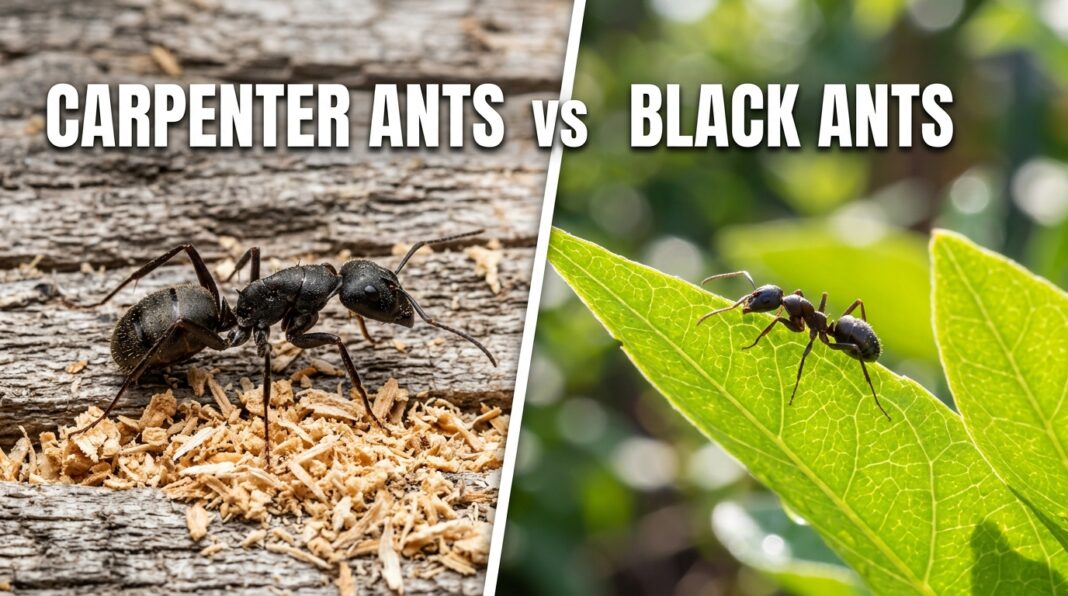
Carpenter Ants vs Black Ants: Introduction
You noticed a large black ant scurrying on the kitchen counter. So what? It’s not a big deal, right?
Maybe it is. Maybe it is not.
Here is the thing – not every black ant is the same. Some just pest the house for crumbs and are harmless, whereas others are the ones damaging your wooden walls without you knowing.
Besides physical differences, the difference between a carpenter ant and a common black ant may significantly impact your actions, whether simply cleaning the surfaces or having to hire a professional.
This guide will cover all the details on distinguishing carpenter ants vs black ants, their roles in your house, and how to deal with their presence.
What Are Carpenter Ants?
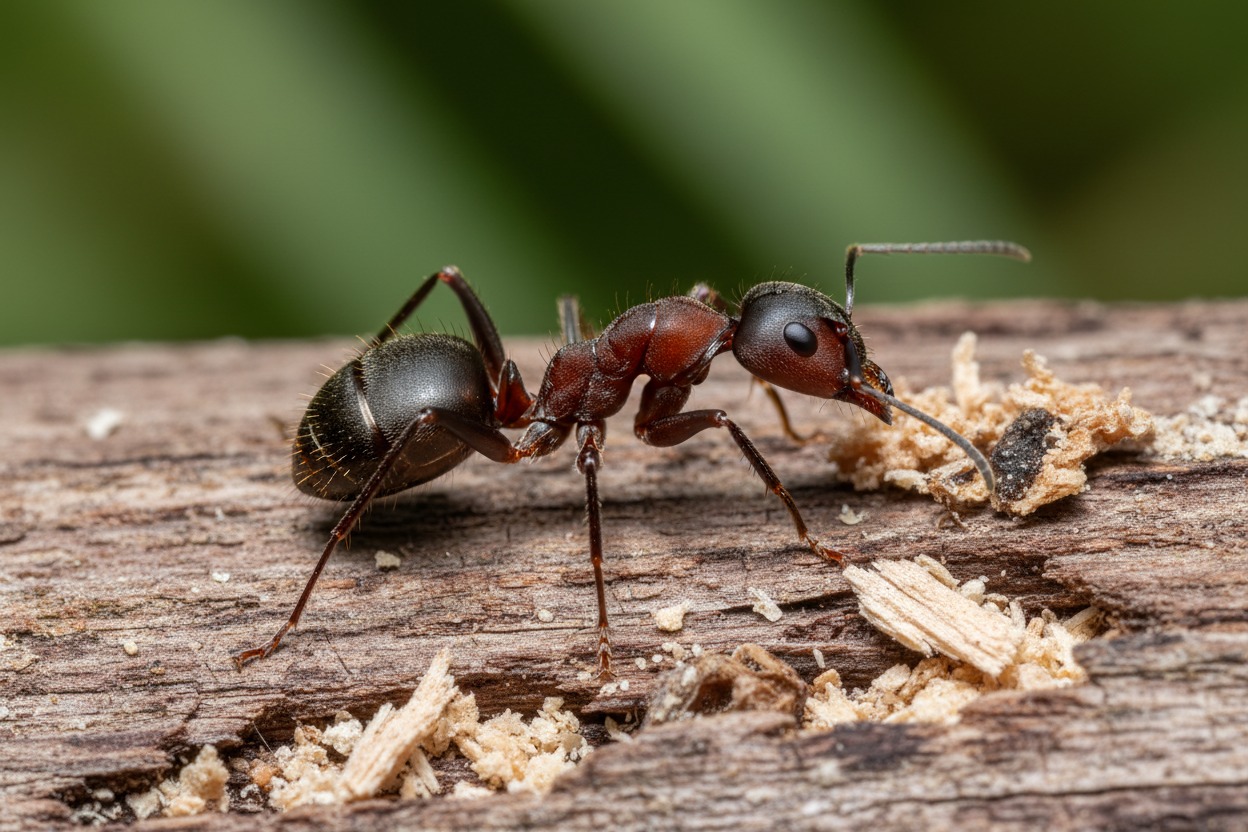
Carpenter ants are part of the genus Camponotus and are some of the largest ants present in North America. Typically, workers are about ½ to ⅝ inch long — large enough to spot immediately.
Most of the time, they are jet black, although some species show reddish-brown or bicolored markings. Actually, their main characteristic is not the color but their behavior.
Carpenter ants don’t consume wood. They hollow it out to create tunnels for their colonies. Wood that is damp and softened is their preferred material: window frames, door frames, decks, and wall voids close to moisture sources.
Key traits of carpenter ants:
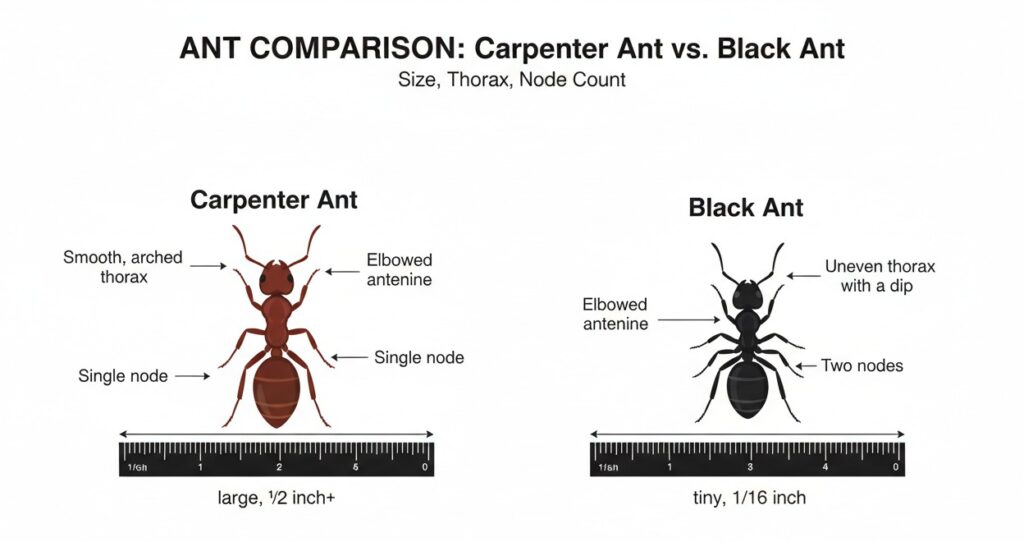
- Large size (½ to ⅝ inch)
- Smooth, arched thorax (the middle body segment)
- Bent (elbowed) antennae
- One node connecting the abdomen to the thorax
- Leave behind fine, sawdust-like frass
They’re most active at night, which is why homeowners often spot them in the evening or early morning. A colony can take 3–6 years to fully mature and may eventually contain 3,000 or more workers.
What Are Black Ants? (The Common House Ant)

When people mention “black ants,” they’re most often talking about one of a few species:
the little black ant (Monomorium minimum), the black garden ant (Lasius niger), or simply pavement
ants that are darker colored.
These are the ants that create the orderly trails you see on the sidewalk or the ones that get into the food in your kitchen.
You can easily differentiate them from carpenter ants by size — they are much smaller, usually 1/16 to ⅛ inch in length. A little black ant worker is hardly bigger than a sesame seed.
Key traits of common black ants:
- Small size (1/16 to ⅛ inch)
- Uniform dark black or dark brown color
- Two nodes connecting the abdomen to the thorax
- Form visible foraging trails
- Attracted to sweet or greasy food
Unlike carpenter ants, these species don’t damage your home’s structure. They’re foragers looking for food — not housing contractors gutting your walls.
Carpenter Ant vs Black Ant: Side-by-Side Comparison
| Feature | Carpenter Ant | Common Black Ant |
|---|---|---|
| Size | ½ to ⅝ inch | 1/16 to ⅛ inch |
| Color | Black, reddish-black, or bicolored | Uniform shiny black |
| Body nodes | 1 node | 2 nodes |
| Thorax shape | Evenly rounded (smooth arc) | Uneven/bumpy profile |
| Antennae | Elbowed | Elbowed |
| Habitat | Wood (decaying or damp) | Soil, pavement, food sources |
| Damage potential | HIGH — structural damage | LOW — nuisance only |
| Diet | Insects, honeydew, proteins | Sweets, proteins, grease |
| Activity time | Mostly nocturnal | Day and night |
| Colony size | 300–3,000+ workers | 2,000–100,000+ workers |
The most reliable quick ID check: size and node count. If the ant is large (nearly the size of your thumbnail) and has one node at the waist, it’s almost certainly a carpenter ant.
How to Identify a Carpenter Ant Infestation
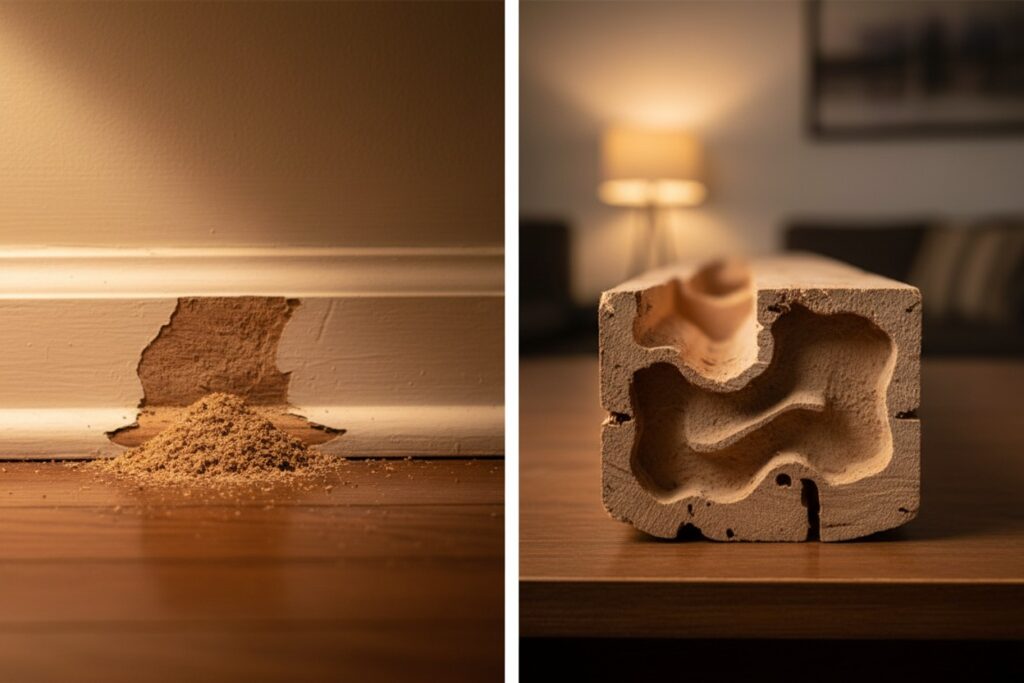
The tricky part about carpenter ants is that their damage is often invisible until it’s serious. Here’s what to look for:
Frass — The Telltale Sign
Carpenter ants push debris out of their galleries through small openings. This frass looks like fine wood shavings mixed with insect parts and soil. If you find small piles of it near wooden structures, take it seriously.
Large Ants at Night
Spotting one or two big black ants occasionally isn’t always alarming. But if you’re seeing multiple large ants inside after dark — especially in your kitchen, bathroom, or near wooden structures — that’s a red flag. Carpenter ants forage up to 100 yards from their nest, so indoor sightings often mean a colony is nearby.
Rustling Sounds in Walls
This sounds dramatic, but it’s real. A large, active colony can produce faint rustling or crinkling sounds inside walls, especially at night. Tap on wood near moisture sources; if it sounds hollow, that’s another warning sign.
Winged Ants (Swarmers)
In spring and early summer, reproductive carpenter ants — called swarmers — leave the nest to start new colonies. Finding winged black ants inside your home, particularly near windows or light sources, is a strong indicator of an established colony in or near your home. The University of Minnesota Extension notes that indoor swarmers almost always indicate a nest inside the structure.
Black Garden Ant vs Carpenter Ant: The Outdoor Edition
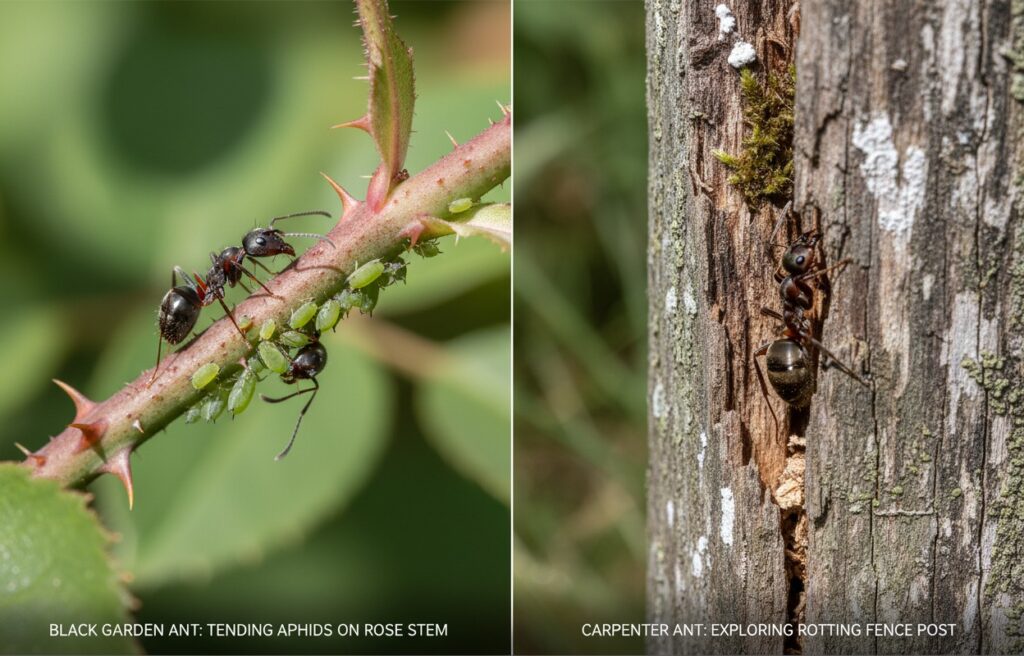
In gardens and yards, the confusion gets even more common. The black garden ant (Lasius niger) is a widespread species that lives underground and tends aphids for honeydew — a fascinating and entirely harmless behavior from your home’s perspective.
Carpenter ants, meanwhile, often nest outdoors first — in old tree stumps, firewood piles, or decaying fence posts — and only move indoors when moisture damage creates the right conditions.
Outdoor ID tips:
- See tiny ants farming aphids on your plants? Those are black garden ants — harmless to your home.
- See a large black ant near a wood pile, fence post, or tree stump? Inspect that wood. You may have a carpenter ant satellite colony nearby.
The USDA Forest Service has documented carpenter ants as a natural part of forest decomposition — they’re ecologically important, just not something you want inside your home.
Large Black Ant: Is It Always a Carpenter Ant?
Not necessarily — but it’s the most likely culprit.
A few other large ant species can appear black or dark brown:
- Bullet ants (Paraponera clavata) — tropical species, not found in most of the continental US
- Odorous house ants — smaller, but dark; emit a rotten coconut smell when crushed
- Pavement ants — medium-sized, dark brown; typically found under sidewalks and slabs
The rule of thumb: if you’re seeing a large black ant (½ inch or bigger) in or around your home in North America, treat it as a carpenter ant until proven otherwise. Get a closer look at the thorax — that smooth, rounded profile is the dead giveaway.
Are Carpenter Ants Dangerous to Humans?

Carpenter ants can bite — their mandibles are strong enough to break skin — but they’re not venomous and rarely bite unless directly handled or threatened.
The real danger is structural. A mature colony excavating wood in your walls, attic, or floor joists for years can cause significant and costly damage. Unlike termites, they don’t eat the wood, but the hollowing effect on load-bearing structures is just as serious over time.
Pest control data from the National Pest Management Association estimates that carpenter ants and termites together account for billions in property damage annually.
Common moisture-prone areas they target:
- Around roof leaks
- Near plumbing penetrations
- Windowsills and door frames
- Crawl spaces and basement sills
- Hollow porch columns
How to Get Rid of Carpenter Ants vs Black Ants
The treatment approach differs significantly between these two types.
For Common Black Ants
These are generally manageable with DIY methods:
- Bait stations — slow-acting baits let workers carry poison back to the colony. Products containing borax are effective and widely available.
- Seal entry points — caulk cracks around windows, doors, and pipe penetrations.
- Eliminate food sources — store food in sealed containers, clean up crumbs, fix leaky faucets.
- Perimeter sprays — residual insecticide sprays around the foundation can create a barrier.
For Carpenter Ants
DIY can help, but it’s rarely enough for an established colony:
- Find and fix moisture — eliminate the damp wood that attracted them in the first place. No moisture fix, no lasting solution.
- Bait products — gel or granular baits with slow-acting insecticides can work if the colony is foraging indoors.
- Dust treatments — insecticidal dust injected into wall voids (requires locating the gallery) is highly effective.
- Professional treatment — for established colonies inside walls, a licensed pest control professional is usually the most reliable option. They can locate satellite nests and treat galleries directly.
Expert Tip: Carpenter ants are almost always a symptom, not just a problem. Before treating, find where your moisture issue is. A pest control company that skips this step is selling you a temporary fix.
Prevention Tips for Both Species
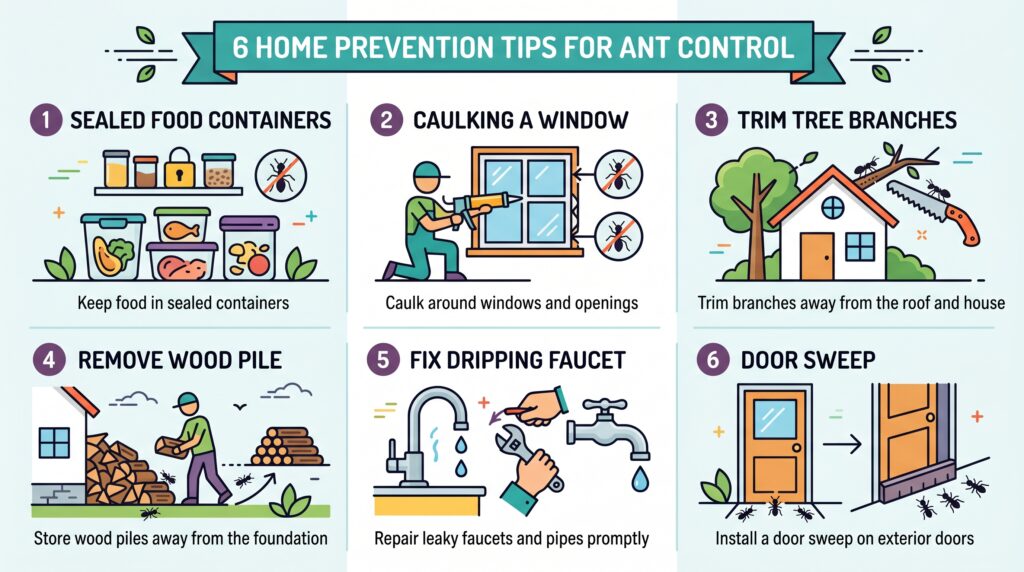
Whether you’re dealing with large black ants or tiny foragers, prevention is far easier than treatment.
Universal ant prevention tips:
- Store food (especially sweets) in airtight containers
- Fix leaky pipes, gutters, and roof areas promptly
- Trim trees and shrubs so branches don’t touch your roof or walls
- Keep firewood stored away from your home’s foundation
- Seal cracks in your foundation, siding, and around utility entries
- Replace rotting wood before it becomes an invitation
- Use door sweeps and weatherstripping on exterior doors
For carpenter ants specifically, reducing wood-to-soil contact around your home is one of the most effective long-term deterrents. Raised deck posts, gravel borders, and proper drainage make your home far less attractive.
Expert Tips: What Pest Professionals Actually Look For
When a pest control inspector visits for an ant problem, here’s what they’re actually assessing — and what you can check yourself:
- Moisture mapping — They look for areas where water has been or is actively getting in. Carpenter ants follow moisture.
- Wood tap test — Knocking on suspected wood and listening for hollowness or crunching.
- Frass location — The position of frass deposits helps pinpoint gallery locations inside walls.
- Entry point analysis — Ants don’t teleport; they come in somewhere. Pros trace the foraging trail back to the entry.
- Exterior nesting sites — Old stumps, wood piles, and dead sections of trees within 100 yards are inspected as potential parent colony locations.
The National Pest Management Association provides continuing education standards for licensed inspectors — a useful resource if you’re evaluating pest control companies.
FAQs: Carpenter Ants vs Black Ants
Q1: How can I tell if a big black ant is a carpenter ant?
Look at the thorax — the middle section of the body. A carpenter ant has a smooth, evenly rounded thorax when viewed from the side. Also check body size (½ inch or larger) and look for a single node at the waist. Common black ants are much smaller and have two nodes.
Q2: Do carpenter ants mean I have termites too?
Not necessarily. They’re completely different insects. However, both are attracted to moisture-damaged wood, so finding one is a good reason to have a professional inspect for the other as well.
Q3: Why am I seeing large black ants in my house in winter?
If carpenter ants appear indoors during winter, it strongly suggests they have a satellite nest inside your home. They wouldn’t normally be active in cold weather unless they’re living inside a heated structure.
Q4: Can I use the same bait for carpenter ants and black ants?
Some baits work on both, but carpenter ants prefer protein-based and sweet baits depending on the season (protein in spring/summer, sweets in fall). Little black ants tend to prefer sweet baits year-round. Check product labels for species-specific guidance.
Q5: How much does it cost to treat carpenter ants professionally?
Treatment costs vary by region, infestation size, and company, but a single carpenter ant treatment typically ranges from $250 to $500. If structural repairs are needed due to damage, costs can climb significantly. Getting 2–3 quotes from licensed pest control companies is always recommended.
Conclusion
Should you stumble upon a big black ant inside your dwelling, there’s no need to freak out- it definitely warrants a step of getting to know it better though!
Initially, the differences between carpenter ant and black ant orphan down to just a few basics: their respective sizes, shapes of their bodies, their behaviors, etc. So, once you mature correctly both size and body shapes, behavior, etc., you would directly know whether you are dealing with a harmless worker ant or an environmentally destructive threat level-first.
If you are not feeling sure about what to do next, apply this two-second evaluation method: Is it big enough (half-inch long or more)? No bumps on the thorax? Only one total waist node? This is definitely a carpenter ant, and your best option is probably to do something about it.
The usual black ants can be gotten rid of by removing food leftovers, dusting with powders or spraying with insecticides, closing the holes through which they come in, and finally, using baits. Alternatively, the major moisture problem with carpenter ants is discovered first. Then treatment. If you see them indoors during winter or find sawdust in closets near wooden parts of the house, don’t hesitate. Get a professional pest control company.
Have you noticed any of the looks like giant black ants inside your house? Please, write below in the comments where you caught them — then we will assist you to determine what you have.”
Information in this article is based on guidance from Penn State Extension, University of Minnesota Extension, Orkin, and the National Pest Management Association.
Also Read: How to Reset Garage Door Opener (Step-by-Step Guide)
How Long Does It Take to Fill a Cavity? Everything You Need to Know