
What Is a CRO in Business? A Clear Guide to the Role
If you are wondering what is a cro in business, the most common answer in an executive-management context is Chief Revenue Officer. A CRO is a senior executive responsible for coordinating the parts of a company that influence revenue, commonly including sales, marketing, customer success, partnerships, pricing, and revenue operations.
The important word is coordinating. A CRO is not simply a salesperson with a C-suite title. The position is designed to bring different revenue-related teams under a shared strategy so that customer acquisition, conversion, retention, and expansion do not operate as disconnected activities. LinkedIn’s description of the role, for example, emphasizes alignment among revenue-generating departments as well as collaboration with finance, product management, and marketing.
Quick Answer: What Does CRO Mean in Business?
In a corporate leadership discussion, CRO meaning usually refers to Chief Revenue Officer. This executive is accountable for the company’s broader revenue strategy and typically helps connect sales, marketing, customer success, partnerships, pricing, and revenue operations.
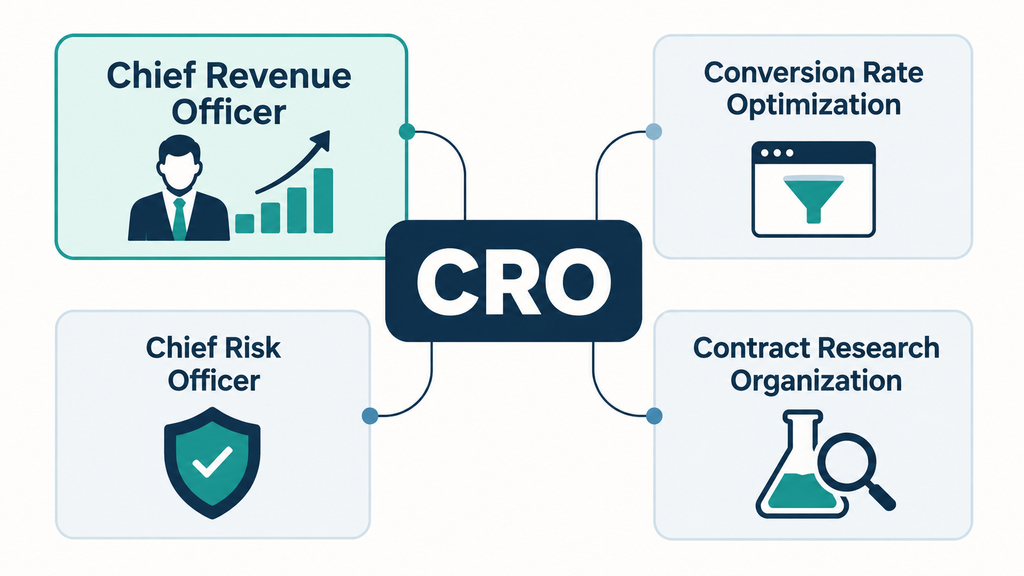
There is one important complication. CRO can mean different things in other settings, including conversion rate optimization in digital marketing and Chief Risk Officer in financial or risk-management discussions. That is why context matters whenever you see the abbreviation.
| If you see CRO in… | It may mean… | Main focus |
|---|---|---|
| Executive leadership | Chief Revenue Officer | Company revenue growth |
| Website or marketing analytics | Conversion Rate Optimization | Increasing desired website actions |
| Banking or risk management | Chief Risk Officer | Enterprise and financial risk |
| Pharmaceutical research | Contract Research Organization | Outsourced research services |
This article focuses on the Chief Revenue Officer because that is generally what CRO means when the discussion involves executives, organizational charts, revenue strategy, sales leadership, or C-suite positions.
What Does a Chief Revenue Officer Actually Do?
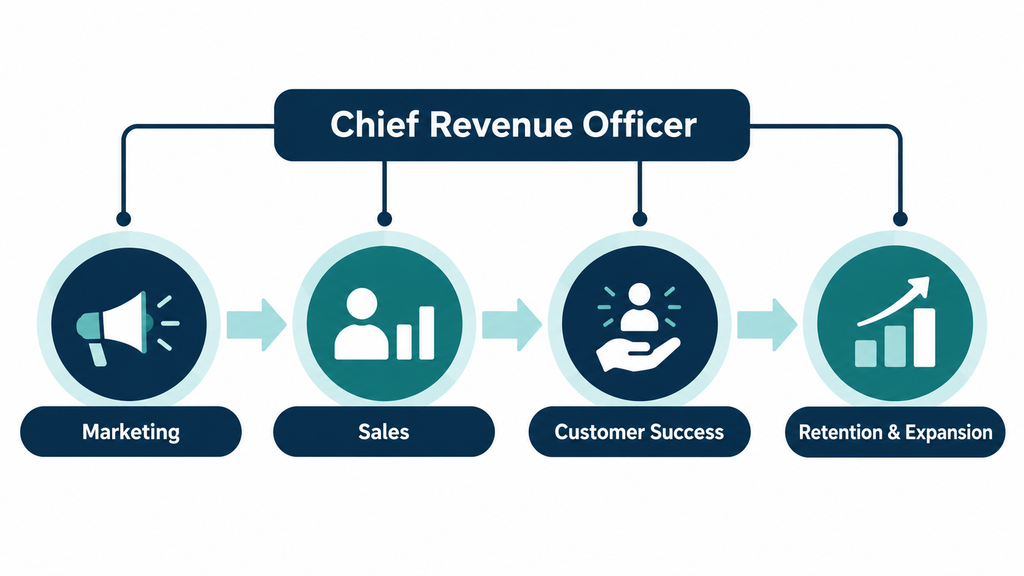
A CRO looks at revenue as a connected system rather than treating sales, marketing, and customer retention as separate problems. Salesforce describes the role as connecting revenue-related functions that may include marketing, sales, customer success, pricing, and revenue operations.
Imagine that marketing generates plenty of leads, but sales says those leads are poor quality. At the same time, the customer-success team reports that customers attracted through a particular campaign frequently cancel.
Without coordinated leadership, each department might optimize its own numbers. Marketing could celebrate lead volume while sales complains about conversion and customer success deals with the resulting churn. A CRO’s job is to examine the entire revenue journey and determine how those pieces affect one another.
Typical CRO Responsibilities
The exact job varies by company, but common responsibilities include:
- Building and executing the overall revenue strategy
- Aligning sales, marketing, customer success, and related teams
- Reviewing sales pipeline health and revenue forecasts
- Identifying new markets, customer segments, or revenue opportunities
- Helping shape pricing and packaging decisions
- Improving customer acquisition and retention processes
- Coordinating strategic partnerships
- Establishing shared performance metrics
- Working with finance on forecasts and investment decisions
- Working with product teams on customer and market feedback
- Removing friction between departments that influence revenue
LinkedIn’s Chief Revenue Officer hiring guide also includes marketplace analysis, pipeline monitoring, pricing collaboration, strategic partnerships, and coordination among marketing, sales, and account-management teams.
A company’s individual structure matters, however. McKinsey notes that C-suite composition varies according to the organization’s business model and operating needs, so there is no universal organizational chart that every CRO must follow.
Why Do Companies Create a CRO Position?
Companies often create a CRO role when managing revenue becomes too complicated to leave entirely inside separate departmental silos. Sales may have one set of goals, marketing another, and customer success another, even though all three influence the same customer relationship.
Revenue operations, often shortened to RevOps, reflects the same cross-functional thinking. Gartner describes RevOps as an end-to-end model that integrates people, processes, technology, and customer engagement across revenue-related functions to improve efficiency and predictability.
A CRO can provide executive-level ownership above those connected activities. The person is not necessarily performing every RevOps task directly. Instead, the CRO can set the commercial direction while revenue operations supplies the systems, processes, data, and reporting needed to execute it.
This becomes particularly useful when a business grows beyond its early stage. A founder may initially handle major sales, pricing, customer relationships, and partnerships personally. As the company expands, those responsibilities become distributed across specialized teams.
If you are still thinking about the transition from planning into execution, Rarely Notes’ guide to what an entrepreneur should do after creating a business plan provides useful context on funding, operations, performance monitoring, and adapting the plan as a company grows. what an entrepreneur should do after creating a business plan
CRO vs CFO: What Is the Difference?
The CRO vs CFO distinction becomes much clearer when you look at what each executive owns.
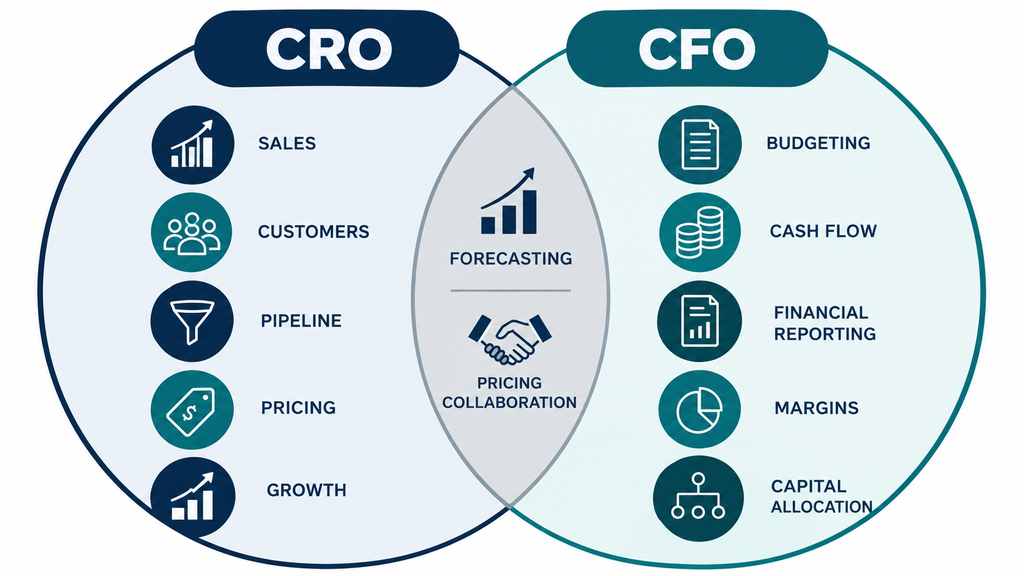
A Chief Revenue Officer primarily concentrates on the company’s ability to generate and expand revenue. A Chief Financial Officer, by contrast, has a broader financial-management mandate involving the organization’s finances, planning, reporting, capital, cash, profitability, and financial controls.
| Area | CRO | CFO |
|---|---|---|
| Primary focus | Revenue generation | Financial management |
| Sales strategy | Usually heavily involved | Usually advisory or financial partner |
| Marketing alignment | Often involved | Usually evaluates financial implications |
| Customer retention | May be directly responsible | Monitors financial effect |
| Revenue forecasting | Major contributor | Reviews and integrates into financial forecasts |
| Cash flow | Indirect influence | Core responsibility |
| Financial reporting | Not normally the owner | Core responsibility |
| Pricing | Commercial perspective | Margin and financial perspective |
| Budgeting | Provides revenue-side needs | Typically leads financial planning |
| Capital allocation | Advises on growth priorities | Major responsibility |
This does not mean one executive is more important than the other. Their responsibilities are complementary.
For example, suppose a company wants to lower its subscription price to attract more customers. The CRO might evaluate whether the price change improves acquisition, competitive positioning, retention, and expansion opportunities. The CFO would examine how the change affects margins, cash flow, profitability, and financial forecasts.
The two perspectives should meet before a decision is made. A company can grow revenue while damaging profitability, just as aggressive cost control can protect margins while making future growth more difficult.
Rarely Notes’ guide on making money in a heating and air conditioning business demonstrates this distinction well in an operational context: revenue alone does not show whether work is producing adequate gross profit after labor, materials, callbacks, and overhead. making money in a heating and air conditioning business
CRO vs VP of Sales: Are They the Same?
A CRO and a VP of Sales may work closely, but the titles normally describe different scopes.
The VP of Sales is usually focused primarily on the sales organization. That might include sales quotas, territory design, account executives, sales managers, pipeline management, coaching, and closing performance.
A CRO generally works across a broader customer and revenue lifecycle. Kingsley Gate notes that a CRO’s remit typically reaches beyond a single sales function and may include responsibility across several revenue-related areas and the customer lifecycle.
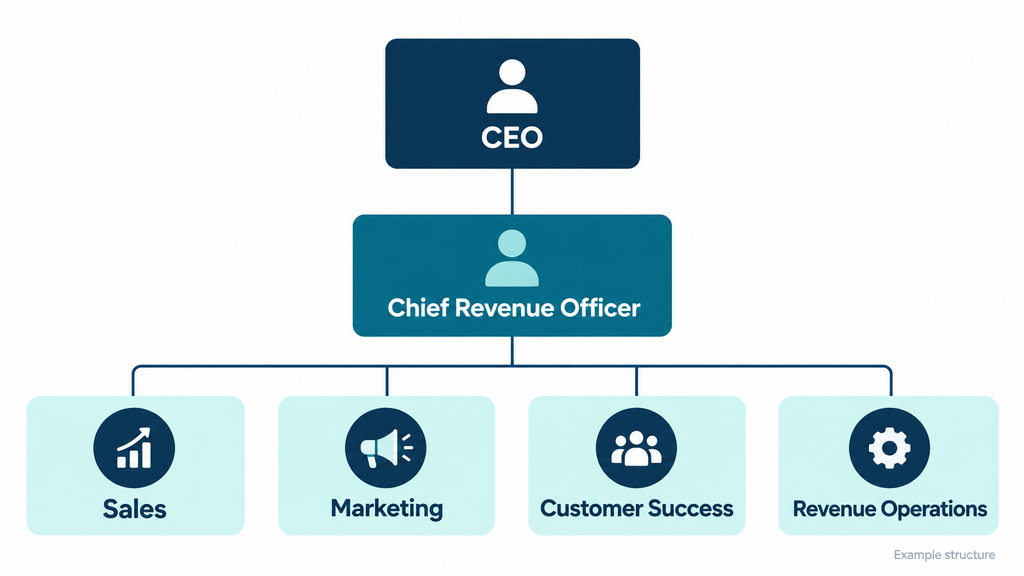
A simplified hierarchy might look like this:
CEO → CRO → VP of Sales / Marketing Leader / Customer Success Leader / RevOps Leader
That is only an example. Some companies place marketing under a CMO who works alongside the CRO, while others have sales and customer success report directly to the CRO. Organizational design depends on the company’s size, business model, leadership team, and strategic priorities.
CRO vs CMO: Where Do Their Responsibilities Overlap?
The Chief Marketing Officer generally focuses on the market, brand, demand generation, positioning, communications, customer acquisition, and marketing strategy. The CRO is concerned with how those activities connect to the wider revenue engine.
The overlap can be substantial. A CMO might determine how to generate qualified demand, while the CRO asks whether that demand converts into customers who stay, renew, expand, and create sustainable revenue.
This is why a well-designed CRO position should not simply duplicate other executives. Before creating the role, a company should clearly define what the CRO owns, which leaders report to the position, and where decision-making authority begins and ends.
Marketing itself can influence the revenue system in several ways. For example, Rarely Notes’ guide to influencer marketing for small businesses illustrates how an acquisition channel must ultimately be assessed within a wider business strategy rather than viewed only as promotional activity.
What Metrics Does a CRO Watch?
A good CRO does not judge the business using revenue alone. Revenue is the final output of multiple activities, so the executive needs indicators that explain why the number is changing.
Depending on the business model, a CRO may monitor:
| Metric | What it can reveal |
|---|---|
| Sales pipeline | Potential future business |
| Conversion rate | How effectively opportunities progress |
| Average deal value | Value generated from typical wins |
| Sales-cycle length | How quickly opportunities become customers |
| Customer acquisition cost | Cost of winning new customers |
| Customer retention | Ability to keep existing customers |
| Renewal rate | Recurring customer continuation |
| Expansion revenue | Additional revenue from current customers |
| Revenue by channel | Which acquisition routes perform best |
| Forecast accuracy | How predictable the revenue operation is |
The correct metrics depend heavily on the company’s model. A subscription software company will care deeply about renewals and recurring revenue, while a manufacturer, agency, retailer, or local service business may require a different dashboard.
One detail I would not overlook is metric ownership. If marketing, sales, finance, and customer success calculate similar metrics differently, leadership can spend more time arguing about the numbers than improving them. Gartner’s RevOps guidance specifically emphasizes shared data, milestones, processes, and governance as foundations for coordinated revenue decision-making.

What Skills Does a Chief Revenue Officer Need?
Because the role crosses departmental boundaries, a CRO needs more than strong selling ability. The executive must understand how different parts of the business interact and be able to make decisions without optimizing one department at the expense of another.
Important capabilities commonly include:
- Revenue strategy: Understanding where revenue currently comes from and where future opportunities may exist.
- Cross-functional leadership: Getting sales, marketing, product, finance, and customer teams working toward compatible objectives.
- Data interpretation: Turning pipeline, customer, retention, and market data into decisions.
- Forecasting: Building realistic expectations about future revenue.
- Customer understanding: Knowing why customers buy, stay, upgrade, leave, or choose competitors.
- Pricing judgment: Understanding how pricing influences demand, sales execution, customer value, and company economics.
- Communication: Explaining strategy clearly to executives, teams, and sometimes boards or investors.
- Operational thinking: Creating repeatable processes instead of relying on individual heroics.
LinkedIn’s CRO role guide similarly emphasizes business strategy, metrics-based decision-making, leadership, revenue growth, product development, marketing, branding, and partnerships.
When Does a Business Need a CRO?
Not every company needs a Chief Revenue Officer. In a small company, adding another executive title can create unnecessary complexity if the founder or CEO can still coordinate the revenue operation effectively.
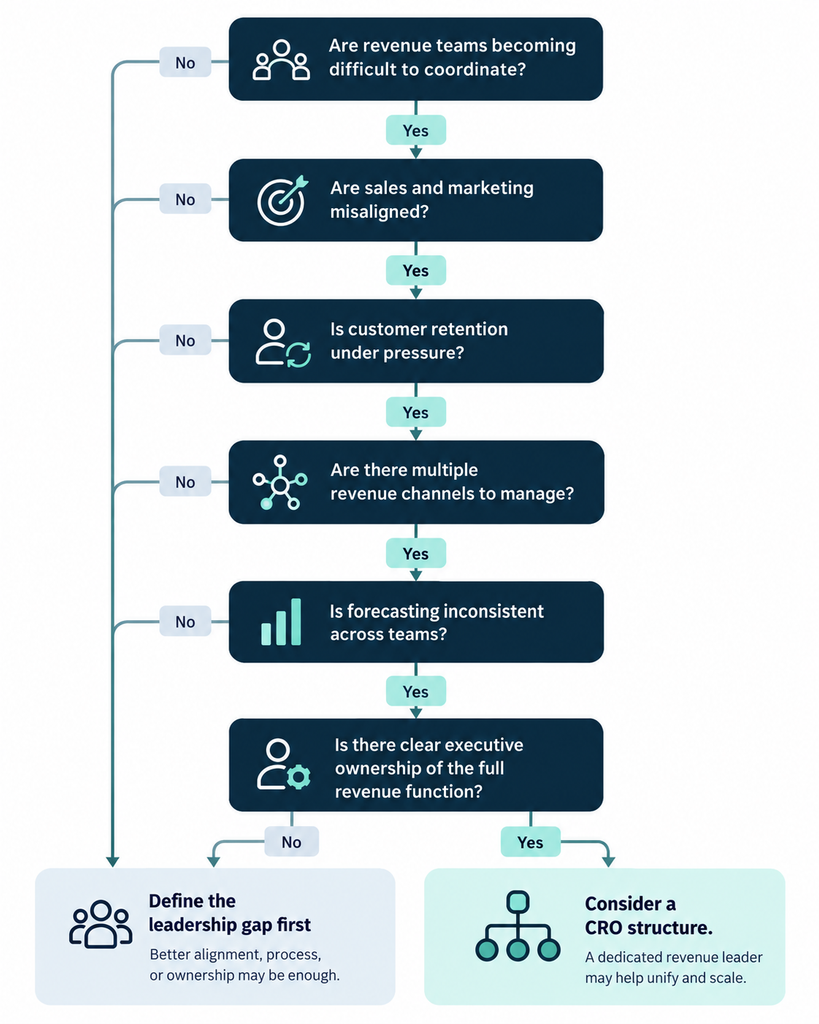
I would start considering the role when several of these problems appear together:
- Sales and marketing regularly disagree about lead quality.
- Revenue forecasting has become unreliable.
- Customer retention is important but has no clear executive owner.
- Multiple sales channels have developed independently.
- Sales, marketing, and customer-success teams use conflicting metrics.
- The business is entering several markets or customer segments.
- Pricing has become strategically complicated.
- Revenue growth increasingly depends on existing customers, not only new sales.
- A CEO is spending too much time coordinating revenue departments personally.
- The organization needs one executive accountable for the entire commercial system.
The decision should start with the company’s problem rather than the title. If the real issue is weak sales management, hiring an excellent VP of Sales could be more appropriate. If the problem is fragmented ownership across acquisition, conversion, retention, pricing, and expansion, a CRO may fit the structure more naturally.
Common Mistakes When Defining the CRO Role
The first mistake is treating a CRO as simply a renamed head of sales. If the executive has no authority or visibility beyond the sales department, the broader title may create expectations that the organizational structure cannot support.
Another problem is giving the CRO responsibility for revenue without clear authority. Holding one person accountable for growth while marketing, pricing, customer success, and sales all report elsewhere can create conflict unless decision rights are clearly established.
Companies should also avoid assuming that creating the position automatically fixes departmental silos. Revenue alignment still requires shared processes, consistent data definitions, communication, and agreement about responsibilities. Gartner’s research on RevOps makes a similar point: integration depends on cooperation across functions rather than merely changing job titles.
Finally, remember that revenue and profit are not identical. A CRO may push for growth, but growth must still work within the company’s financial constraints. That is one reason close cooperation between the CRO and CFO matters.
Frequently Asked Questions
What does CRO stand for in business?
CRO commonly stands for Chief Revenue Officer when discussing executive leadership. The person oversees or coordinates the company’s revenue strategy across functions such as sales, marketing, customer success, partnerships, and revenue operations.
What is the simple CRO meaning?
The simplest CRO meaning in an executive context is Chief Revenue Officer, the senior leader responsible for making the company’s revenue-generating activities work together. In other contexts, CRO can mean conversion rate optimization, Chief Risk Officer, or Contract Research Organization, so always check the surrounding topic.
What is the difference between CRO vs CFO?
In a CRO vs CFO comparison, the CRO is primarily concerned with generating and expanding revenue, while the CFO oversees the company’s broader financial management. They often collaborate on forecasting, pricing, budgets, investment decisions, and the financial consequences of growth initiatives.
Is a CRO higher than a VP of Sales?
A CRO is generally a broader C-suite role, while a VP of Sales normally leads the sales function. However, titles and reporting structures differ among organizations, so the actual responsibilities matter more than the title alone.
Who does a CRO report to?
A Chief Revenue Officer often reports to the CEO because the position typically spans several major business functions. Company structures vary, however, and the reporting line should match the authority and responsibilities assigned to the role.
Who reports to a Chief Revenue Officer?
Depending on the company’s structure, leaders from sales, revenue operations, customer success, partnerships, account management, or marketing may report to the CRO. Not every company puts all of these teams under the same executive, so there is no universal reporting structure.
What is the difference between CRO and conversion rate optimization?
A Chief Revenue Officer is an executive position, whereas conversion rate optimization is a marketing and experimentation discipline focused on increasing the percentage of users who complete a desired action. You can usually tell which meaning applies from whether the conversation concerns a person and organizational role or website and campaign performance.
Conclusion
Understanding what’s a cro in business becomes easier once you stop thinking of the role as simply “the person responsible for sales.” A Chief Revenue Officer is intended to connect the larger revenue system, from attracting customers and converting opportunities to retaining accounts, expanding relationships, improving forecasting, and coordinating the teams that influence those outcomes.
The most important question for a business is therefore not simply, “Should we hire a CRO?” It is, “Who currently owns our complete revenue journey, and are the teams influencing it working from the same strategy?” If that ownership has become fragmented, mapping your sales, marketing, retention, pricing, and revenue responsibilities is a useful first step before deciding how the leadership structure should change.