What Does SOW Stand for in Business? Meaning and Example
If you have been asked to review a project document, you may be wondering, what does sow stand for in business? Usually, SOW means statement of work: a document that sets out the work to be done, what will be delivered, when it is due, who is responsible, and how completion will be judged. It gives a client and a provider a shared reference before work begins.
The abbreviation can also mean scope of work, which is usually the section describing the boundaries of the work. The distinction matters when someone sends you an “SOW” to sign: read the heading and contents rather than assuming both parties mean the same document.
Key takeaways
- A statement of work describes a specific project and the agreement for delivering it.
- A scope of work describes the included and excluded work, often within the larger statement.
- A useful SOW names deliverables, deadlines, responsibilities, review standards, price or payment terms, and a way to approve changes.
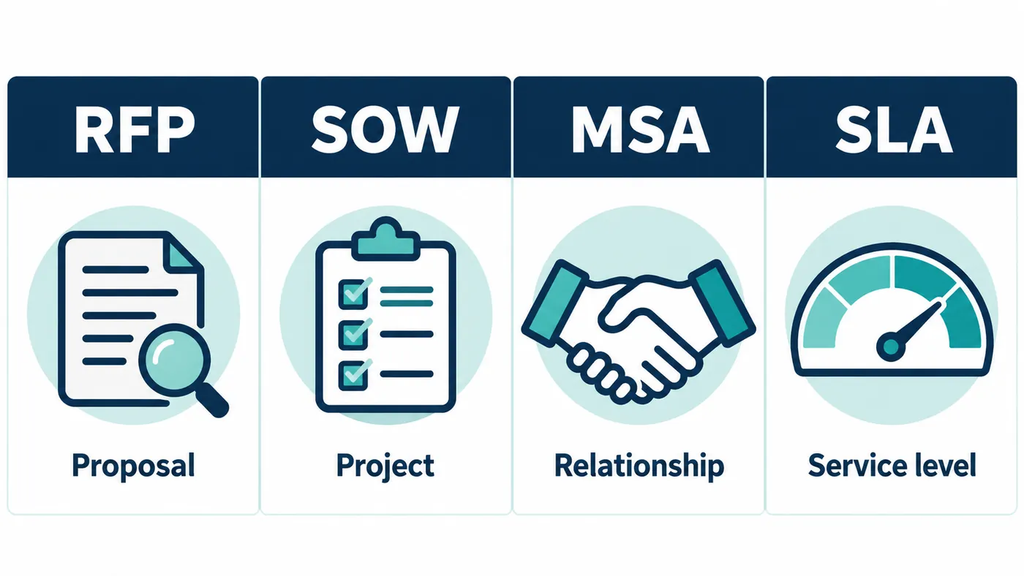
- An RFP may contain a draft SOW; an MSA supplies broader relationship terms; an SLA sets measurable ongoing service commitments.
What does SOW stand for in business, exactly?
In most client and vendor conversations, SOW is the statement of work. Think of it as the project’s written operating agreement. It turns “build us a website” or “run a campaign” into an agreed list of outputs, dates, review steps, and commercial expectations.
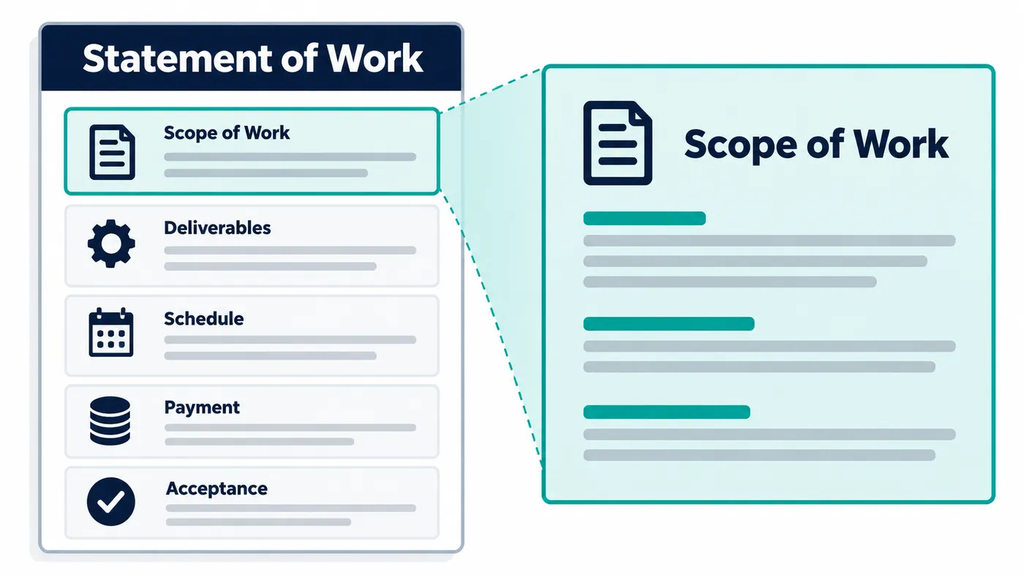
The scope of work is narrower. It answers what tasks are included, what is excluded, and where the project stops. A statement of work can include that scope alongside payment, roles, milestones, acceptance, and change procedures. Atlassian’s comparison of statement and scope of work makes the same practical distinction.
Why do businesses use a statement of work?
A statement of work helps the buyer know what they are purchasing and helps the provider know what they have promised. During the project, both can refer back to the same description when reviewing progress, requesting changes, or deciding whether a deliverable is complete. The USPS guidance on statements of work lists responsibilities, deliverables, completion criteria, schedule, and change procedures among the usual components.
Clarity matters most when a request sounds simple but can be interpreted in several ways. “Create a new website,” for instance, could mean a five-page site using supplied copy, or it could include writing, photography, migration, accessibility review, and ongoing updates. Writing down the boundary makes that conversation happen before either side budgets for the wrong project.
What should a good SOW include?
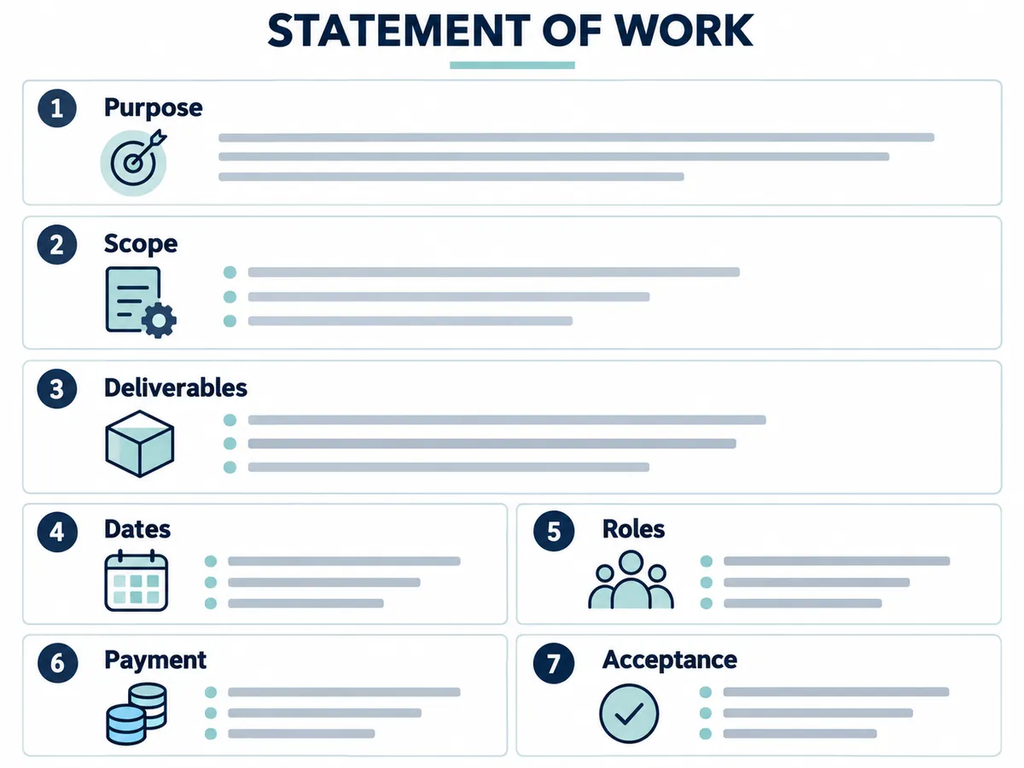
There is no single format for every business. I would start with the decisions that could otherwise trigger a disagreement, then add the detail needed to make each one testable. The Texas Department of Information Resources SOW templates show that the format can vary by the kind of service being purchased.
| Section | Question it should answer | Example of useful detail |
|---|---|---|
| Parties and purpose | Who is involved, and why? | Client and provider names; goal of a website refresh |
| Scope and exclusions | What work is included or left out? | Five pages included; copywriting excluded |
| Deliverables | What will the client receive? | Design files, published pages, and an editor handoff |
| Schedule | When are drafts and final work due? | Dates tied to client feedback and approvals |
| Responsibilities | What must each side provide? | Client supplies brand assets and approves drafts |
| Acceptance | How will work be reviewed and approved? | Pages checked against an agreed list and reviewed within a stated period |
| Price and payment | What is charged, and when? | Fixed fee, approved expenses, and milestone invoices |
| Changes | How are extra requests handled? | Written request, revised fee and date, approval before extra work |
Write deliverables as outputs someone can inspect. “Improve our website” states a goal, while “publish five responsive pages using approved copy” identifies work that can be checked. Where a project depends on the client supplying material, name that dependency and explain how a delay affects the schedule.
A simple statement of work example
Imagine a small business hiring a designer for a new website. An initial request says, “Make a clean site by next month.” That leaves important decisions open, so the parties turn it into a short SOW. This example is illustrative, not a contract template.
| Item | Illustrative wording |
|---|---|
| Goal | Replace the current website with a five-page site |
| Deliverables | Homepage, about, services, FAQ, and contact pages; one editor handoff session |
| Client input | Supply approved copy, images, and access by the agreed date |
| Review | One consolidated feedback round per page and one correction round |
| Acceptance | Each page loads on agreed device sizes, displays supplied copy, and has working navigation and contact form |
| Exclusions | New brand identity, photography, hosting fees, and ongoing maintenance |
| Change process | Additional pages or revisions require a written estimate and approval |
The price, milestone dates, and review period would also need to be filled in by the actual parties. A good test is whether someone who missed the initial meeting could read the document and understand what “done” means. SAP’s SOW checklist likewise emphasizes deliverables, acceptance criteria, responsibilities, and payment terms.

How to write and review an SOW step by step
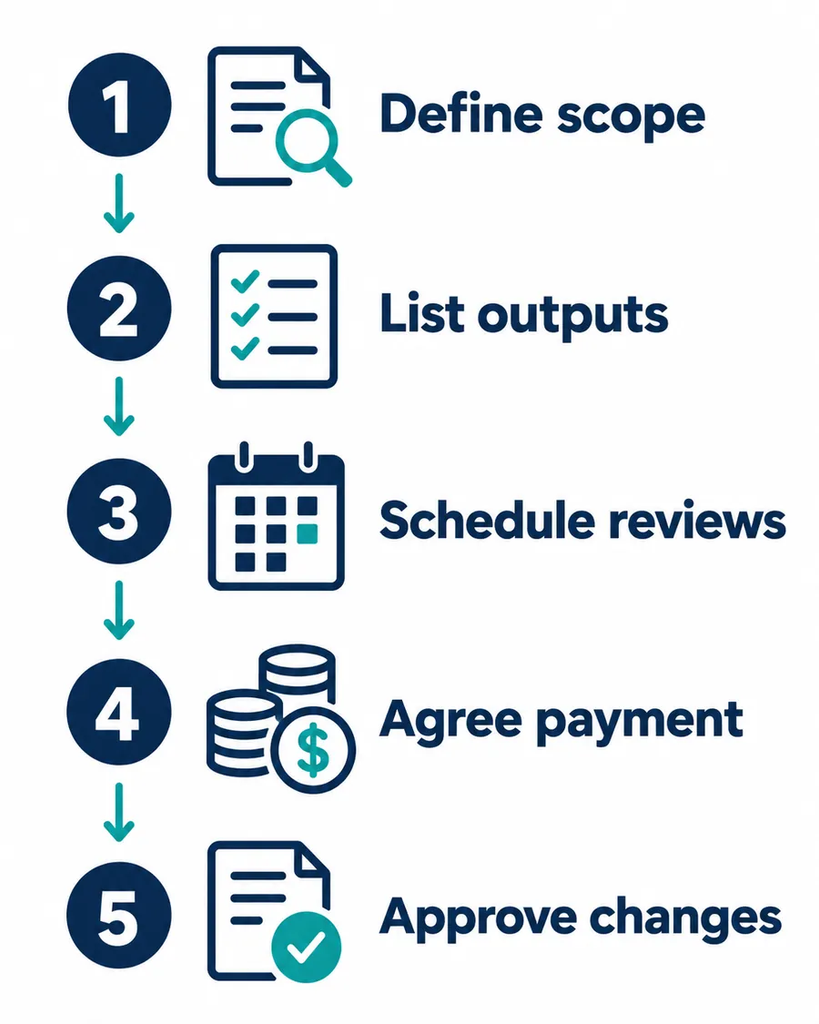
1. Define the result and boundaries
Start with the business goal, then list the actual work needed to reach it. State exclusions with the same care as inclusions, especially when a related service could reasonably be assumed. For a campaign, clarify whether the provider is planning, producing assets, arranging partners, buying media, reporting results, or doing a combination.
For a marketing engagement, you can look at a small-business influencer campaign guide to identify the moving parts before deciding which ones belong in your agreement. Use the SOW to identify the specific outputs the chosen provider will deliver, rather than copying a general campaign checklist into a contract.
2. Describe each deliverable and its review
State the format, quantity, and handoff method. Add acceptance criteria that the parties can check without debating taste after the fact. If revisions are included, specify how many rounds, how feedback is collected, and who has authority to approve.
3. Connect the timeline to dependencies
Give dates or a clear schedule anchored to a start event. If the provider needs files or feedback from the client, state when they are due and how the timetable is updated if they arrive late. This keeps a missed input from being confused with missed provider performance.
4. Match payment to the agreement
State whether the fee is fixed, hourly, or tied to milestones. Identify billable expenses, invoice timing, payment due dates, and what happens if the scope changes. Once the project starts, a small-business invoicing and bookkeeping guide can help an owner organize the invoices that follow the agreed milestones.
5. Decide how changes are approved
Projects change, and the SOW should explain who can request a change and who can approve it. Put the effect on cost, deliverables, and dates in writing before the added work begins. The USPS SOW guidance explicitly includes change control and acceptance procedures among project procedures.
SOW vs. RFP, MSA, and SLA
These documents answer different questions. They can appear in the same transaction, but their order and exact legal effect depend on the procurement process and the wording the parties use. USPS purchasing guidance notes that a service RFP can include an SOW, while Thomson Reuters’ contract explanation describes an SOW as a more focused document that may sit under an MSA.
| Document | Main question | Typical role |
|---|---|---|
| RFP, request for proposal | What are we asking potential providers to propose? | Invites bids and may include draft project requirements |
| SOW, statement of work | What will this provider deliver for this project? | Defines project-specific work, dates, and acceptance |
| MSA, master services agreement | What terms govern the broader relationship? | Covers overarching terms that may apply to multiple SOWs |
| SLA, service-level agreement | What measurable ongoing service level is promised? | Sets service targets, measurement, and possible remedies |
An SLA is easiest to picture with a hosted service. The Google Cloud Compute Engine SLA defines covered services, an uptime measure, and conditions for credits. A website-build SOW might instead define the handoff of a completed website. Ongoing hosting support could involve both a project SOW and a separate service commitment.
Common SOW mistakes to catch before signing
Watch for terms such as “as needed,” “unlimited revisions,” or “complete solution” without a clear boundary. They can leave both sides with different expectations about effort and price. Replace vague language with quantities, outputs, approval criteria, or a defined process for decisions that cannot be made yet.
Check for conflicting documents, too. If an MSA and SOW both address payment or ownership, the parties should agree which controls when the wording differs. Confirm the names of the parties, the person authorized to approve changes, and whether the promised delivery date depends on client inputs. This is general business information, not legal advice; ask a qualified professional to review terms when the financial or legal stakes are significant.
Frequently asked questions
What comes first, SOW or RFP?
It depends on the buying process. A buyer may draft a preliminary SOW before issuing an RFP so vendors can price the same requirements; after selection, the parties may refine and agree on the final SOW. USPS purchasing practice describes developing an SOW or another requirements document before issuing an RFP.
What is the difference between SOW and SLA?
An SOW describes work for a particular project, including its deliverables and schedule. An SLA describes a measurable level of ongoing service, such as availability and any stated remedy if the target is missed. One engagement can have both.
What’s the difference between SOW and MSA?
An MSA sets broader terms for a working relationship, while an SOW describes one specific engagement. Several SOWs may operate under one MSA, depending on how the documents are written and incorporated.
What is an SOW in a project or in project management?
It is the written reference for agreed project work, outputs, timing, and how completion will be assessed. The project team can use it when tracking milestones and discussing a proposed change. It is especially useful when a client and an outside provider must align their expectations.
What is SOW in a contract or sales process?
In a contract, an SOW may be an attachment or a separately signed project document that defines the work covered by the agreement. In sales, a proposed SOW helps turn a quoted service into specific deliverables and terms; its binding effect depends on its wording and the surrounding agreement.
Who prepares the statement of work?
The client or the provider can draft it, often with input from the people managing and delivering the work. Both sides should review it because a draft written by one party may miss the other party’s dependencies, review needs, or assumptions.
Conclusion
So, what does SOW stand for in business? In most project agreements, it means statement of work, the document that connects a business request to defined deliverables, responsibilities, dates, payment, and acceptance. Before you approve one, read it as though you were joining the project tomorrow: can you tell what each side must do and how a change will be handled?
Use the sections and example above as a review checklist for your next project. If a point still depends on an assumption, settle it with the other party and put the agreed wording in the SOW before work starts.