Key Takeaways
- Custom signage should be planned around purpose, placement, viewing distance, brand requirements, and site conditions.
- Hightech Signs provides commercial sign options, including monument signs, lobby signs, ADA signs, wayfinding, vehicle graphics, wall graphics, murals, dimensional lettering, and development signage.
- Legibility, contrast, hierarchy, and material selection affect whether a sign works in real-world conditions.
- Address accessibility and permitting early, especially for permanent room identification and outdoor signs.
- Photos, logo files, dimensions, location details, and timing expectations help develop an accurate project scope.
A successful sign project begins well before fabrication. Whether your business needs a visible exterior identifier, a polished lobby display, accessible room signs, or graphics for company vehicles, the goal is to create something that works on-site and enhances the way customers experience your brand. Hightech Signs helps businesses turn a rough idea into a practical plan for custom signs Austin projects.
The strongest requests identify what the sign must accomplish, who needs to see it, where it will be installed, and when it is needed. That early clarity helps Hightech Signs recommend an appropriate format, organize the design, select materials, and prepare the project for production and installation.
Why a Basic Business Sign Is Not Always Enough
Commercial signage often has more than one job. An exterior sign helps people identify a property from the street, while a lobby sign creates a professional first impression once visitors enter. Directional signs can guide people to departments, suites, parking areas, and entrances. ADA signs can identify permanent spaces, and vehicle graphics can carry a business identity throughout the community.
A coordinated approach keeps those pieces connected. Using compatible colors, typography, logo treatment, and visual hierarchy across exterior, interior, and mobile signage can make a property easier to navigate while giving customers a more consistent impression of the business.
How Hightech Signs Turns an Idea Into a Sign Plan
A vague request such as “we need a bigger sign” is a useful starting point, but it needs refinement. Hightech Signs can help clarify the project through a practical sequence:
- Define the purpose. Identify whether the sign is intended for identification, promotion, navigation, accessibility, safety, decoration, or a combination of these purposes.
- Review the location. Consider wall space, property lines, traffic patterns, lighting, mounting surfaces, pedestrian access, and weather exposure.
- Select the format. Match the need to a solution such as a monument sign, dimensional lettering, a lobby sign, wayfinding signage, wall graphics, or vehicle graphics.
- Organize the design. Prioritize the information people need to recognize or read quickly, then build the layout around the logo, message, colors, and available space.
- Confirm production details. Review dimensions, materials, finishes, installation needs, and approval points before fabrication begins.
Choosing the Right Sign Type for the Problem
Different environments call for different types of signage. A business does not need to treat every sign as a separate purchase. Instead, it can select components that solve specific visibility and navigation problems.
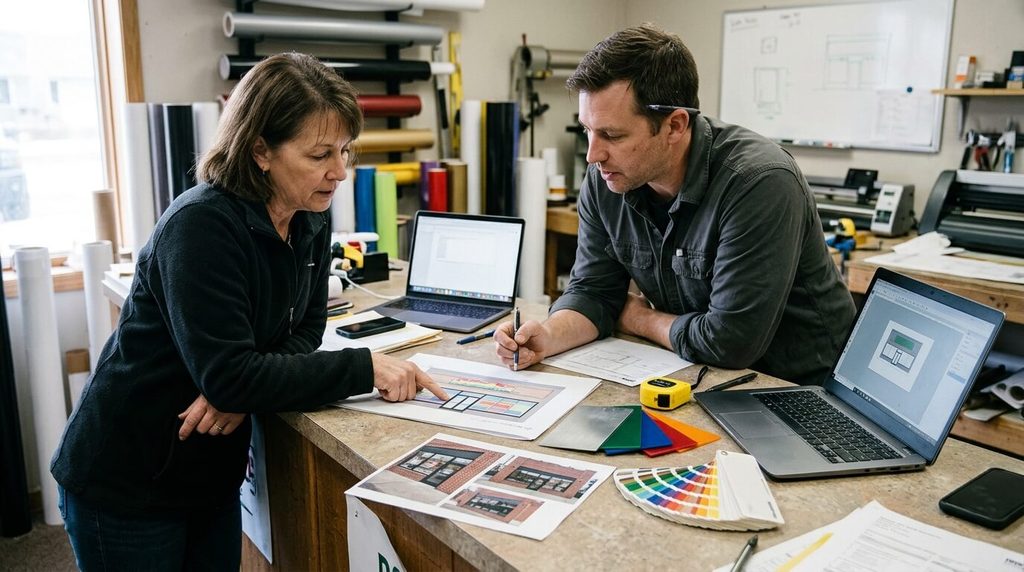
Photorealistic candid documentary-style photo of a small business owner and sign professional reviewing a printed sign design and site photos at a real office counter, with material samples and a laptop nearby, natural window light, slightly imperfect everyday environment, no posed expressions.
- Monument signs and dimensional lettering: Useful when a building or property needs a stronger, more permanent street-facing identity.
- Lobby signs: A fitting choice when the reception area needs a finished brand presence for customers, guests, or tenants.
- Wayfinding signs: Helpful for offices, campuses, retail centers, healthcare settings, and other properties where people need directions.
- ADA signs: Designed for room identification and accessibility needs, including applications that require tactile information.
- Vehicle graphics: A practical option for service vehicles, delivery vehicles, and fleets that travel throughout Austin and Central Texas.
- Wall wraps and murals: Effective for turning underused interior surfaces into branded, informational, or decorative spaces.
- Development and MDO signs: Appropriate for property, construction, and development-related communication where durable exterior panels may be needed.
Designing for Legibility, Visibility, and Distance
A sign that looks appealing up close may not be visible from a sidewalk, parking lot, or moving vehicle. Viewing distance should guide the size of the lettering and how much information you include. A lobby sign can include more visual detail because visitors see it up close. A monument sign usually needs a shorter message, strong contrast, and larger elements because it may be viewed at a greater distance.
Hightech Signs emphasizes legibility, readability, visibility, and noticeability in commercial sign planning. In practice, that means prioritizing key information, avoiding overcrowded layouts, using legible letterforms, and creating contrast between copy and background. Lighting, glare, shadows, and the complexity of the surrounding environment should also be considered before finalizing a design.
Accessibility Details to Address Early
Branding signs and accessible room-identification signs serve different purposes. For certain permanent rooms and spaces, the ADA Standards address visual and tactile requirements. The requirements for accessible signs state that permanent room and space labels may require raised characters and Grade 2 Braille, while directional and informational signs generally have visual requirements when provided.
Planning should account for contrast, non-glare finishes, placement near doors, mounting height, door swing, and clear approach space. Requirements can depend on the sign’s content and location, so a project-specific review remains important.
Does an Outdoor Sign Need an Austin Permit?
Outdoor signage in Austin often requires a permit. The City requires sign permits for outdoor signage, although some signs may be exempt. Requirements also vary by sign type and outline the documentation you may need for freestanding, roof, projecting, wall, and awning signs.
Businesses should provide the property address and proposed sign location early in the process. Illuminated signs may also involve electrical permitting and inspection. Landlord rules, property-management approval, sign district regulations, and structural requirements can affect the final scope, so they should be confirmed before fabrication or installation is scheduled.
Materials and Finishes for Austin Conditions
Material selection should reflect the application rather than appearance alone. Aluminum, acrylic, vinyl, MDO, dimensional materials, and printed panels each offer different possibilities for interior use, exterior exposure, mounting, and finish. A material that works well for a temporary development sign may not suit permanent lobby lettering.
Sun exposure, rain, maintenance expectations, service life, and installation surface all influence the decision. Matte or non-glare finishes can be particularly useful where readability matters under changing light conditions.
What to Include in Your Custom Signs Austin Request
- Business name, logo files, and existing brand guidelines.
- The sign’s purpose and the audience it needs to reach.
- Property address, installation location, and photos of the site, wall, vehicle, or surface.
- Approximate dimensions and whether the sign is interior or exterior.
- Preferred colors, materials, finish, and lighting needs.
- Desired completion date and available budget range.
- Any landlord, property-management, permit, or accessibility requirements already identified.
Before approving production, review what SOW stands for in business to understand how a written project agreement can clarify deliverables, timelines, responsibilities, and approval steps.
Move From a Sign Request to a Coordinated Solution
Hightech Signs gives Austin businesses a structured way to move from an initial signage question to a site-appropriate solution. By sharing clear project details, artwork, site information, and timing needs, businesses can begin a conversation about the sign types, materials, production steps, and installation approach that best fit their goals.