Does Business Insurance Cover Theft? Here’s What Actually Pays Out
You walk in on a Monday morning. The back door is open. The register is empty. Two laptops are gone.
Your first thought is probably not about insurance. It’s about the mess. But your second thought is almost always the same question. Does business insurance cover theft?
Here’s the honest answer. It depends on what kind of theft happened and which policy you actually own. A break-in at night is covered by one type of policy. Money missing from your own bookkeeper is covered by a completely different one. And most business owners find this out the hard way, after the loss, when it’s too late to fix.
This guide breaks down exactly which policy covers which kind of theft. No guessing. No vague answers. Just what pays, what doesn’t, and what it costs to close the gaps.
The Quick Answer
Business insurance can cover theft. But no single policy covers every kind of theft. Here’s the short version before we go deeper.
| Type of Theft | Covered By | Covered by General Liability? |
|---|---|---|
| Break-in, stolen inventory or equipment | Commercial property insurance | No |
| Money stolen by an employee | Commercial crime insurance | No |
| Robbery involving force or threats | Commercial property insurance | No |
| Data breach or stolen customer info | Cyber insurance | No |
| Stolen company vehicle | Commercial auto (comprehensive) | No |
| Business identity theft | Identity theft coverage or endorsement | No |
Notice the pattern. General liability insurance, the policy most small business owners buy first, does not cover theft at all. It’s built for a different job. We’ll explain why in a minute.
Does Business Liability Insurance Cover Theft?
Short answer, no. And this trips up many new business owners.
General liability insurance protects you when your business hurts someone else or damages their property. Think of a customer slipping on a wet floor, or a contractor accidentally damaging a client’s wall. It covers claims made against you by other people.
Theft is different. Theft is a loss of your own property. Liability insurance was never designed to replace stolen items, and Insureon’s general liability guide confirms this directly, stating that a standard general liability policy does not cover the theft of your business property.
This confusion is common enough that NEXT Insurance built an entire explainer just around it. If you want theft coverage, you need a property or crime policy layered on top of liability, not liability alone.
Does Small Business Insurance Cover Theft?
This is where the real answer lives. “Small business insurance” isn’t one policy. It’s usually a mix of several, and theft coverage depends on which ones you’re carrying.
Commercial Property Insurance
This is your main line of defense against a break-in. It covers physical business property, including equipment, inventory, furniture, and computers, if they’re stolen or damaged at your business location.
Here’s the catch most people miss. Many policies cover only theft involving forced entry. If someone walks in through an unlocked door and walks out with your laptop, some insurers may deny the claim, according to C.T. Lowndes’ breakdown of commercial theft coverage. Read your policy’s definition of “theft” closely. It matters more than most owners realize.
Business Owner’s Policy (BOP)
A BOP bundles general liability and commercial property insurance into one package, often at a lower combined cost. Since it includes the property portion, a BOP typically covers theft in the same way as standalone commercial property insurance. Insureon reports the average BOP costs about $83 a month, or roughly $990 a year, making it one of the more affordable ways to get theft protection alongside liability coverage in a single policy.
What a BOP Still Won’t Cover
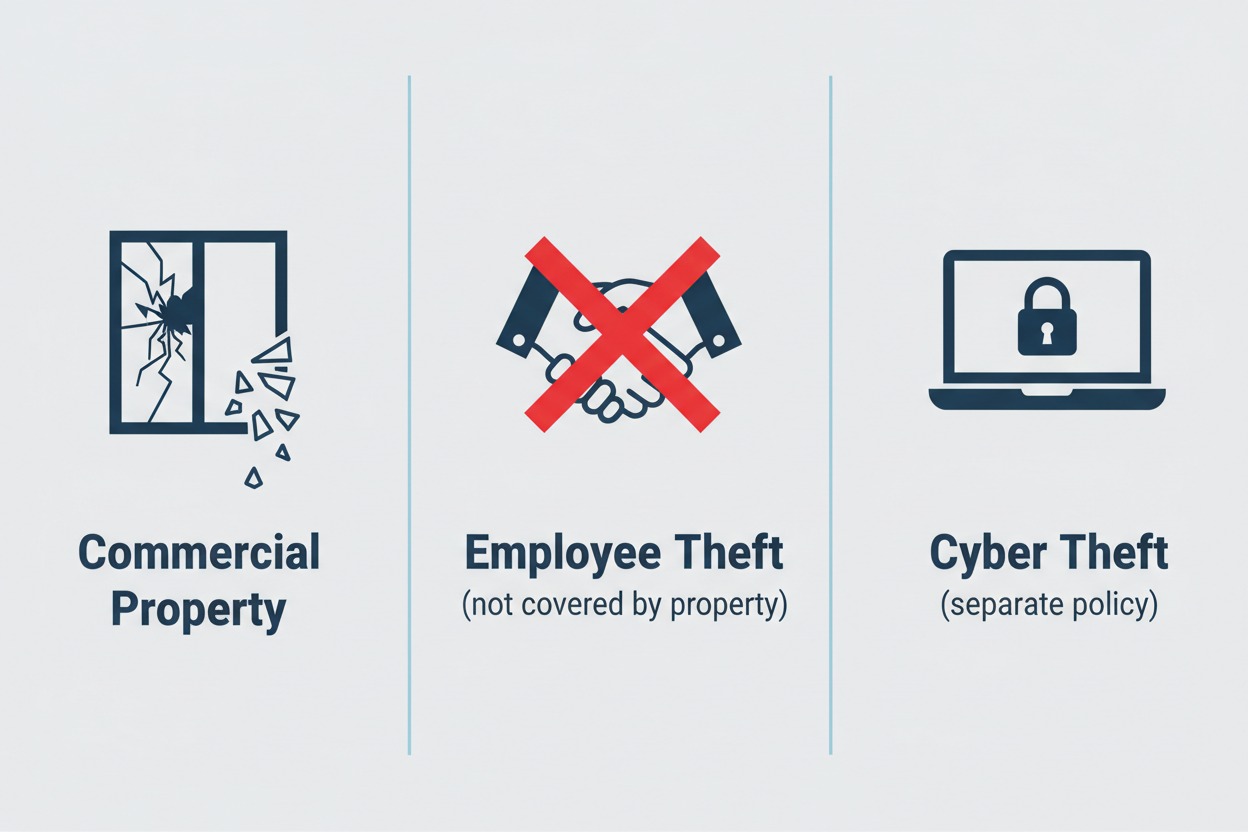
A standard BOP still leaves gaps. It generally will not cover employee theft, cyber theft, or identity theft on its own. Those need separate coverage, which we’ll walk through next.
Does Business Insurance Cover Employee Theft?
This is the question that catches the most business owners off guard, and the answer is not what most people expect.
Standard commercial property insurance and a standard BOP do not cover employee theft. If a trusted staff member takes cash from the register, steals inventory, or forges a check, your basic property policy will not pay for it. Bethany Insurance Agency states this plainly, noting that without commercial crime insurance, employee dishonesty may simply not be covered at all.
This gap matters more than people assume. According to the Association of Certified Fraud Examiners, businesses worldwide lose an estimated 5% of annual revenue to fraud, and small businesses with fewer than 100 employees suffer a median loss of $150,000 per fraud case. That’s a number most small businesses simply cannot absorb without coverage.
Here’s a real example of how this plays out. The U.S. Department of Justice reported a case in Georgia where a woman embezzled more than $3.5 million from her employer over five years, between 2015 and 2020. She wasn’t a stranger who broke in overnight. She was a trusted employee with ongoing access to company finances, which is exactly the profile a standard property policy is not built to catch or cover.
The Two Ways to Close This Gap
You have two main paths to protect against employee theft.
Employee dishonesty coverage. This is usually an add-on endorsement to your existing commercial property policy or BOP. It reimburses your business directly for cash, property, or securities stolen by an employee, up to your policy limit.
A fidelity bond. Sometimes called an employee dishonesty bond, this works similarly but is often purchased as a standalone product. Some industries, especially cleaning and janitorial services, are frequently asked by clients to carry a fidelity bond, according to Insureon’s fidelity bond guide.
Fidelity Bond vs. Crime Insurance
People use these terms almost interchangeably, but there’s a real difference worth knowing.
| Feature | Fidelity Bond | Commercial Crime Insurance |
|---|---|---|
| Covers employee theft | Yes | Yes |
| Covers theft by outsiders | No | Yes |
| Covers computer fraud | No | Often, as an add-on |
| Typical coverage limits | Lower | Higher |
| Required by some contracts or ERISA plans | Yes, in specific cases | Not usually required |
According to Higginbotham’s comparison of the two, fidelity bonds protect only against employee-committed crimes, while a full commercial crime policy protects against both employee crimes and theft committed by third parties. If your business handles retirement plan funds for employees, note that the Department of Labor requires an ERISA fidelity bond for anyone who manages those funds, regardless of your other coverage.
Does Business Insurance Cover Burglary?
Yes, generally, but the word “burglary” carries a specific meaning in insurance that’s worth understanding.
In most policies, burglary refers to theft involving visible signs of forced entry, like a broken window, a pried-open door, or a disabled lock. Robbery is a separate category, referring to theft involving force or the threat of force against a person, such as someone being held up at gunpoint.
AMAROK’s coverage breakdown confirms that most standard commercial policies cover robbery, since it clearly involves force or threats, whereas coverage for burglary and other theft scenarios may carry more conditions.
Here’s a detail that catches people off guard after a burglary claim. Filing even one theft claim can raise your premiums. According to the same AMAROK analysis, businesses commonly see a 5% to 25% premium increase after a single claim, and these increases can compound if multiple claims occur within the same policy period. It’s a real cost worth factoring in before deciding whether a smaller loss is even worth filing a claim for.
Reducing Your Burglary Risk
Prevention doesn’t just protect your property. It can also make your business a better risk in an insurer’s eyes, and sometimes even lower your premium. A few practical steps make a real difference:
- Install visible security cameras and alarms. These act as a deterrent and provide evidence if a break-in does occur.
- Improve exterior and interior lighting. Well-lit entrances and storage areas are simply harder to target without being noticed.
- Use commercial-grade locks and a safe for cash. Standard residential locks are often not enough for a business location.
- Keep a documented inventory with photos and receipts. This becomes essential if you ever need to prove a claim’s value.
- Train staff on closing procedures. A surprising number of burglaries exploit a simple mistake, like a door left unlocked at closing.
These same steps, according to NEXT Insurance’s theft prevention guidance, can help reduce your overall risk profile with insurers, which sometimes translates into better pricing over time.
Commercial Crime Insurance
If you only remember one section from this article, make it this one. Commercial crime insurance is the closest thing to a complete answer to “does business insurance cover theft,” because it’s designed to fill the gaps left by every other policy.
What It Actually Covers
According to Nationwide’s commercial crime page, this type of policy can protect a business against burglary, robbery, forgery, computer fraud, and employee dishonesty, all under one umbrella. A more detailed breakdown from the Surety & Fidelity Association of America notes that despite a business’s best prevention efforts, losses from employee misconduct still happen, which is exactly the risk this coverage is built to absorb.
Typical coverage areas include:
- Employee theft or dishonesty
- Forgery and check alteration
- Theft of money and securities, both on and off premises
- Computer fraud and funds transfer fraud
- Counterfeit currency accepted as payment
- Kidnap, ransom, or extortion in some policies
What It Costs
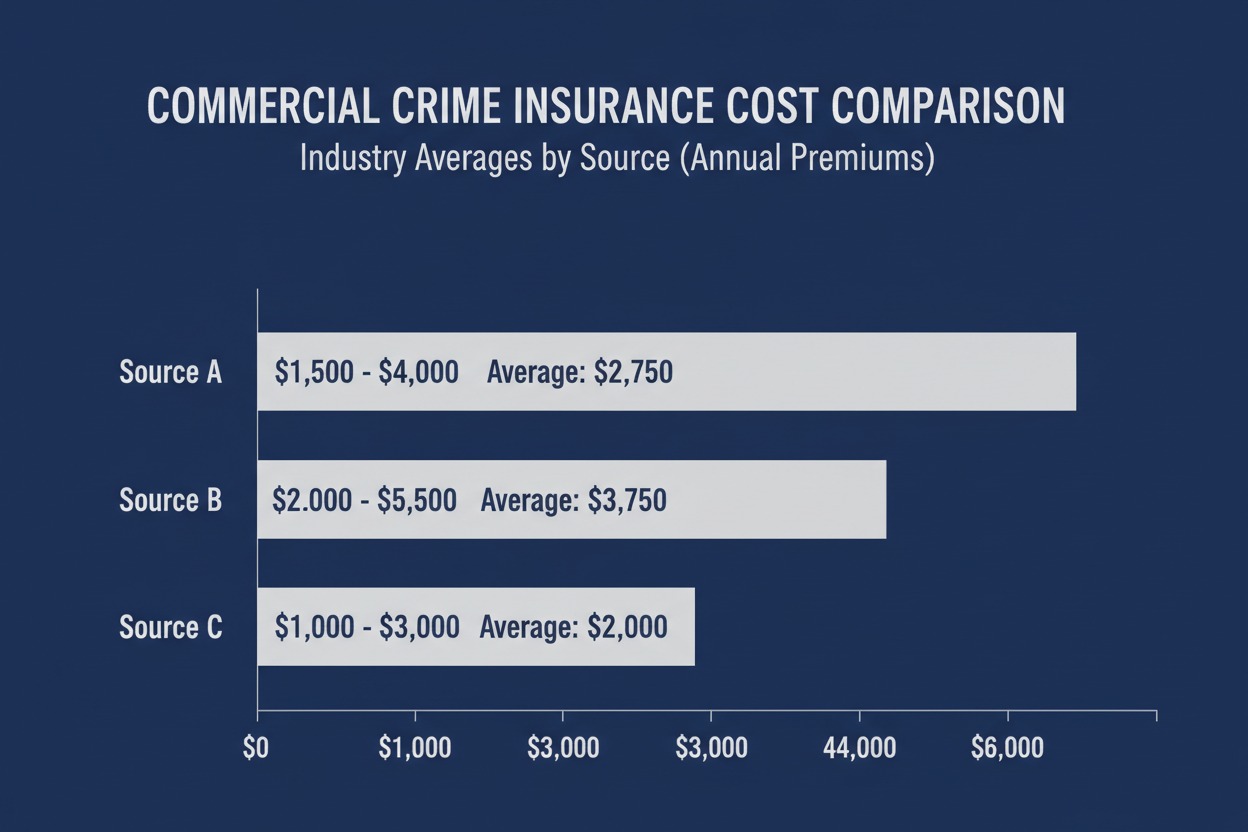
This varies more than most types of business insurance, because pricing depends heavily on how much cash your business handles and how strong your internal financial controls are. Reported ranges vary by source, but they cluster in a fairly consistent band:
| Source | Reported Annual Cost Range |
|---|---|
| Fit Small Business | $650 to $2,500 |
| Insuranceopedia | $300 to $3,000 |
| Commercial Insurance Center | $500 to $5,000 |
The spread exists because insurers price this coverage based on your specific risk. A cash-heavy retail business with weak internal controls will pay more than a small consulting firm with strict financial oversight and no cash handling.
Does Business Insurance Cover Identity Theft?
This question comes up more than you’d expect, and it splits into two very different answers depending on whose identity was stolen.
Personal Identity Theft Coverage for You or Employees
Some insurers, including Travelers and The Hartford, offer identity fraud expense reimbursement as an add-on. This helps cover the cost of restoring someone’s identity after fraud, including legal fees, lost wages, and paperwork expenses. It typically does not reimburse the stolen money itself, since that’s usually the bank’s or credit card issuer’s responsibility to resolve.
According to Equifax, this kind of coverage generally costs between $25 and $60 a year, with payout limits usually landing between $10,000 and $15,000.
Business Identity Theft
This is a different and often more damaging problem. Business identity theft occurs when someone steals your company’s EIN, bank account details, or public filing information to open new credit lines, file fraudulent tax returns, or drain business accounts.
This is genuinely serious. Zander Insurance reports that businesses lose over $8 billion to this kind of fraud every year, and that a striking 60% of businesses that suffer identity fraud close within one year of the event, according to Wall Street Journal reporting cited in that same source.
Standard commercial crime insurance generally does not automatically include business identity theft protection. It’s usually a separate service or endorsement, often bundled with credit monitoring and account monitoring rather than sold as a traditional insurance payout. If your business relies on strong business credit or frequently applies for financing, this coverage is worth a serious look, not an afterthought.
The risk grows with how public your business information already is. Your EIN, state registration details, and even your business address are often a matter of public record. Fraudsters use exactly this kind of publicly available information to open credit lines or file fraudulent documents in your company’s name, which is part of why this type of fraud can be harder to catch early than a simple stolen credit card.
What Business Insurance Almost Never Covers
Even with a strong mix of policies, a few theft scenarios commonly fall outside coverage entirely. Knowing these upfront saves a painful surprise later.
- Mysterious disappearance. If property simply vanishes with no evidence of a break-in or witnessed theft, many property policies won’t pay, since there’s no proof a covered event actually occurred.
- Theft by business partners or executives acting alone. Most crime policies are written to cover employees, not owners or partners, and coordinated acts involving partners are frequently excluded.
- Cybercrime under a standard crime policy. Crime insurance often excludes data breach costs entirely. That’s what cyber insurance is for, and the two policies are not interchangeable.
- Vehicle theft without comprehensive coverage. The liability or collision portions of a standard commercial auto policy won’t cover a stolen company vehicle. You need comprehensive coverage specifically.
- Wrongful termination claims are tied to a theft investigation. If firing a suspected thief leads to a wrongful termination claim, that’s a job for employment practices liability insurance, not a crime policy.
Which Businesses Need This Coverage Most
Every business faces some risk of theft, but a few industries face it more directly than others.
Retail stores. High foot traffic and cash handling make retail one of the most exposed categories. Small business retailers report theft at a striking rate. According to Insureon’s data, 56% of small business retailers reported theft in 2022, and 53% of owners say the problem is getting worse.
Restaurants and cafés. Cash registers, tip jars, and high employee turnover combine to create real exposure to both burglary and internal theft.
Professional service firms. It’s easy to assume consultants and financial firms are lower risk, but the same Insureon data found that 45% of small professional service firms experienced theft in the previous year, with 42% reporting it was getting worse.
Construction and contracting businesses. Tools and equipment left on job sites are a frequent target, and unlike a locked storefront, a job site is much harder to fully secure overnight.
Cleaning and janitorial services. These businesses often work unsupervised inside client homes and offices, which is exactly why clients frequently require a fidelity bond before signing a contract.
Any business handling retirement plan funds. This one isn’t optional. If you manage a 401(k) or similar plan for employees, an ERISA fidelity bond is a federal requirement, not a nice-to-have.
How to File a Business Theft Claim
If theft occurs despite your coverage, how you handle the first 48 hours genuinely affects whether your claim is approved smoothly or delayed.
- Call the police first, before your insurer. A police report is often required documentation, and it establishes an official timeline of the event.
- Document everything with photos and video. Capture the scene before you clean up or move anything, including any signs of forced entry, as your policy may require.
- Pull your inventory records. If claimed values don’t match your financial records, insurers may dispute the payout, according to Bethany Insurance Agency’s claims guidance.
- Report the loss to your insurer promptly. Delayed reporting is one of the most common reasons claims get denied. Most policies specify a reporting window, so don’t wait.
- Keep a written timeline of what happened. Note when you last saw the property, when you discovered it missing, and who else had access during that window.
- Cooperate fully with the claims investigation. For larger losses, especially those suspected to be employee theft, insurers may bring in an investigator. Being organized and responsive speeds up the process considerably.
Expert Tips for Business Owners
- Read the word “theft” in your policy carefully. Some policies distinguish between burglary, robbery, and general theft, and each may have different conditions attached. Don’t assume they’re interchangeable just because they sound similar.
- Pair commercial property with commercial crime insurance if you handle any cash. Property insurance alone leaves the most common and most damaging type of small business theft, employee dishonesty, completely uncovered.
- Strengthen your internal controls before you shop for a quote. Insurers price commercial crime coverage partly based on your financial controls. Simple steps like separating who handles deposits from who reconciles the books can genuinely lower your premium.
- Think twice before filing a claim for a small loss. Since even one theft claim can raise your premium by 5% to 25%, a smaller loss might cost less to absorb directly than to claim.
- Revisit your coverage after any major growth. If you’ve added employees, started handling more cash, or expanded to a new location, your existing policy limits may no longer match your actual exposure.
If you’re still building out your financial systems as a new business, tightening your bookkeeping now makes both fraud prevention and insurance underwriting easier later. Our guide on using QuickBooks for a small business is a good next step if you haven’t set up clean financial tracking yet.
Pros and Cons of Business Theft Coverage
| Pros | Cons |
|---|---|
| Covers a wide range of theft scenarios when properly layered | No single policy covers every type of theft |
| Commercial crime insurance is relatively affordable given the risk | Filing a claim can raise future premiums |
| Can be bundled with property insurance through a BOP for savings | Employee theft requires a separate policy; most owners don’t realize they need one |
| Some coverage extends off-premises, not just at your location | Coverage often requires forced entry evidence for burglary claims |
| Business identity theft options exist for high-risk industries | Business identity protection is often sold separately from core insurance |
Common Mistakes Business Owners Make
- Assuming general liability covers theft. It doesn’t, and this is the single most common misunderstanding in this whole topic.
- Skipping crime insurance because “my employees are trustworthy.” Trust isn’t a control. Even strong teams face turnover, financial pressure, and the occasional bad actor.
- Not reading the forced entry clause. A claim can be denied simply because the door wasn’t forced open, even if the theft was real.
- Treating business identity theft as the same as personal identity theft. They’re different risks with different coverage paths, and confusing the two leaves a real gap.
- Filing every small claim automatically. Sometimes absorbing a minor loss costs less over time than the resulting increase in premium.
- Never revisit coverage limits as the business grows. A policy sized for your first year in business often falls short once inventory value, cash handling, or headcount increases, leaving a real gap between what you carry and what you’d actually need to replace after a loss.
Frequently Asked Questions
Does business insurance cover theft?
Yes, but only through the right combination of policies. Commercial property insurance or a BOP covers theft of physical business property, while commercial crime insurance covers employee theft and related dishonesty. General liability insurance does not cover theft at all.
Does business liability insurance cover theft?
No. General liability insurance covers claims arising from your business causing injury or property damage to someone else. It does not cover theft of your own business property under any circumstances.
Does business insurance cover employee theft?
Only if you carry commercial crime insurance or an employee dishonesty endorsement. Standard commercial property insurance and a basic BOP typically exclude theft committed by your own employees.
Does business insurance cover identity theft?
It depends on the type. Personal identity theft coverage for you or employees is often available as an affordable add-on. Business identity theft, involving your company’s EIN or credit, usually requires separate protection, as it’s not automatically covered under standard commercial crime insurance.
Does business insurance cover burglary?
Generally, yes, through commercial property insurance, as long as there’s evidence of forced entry. Some policies define burglary and general theft differently, so it’s worth confirming exactly how your policy defines each term.
What is commercial crime insurance, and do I need it?
Commercial crime insurance is a policy designed to cover losses from criminal acts such as employee theft, forgery, and computer fraud, which standard property insurance typically excludes. If your business handles cash, has employees with access to finances, or manages client funds, it’s worth the relatively modest annual cost.
Will my insurance premium go up if I file a theft claim?
Often, yes. Industry data show that premium increases of roughly 5% to 25% after a single claim are common, and repeated claims can compound the increase further. For smaller losses, it’s worth weighing the claim payout against the long-term cost of a higher premium before filing.
Final Thoughts
Does business insurance cover theft? The real answer is yes, spread across several different policies, not one.
Commercial property insurance handles a break-in. Commercial crime insurance handles dishonest employees. Cyber insurance handles a data breach. And identity theft coverage, personal or business, handles a completely separate kind of fraud.
The businesses that get burned aren’t usually uninsured. They’re underinsured in one specific spot because they assumed a single policy covered everything. Review what you actually carry, match it against the scenarios above, and close the gap before a Monday morning like the one at the start of this article happens to you.
If you’re still setting up the legal and financial side of your business alongside your insurance, our guides on what to do after creating a business plan and paying yourself as a business owner LLC are good places to keep building from here.