
How to Start an HVAC Business: Costs, Licenses, State Rules
Here’s a number that surprises most people: you can start an HVAC (Heating, Ventilation, and Air Conditioning) business for less than the cost of a used pickup truck, or you can spend more than most people pay for a house. Both owners will call themselves “HVAC contractors.” Only one of them read the fine print first.
I will explain state licensing boards, federal rules, and real startup costs from around the country to create this guide. I will also cover things most “how to start an HVAC business” articles miss, like one big state that has no statewide HVAC license and a legal way for people with no HVAC experience to own an HVAC company right away.
If you’re serious about how to start a HVAC business, this is the guide that walks you through the real costs, the real licenses, and the real state-by-state rules. Not just the generic checklist.
If you’re exploring service-business ideas more broadly, Rarely Notes’ Startups section also breaks down other hands-on business paths worth comparing before you commit.
Is Starting an HVAC Business Actually a Good Idea Right Now?
Short answer: yes, if you go in with real numbers instead of guesses.
HVAC is not optional spending. People don’t delay fixing a broken furnace in January like they would a kitchen remodel. According to Workiz’s 2026 industry report, contractor businesses grew about 2.3% each year from 2020 to 2025. Energy-efficiency rules are expected to keep increasing demand, with the industry needing tens of thousands of new technicians soon.
The key is to set your expectations at the right time. According to Workiz, it usually takes 2 to 4 years to make a good profit unless you already know marketing well. However, many HVAC owners start making steady profits in 18 to 36 months if there is strong local demand and they run their operations efficiently. SmartService’s cost breakdown explains it simply: a solo owner can expect to earn between $50,000 and $100,000 in net income in the first year. The biggest factor is how fast you can gain regular maintenance customers.
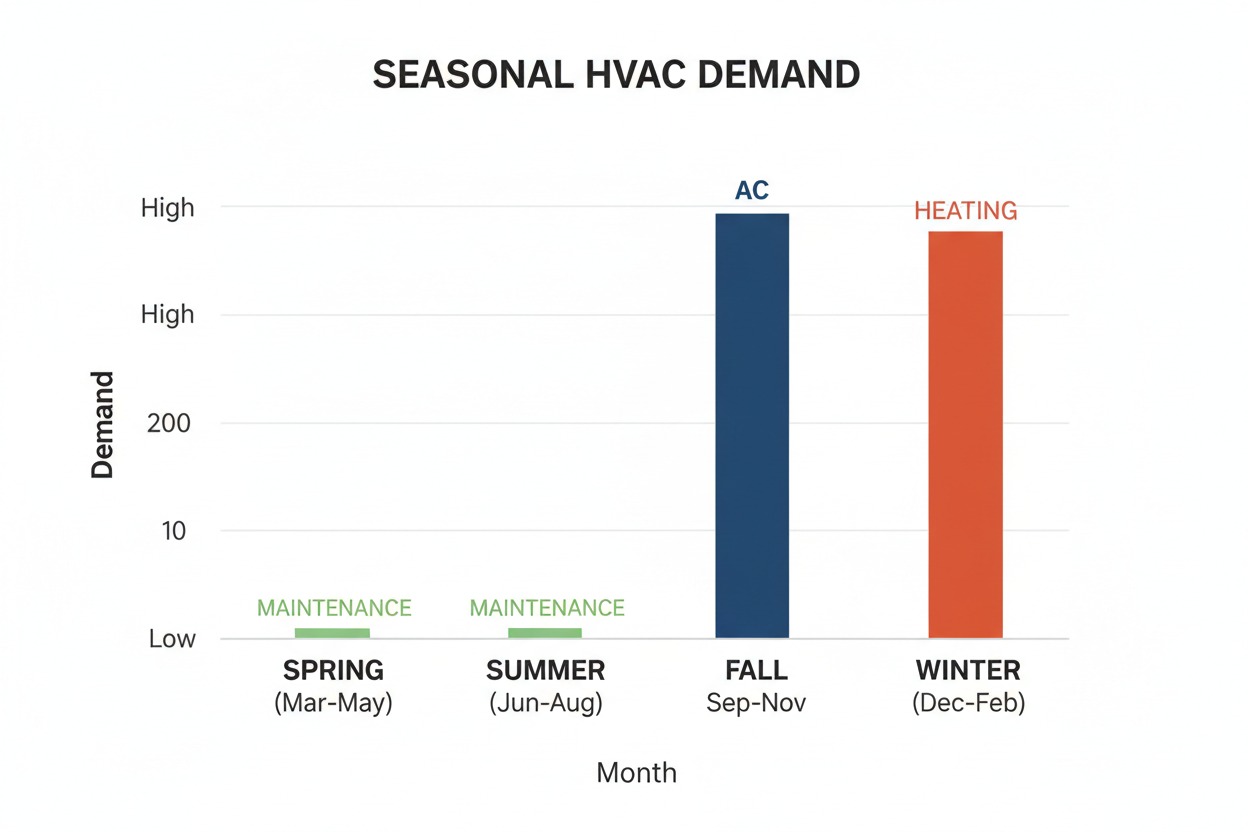
If your area has hot summers, cold winters, or both, that can help your business. HowMuchToStart.com’s HVAC cost calculator says AC work is busiest from May to September, and heating work is busiest from November to February in most places. The in-between times are mostly for maintenance.
How Much Does It Cost to Start an HVAC Business?
This is the single most-searched question about starting an HVAC company. And it’s also the one where blog posts contradict each other the most. So let’s be precise about why the numbers swing so wildly.
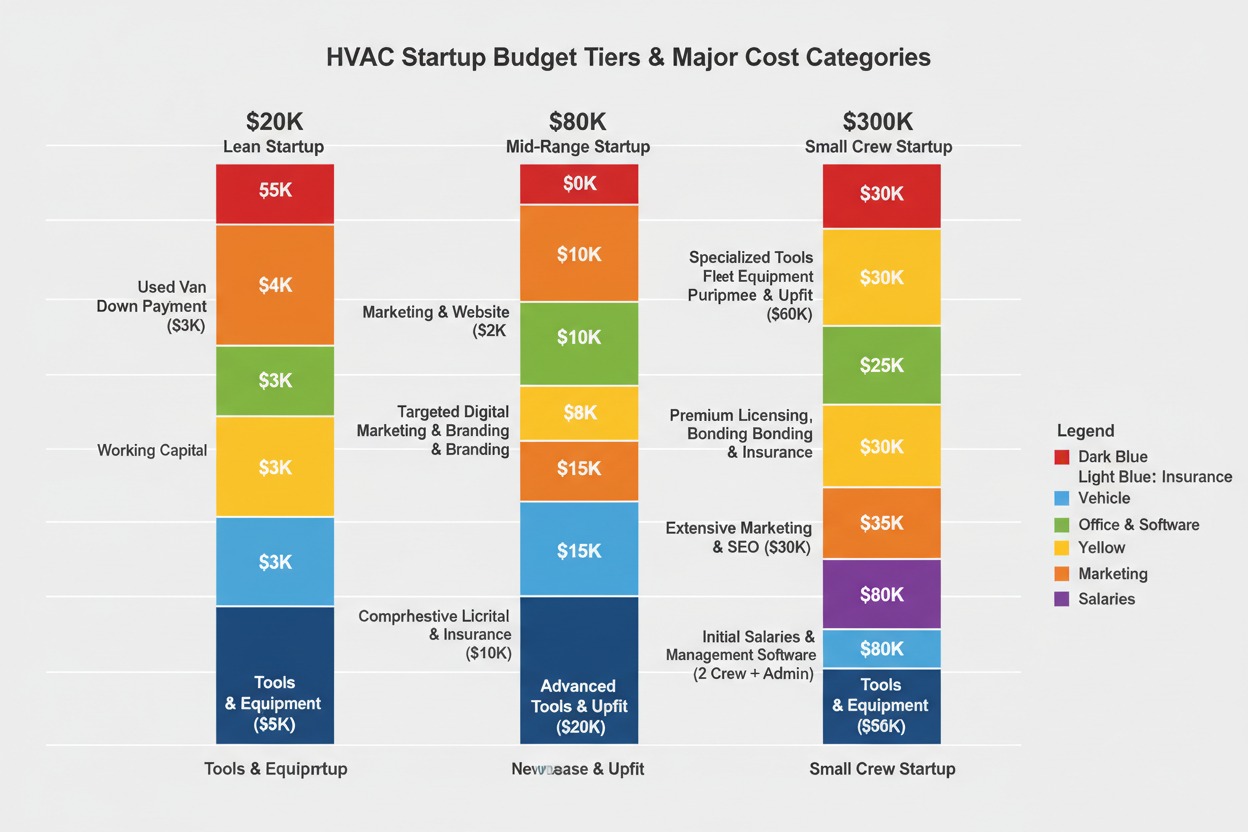
The honest range, pulled from multiple independent cost breakdowns, looks like this:
| Startup Path | Typical Cost | What It Gets You |
|---|---|---|
| Lean solo operator | $20,000–$30,000 | Used van, starter tool kit, licensing, minimal insurance |
| Owner-operator with room to grow | $40,000–$80,000 | Better equipment, marketing budget, and a few months of operating cash |
| Small crew from day one | $150,000–$350,000 | Multiple trucks, a leased bay, part-time office help, parts inventory |
| Franchise buy-in | $50,000–$100,000+ | Brand recognition, training systems, but ongoing royalty fees |
That first row matters most for most beginners. Per SmartService’s line-by-line breakdown, the honest startup math for a lean owner-operator HVAC company is $20,000 to $30,000, covering equipment, vehicle, licensing, insurance, marketing, and software. most of the spend goes to the truck, the equipment, and the first 90 days of insurance.
Here’s where that lean budget actually goes, line by line:
| Category | Typical Cost | Notes |
|---|---|---|
| State HVAC contractor license | $200–$2,000 | Varies dramatically by state; some require exams and bonds |
| Local business license, EIN, sales tax registration | $100–$500 | One-time setup cost |
| General liability insurance | $1,500–$3,500/year | For a one-truck operation |
| Commercial auto insurance | $1,500–$3,000/year | Per vehicle |
| Tools and in-transit coverage | $300–$800/year | Protects equipment on the road |
| Refrigerant recovery machine | $600–$1,500 | Required by the EPA for any refrigerant work |
| Gauges, vacuum pump, leak detector | $600–$1,800 | Core diagnostic tools |
| Combustion analyzer | $700–$1,500 | Worth it for gas furnace and water heater work |
| Hand tools, drills, basic gear | $2,000–$4,000 | To start |
| Parts inventory (capacitors, contactors, thermostats) | $1,500–$5,000 | Builds over time |
| Vehicle (used van/truck) | $5,000–$20,000+ | The biggest single line item for most owners |
This breakdown lines up closely with other independent estimates. Payzerware’s HVAC startup cost guide puts the range at $2,000 to $100,000, depending on location, scale, and how much equipment is purchased upfront, while HVAC Mavericks cites an average closer to $10,000–$50,000. On the higher end, HowMuchToStart.com’s state-adjusted calculator estimates $20,000 to $200,000 overall, noting that a 2–3 technician company with equipped vans and a service agreement program typically runs $70,000 to $150,000.
Don’t forget the hidden cost most first-time owners underestimate: your own lost income. RS Gonzales’s founder guide points out that many startups feel “cash poor” in month three, not because the business failed, but because they underestimated the transition away from a steady paycheck and benefits. Budget several months of personal living expenses separately from your business startup fund.
What Licenses Are Needed to Start an HVAC Business?
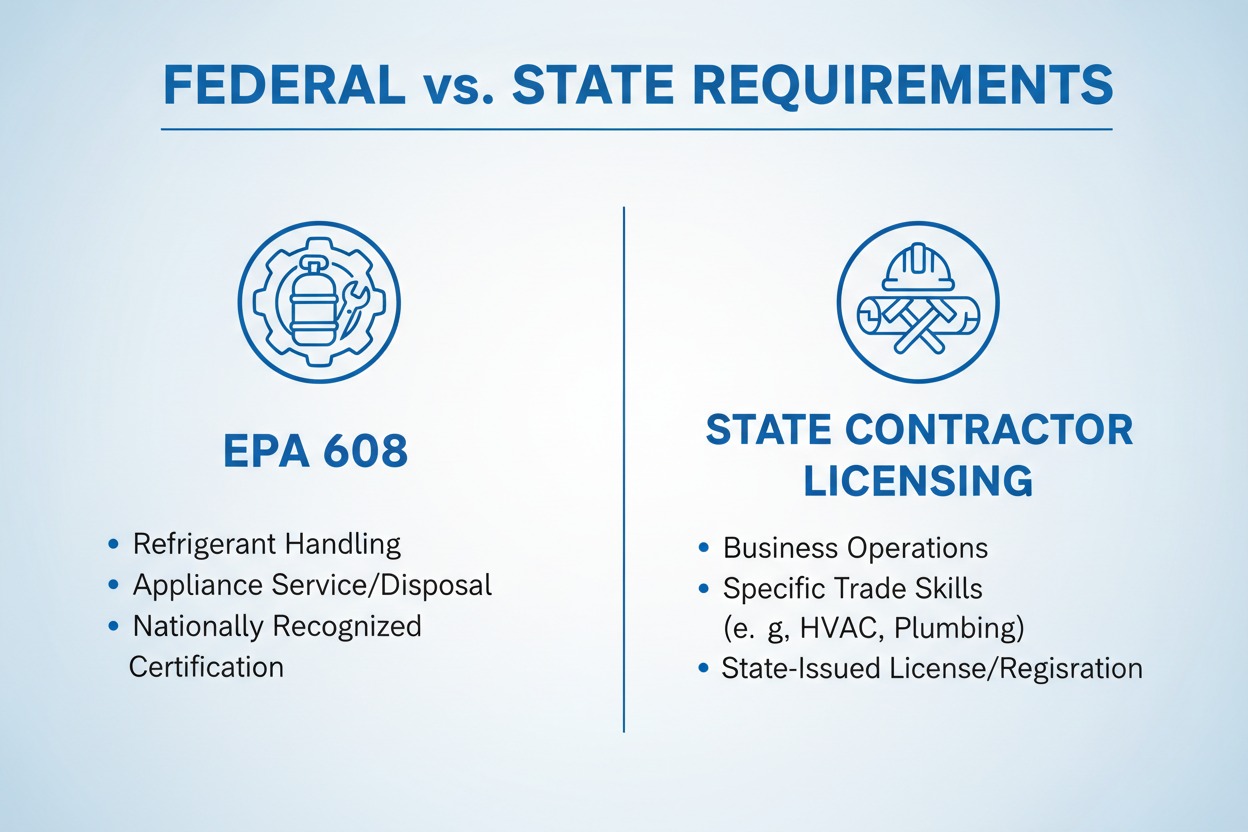
This is where most guides get vague, so let’s be specific. There are actually two separate layers of legal requirements, and confusing them is one of the most common early mistakes.
Layer 1: Federal — EPA Section 608 Certification
This one applies everywhere in the country, no exceptions. According to the EPA’s official Section 608 requirements page, any technician who maintains, services, repairs, or disposes of equipment that could release refrigerants into the atmosphere must be certified by an EPA-approved testing organization.
There are four certification types, and choosing the right one matters:
| Certification Type | Covers | Best For |
|---|---|---|
| Type I | Small appliances (under 5 lbs refrigerant) | Residential appliance service |
| Type II | High/very-high-pressure systems | Standard residential and light commercial HVAC |
| Type III | Low-pressure systems (large chillers) | Large commercial/industrial systems |
| Universal | All of the above | Maximum flexibility across residential, commercial, and industrial |
The good news, according to The Training Center’s certification guide: the certification itself has no state-level requirements, is valid across the entire country, has no prerequisites to take the exam, and never expires once earned. The bad news for anyone tempted to skip it. SkillCat’s EPA 608 guide notes that knowingly venting refrigerant can result in a federal fine of up to $44,539 per day per violation.
Layer 2: State (or Local) Contractor Licensing
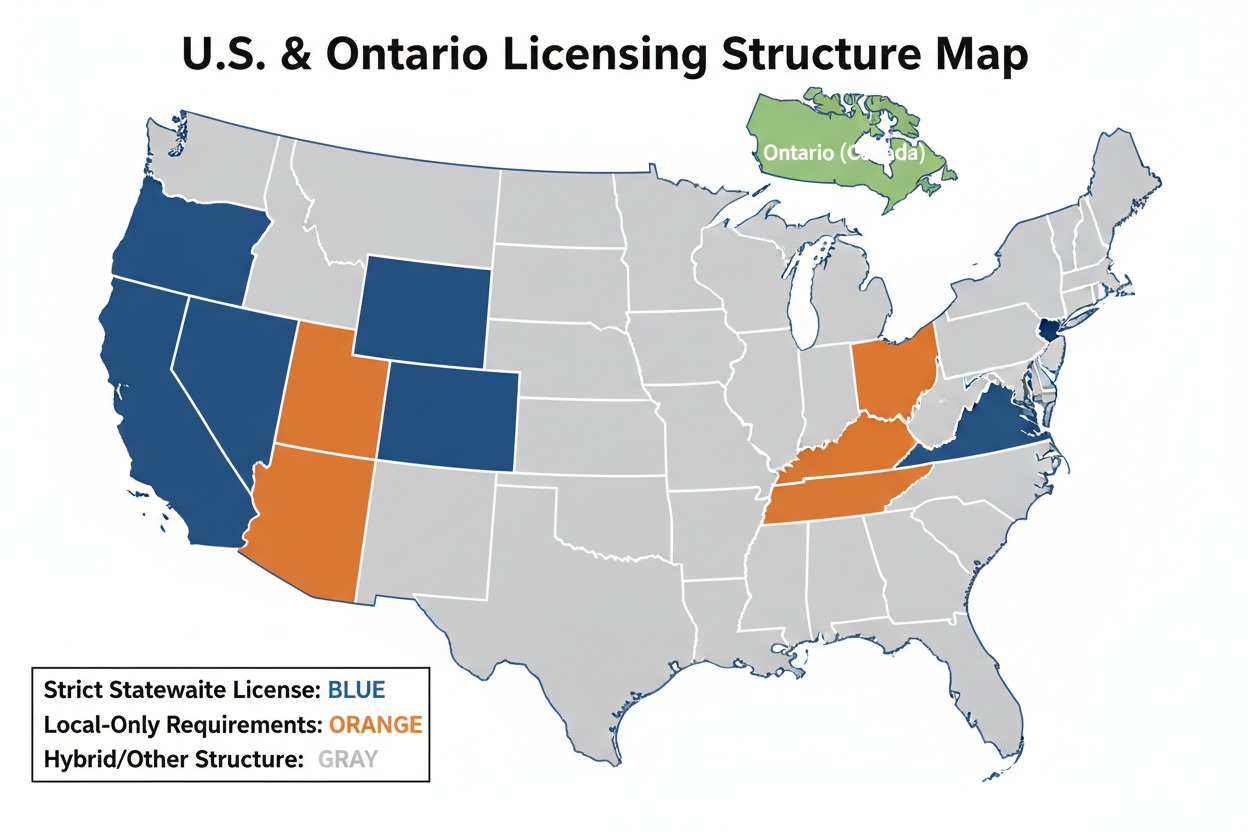
This is where things get genuinely complicated, because every state does this differently. And this is the part most competing articles gloss over. Some states license at the state level, some delegate entirely to cities and counties, and at least one major state has no HVAC license at all. We’ll break down each state you asked about below.
Other Licenses and Registrations You’ll Likely Need
- Employer Identification Number (EIN) — free from the IRS, needed for taxes and hiring.
- Business entity registration (LLC, sole proprietorship, etc.) — RS Gonzales notes that most HVAC startups form an LLC specifically for liability protection.
- Local business license and sales tax registration.
- Workers’ compensation insurance, per SmartService’s cost guide, is required once you hire your first W-2 employee and typically runs 5 to 12 percent of payroll, depending on the state and class code.
Can You Start an HVAC Business With No Experience?
This is one of the most-searched questions on this topic, and most articles either say a flat “no” or a misleadingly simple “yes.” The real answer involves a mechanism almost nobody explains clearly: the qualifying agent.
As Licensing Connection’s guide to qualifying agents explains, a qualifying agent is a licensed individual whose credentials allow a company to hold a contractor’s license and legally perform work in a given state. The qualifying agent doesn’t necessarily own the company. In many cases, they’re an employee, a partner, or an outside professional brought in specifically to fill this role, and their credentials satisfy the licensing board’s requirements on the company’s behalf.
In plain terms, you can legally own and run an HVAC business without holding the trade license yourself, as long as a properly licensed person is officially listed on your company as the qualifying individual. Housecall Pro confirms this directly: you can start an HVAC business without direct experience, but you’ll need to hire or partner with a licensed technician until you meet the requirements yourself. Many successful owners come from business or sales backgrounds and partner with experienced HVAC techs to handle the fieldwork.
That said, this path isn’t a shortcut without trade-offs:
Pros of the qualifying-agent route:
- You can launch immediately instead of waiting years to personally earn a license
- You can focus on sales, operations, and marketing while a partner handles technical compliance
- It’s a legitimate, widely used business structure. Not a loophole
Cons of the qualifying-agent route:
- You’re dependent on your qualifying agent staying with the business
- You still need deep enough industry knowledge to hire, price, and manage technical work credibly
- Some states restrict who can serve as a qualifying agent and how
The other legitimate no-experience path is franchising. According to DUCTZ’s franchise page, franchise owners often come from completely unrelated backgrounds, such as teaching, law, business, and the military, because the franchise provides the tools, training, and systems needed to run the technical side.
If you don’t go either of those routes, the realistic timeline to personally qualify is longer: most states require two to five years of documented, supervised field experience before you can sit for a contractor licensing exam yourself (details vary significantly by state; see the next section).
How to Start an HVAC Business in Your State
Licensing is the part of how to start a HVAC business that varies the most by location, and it’s also where most generic guides fall short. Here’s what the actual regulations say for each state you’re comparing.
How to Start an HVAC Business in Texas
Texas licenses HVAC contractors through the Texas Department of Licensing and Regulation (TDLR). Per NEXT Insurance’s Texas licensing breakdown, you generally need four years of practical experience under the supervision of a licensed contractor within the past six years, or one year with a technician certificate plus three years of supervised experience. ServiceTitan’s Texas guide notes the application fee is $115, plus a $60 exam fee paid to the third-party test provider, and a $65 annual renewal fee.
There’s also a faster path: after two years under a licensed contractor, techs can become a Certified ACR Technician by completing a 2,000-hour certification program, shortening the remaining wait to three additional years of experience.
How to Start an HVAC Business in Florida
Florida licenses HVAC contractors through the Department of Business and Professional Regulation (DBPR). According to Lumberfi’s Florida licensing wiki, Class A contractors face no limitations on system size, while Class B contractors are limited to systems with a cooling capacity of 25 tons or less and a heating capacity of 500,000 BTU or less.
NEXT Insurance’s Florida guide notes applicants generally need four years of proven construction experience (though up to three years of college credit or military experience can substitute), plus passing scores of 70% or higher on both a trade knowledge exam and a business and finance exam. That same source confirms license holders must carry at least $100,000 in liability insurance and $25,000 in property damage insurance.
How to Start an HVAC Business in Virginia
Virginia is unique in that, per Adapt Digital Solutions’ breakdown of Virginia’s DPOR rules, contractor licenses are issued to business entities, not individuals — every licensed firm must designate a Qualified Individual whose experience and exam results qualify the business.
This is Virginia’s own built-in version of the qualifying-agent structure discussed above. NEXT Insurance’s Virginia HVAC guide lays out how experience requirements scale by license class: five years for Class A (with a $45,000 net worth requirement), three years for Class B ($15,000 net worth requirement), and two years for Class C (no net worth requirement). That same source notes Virginia has a reciprocity agreement for HVAC licenses only with Maryland — there’s no reciprocity with any other state.
How to Start an HVAC Business in California
California requires the C-20 Warm-Air Heating, Ventilating and Air-Conditioning Contractor license, issued by the Contractors State License Board (CSLB). Per Sun Coast Insurance’s California HVAC guide, anyone performing HVAC work valued at $500 or more in labor and materials must hold this license. Billd’s C-20 licensing breakdown notes you need four full-time years of journey-level experience over the last ten years before you can take the exam, and up to three of those years can come from an approved college or vocational program.
Per a recent rule change described in PermitFlow’s California HVAC guide, the CSLB now strictly requires proof of EPA Section 608 Certification (Type II or Universal) before issuing a C-20 license, and even contractors with zero employees are required to carry workers’ compensation insurance.
How to Start an HVAC Business in Georgia
Georgia calls its HVAC credential the Conditioned Air Contractor license, which is administered by the Georgia Secretary of State. According to Budget Heating’s regulatory guide, Class I is restricted to systems not exceeding 175,000 BTU heating and 60,000 BTU cooling, while Class II has no size limitations.
Class I requires four years of documented experience, and Class II requires five, plus EPA Type II or higher certification and a board-approved heat loss/gain design course. Unlike most states, Lumberfi’s Georgia licensing wiki notes applicants must also submit three notarized professional references from architects, engineers, inspectors, or licensed Conditioned Air Contractors.
How to Start an HVAC Business in Illinois
Here’s the surprise: almost no other article states plainly that Illinois has no statewide HVAC license at all. According to NEXT Insurance’s Illinois HVAC guide, unlike plumbers in Illinois, there is no state-level license requirement for entry- and mid-level HVAC professionals — even in Chicago, the state’s largest city, no license is required to perform heating, air conditioning, and refrigeration work.
That said, Chicago requires a general contractor license to pull permits for HVAC work involving hardwired electrical connections, and Springfield requires registration with the city’s Building and Zoning Department plus a passing exam. Regardless of local rules, Workiz’s Illinois licensing guide confirms EPA Section 608 certification is still mandatory by federal law for anyone handling refrigerants anywhere in Illinois. This makes Illinois one of the fastest states to legally launch in. But also one where you should double-check your specific city or county before assuming you’re in the clear.
How to Start an HVAC Business in Tennessee
Tennessee licenses HVAC contractors through the Board for Licensing Contractors (BLC), but only for projects above a certain size. Per Contractor Requirements’ Tennessee guide, a state-level contractor license is mandatory for projects valued at $25,000 or more, including both materials and labor — for smaller projects, local licensing or a Limited Licensed Electrician license may apply instead. Lumberfi’s Tennessee licensing wiki notes applicants generally need at least three years of HVAC experience and must pass both a Business and Law exam and a trade-specific HVAC/Refrigeration exam, each requiring a 73% passing score.
ServiceTitan’s Tennessee guide adds that Tennessee doesn’t have direct reciprocity agreements with most states, but does have trade exam waiver agreements with several, including Alabama, Louisiana, Mississippi, Ohio, and South Carolina.
How to Start an HVAC Business in Ontario
Ontario’s system works differently from anything on the U.S. side of this list, since HVAC work involving gas appliances falls under a separate regulator. According to Skilled Trades College of Canada’s Ontario HVAC guide, two main bodies regulate HVAC in Ontario — the skilled trades certification system and the Technical Standards and Safety Authority (TSSA) — and there’s no single “HVAC license,” but rather several certifications depending on the specific work performed.
Specifically for gas-fired equipment, Herzing College’s guide to TSSA gas tech certification explains that any tradesperson working with oil or gas must be certified through the TSSA. The entry-level G3 certification allows work on gas equipment up to 400,000 BTUH but only under the supervision of a G2- or G1-certified technician. George Brown Polytechnic’s G3 program page confirms certification exams require a score of 75% or higher to pass.
Step-by-Step: How to Start an HVAC Business
Once you understand the costs and licensing landscape, the actual launch sequence is fairly consistent nationwide. Here’s the order that avoids the most common delays.
1. Get Your EPA Section 608 Certification First
Get your EPA Section 608 certification first. It’s federally required, doesn’t expire, and has no prerequisites. There’s no reason to wait. Because it’s a prerequisite for handling refrigerants on nearly every job you’ll take, knocking it out before you’ve even settled on a business structure means one less bottleneck later. Many technicians study and test for this while still working for someone else, which is the smart move.
2. Choose Your Business Structure
Choose your business structure. Most owners choose an LLC for liability protection and then register it with their state. An LLC shields your personal assets if the business is ever sued, and it’s relatively cheap and fast to set up compared to a corporation. Whatever structure you choose, register it with your state’s business filing office before proceeding to financial or licensing steps.
3. Get Your EIN From the IRS
Get your EIN from the IRS. It’s free and takes minutes online. You’ll need this number to open a business bank account, file taxes, and eventually run payroll, so there’s no reason to pay a third party to obtain it for you.
4. Decide Your Licensing Path
Decide your licensing path: personally qualify through work experience, bring on a qualifying agent, or pursue a franchise model. Each path has different timelines and costs. Personally qualifying usually means documenting years of hands-on experience and passing a trade exam, while a qualifying agent lets you launch faster but ties your legal standing to someone else’s license. Franchising trades independence for a built-in system and brand recognition. Pick the path that matches your experience level and how quickly you want to be operational.
5. Secure Insurance
Secure insurance — general liability at minimum, plus commercial auto and workers’ comp once you hire. General liability protects you against claims arising from property damage or injury on a job site, and most clients and municipalities won’t let you work without proof of it. As you add trucks and employees, layer in commercial auto and workers’ comp to stay compliant and protected.
6. Apply for Your State or Local Contractor License
Apply for your state or local contractor license, budgeting for exam fees and processing time (this can take anywhere from a few weeks to several months, depending on the state). Start this application as early as possible, since delays here can stall the rest of your launch. You generally can’t legally advertise or contract for HVAC work until it clears.
7. Buy Your Core Tools and Vehicle
Buy your core tools and vehicle. Start lean. A used van and a starter tool kit are enough to begin taking service calls. Resist the urge to buy everything new or fully outfit a fleet before you have steady revenue; you can reinvest in equipment as jobs come in.
8. Set Up Basic Business Software
Set up basic business software for scheduling, invoicing, and customer records. Even a simple, affordable platform keeps you organized from day one and prevents missed appointments or lost invoices as your customer base grows.
9. Build Your First Marketing Channels
Build your first marketing channels: a Google Business Profile, a simple website, and word-of-mouth referrals. These three channels cost little to nothing and are often where a new HVAC business gets its first real leads, well before paid advertising makes financial sense.
10. Focus Early Revenue on Maintenance Agreements
Focus early revenue on maintenance agreements. Per SmartService’s cost breakdown, maintenance agreements (typically priced at $150 to $300 per customer per year) are the line item that turns a seasonal business into a year-round one. Prioritizing these agreements early builds predictable revenue and customer loyalty that carries you through slower months.
If you’re weighing HVAC against other hands-on service businesses before committing, Rarely Notes’ guide to starting a sticker business walks through a much lower-overhead alternative — useful context if you’re still comparing capital-intensive versus low-capital startup paths.
Pros and Cons of Starting an HVAC Business
Pros
- Essential, non-discretionary demand. People don’t put off a broken furnace
- Strong recurring revenue potential through maintenance contracts
- Multiple entry paths (personal licensing, qualifying agent, franchise)
- Lower barrier to entry than many licensed trades if you start lean
Cons
- Licensing timelines and rules vary enormously by state, adding real complexity if you plan to expand
- Upfront equipment and insurance costs add up quickly
- Seasonal cash flow swings require careful budgeting
- The hidden opportunity cost of lost W-2 income during the first year
Expert Tips for New HVAC Business Owners
- Get your EPA 608 Universal certification even if your state doesn’t require it right away. It never expires and immediately expands the systems you’re legally allowed to service.
- Never assume your license transfers across state lines. As Sergey Nikolin, co-founder of Product Air Heating & Cooling, told Housecall Pro: some states, especially in the South, have reciprocity deals that can save you from retaking exams, but plenty don’t — knowing this ahead of time can save you headaches when you’re ready to grow.
- Separate your personal and business finances from day one. RS Gonzales’s founder guide warns that mixing business income with personal expenses creates chaos at tax time and damages your financial clarity.
- Budget insurance is an annual cost, not a one-time cost. Per SmartService, total annual insurance for a solo operation typically runs $3,000 to $7,000 per year, not a one-time fee.
- If you’re going the qualifying-agent route, put the relationship in writing early. Your entire legal ability to operate depends on that person staying attached to your license.
- Launch in the off-season if you can. Starting in spring or fall gives you breathing room to set up licensing, insurance, and marketing before the summer AC rush or winter heating surge hits.
- Track your recurring maintenance agreement percentage from month one. It’s the single best predictor of whether your revenue will smooth out or stay feast-or-famine.
For general context on where HVAC fits within the broader consumer services landscape, Rarely Notes’ overview of companies in the consumer services field is a useful companion read when mapping your competitive landscape.
Frequently Asked Questions
How much does it cost to start an HVAC business?
Realistic startup costs range from about $20,000 for a lean, solo owner-operator with a used van and starter tools, up to $80,000 for a business with more equipment and marketing runway, and $150,000 to $350,000 for a small operation with a crew from day one. Most of the cost goes toward the vehicle, tools, licensing, and the first several months of insurance.
Can you start an HVAC business with no experience?
Yes, through two legitimate paths: partnering with a licensed “qualifying agent” who attaches their credentials to your business license, or joining an HVAC franchise that provides training and systems. Without one of these, most states require two to five years of documented, supervised field experience before you can personally hold a contractor license.
What licenses are needed to start an HVAC business?
At minimum, you need EPA Section 608 certification (federally required nationwide for anyone handling refrigerants) plus a state or local contractor license, which varies significantly by location. Some states, like Illinois, have no statewide HVAC license at all, while others, like California and Virginia, have detailed experience and exam requirements.
How long does it take to start an HVAC business?
It typically takes 5 to 6 years, depending mostly on licensing. Someone with existing HVAC experience who already qualifies for a contractor license might launch in three to six months after completing registration, insurance, and equipment setup. Someone starting from zero experience faces a multi-year path unless they use a qualifying agent or franchise model.
Is HVAC a profitable business to start?
It can be. Typical first-year net income for a working solo owner-operator runs $50,000 to $100,000, though this depends heavily on how quickly you build a recurring maintenance customer base. Most owners report reaching steady profitability within 18 to 36 months with consistent local demand and efficient operations.
Final Thoughts
Starting an HVAC business isn’t a single decision. It’s a stack of smaller ones: how you’ll get licensed, how lean you’ll launch, and which state’s rules you’re actually working under. Skip any one of those, and you’ll find out the hard way, usually mid-job with an inspector or a denied permit.
The good news is that every piece of this (the EPA certification, the state licensing path, even the qualifying-agent workaround if you’re starting from zero) is a documented, repeatable process. You don’t need to guess your way through it.
If you’re mapping out your next move, browse Rarely Notes’ Growth section for more practical, step-by-step business breakdowns like this one.