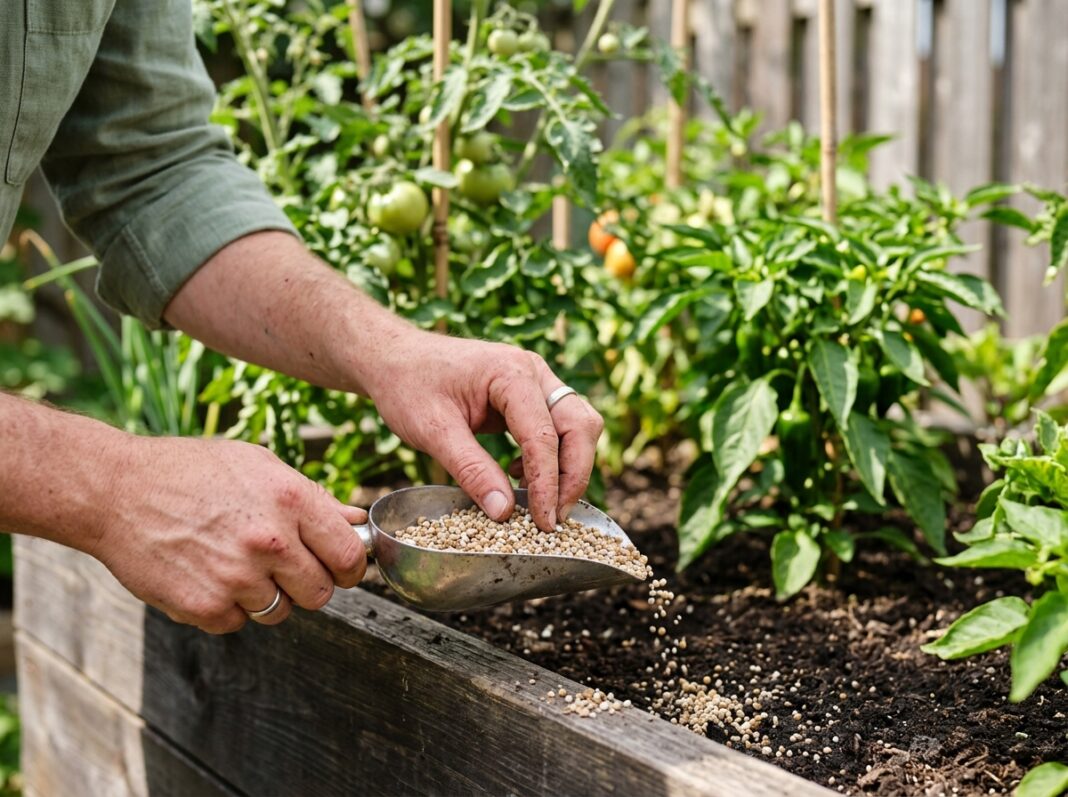
How to Dose Fertilizer for Plants? (Introduction)
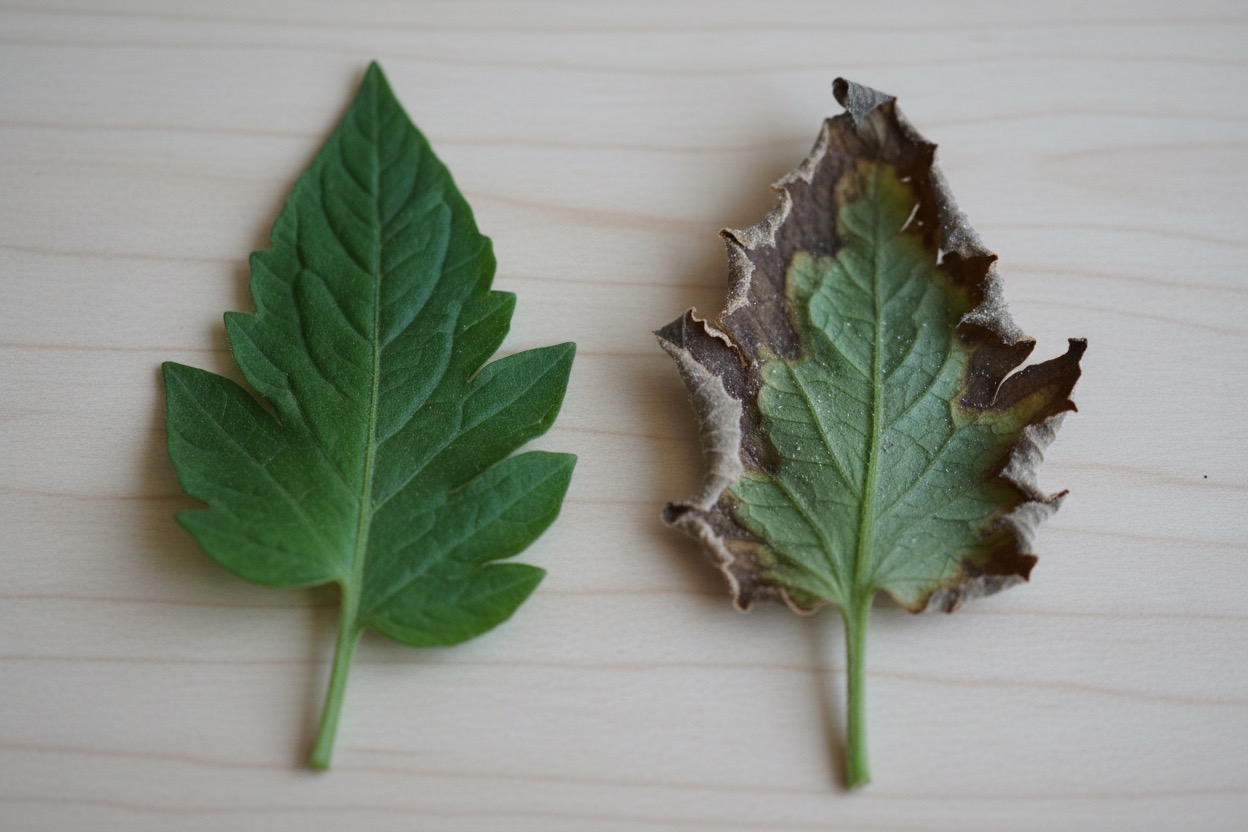
Here’s a secret most gardeners won’t say: you’ve probably stood in the garden aisle with a bag of fertilizer, not sure how much to use. Maybe you guessed. Maybe you added a bit more “just to be safe.” Then a week later, your tomato leaves turned brown and crispy, and you didn’t know why.
You are not alone, and it is not your fault. Most people do not explain fertilizer amounts in simple numbers. Bags say things like “follow label instructions,” which is as helpful as a recipe that says “add some salt.”
Using too much fertilizer harms plants by burning roots, damaging leaves, and sometimes killing the plant. Using too little fertilizer makes plants weak, small, and less productive. The right amount is smaller than many think, and the best way to get it right is by using exact measurements, not guesswork.
This guide shows you how to dose fertilizer for plants like vegetables, houseplants, trees, shrubs, and flowers using simple math and rates taught by university experts. It also explains the best fertilizer for vegetables, so you use the right product and dose for your plants.
What Fertilizer Actually Is (and Why the Dose Matters So Much)
Fertilizer is food for plants, but that description doesn’t show how exact it needs to be. Soil often lacks sufficient levels of the three main nutrients plants need: nitrogen (N), phosphorus (P), and potassium (K). These are the three numbers you see on every fertilizer label as the NPK ratio.
Plants also need small amounts of micronutrients like calcium, magnesium, iron, and zinc. If they get too little, they don’t grow well. If they get too much, it can harm them or prevent them from absorbing other nutrients they need.
Think of fertilizer like medicine. The right amount helps. The wrong amount — even if it’s good stuff — can hurt. This is because fertilizer salts directly affect plant roots.
Understanding the NPK Label Before You Measure Anything
Every fertilizer package has three numbers, like 10-10-10 or 5-10-5. These numbers show the percent by weight of nitrogen, phosphorus, and potassium, in that order.
So a 100-pound bag of 5-10-10 fertilizer contains 5 pounds of nitrogen, 10 pounds of phosphorus, and 10 pounds of potassium, with the remainder being filler material that helps with even spreading.
What Each Nutrient Actually Does
| Nutrient | What It Does | Signs of Deficiency |
|---|---|---|
| Nitrogen (N) | Drives leafy, green growth and stem strength | Pale or yellowing lower leaves, slow growth |
| Phosphorus (P) | Supports root development, flowering, and fruiting | Stunted roots, purple-tinted young leaves |
| Potassium (K) | Improves disease resistance and overall plant vigor | Brown or scorched leaf edges |
This matters for dosing because a 10-10-10 fertilizer has twice as much nitrogen as a 5-10-10. If you use the same amount without checking the percentage, you might give a plant too much or too little fertilizer without knowing.
The Core Formula: How to Calculate Fertilizer Dose
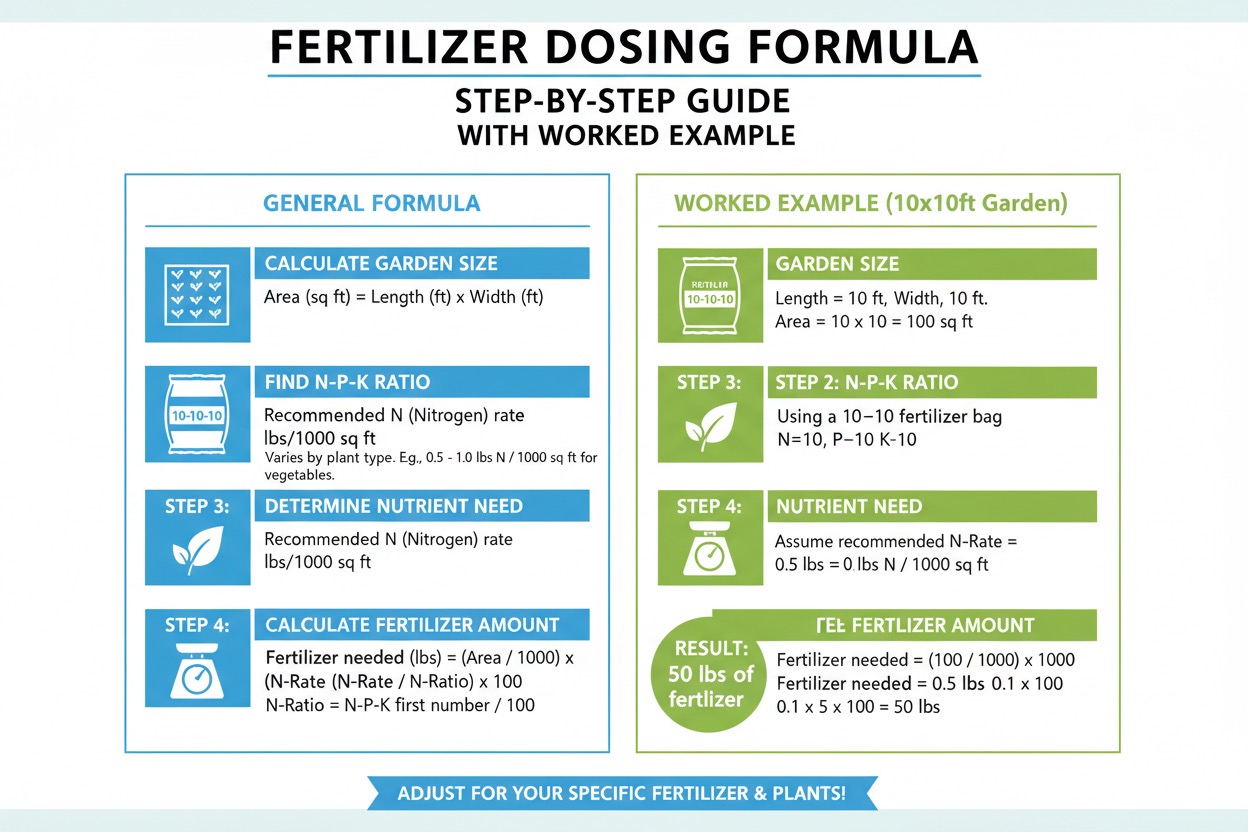
This part may seem scary, but it’s just one simple equation used by university extension fertilizer guides across the country:
Amount of fertilizer needed = Desired nutrient rate ÷ % of that nutrient in the fertilizer
Real Example: Dosing Nitrogen for a Garden Bed
Say your goal is 1 pound of actual nitrogen per 1,000 square feet, using a 10-10-10 fertilizer (10% nitrogen).
- Divide your target nitrogen amount (1 lb) by the nitrogen percentage (0.10)
- 1 ÷ 0.10 = 10
That means you need 10 pounds of 10-10-10 fertilizer per 1,000 square feet to deliver 1 pound of actual nitrogen.
This method is confirmed by Rutgers Cooperative Extension: using 5 pounds of 20%-nitrogen fertilizer per 1,000 square feet on a 25,000-square-foot area means you need 125 pounds total (5 lbs times 25, because 25,000 is 25 times 1,000). The same formula applies to trees and shrubs — UNH Extension says a 15-5-10 fertilizer (15% nitrogen) needs 6.6 pounds per 1,000 square feet to give 1 pound of nitrogen, since 100 divided by 15 is 6.6.
Scaling the Math to a Small Home Garden
Most home gardens aren’t thousands of square feet. They’re tens or hundreds. Here’s the adjusted process:
Step 1: Calculate your garden’s square footage (length × width).
Step 2: Find your target rate per 100 square feet (covered in detail below).
Step 3: Multiply that rate by the number of “100 square foot units” your space contains.
For example, a 20-by-15-foot garden is 300 square feet, or three sections of 100 square feet each. If you need 2 pounds of 10-10-10 fertilizer per 100 square feet, you will need 6 pounds in total.
How to Dose Fertilizer for Vegetable Gardens (Real Extension Numbers)
This is the part most people are looking for, so let’s use exact, reliable numbers — not rough estimates.
General Pre-Planting Rate
Several university extension programs suggest similar amounts. Colorado State University Extension advises using 1 pound of 10-10-10 fertilizer or 2 pounds of 5-10-5 fertilizer for every 100 feet of row before planting.
Texas A&M AgriLife Extension suggests using 2 to 3 pounds of fertilizer, such as 10-20-10, per 100 square feet if you haven’t tested your soil. Use 2 pounds in sandy soil and 3 pounds in clay soil, as clay holds nutrients better.
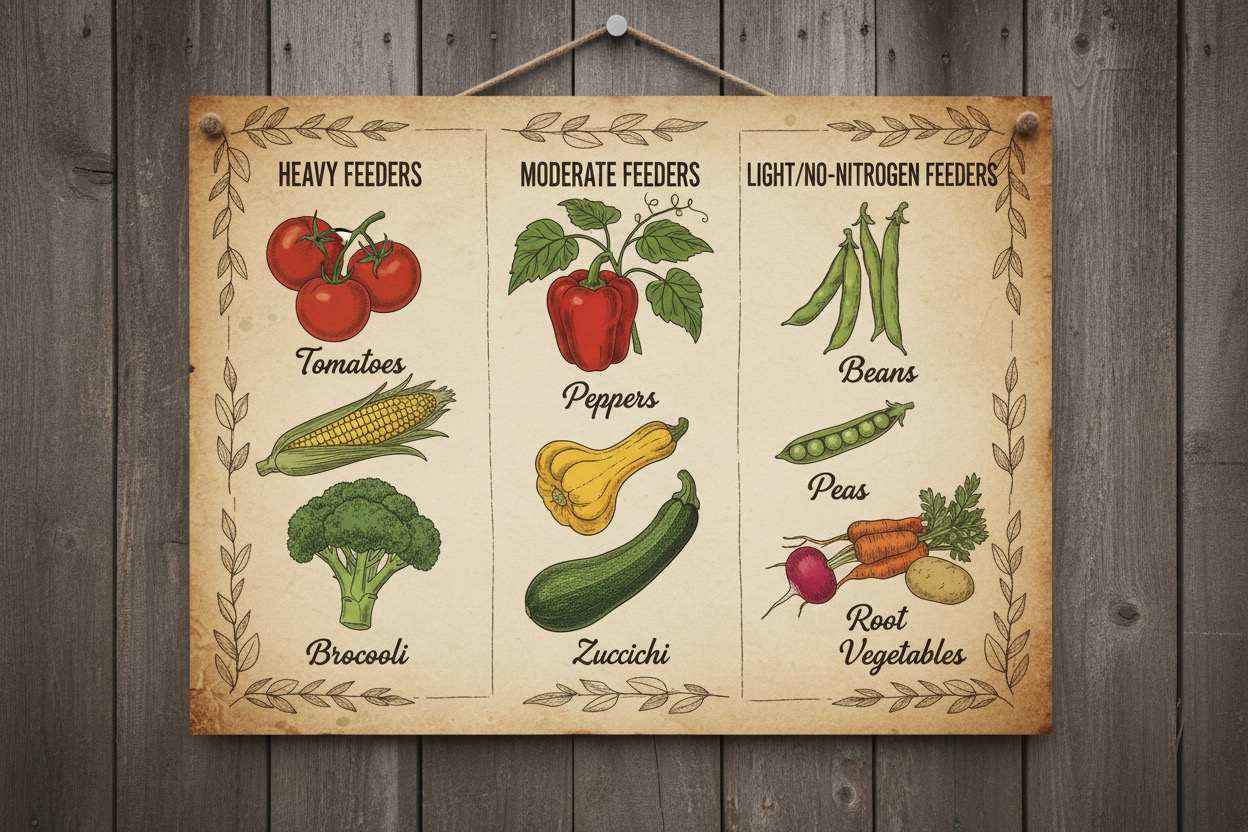
University of Maryland Extension gives a simple rule for nitrogen: use 2 pounds per 1,000 square feet (0.2 lbs per 100 sq ft) for most vegetables, and 3 pounds per 1,000 square feet (0.3 lbs per 100 sq ft) for heavy feeders like tomatoes, broccoli, and beets.
Quick Reference Table: Vegetable Garden Fertilizer Rates
| Fertilizer Type | Application Rate | Best For |
|---|---|---|
| 10-10-10 (balanced) | 1–2 lbs per 100 sq ft | New beds, general vegetables |
| 10-20-10 | 2–3 lbs per 100 sq ft | Pre-plant, fruiting vegetables |
| 5-10-5 or 5-10-10 | 2 lbs per 100 ft of row | Lower-nitrogen needs |
| 6-6-6 (broadcast) | 3 lbs per 100 sq ft | General vegetable beds |
| 8-8-8 (broadcast) | 2.5 lbs per 100 sq ft | General vegetable beds |
| 10-0-10 (broadcast) | 2 lbs per 100 sq ft | Phosphorus-rich soils |
| Compost or composted manure | 25–100 lbs per 100 sq ft | Soil-building, sandy soils |
Broadcast rates sourced from the University of Florida IFAS Extension vegetable gardening guide.
Side-Dressing Rates (Mid-Season Feeding)
Pre-planting fertilizer does not last all season. Most vegetables need a second or third feeding while growing, called side-dressing.
Texas A&M AgriLife Extension suggests using about ½ cup of garden fertilizer for every 10 feet of row when side-dressing. Apply it along the sides of rows and water it into the soil. The University of Florida IFAS guide recommends about 2.5 to 5 ounces of 10-10-10 fertilizer per 10 feet of row, placed 2 to 3 inches to the side and 1 to 2 inches below the seed or plant row.
Dosing for Specific Heavy Feeders
Not all vegetables need the same amount of fertilizer. The University of Maryland Extension says tomatoes and leafy greens need more nitrogen than beans because beans get some nitrogen from the air through their roots.
Meanwhile, the Old Farmer’s Almanac says some root vegetables should not get extra nitrogen. These include sweet potatoes, watermelons, carrots, beets, turnips, parsnips, and lettuce. Too much nitrogen makes leaves grow more but hurts the roots or fruits you want to harvest.
For crops that do benefit from a mid-season nitrogen boost, the Old Farmer’s Almanac suggests specific times: peppers, eggplants, and tomatoes after the first fruit appears; sweet corn when plants reach 8 to 10 inches tall and again a week after tassels show; and leafy greens like spinach, kale, and turnip greens when plants are about one-third grown.
How to Dose Fertilizer for Houseplants
Houseplants are a completely different dosing challenge than garden beds, mostly because of one factor: light availability changes how much a plant can actually use.
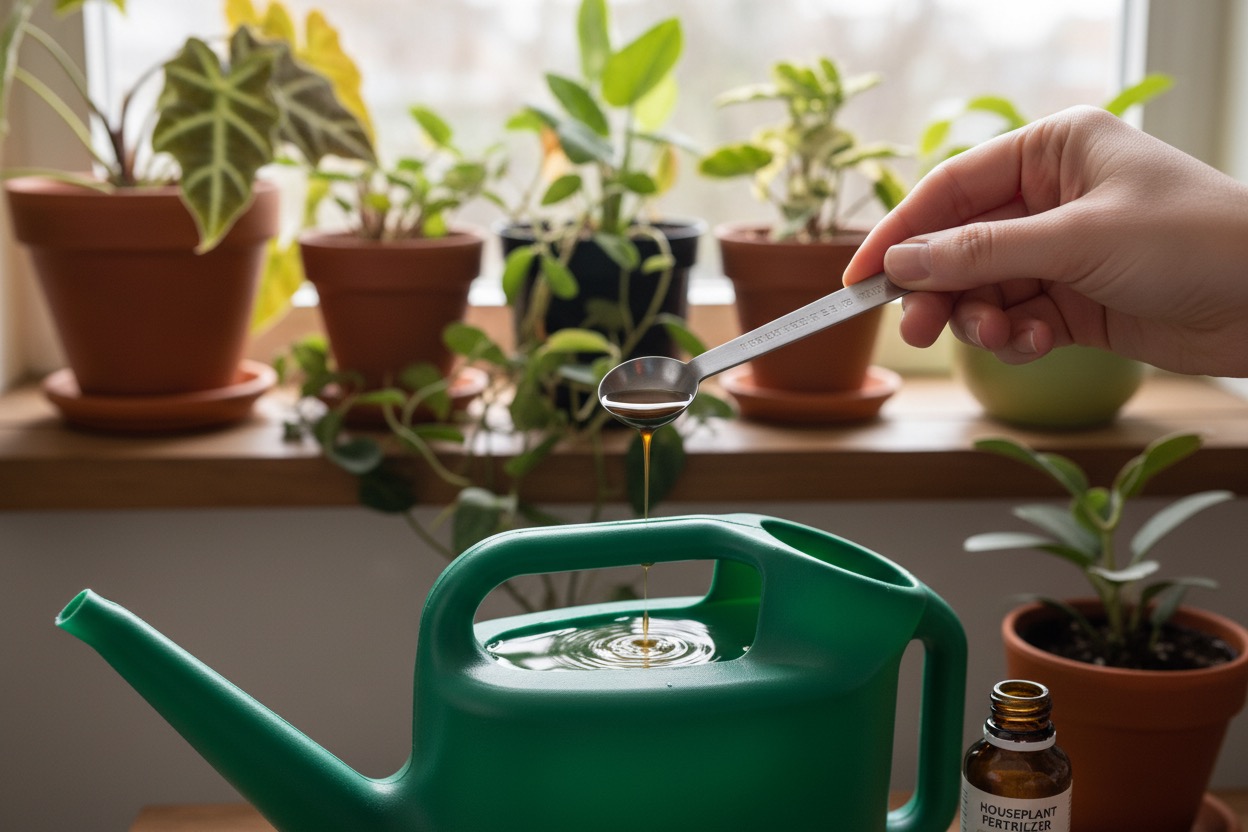
The Half-Strength Rule
Cooperative extension offices all agree: use fertilizer at a weaker strength, not the full amount on the label. Iowa State University Extension and Outreach suggests mixing general-purpose fertilizers at half or quarter strength because houseplants grow more slowly than outdoor plants, which the labels are designed for.
University of Connecticut’s Home Garden Education Office suggests an easy way to dilute fertilizer: if the label says one teaspoon per quart once a month, you can use half a teaspoon per quart every two weeks, or a quarter teaspoon per quart every week. This provides the plant with nutrients in smaller, more frequent doses rather than a single strong dose.
Seasonal Dosing Changes
Houseplants mainly use fertilizer when they are actively growing, usually from March to October. UConn Extension says that in winter, when light is low and temperatures are cooler, plants rest and should not be fertilized.
UNH Extension suggests feeding indoor herbs that are growing with a half-strength liquid fertilizer every 1 to 2 weeks, adjusting the frequency based on how much new growth you see.
Houseplant Dosing Quick Reference
| Season | Strength | Frequency |
|---|---|---|
| Spring/Summer (active growth) | Half to full strength | Every 2–4 weeks |
| Fall (transition) | Half strength | Monthly, tapering off |
| Winter (dormancy) | None for most plants | Stop entirely, or quarter-strength monthly for tropicals in heated homes |
| After repotting | None | Wait several weeks before resuming |
How to Dose Fertilizer for Trees and Shrubs
Trees and shrubs grow slower than vegetables, so giving them too much fertilizer causes fast but weak growth that can get sick and break easily.
The Standard Rate
Multiple extension sources agree on a similar nitrogen range for trees and shrubs. The University of Maryland Extension suggests applying 2 to 3 pounds of nitrogen per 1,000 square feet for shrubs, with less used near building foundations to avoid too much growth.
UMass Amherst Extension suggests using 1 to 3 pounds of actual nitrogen per 1,000 square feet each year for tree care. Clemson Cooperative Extension’s Home & Garden Information Center follows the ANSI A300 standard: use 2 to 4 pounds of total nitrogen per 1,000 square feet yearly for slow-release fertilizers, but no more than 6 pounds total. For fast-release nitrogen, use 1 to 2 pounds per 1,000 square feet, not more than 4 pounds a year.
How to Measure the Root Zone
A tree’s “application area” is its root zone, usually the space under the canopy and sometimes a few feet beyond the drip line. The University of Missouri Extension gives an example: for a 20-foot by 20-foot area where you want 2 pounds of nitrogen per 1,000 square feet, you calculate (20 × 20) ÷ 1,000 × 2 = 0.8 pounds (about 12 ounces) of nitrogen needed for the tree.
A Note on Evergreens vs. Deciduous Plants
Not all woody plants need the same amount of fertilizer. UNH Extension says rhododendrons, azaleas, and other shallow-rooted plants should get less fertilizer. Plants that grow fast, like forsythia, honeysuckle, privet, and silver maple, often need little or no extra nitrogen.
Liquid vs. Granular Fertilizer: How the Dosing Differs
The form of fertilizer you choose changes how precisely — and how often — you need to dose it.
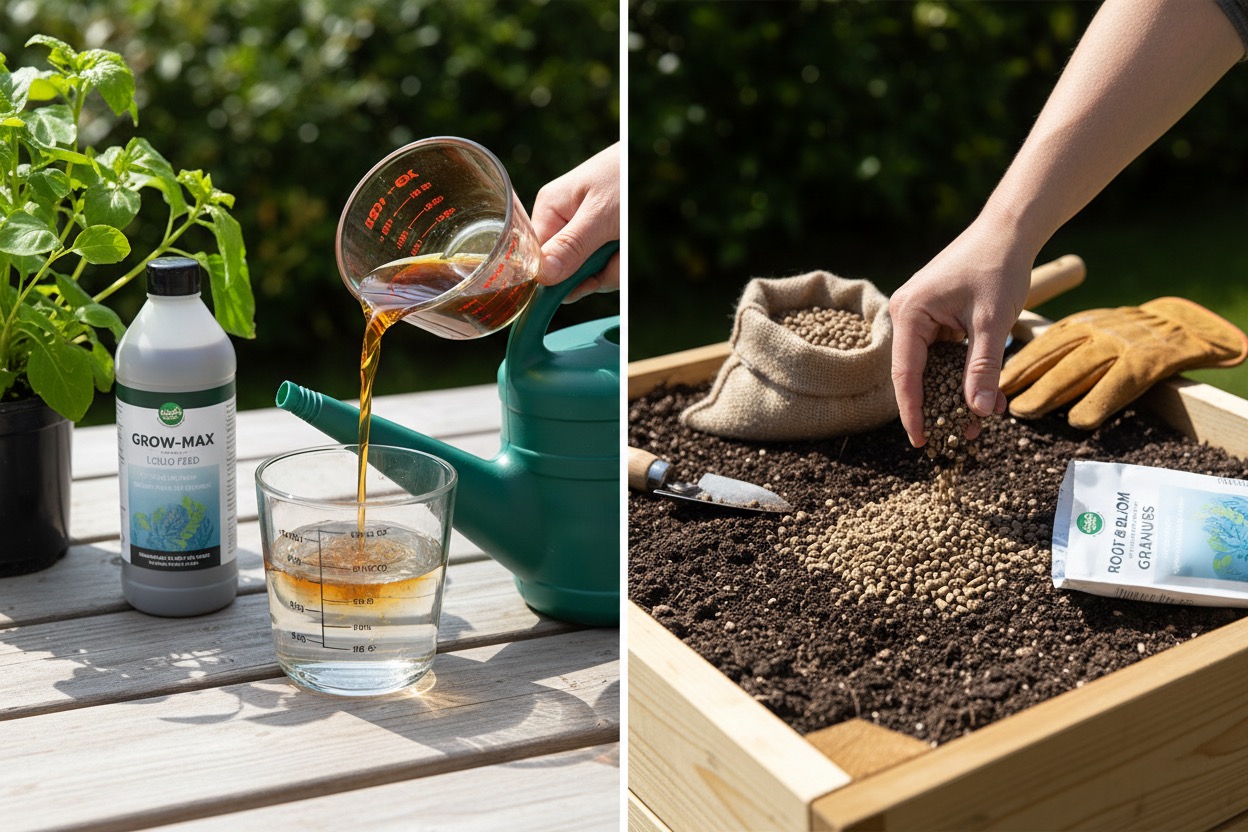
Liquid Fertilizers
Liquid fertilizers are fast-acting and dissolve in water for direct root or foliar delivery.
How to dose them correctly:
- Check the label for the exact dilution ratio (such as 1 tsp per gallon)
- Always measure with a spoon or marked container — never estimate by eye
- Water the soil before applying, to reduce the risk of root shock
- Reapply every 1–2 weeks during active growth for most plants
Granular Fertilizers
Granular products release more slowly and last longer between applications.
How to dose them correctly:
- Measure by weight or volume exactly as instructed
- Scatter evenly and lightly work into the top inch or two of soil
- Water thoroughly afterward to begin activating the nutrients
- Reapply on the schedule listed on the label, typically every 6–8 weeks for standard granular products
Slow-release, polymer-coated granular fertilizers break down more gradually over weeks or months, which makes them more forgiving for beginners since the risk of a single over-application is lower.
The Bigger Mistake: Skipping the Soil Test
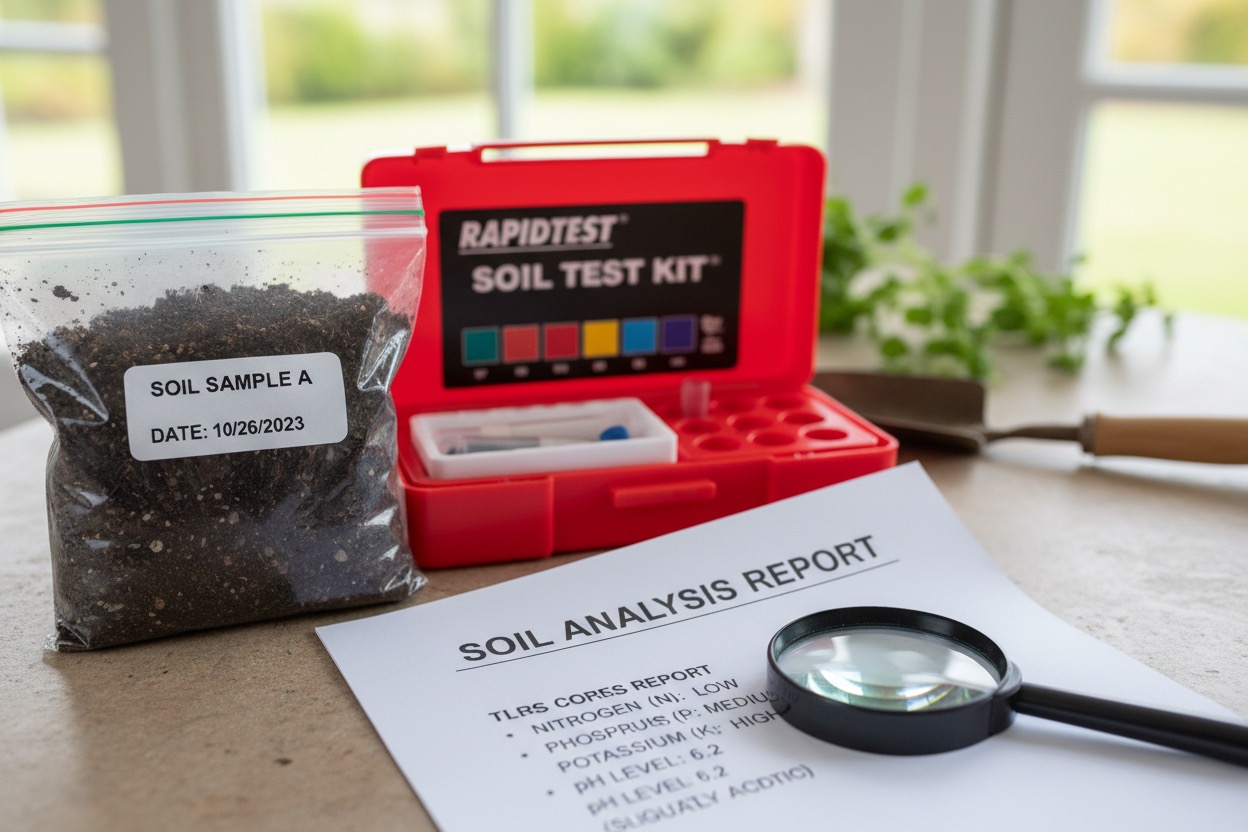
Here’s something most dosing advice glosses over: you can do the math perfectly and still over- or under-fertilize if you don’t know what your soil already contains.
University extension offices across the country agree on this starting point: test before you amend. Many gardens already carry plenty of phosphorus and potassium from years of previous fertilizing — adding more on top doesn’t help, and it can actually block uptake of other nutrients like iron and zinc.
Penn State Extension’s vegetable soil fertility resources focus on the “4Rs”: choosing the right fertilizer type, amount, timing, and place, using real soil tests instead of guessing.
How Often Should You Soil Test?
Recommendations vary slightly by region but are remarkably consistent:
- Michigan State University Extension recommends every two to four years
- Montana State University Extension suggests every three to four years, or sooner with poor growth
- Riley County Extension (Kansas) recommends testing before planting, then every 3 years if adjustments were needed, or every 5 years once levels are balanced
A basic soil test usually costs less than a single bag of fertilizer and accurately identifies which nutrients are lacking, ensuring that every dollar spent on fertilizer addresses a genuine deficiency.
Best Fertilizer for Vegetables: Organic vs. Synthetic
Once you know how much fertilizer to use, the next question is which type to buy. This trips up a lot of gardeners, so let’s simplify it.
The Honest Answer: Neither Is Universally “Better”
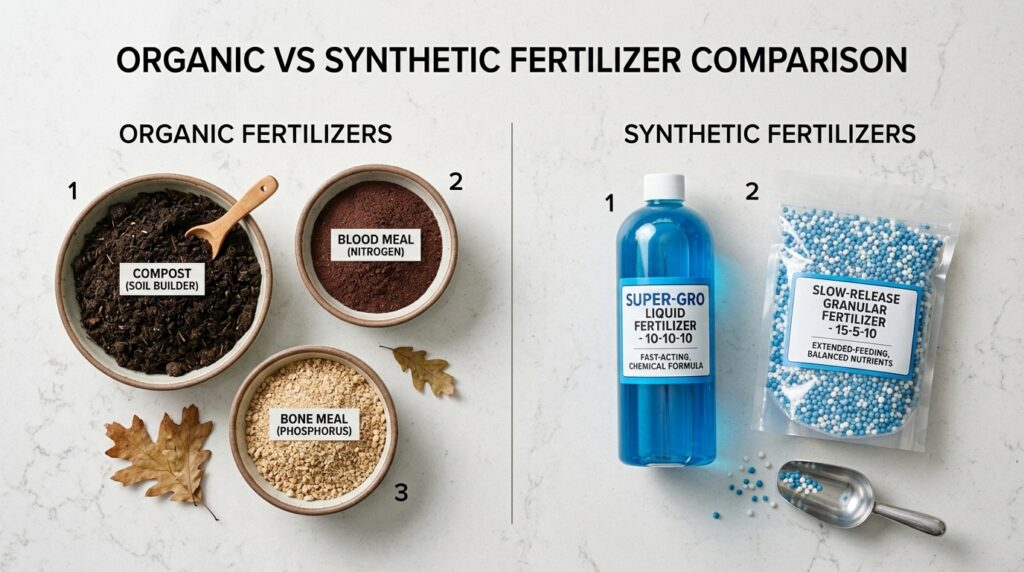
According to the Old Farmer’s Almanac, organic fertilizers release nutrients slowly and improve soil health, while synthetic fertilizers provide faster nutrient availability — neither is universally better, and the right choice depends on your garden’s needs.
Oregon State University Extension explains the core difference: organic fertilizers like manure, compost, and bone meal come directly from plant or animal sources, while synthetic fertilizers like ammonium sulfate are manufactured products, often made from naturally occurring mineral deposits or nitrogen pulled from the atmosphere.
Organic Fertilizer Options for Vegetables
| Organic Fertilizer | Approximate NPK | Best Use |
|---|---|---|
| Blood meal | 12-0-0 | Fast nitrogen boost for leafy growth |
| Bone meal | 3-15-0 | Phosphorus for root development, flowering |
| Fish emulsion | ~5-1-1 | Gentle, fast-acting all-purpose feed |
| Cottonseed meal | 6-2-1 | Slow-release nitrogen |
| Kelp meal | 1-0-2 | Trace minerals, potassium |
University of Maryland Extension lists several high-nitrogen organic options for vegetable gardens, including cottonseed meal, blood meal, fish meal, and fish emulsion, all of which are useful for feeding nitrogen-hungry crops without synthetic inputs.
Synthetic Fertilizer Options for Vegetables
Synthetic, water-soluble fertilizers work faster and provide precise nutrient levels, which helps during growth stages such as flowering or fruiting. It’s smart to change formulas as the season goes on — the Old Farmer’s Almanac suggests using less nitrogen fertilizer once fruiting crops start to flower, because too much nitrogen then makes more leaves instead of fruit.
The Hybrid Approach (What Most Experienced Gardeners Actually Do)
In practice, many gardeners don’t pick a single side. A common, practical strategy uses organic, slow-release fertilizer as the season-long base, with a synthetic liquid feed added during peak flowering or fruiting demand. That combination captures the soil-building benefits of organic feeding while still allowing a fast response if a heavy producer like tomatoes shows stress mid-season.
The “best” fertilizer for vegetables is often two products working together, not one perfect bag.
Step-by-Step: How to Dose and Apply Fertilizer the Right Way
Here is the full workflow, combined into a single simple process.
Step 1: Test Your Soil First
Don’t skip this. A soil test shows what your soil already has, so you only add the nutrients it needs.
Step 2: Measure Your Garden, Bed, or Root Zone
Calculate the square footage of beds by multiplying length and width. For trees and shrubs, estimate the area covered by the canopy or roots. For containers, record the pot size in gallons or quarts.
Step 3: Choose a Fertilizer That Matches the Plant’s Actual Needs
Plants that grow a lot, like tomatoes and corn, need more nitrogen. Root vegetables usually need little or no nitrogen. Plants that make flowers and fruit need more phosphorus and potassium as they grow.
Step 4: Calculate Your Dose Using the NPK Percentage
Use this formula: target nutrient rate divided by the nutrient percentage in the bag equals pounds of fertilizer needed.
Step 5: Apply at the Right Time and Place
- Pre-planting: Broadcast and till into the top several inches of soil before planting
- Side-dressing: Apply along the sides of rows during active growth, then water it in
- Around trees/shrubs: Broadcast evenly under the canopy, sweeping any fertilizer off branches before watering
- Avoid foliage contact: Keep dry fertilizer off leaves to prevent burn
Step 6: Watch Your Plants and Adjust
Pale, slow-growing plants might need more nitrogen. Plants that are tall with many leaves but few flowers or fruit may have too much nitrogen compared to phosphorus and potassium.
How to Recognize (and Fix) Over-Fertilizing
Even with careful math, errors can happen. Here’s how to spot them early.
Common Signs of Over-Fertilizing
According to many gardening sources, signs of fertilizer burn usually include:
- A white, crusty salt buildup on the soil surface
- Yellow or brown leaves, sometimes with bright yellow veining
- Brittle, crispy brown edges on leaves
- Slowed or stunted growth despite recent feeding
- Wilting, even when soil is moist
- Leaf or fruit drop
- An increase in sap-sucking pests like aphids, drawn to lush, nitrogen-fed growth
One early sign to watch for is too many leaves but very few flowers or fruit, which can happen before you see any leaf damage.
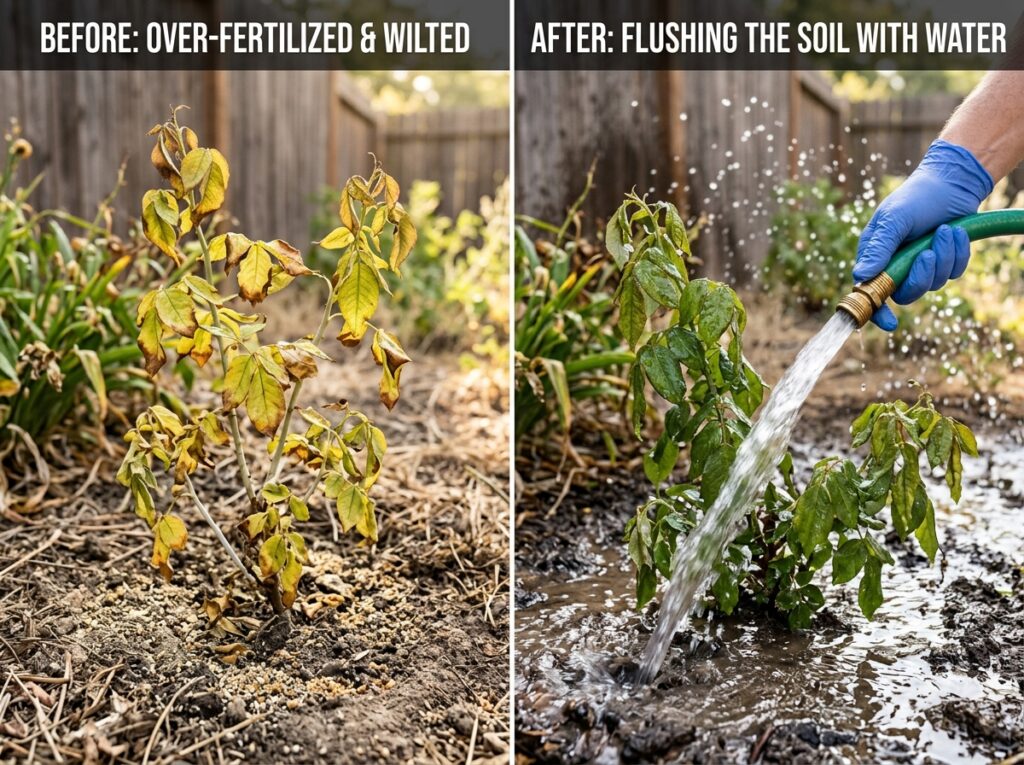
How to Fix Overfertilized Soil
If you catch it early, you can usually recover. The common advice from gardening experts is to water the soil deeply for several days. This helps wash away extra fertilizer salts from the roots.
Practical steps:
- Stop fertilizing immediately — no additional nutrients of any kind, including compost
- Remove visible granular fertilizer that hasn’t dissolved yet
- Water deeply and slowly, allowing it to fully drain, repeating over several days
- Trim severely damaged foliage once the plant stabilizes
- Wait before testing again — soil tests taken too soon after fertilizing or flushing won’t give accurate readings
Most slightly damaged plants get better in a few weeks. Plants with severely burned roots take longer and may not fully recover in some cases.
Pros and Cons of Different Fertilizer Dosing Approaches
| Approach | Pros | Cons |
|---|---|---|
| Granular, pre-measured dosing | Precise, long-lasting, easy to calculate | Requires upfront math; risk of burn if miscalculated |
| Liquid/water-soluble fertilizer | Fast-acting, easy to dilute and adjust | Needs more frequent application; less margin for error |
| Organic slow-release | Builds soil health, lower burn risk | Slower results; less precise nutrient control |
| Soil-test-based custom dosing | Most accurate, avoids waste and nutrient lockout | Takes more time and planning upfront |
Expert Tips for Dosing Fertilizer Like a Pro
- Always round down when unsure. It’s far easier to add more fertilizer later than to recover from over-fertilizing.
- Water before and after applying granular fertilizer. Moist soil reduces root shock, and post-application watering moves nutrients into the root zone rather than leaving them on the surface.
- Match fertilizer timing to soil temperature, not the calendar. Cold soil means dormant root activity — fertilizing too early in spring is often a waste of product.
- Keep a simple garden log. Note what you applied, how much, and when. This makes it dramatically easier to diagnose problems later and repeat what worked.
- Don’t fertilize stressed or drought-affected plants. Stressed plants take up very little water, which concentrates fertilizer salts around the root zone and increases the risk of burning. Restore normal watering first.
- Treat the label rate as a ceiling, not a target. Especially with fast-release synthetic products, it’s safer to dose slightly below the recommended rate and observe the results before increasing the dose.
- Wait after transplanting or repotting. Freshly disturbed roots are especially sensitive — give plants a few weeks to re-establish before introducing fertilizer.
Frequently Asked Questions
How do I calculate how much fertilizer to use for my garden?
To find how much fertilizer you need, divide the amount of nutrient you want (like 1 pound of nitrogen per 1,000 square feet) by the nutrient percentage on the fertilizer label. For example, with a 10-10-10 fertilizer, divide 1 by 0.10. This gives 10 pounds of fertilizer needed to supply 1 pound of nitrogen.
If you want to get the right amount of fertilizer for your plants, it is important to understand that more fertilizer does not always mean better growth. Factors such as the plant type, fertilizer strength, soil condition, and application frequency all affect how much your plants actually need. For a more detailed guide, learn how to dose fertilizer for plants and discover practical tips for applying the right amount without overfertilizing.
What is the best fertilizer for vegetables in a home garden?
There is no one best fertilizer. It depends on your soil test and what you are growing. A balanced 10-10-10 fertilizer is good for most vegetable beds. Plants like tomatoes need more phosphorus and potassium when they flower and fruit. Many gardeners use an organic slow-release fertilizer alongside a synthetic liquid feed during periods of strong growth.
How often should I fertilize my vegetable garden?
Most vegetables do well with one feeding before planting and then feeding again every 4 to 6 weeks while growing. Plants that use a lot of nutrients, like tomatoes and corn, usually need more frequent feeding. Plants that use fewer nutrients, like beans or root vegetables, often need little or no extra nitrogen.
What happens if I use too much fertilizer?
Too much fertilizer causes fertilizer burn, showing as yellow or brown leaf edges, salt buildup on the soil, wilting, and slow growth. In bad cases, it harms roots and can kill the plant. If noticed early, watering the soil deeply for several days can help the plant get better.
Do I really need a soil test before fertilizing?
Yes, if you want the right amount. A soil test tells you what nutrients your soil already has, so you don’t waste money or cause problems with nutrient balance. Many extension offices offer cheap tests, and the results usually last two to four years.
Final Thoughts
Fertilizer dosing doesn’t have to be a guess, and you should avoid adding extra “just in case.” When you learn the basic math of NPK percentages, measure your space’s square footage, and start with a proper soil test, you use facts, not guesswork.
Begin with small amounts, check results closely, and see how your plants react. This cycle — test, dose, watch, change — is the key to successful gardening, whether you care for tomatoes, houseplants, or shrubs.
If this guide helped, save it for next season and think about getting a soil test before you plant again. It’s the best way to spend your money for a healthy garden.
Also Read: How to Use Down to Earth All Purpose Mix 4-6-2 (Complete Guide)