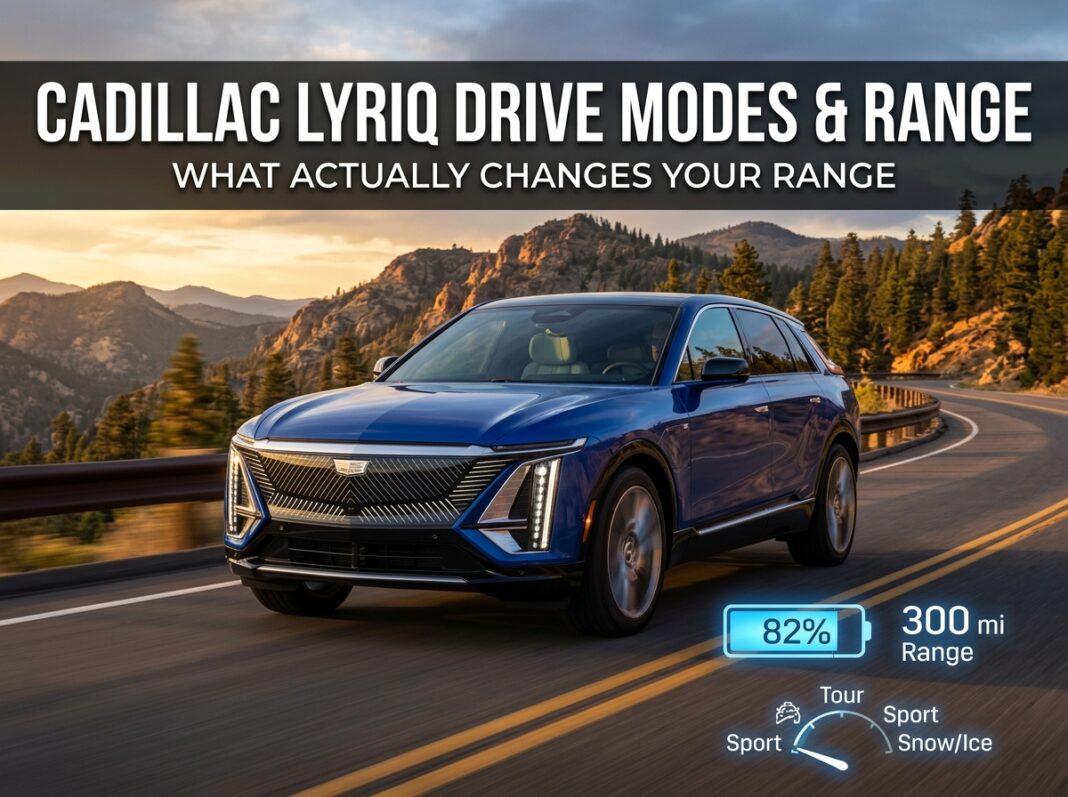
Do The Driving Modes In Cadillac Lyriq Offer Different Ranges Or Battery Usages?
You’re sitting in your LYRIQ at a red light, thumb ready on the drive mode screen. Tour. Sport. Snow/Ice. My Mode. You might ask: does choosing one really affect your mileage? Or is it just a label that only changes the steering feel?
That’s a good question, and Cadillac doesn’t give a simple chart to answer it. The LYRIQ doesn’t have a sticker saying “Tour Mode: 326 miles, Sport Mode: 280 miles.” So let’s look at what is true, what is marketing, and what really changes how far you can drive on a charge.
This guide explains if the driving modes in the Cadillac LYRIQ change the range or battery use. It uses information from Cadillac, the engineering behind it, and common sense about how electric motors use energy. No made-up numbers or guesses.
The Short Answer
Cadillac does not provide separate EPA range numbers for Tour, Sport, Snow/Ice, or My Mode. The official EPA range for the LYRIQ is 326 miles for rear-wheel drive and up to 319 miles for all-wheel drive. These numbers are based on the vehicle’s drivetrain, not the drive mode.
The modes change how the vehicle delivers power, and this affects energy use in any electric vehicle. So, the battery capacity stays the same, but your real-world efficiency can change because each mode affects throttle response, regenerative braking, and traction control.
Think of it like this. Driving fast doesn’t make your gas tank smaller, but it uses fuel quicker. The LYRIQ’s 102 kWh battery platform works the same way.
What the LYRIQ Is Actually Built On
Before looking at the modes, it’s helpful to know about the platform below them. The LYRIQ uses GM’s Ultium battery system, with a 102 kWh energy capacity pack used in all drivetrain versions. The battery pack is the same hardware whether you have the base RWD Luxury trim or the fully loaded AWD Sport model.
The main difference between configurations is the motor setup. RWD LYRIQ models have one motor with 365 horsepower and 325 lb-ft of torque. AWD models have a second motor in the front, increasing power to 515 horsepower and 450 lb-ft of torque. The second motor causes AWD models to have a lower EPA-estimated range than RWD models, even with the same battery. This is because more hardware uses more energy and the extra motor adds weight.
This is important for understanding drive modes because they don’t change the hardware. They are software settings added on top of the same physical system. When you pick Sport mode, you’re not getting more battery power or a different motor — you’re just changing how quickly the current hardware reacts to your commands.
What Cadillac Officially Says About Each Mode
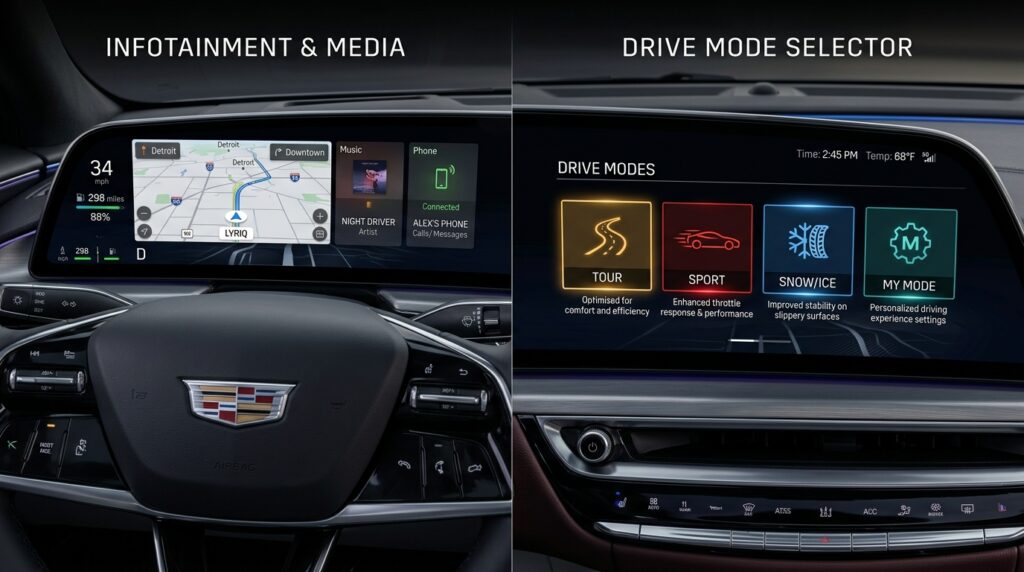
Before discussing range effects, it helps to understand what each mode is meant to do, based on Cadillac’s own information. This is not guesswork — it comes directly from the Cadillac Driver Mode Control support page and the official owner’s manual.
Tour Mode
Tour is the default mode designed for regular city and highway driving, offering a smooth ride that balances comfort and control.
If you never change the drive mode, you’ll be in Tour. It’s designed for daily driving with smooth throttle response and no sudden power spikes.
Sport Mode
Sport mode improves handling and acceleration on dry roads. When active, it changes steering effort, pedal response, electric vehicle sound, adaptive cruise control, and suspension settings if available.
This mode is designed for engagement, not efficiency. The pedal is more sensitive, so the same foot pressure makes the motor respond faster and sharper.
Snow/Ice Mode
Snow/Ice mode changes pedal settings to improve grip on slippery surfaces. This can reduce acceleration on dry roads. It also adjusts the electric all-wheel-drive system and steering.
Snow/Ice mode switches back to Tour mode each time you restart the car. Cadillac designed it this way to prevent you from driving in low-traction mode on a clear day by mistake.
My Mode
My Mode lets you customize your daily drive by adjusting settings like acceleration, brake response, steering effort, suspension, and motor sound to your liking. These settings stay saved even when you turn the vehicle off and on.
Most owners don’t use this mode enough. You can create your own custom mix, choosing a smooth Tour feel or a sharp Sport feel, based on what you prefer.
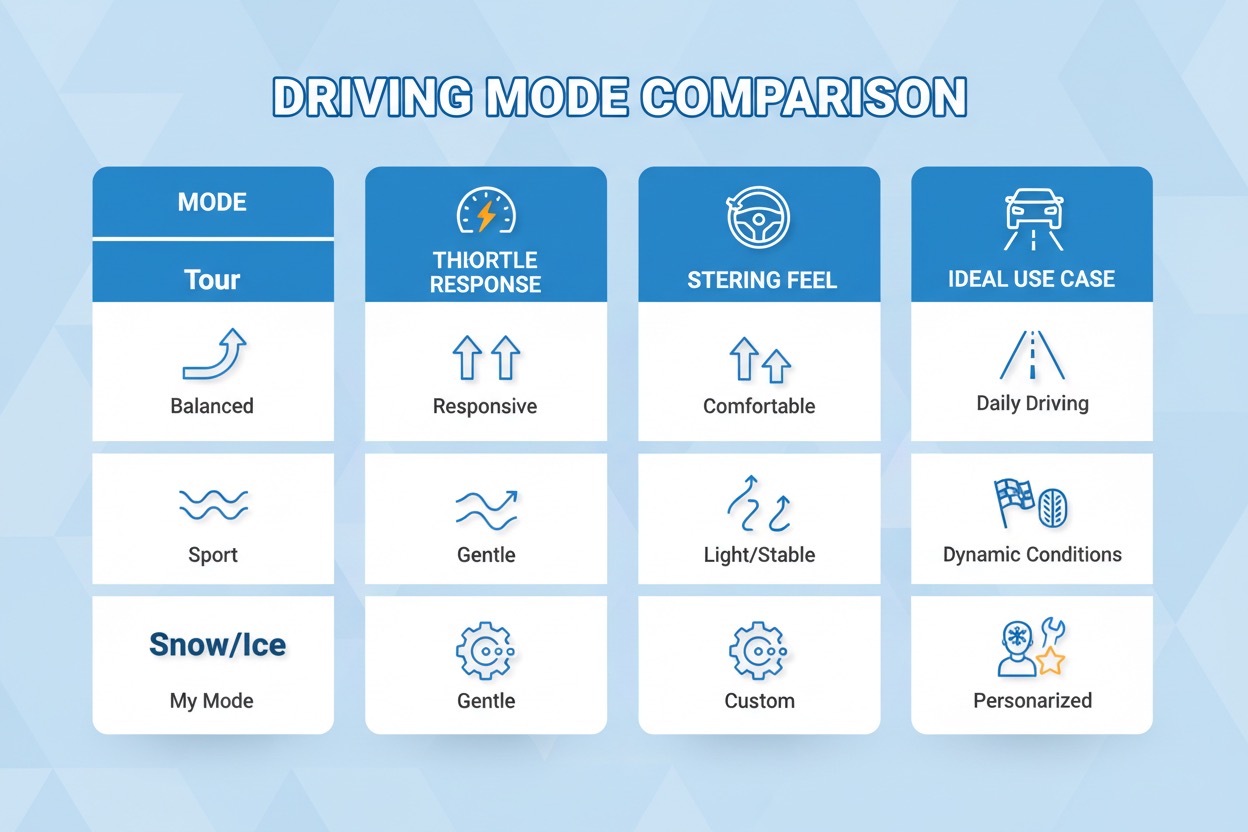
Quick Reference: LYRIQ Drive Mode Comparison
| Mode | Throttle Response | Steering Feel | Best Suited For | Resets on Restart? |
|---|---|---|---|---|
| Tour | Smooth, gradual | Standard, comfortable | Daily driving, commuting, road trips | No (stays selected) |
| Sport | Sharp, immediate | Tightened, heavier | Dry roads, spirited driving | No (stays selected) |
| Snow/Ice | Softened, gradual | Adjusted for traction | Snow, ice, slippery roads | Yes (returns to Tour) |
| My Mode | Customizable | Customizable | Personalized daily driving | No (stays selected) |
Why Drive Modes Affect Energy Use (Even Without Changing Battery Size)
Here’s the key part about your range question. The battery has a fixed 102 kWh capacity, but how fast it uses that power depends a lot on how hard the motor is working.
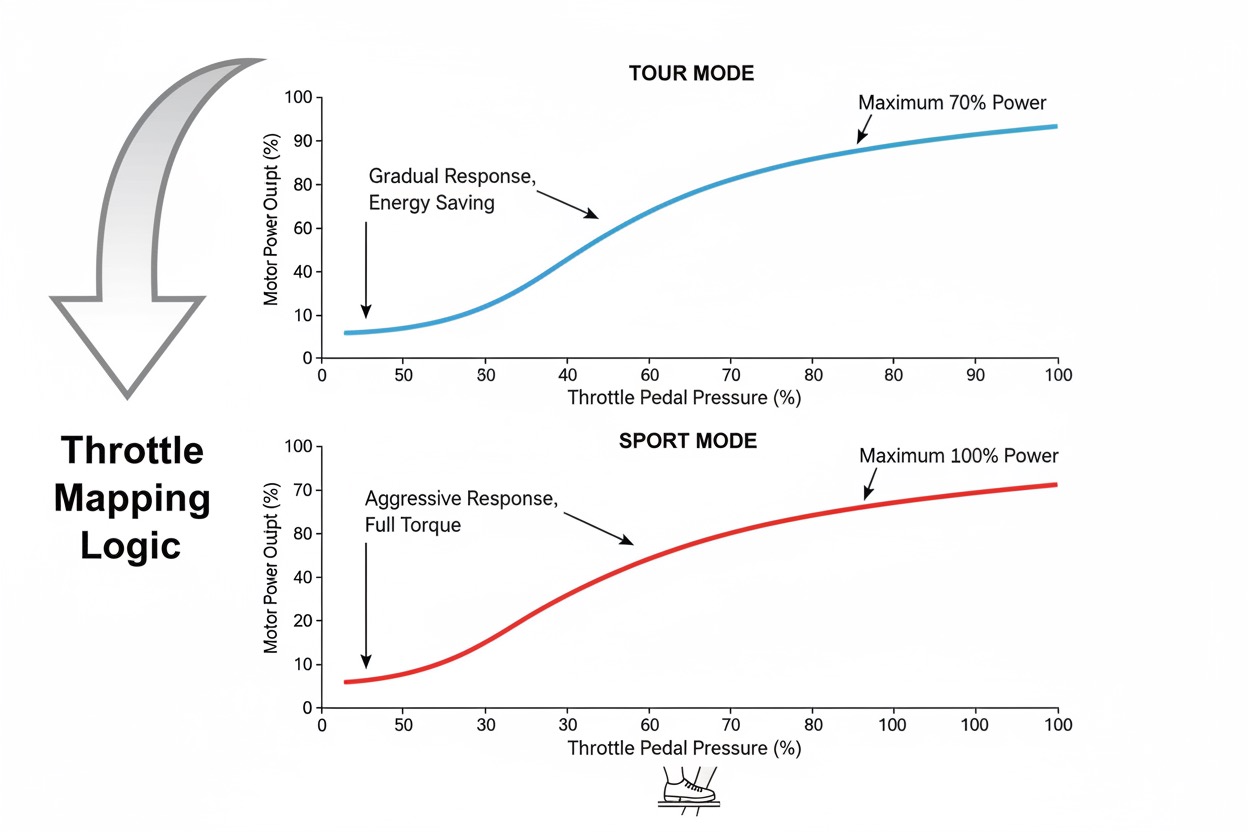
Throttle Mapping Changes How Hard the Motor Works
In Sport mode, a little pedal pressure gives you more power and faster motor response. This works because the connection between your pedal and the motor is set differently.
Electric motors use current based on how much torque is needed. Quick, repeated bursts of speed use more current in short times than smooth, steady acceleration over the same distance. This applies to all EVs, not just the LYRIQ.
Regenerative Braking Strength Varies by Mode
Regenerative braking is a key feature in any EV because it captures energy when slowing down instead of losing it as heat like regular brakes do.
Tour mode focuses on smooth and steady power, which helps make regen braking more consistent. Drivers who mostly use Tour mode, especially with One-Pedal Driving on, often get real-world mileage close to EPA estimates because this mode encourages a driving style similar to EPA tests.
Snow/Ice Mode Isn’t About Efficiency
It’s important to clear up a common mistake: Snow/Ice mode is not meant to extend driving range. Cadillac made it to reduce wheel slip and help control on slippery roads, not to increase miles per charge. Any improved efficiency is just a side effect, not the main purpose.
If you drive on dry roads, using Snow/Ice mode won’t improve your range. Cadillac says it can reduce acceleration on dry pavement because it focuses on better traction in winter conditions.
The Bigger Factors That Actually Move the Needle
Here is something every honest guide on this topic should say clearly: drive mode selection is a small factor compared to a few other things that really affect real-world EV range.
Driving Style Matters More Than the Mode Label
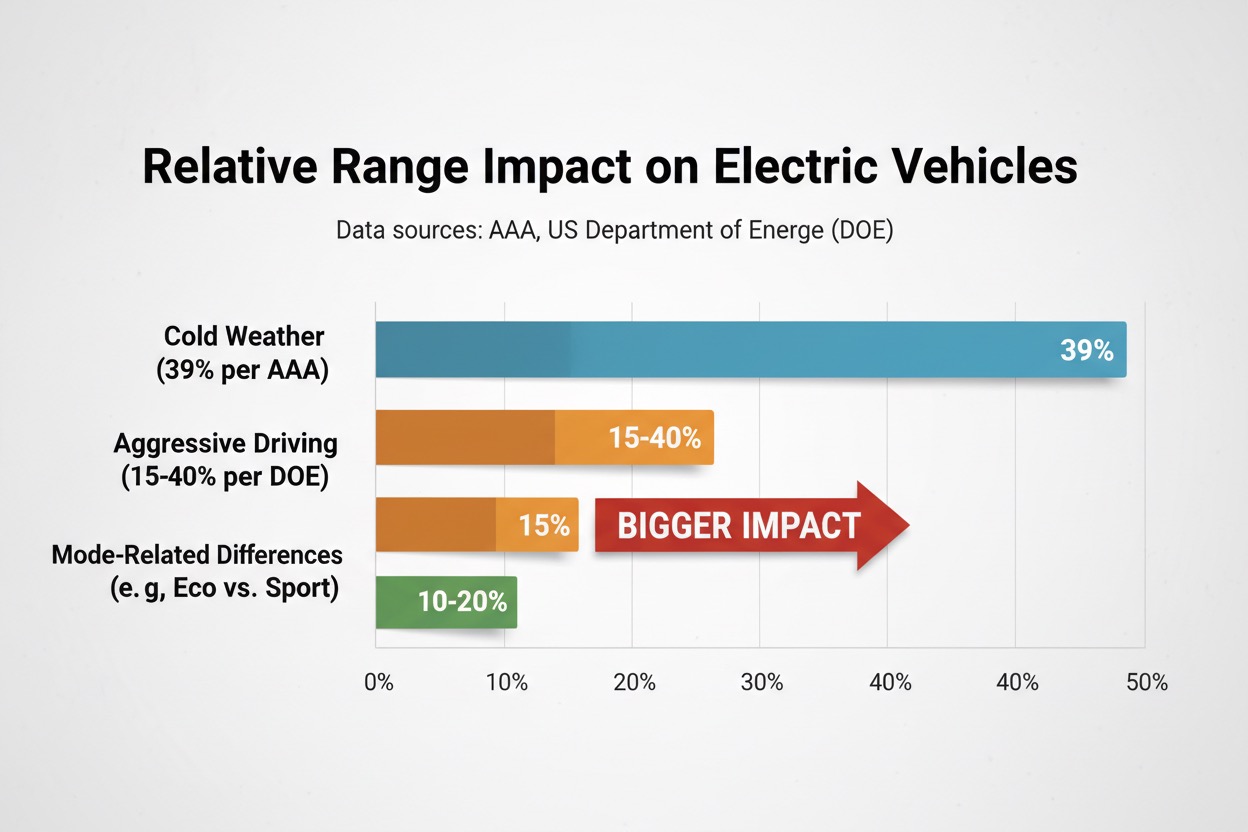
The U.S. Department of Energy has researched this a lot. Their findings explain why Sport mode can lower your range — aggressive driving like speeding, quick acceleration, and hard braking can reduce fuel economy by about 15% to 30% on highways and 10% to 40% in city traffic.
That research was first done on gasoline cars, but the basic idea — that quick acceleration uses much more energy than smooth driving over the same distance — applies just as well to EVs. A study from Oak Ridge National Laboratory showed that aggressive driving can reduce fuel efficiency by 10 to 40 percent in stop-and-go traffic and about 15 to 30 percent on highways. The study also found that hybrid cars are even more affected by driving style than regular gas cars, which is important since hybrids act a lot like full EVs when it comes to motor-driven acceleration.
This is why Sport mode can lower your range: it makes it easier to accelerate quickly with less pedal movement, and quick acceleration uses more battery — not the mode name itself.
Cold Weather Has a Much Bigger Impact Than Mode Selection
Most drivers don’t realize this. A AAA Electric Vehicle Range Testing study found that at 20°F, electric vehicles were 35.6% less efficient and had a 39.0% shorter driving range than at 75°F.
For context, this change is much bigger than anything caused by choosing a drive mode. AAA’s research also showed that hot weather affects efficiency too, but less — EVs had a 10.4% drop in efficiency and an 8.5% shorter driving range at 95°F, mostly because of energy used for cooling the cabin.
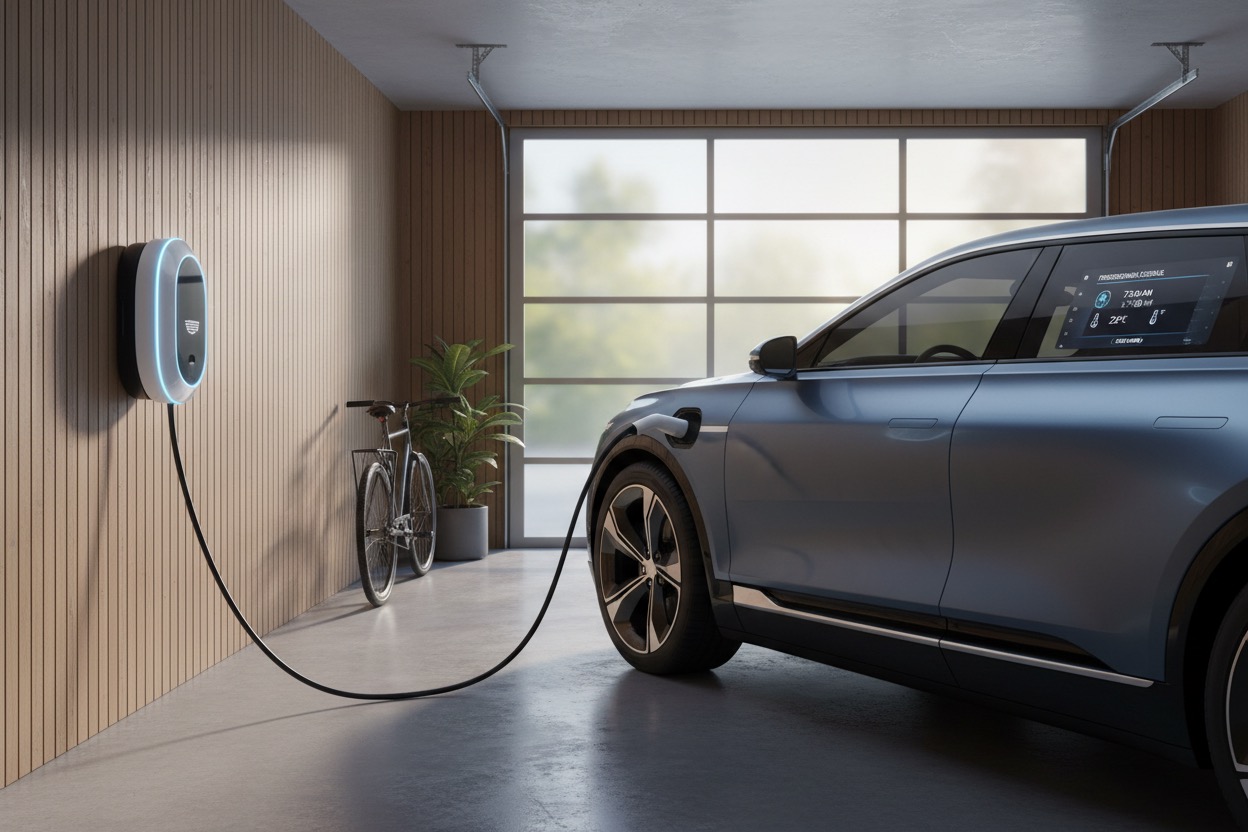
To get the most range in winter, don’t change drive modes. Instead, warm up the cabin while the car is still plugged in. This way, the energy to heat the cabin and battery comes from your home power, not the car’s battery.
Speed and Aerodynamic Drag
Wind resistance grows quickly at higher speeds. The Department of Energy notes that gas mileage drops fast at speeds over 50 mph. This extra air resistance also affects electric vehicles because any car needs more energy to push through more air, no matter the engine type.
This means a LYRIQ driving at 80 mph on the highway in Tour mode can use more energy per mile than the same LYRIQ driving 65 mph in Sport mode around town. Speed can have more impact than mode choice.
Climate Control and Cabin Heating
Heating or cooling the cabin uses the same battery that powers the wheels. In cold weather, this uses a lot of energy. This is why the AAA cold-weather results are important — they were taken with the heating system running.
What Independent Testing Actually Shows
Numbers from real tests are much more useful than guesses, so let’s look at what has actually been measured.
Car and Driver’s 75-mph highway range test showed that the rear-drive LYRIQ went 270 miles at 75 mph, while the all-wheel-drive model only went 220 miles. Both have similar EPA ratings, but the AWD’s extra motor and weight lower its range on the highway.
This one data point is worth pausing on because it shows the article’s main idea better than any mode comparison: the difference between RWD and AWD at 75 mph (about 270 vs. 220 miles, a 19% gap) is bigger than any official range difference Cadillac has shared for drive modes. Drivetrain and speed affect range more than the drive mode setting.
Owner-reported data from the Cadillac Owners Forum shows a similar pattern. One AWD owner driving mostly at 75–78 mph on a 63-mile commute averaged 2.5 miles per kWh. Other owners driving more slowly at 65–70 mph had better efficiency. The forum agrees with test data: slowing down from 75 mph to 70 mph can increase range more than just switching from Sport to Tour mode.
Realistic Range Expectations by Driving Condition
Based on independent tests and owner feedback, here is a general summary of what LYRIQ owners really experience compared to the EPA rating:
| Driving Condition | RWD (326-mile EPA rating) | AWD (319-mile EPA rating) |
|---|---|---|
| Mixed city/suburban, mild weather | Often close to or exceeding EPA rating | Often close to EPA rating |
| Steady 65–70 mph highway, mild weather | Roughly 290–310 miles | Roughly 250–280 miles |
| Steady 75 mph highway, mild weather | Roughly 270 miles | Roughly 220 miles |
| Cold weather with cabin heat in use | Significant reduction (see AAA data below) | Significant reduction (see AAA data below) |
Highway numbers come from independent 75-mph tests by Car and Driver and owner reports; use them as rough guides, not exact values, because wheel size, tires, wind, and elevation can change the results.
This table shows that speed, at a set drive mode, can change your range by over 50 miles. This effect is much bigger than choosing Tour or Sport mode.
One-Pedal Driving and Regen on Demand: The Part Most Guides Get Wrong
Here’s something important to clear up: many articles mix up drive modes and regenerative braking, but they are actually different systems.
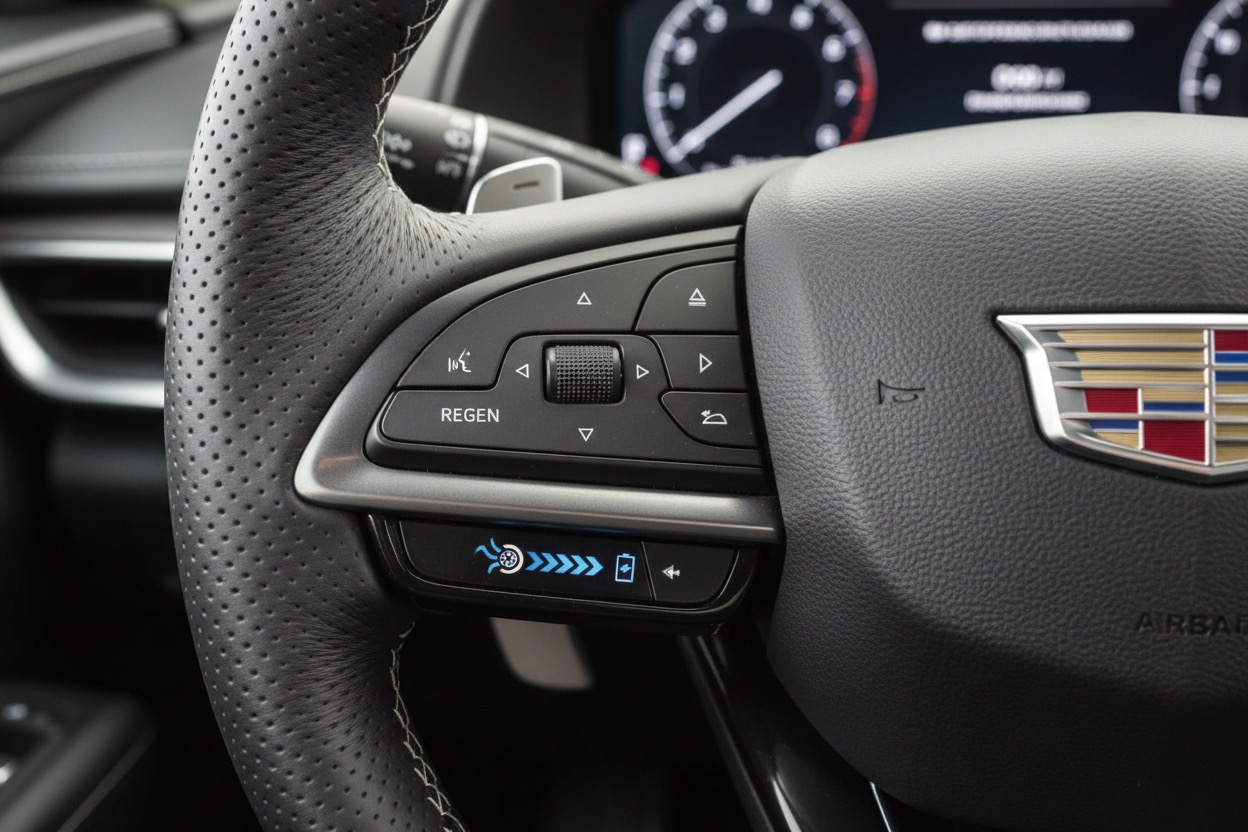
According to Cadillac’s support page, One-Pedal Driving and the Regen on Demand paddle are turned on separately using the Vehicle Controls app or a button. They do not depend on the drive mode you choose. Once you turn One-Pedal Driving on, it stays on until you turn it off, even if you change drive modes or restart the vehicle.
This is an important difference. You can use Sport mode with One-Pedal Driving on, which recovers energy strongly when you lift the throttle. You can also use Tour mode with One-Pedal Driving off. The regen strength and throttle response are controlled separately, not combined.
How Regen on Demand Works
The Regen on Demand paddle, located on the steering column, lets you slow down and recover energy anytime, without using the accelerator or brake pedal. Pulling the paddle harder increases deceleration on vehicles with Variable Regen on Demand, letting you control how much energy goes back to the battery.
Cadillac’s guide mentions some important limits: Regen on Demand and One-Pedal Driving may not work fully when the battery is full or very cold or hot. One-Pedal Driving is also not recommended on slippery roads because strong regen braking can act unpredictably on low-traction surfaces.
The 80% Charging Recommendation
When using regenerative braking, Cadillac advises charging your battery only up to 80% for daily driving. This leaves space in the battery to store energy recovered during braking. If the battery is full at 100%, it can’t capture energy, so regen braking won’t work well in the first miles. For longer trips where you need more range, charging over 80% is fine.
Practical Guidance: Which Mode Should You Actually Use?
Now that you know how it works, here’s how to use it when driving.
For Daily Commuting and Long Road Trips
Use Tour mode. This is Cadillac’s default setting for regular city and highway driving. It has a smoother throttle that helps avoid aggressive acceleration, which wastes energy. To get close to the EPA’s estimated range of 326 miles for RWD or 319 miles for AWD, use Tour mode and drive steadily and moderately.
For Winter or Wet-Road Driving
Use Snow/Ice mode only when road conditions really need it. Cadillac’s guide says it can reduce acceleration on dry roads, but on slippery surfaces, it helps with traction and control. This mode is for safety, not for saving range, even though it’s in the same menu.
For Weekend Drives or Spirited Driving
Sport mode is made for better handling and faster acceleration on dry roads. If you don’t need to save battery on a trip, it’s fine to use. Just know it won’t give you the best efficiency.
For Drivers Who Want a Personalized Balance
My Mode is rarely used. It lets you adjust acceleration, braking, steering, and suspension separately. You can keep smooth throttle response for better range while changing steering feel or suspension stiffness to your liking without using more battery.
Setting the Record Straight: What’s Confirmed vs. What’s Just Repeated Online
If you looked up this topic before coming here, you might have seen numbers like “Sport mode cuts range by 10-20%,” or “15-25%,” or “One-Pedal Driving boosts efficiency by 5-10%.” To be clear, these numbers are not from Cadillac, the EPA, or any official testing labs.
Here is a simple list of what is confirmed and what is often said without proof:
| Claim | Status |
|---|---|
| LYRIQ has a 102 kWh battery pack | Confirmed — Cadillac.com official specs |
| RWD EPA range is 326 miles, AWD up to 319 miles | Confirmed — Cadillac.com official specs |
| Tour, Sport, Snow/Ice, and My Mode adjust throttle, steering, and traction settings | Confirmed — Cadillac owner’s manual and support documentation |
| One-Pedal Driving and Regen on Demand work independently of drive mode selection | Confirmed — Cadillac support documentation |
| RWD covered 270 miles and AWD covered 220 miles in a 75-mph highway test | Confirmed — Car and Driver instrumented test |
| Cold weather (20°F) reduces EV range by an average of ~39% | Confirmed — AAA Electric Vehicle Range Testing |
| Sport mode specifically reduces LYRIQ range by “10-20%” or any other specific published percentage | Not published by Cadillac, EPA, or any independent testing source found |
| One-Pedal Driving improves efficiency by “5-10%” specifically on the LYRIQ | Not published by Cadillac or any independent testing source found |
Sport mode does affect your range because it makes the throttle more responsive, so you can accelerate faster. Faster acceleration uses more energy and lowers efficiency. However, there is no exact percentage of range loss from Sport mode alone, separate from factors like speed, temperature, and driving style. Cadillac and independent testers have not published any specific numbers. Be careful of guides that claim to have this information.
Pros and Cons of Each Approach
| Mode/Strategy | Pros | Cons |
|---|---|---|
| Tour Mode (daily default) | Smoothest energy use, closest to EPA estimates, comfortable ride | Less exciting throttle response |
| Sport Mode | Genuinely fun, sharper handling and acceleration | Encourages the aggressive driving behavior that reduces efficiency most |
| Snow/Ice Mode | Real traction and safety benefit on slick roads | Reduced acceleration on dry pavement; not an efficiency tool |
| My Mode | Fully customizable; can mimic Tour’s efficiency with personal touches | Takes time to configure properly; easy to accidentally build a “Sport-like” setup |
| Preconditioning while plugged in | Genuinely preserves range in cold weather | Requires planning ahead before departure |
Expert Tips for Maximizing Real-World Range
- Default to Tour mode for anything range-sensitive. It’s Cadillac’s own everyday-driving calibration, and it pairs naturally with smoother acceleration habits.
- Precondition the cabin while plugged in, especially in winter. Since AAA’s research shows cold weather alone can cut range by close to 39%, warming the cabin from your home outlet before unplugging avoids pulling that energy from the battery during your drive.
- Treat Sport mode as a tool, not a daily setting. Save it for moments when you actually want the sharper response, rather than leaving it on by default.
- Watch your speed on highways. Since aerodynamic drag increases sharply at higher speeds, dropping from 75 mph to 65 mph can meaningfully extend range, often more than any drive mode switch would.
- Use Snow/Ice mode for what it’s built for. It’s a traction and safety tool first. Don’t expect it to behave like an efficiency mode on dry, clear roads.
- Build a genuinely efficient My Mode profile. Configure smooth acceleration feel and standard regenerative braking, and you’ll likely come closer to Tour-level efficiency while still personalizing steering and suspension feel to your preference.
- Remember that the EPA numbers are a benchmark, not a guarantee. Cadillac itself notes that actual range may vary based on several factors, including temperature, terrain, battery age, loading, and how the vehicle is used and maintained — drive mode is just one variable among several.
Frequently Asked Questions
Do the driving modes in Cadillac LYRIQ offer different ranges or battery usages?
Cadillac does not provide separate EPA range numbers for each mode, and the battery’s 102 kWh size stays the same no matter the mode. But the modes change throttle response, regenerative braking, and traction control, which affect how fast you use energy when driving. Tour mode is for efficient daily driving, while Sport mode encourages quick acceleration that lowers range.
Which Cadillac LYRIQ drive mode gives the best range?
Tour mode, Cadillac’s standard setting for city and highway driving, is usually the best choice to maximize range. It smooths out acceleration to help save battery power.
Does Sport mode really reduce range in the LYRIQ?
Sport mode does not lower the battery capacity, but it allows faster, sharper acceleration with less pedal effort. However, hard acceleration uses more energy and can reduce your real-world range if used often. Driving smoothly in Tour mode helps save battery and extend range.
What’s the official range of the Cadillac LYRIQ?
The Cadillac LYRIQ has an EPA-estimated range of 326 miles for the single-motor rear-wheel-drive model and up to 319 miles for the dual-motor all-wheel-drive model. These numbers depend on the drivetrain, not on your usual drive mode.
Does cold weather affect LYRIQ range more than the drive mode?
Yes, a lot. According to AAA’s Electric Vehicle Range Testing research, cold weather around 20°F can lower an EV’s driving range by nearly 39% compared to 75°F. This effect is much bigger than what drive mode choice causes.
Final Thoughts
Do the driving modes in the Cadillac LYRIQ affect range or battery use? Technically, no. The battery size and EPA range depend on the drivetrain, not the drive mode. But in real life, yes, the modes do change how fast the battery drains. They adjust how much power you can use for quick acceleration and how the car handles regenerative braking and traction.
The simple truth is that drive mode is just one factor among many and probably not the most important. Cold weather, speed, and how you accelerate likely affect your car more than the drive mode you choose.
If you want to get the most range, use Tour mode, warm up your cabin before winter drives, and drive at steady speeds on the highway. If you want a fun, responsive ride, use Sport mode but plan your charging stops carefully. Now you can choose with real information, not guesswork.
Also Read: How Is It Possible for Ski Jumpers to Stay in the Air So Long And How Do They Train For That?