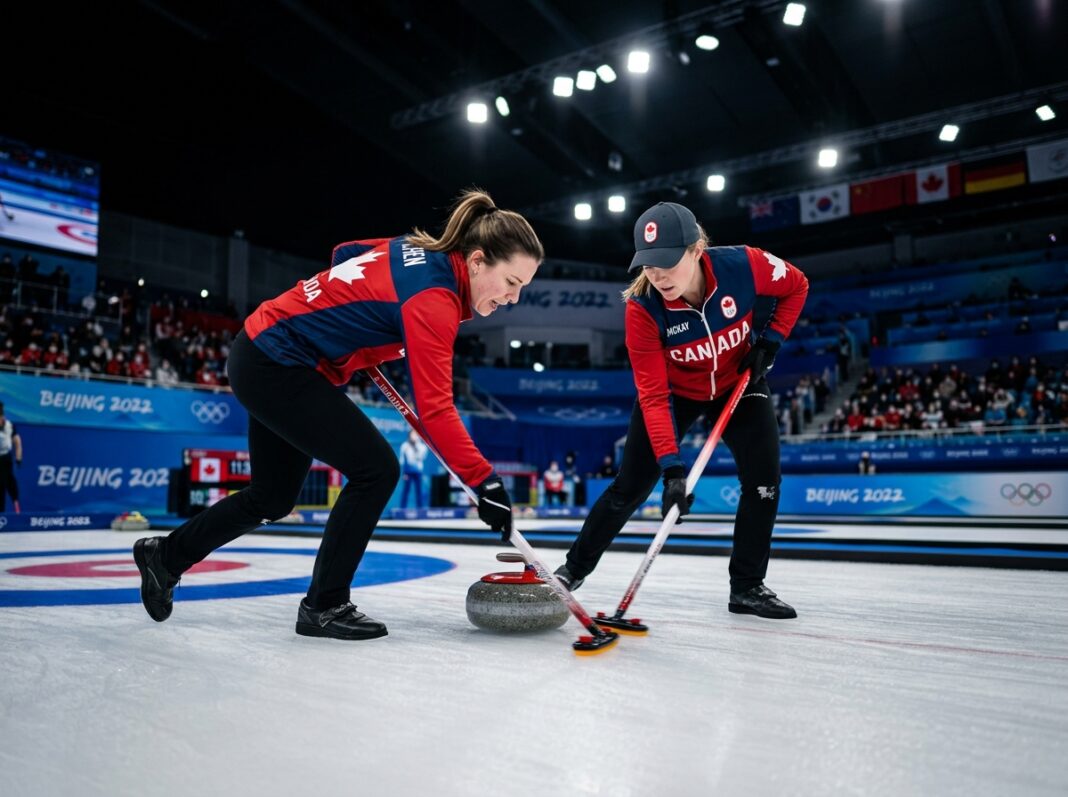
How Do Brooms Affect the Stone’s Path in Olympic Curling? The Real Science Explained
If you’ve ever seen Olympic curling and wondered why two athletes run down the ice shouting and brushing hard in front of a sliding stone, you’re not alone. It seems confusing and maybe not needed.
But here’s the thing: that fast sweeping is one of the most exact, physics-based moves in all winter sports.
Let’s answer the question clearly. How do brooms affect the stone’s path in Olympic curling? Sweeping warms a tiny layer of ice, reducing friction, so the stone slides farther and changes its curl. It sounds simple, but it’s not. The real process involves pebbled ice, heat, rotation, and a big controversy that almost split the sport.
By the end of this guide, you’ll know what happens when a broom hits the ice and why it’s so important that some equipment bans focus on it.
What Is Curling, Quickly, For Anyone New to the Sport
Before we get into the broom science, let’s make sure we’re on the same page.
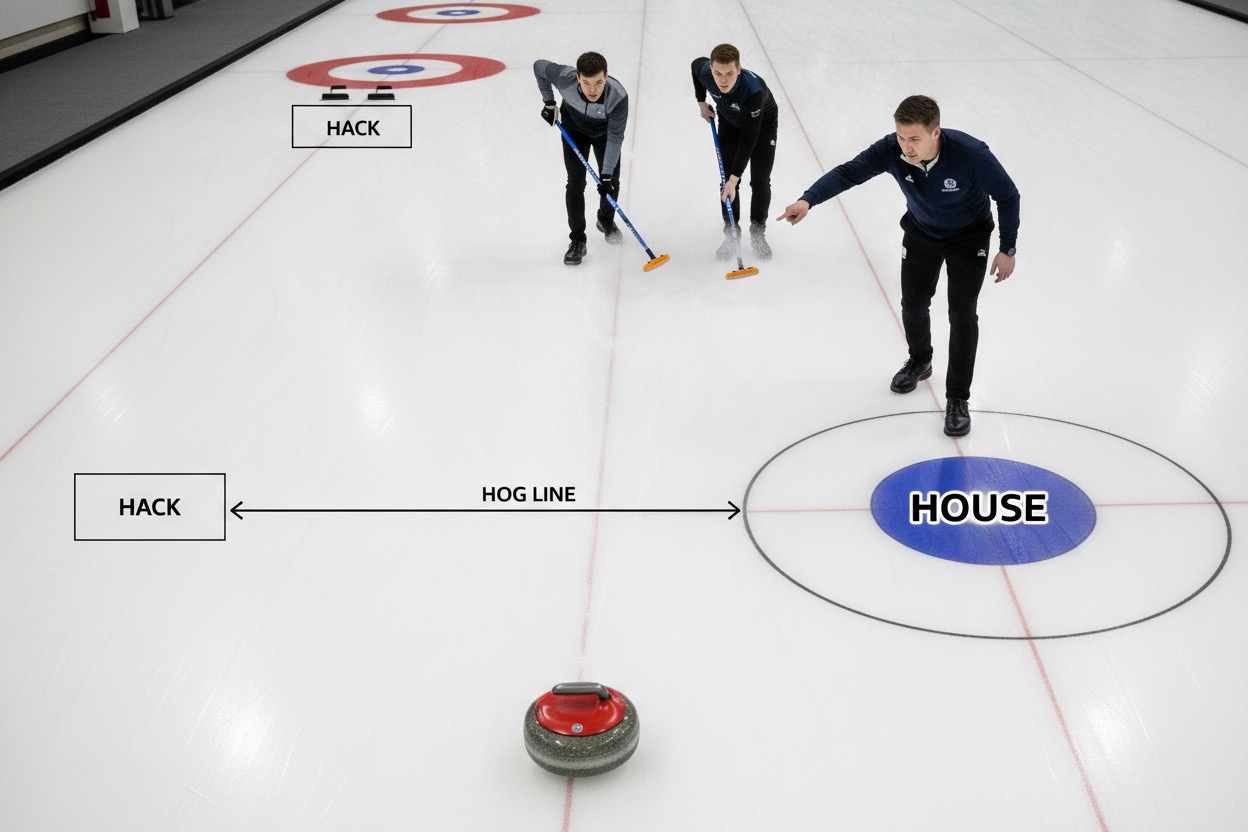
Curling is a team sport played on ice. Players slide heavy granite stones toward a round target called the “house.” The aim is to get your stones closer to the center than the other team.
Two teammates, called sweepers, walk or run next to the stone after it is thrown. They sweep the ice in front of it. A skip stands near the target and gives instructions like sweep, don’t sweep, or sweep harder based on how the shot is going.
Sweeping isn’t just decoration. It’s a real-time way to fix the stone’s path. That’s why curling is called “chess on ice.”
How Do Brooms Affect the Stone’s Path in Olympic Curling? The Core Science
Here’s the part everyone actually wants to know.
When a broom head rubs the ice, it causes friction. This friction makes heat. The heat melts a very thin layer of ice in front of the stone.
A thin layer of water lowers the friction between the stone and the ice. With less friction, the stone:
- Travels farther than it otherwise would
- Curls less sharply, because the melted path delays how much the stone can grab and turn
The official Olympics website confirms that sweeping creates a thin layer of water, helping the stone glide more smoothly. This makes it seem like the stone speeds up, but actually its path is longer because of less friction. The Olympics’ explainer on sweeping is a clear official source.
Sweeping doesn’t make the stone go faster in the usual way. It just slows down how quickly the stone loses speed. This is a small but important difference.
Why the Ice Isn’t Actually Smooth
This is the part most casual viewers miss completely.
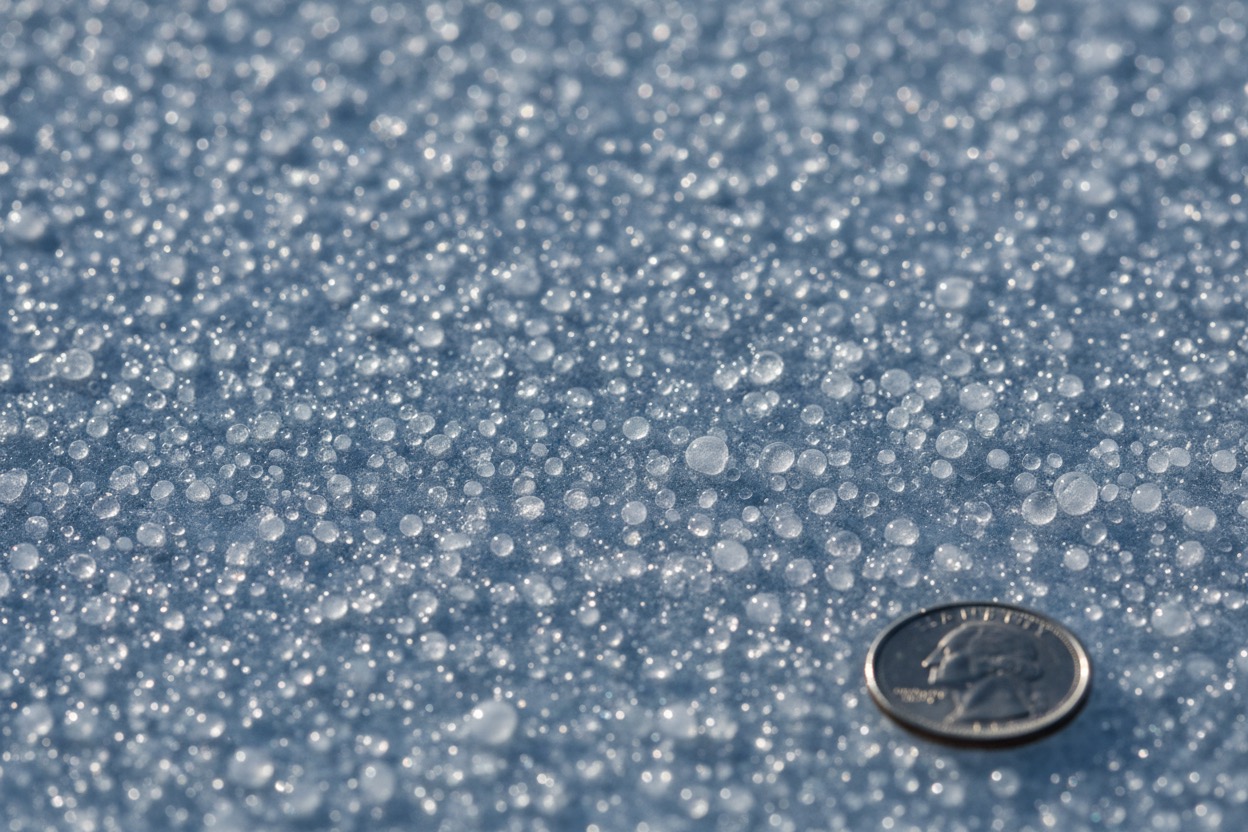
Curling ice is different from hockey ice. Hockey ice is flooded to be flat and smooth. Curling ice has a textured surface called “pebble.”
Before a game, ice technicians spray small drops of water on the ice. These drops freeze into tiny bumps, like a rough orange peel. These bumps create friction between the ice and the stone, which weighs over 20kg, making skill and strategy harder.
Without the pebble, a 44-pound granite stone would hardly move and definitely wouldn’t curl. The pebble is what makes sweeping effective in the first place.
The Step-by-Step: What’s Actually Happening When a Broom Hits the Ice
Let’s break this down into a simple sequence because the physics happens quickly and it’s easy to lose the order of events.
- The stone is released with a slight clockwise or counterclockwise spin (called the “handle”).
- The stone begins to curl naturally as it travels, due to its rotation interacting with the pebbled surface.
- Sweepers identify whether the shot is too light, too heavy, or off-line based on the skip’s read.
- Brushing begins directly in front of the stone’s path, generating friction-based heat.
- The pebble tops melt slightly, creating a thinner film of water.
- Reduced friction lets the stone slide farther and delays the curl, effectively straightening the path.
- The skip calls off sweeping once the stone is tracking correctly, or sweepers ease off to let it curl back in.
This whole process takes just seconds, and top sweepers watch the stone’s speed and path live to know when to press down.
Distance vs. Curl: Two Separate Effects
It helps to think of sweeping as controlling two different things, not one.
| Effect | What Sweeping Does | Why It Matters |
|---|---|---|
| Distance | Reduces friction, lets stone travel farther | Saves a shot that was thrown too light |
| Curl (Trajectory) | Delays lateral movement, keeps stone straighter | Corrects a shot drifting off the intended line |
A well-timed sweep can move a stone’s final position by several feet, according to sports science reports on curling. This is a big change in a game often decided by inches.
This double effect is why the official Olympics says sweeping helps curlers control the stone’s speed, path, and curl — it’s two actions working together, not just one.
Why Sweeping Looks So Intense (And Why It Has To)
If you’ve watched curling and thought the sweepers looked like they were working really hard, you were right.
Effective sweeping requires real athletic output. Sweepers need:
- Explosive upper-body and core strength
- Precise timing — sweeping has to begin almost immediately after release for maximum effect
- The ability to read ice conditions and stone speed on the fly
- Stamina, since a single game can require dozens of intense sweeping bursts
Sports science reports that top curlers’ heart rates often go over 180 beats per minute while sweeping, making it more like sprint training than a casual activity on the ice.
This is why sweeping is called predictive, not reactive. Top teams don’t wait to see what the stone does. They predict how it will move seconds before it arrives, using the skip’s read of speed, ice, and the stone’s spin.
What Curling Brooms Are Actually Made Of
Curling brooms have changed a lot since the sport began.
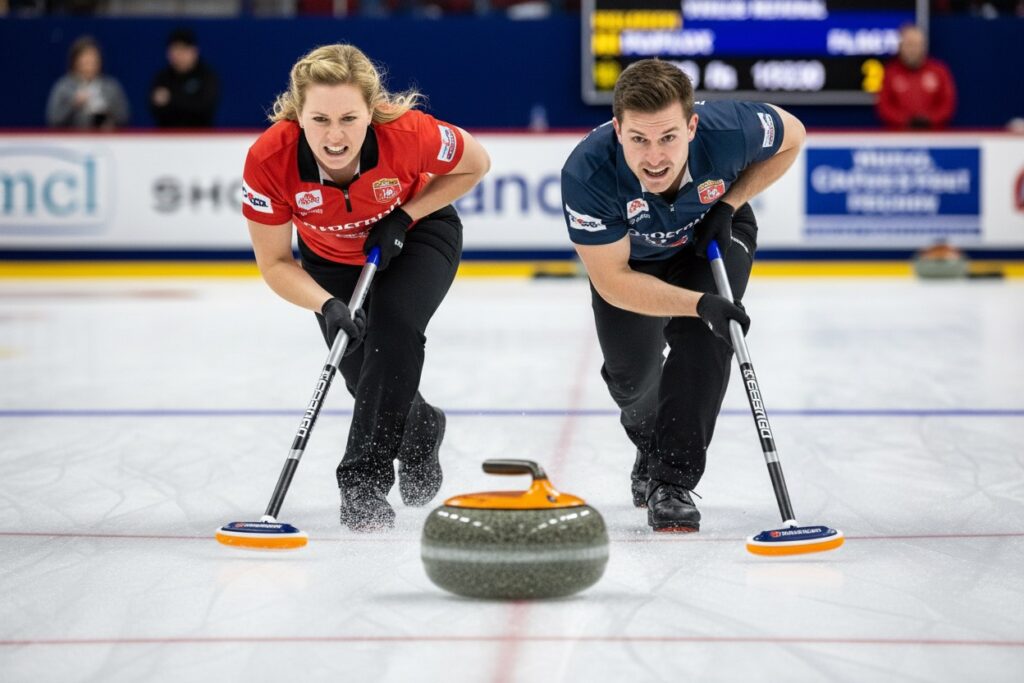
Early curling brooms used straw or corn fibers. Today, Olympic curling brushes use synthetic materials for better performance. Modern brush heads are made to create steady friction while following competition rules.
A modern broom has two main parts:
- The handle is typically a lightweight tube the curler grips to drive the brush head side to side
- The head is a multi-layer construction with a fabric layer that contacts the ice, a flexible cushioning layer, and a rigid frame connecting it to the handle
Patent documents on modern broom design say that how well a broom cleans depends on how hard you press down on the broom head, how fast you move it, and the kind and state of the bristles.
In other words, the broom is only part of the solution. How you use it is just as important as what it is made of.
Modern Materials: Carbon Fiber and Beyond
Modern brooms usually have handles made from carbon fiber or fiberglass with fabric heads that follow World Curling rules set by the sport’s international body.
These materials are light for quick, repeated strokes and strong enough to last through long tournaments.
“Broomgate”: When Brooms Got Too Good
This is where the story becomes really interesting, and it explains why curling cares a lot about broom rules today.
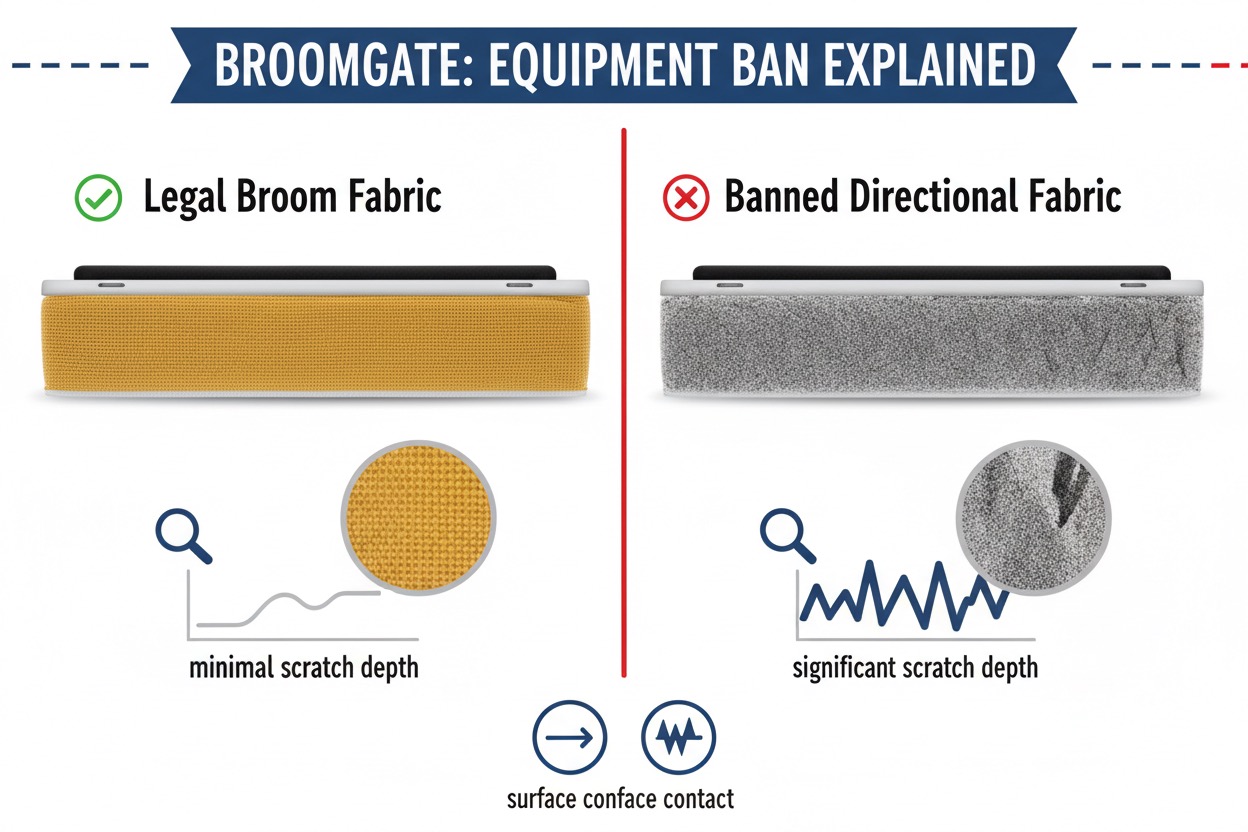
Around 2015, some manufacturers made new broom head fabrics that worked differently from old ones. Instead of just making heat by rubbing, these fabrics scratched the ice in a certain direction, like tiny sandpaper.
The effect was clear. Sweepers using these “directional fabric” brooms could control a stone’s path much more than before. According to Wikipedia’s history of the controversy, the new brush heads were criticized for steering the rocks like a joystick.
This worried the top players in the sport. Olympic gold winners Brad Jacobs, Brad Gushue, Jennifer Jones, and former world champion Glenn Howard were among 50 Canadian and international teams who signed a statement. They said their teams would not sweep with broom heads that had directional fabric because they feared it would reduce the skill needed to throw an accurate shot.
The controversy became known as “Broomgate” in the curling world and was joked about on late-night TV. In November 2015, the World Curling Federation banned modified brushes, a decision Stephen Colbert called “Broomageddon.”
How Broomgate Was Resolved
The fix wasn’t instant. It took real research.
The decision was made at the Sweeping Summit in Kemptville, Ontario, in May 2016. There, athletes, officials, ice-makers, and scientists from Canada’s National Research Council tested over 50 types of brushes using robots and GPS tracking.
The result changed the sport from then on. Custom brooms were banned, and only standard, certified mustard-yellow fabrics were allowed—a rule that has stayed important in broom rules ever since.
Later research showed why the ban was needed. A Western University study found that the banned “Frankenbroom” heads made scratches in the ice up to four times deeper than allowed broom fabric, confirming what players had guessed by feel.
Broomgate 2.0: The Controversy Didn’t End in 2016
If you think this was a one-time issue, it wasn’t.
About ten years later, a new argument started — this time about the foam padding inside the broom head instead of the fabric on top.
Before the 2024-25 season, makers like Goldline and BalancePlus added firmer foam inserts to their brooms. Players and officials worried this gave sweepers too much control over stones. Reports from the sport’s main tour say over 30 teams signed a note asking teams with firmer broomheads to change them before a big Grand Slam event to keep things fair.
At first, the World Curling Federation checked the situation and found that all approved equipment still followed the rules, despite the concerns. But the debate continued.
By mid-2025, the federation took action. World Curling tightened rules on sweeping equipment, banning several popular broom models from makers like Goldline, BalancePlus, and Hardline. Only softer foam brushes were allowed in competitions from that point on.
The federation was clear about why. One official said there was much talk about brushing being too strong and making a good stone throw less valuable, as makers had spent years testing the limits of the rules.
This is helpful to know if you’re watching modern Olympic curling: every broom used is carefully checked to make sure sweeping helps skill, not replaces it.
The Underlying Physics: Why Scientists Still Argue About This
Here’s something surprising. Even after many years of study, scientists still don’t fully understand how a curling stone curls or exactly how sweeping affects it.
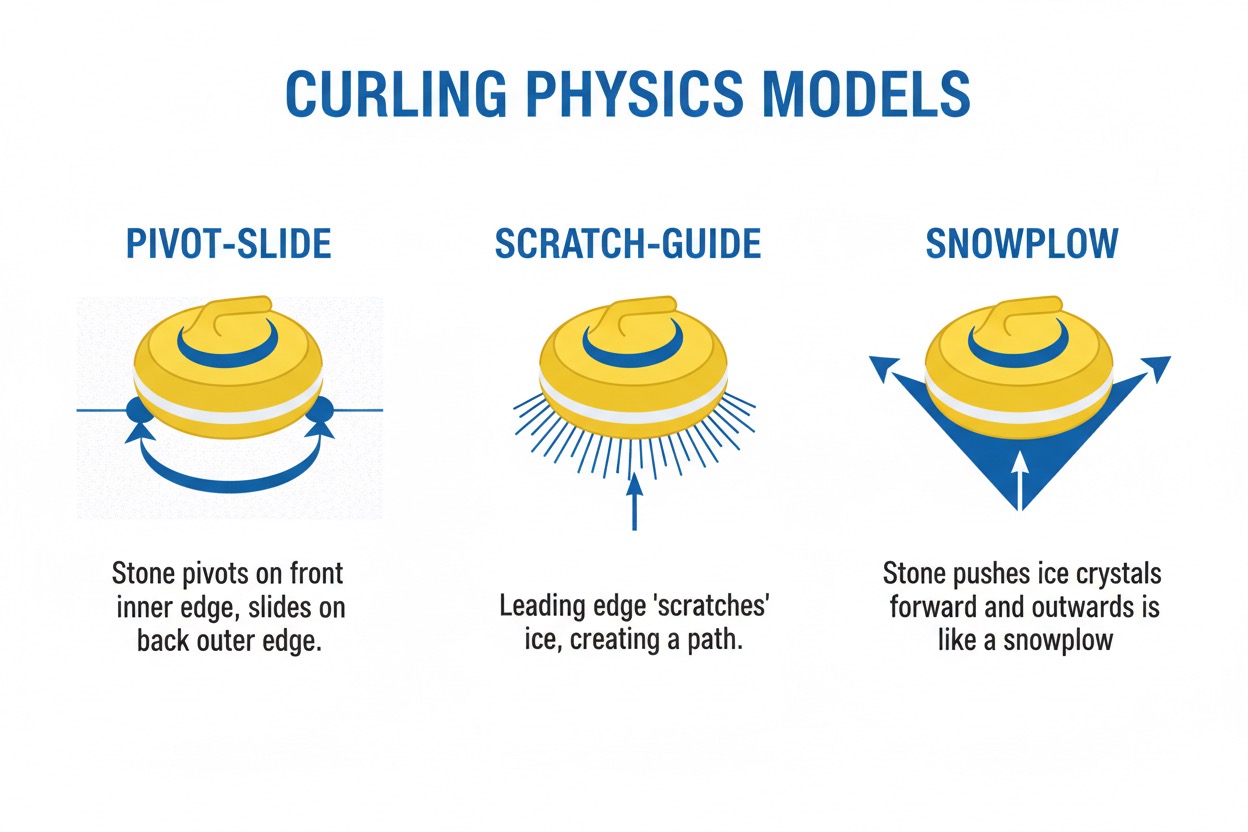
There are several competing theories:
- The pivot-slide model — proposes the stone’s path is a sequence of tiny pivots around individual ice pebbles followed by short slides, repeated thousands of times over the stone’s travel
- The scratch-guide model — suggests the rotating stone’s running band creates microscopic scratches in the ice, and crossing those scratches at an angle generates a sideways guiding force
- The evaporation-abrasion model and snowplow model — alternative explanations focused on how the stone interacts with melted water and pebble debris
A university research group reported that different ideas have been suggested, such as the pivot-slide model, the evaporation-abrasion model, and the snowplow model. In 2020, a team from Japan tried to clarify by testing each idea using motion trackers, a laser scanning microscope, and changed stone surfaces.
Researchers have shown the scratch-guide effect directly. A Swedish team added artificial scratches to the ice in different directions and made a stone move in a zigzag path. This proves that surface scratches help control direction, which is why broom fabric texture became an important issue.
A peer-reviewed article published by the Canadian Society for Exercise Physiology clearly states that there is strong knowledge about game factors but still some debate about the physics behind the curl and how sweeping changes the stone’s path. You can read more in the published review on curling rock motion models.
When someone says they know exactly why a curling stone curls, be careful. Even physicists are still discussing the details. What everyone agrees on is that sweeping helps the stone go farther and curl less, no matter the exact reason behind it.
Pros and Cons of Modern Broom Technology
Equipment changes in curling have had both good and bad effects. It is important to consider both.
Pros:
- Allows skilled sweepers to rescue imperfect shots, rewarding teamwork
- Adds a real athletic and strategic dimension to a sport that might otherwise look passive
- Regulation has made equipment more consistent and fair across all competing nations
- Modern fabrics are more durable and weather-resistant than old straw or corn-fiber brooms
Cons:
- Aggressive broom technology has repeatedly threatened to overshadow throwing skill, as seen in both Broomgate controversies
- Equipment bans create costly turnover for athletes and clubs who must replace banned gear
- Ongoing rule changes can create confusion, especially for amateur or recreational curlers buying gear
- The sport’s governing bodies are still refining standards, meaning today’s “legal” broom could be reclassified in future seasons
How This Applies If You’re Buying a Curling Broom
If you are new or have some experience in curling and want to buy your own broom instead of just watching, knowing the broom controversy history can help you choose the right one.
Here’s what to keep in mind:
- Stick to certified, retail equipment. Since the original Broomgate ruling, retail-only equipment became mandatory in competitive curling, so always check that any broom you buy is on your league’s or club’s approved equipment list.
- Don’t assume “newest” means “best.” As Broomgate 2.0 showed, manufacturers regularly push designs that later get banned. A broom approved last season isn’t guaranteed to stay approved.
- Match the broom to your role. Lighter heads suit players who sweep often during a game, while handle length should match your height and sweeping stance for efficient technique.
- Check your club or league’s current rules before competing, since national federations generally follow the World Curling Federation’s equipment list, but enforcement timing can vary locally.
If you are playing for fun or in a local league, any certified retail broom will work fine. The differences that cause major debates mainly matter at top competitive levels, where small details decide winners.
Expert Tips: What Coaches Actually Watch For
Based on how coaches and top programs describe sweeping, here are some key points that make sweeping effective instead of wasted effort:
- Timing beats raw power. Sweeping immediately after release has more impact than sweeping later in the stone’s path, because the stone has more remaining distance for the friction reduction to compound.
- Read the ice, not just the stone. Ice conditions change throughout a game as the sheet gets used, so experienced sweepers adjust pressure based on how the ice has behaved on previous stones, not just the current one.
- Communication matters as much as technique. The skip’s call and the sweepers’ response need to happen almost instantly, which is why team chemistry plays such a visible role in elite curling.
- Sweeping can’t fix everything. A poorly thrown stone with bad weight or a wildly off-line release often can’t be fully corrected, no matter how hard the team sweeps. Good sweeping extends a good shot’s margin for error — it doesn’t replace good throwing.
Frequently Asked Questions
Does sweeping make a curling stone go faster?
Not exactly. Sweeping doesn’t increase the stone’s speed. It reduces friction, which slows the stone’s natural deceleration, allowing it to travel farther than it would on unswept ice. The effect appears as added speed, but it’s actually reduced resistance.
Can sweeping completely change the direction of a stone?
Sweeping can help reduce or delay the curl and change where a stone lands by a few feet, but it cannot change the stone’s direction or fix a badly thrown shot. It only works with the stone’s natural curl path.
Why is curling ice different from hockey ice?
Curling ice is covered with small frozen water drops called pebble, which makes the surface rough. Hockey ice is flooded to be flat and smooth. The pebble texture helps the stone curl and lets sweeping work well.
What happened during “Broomgate” in curling?
Broomgate was a 2015 controversy about new broom fabrics that let sweepers steer stones too much. Top players complained, and the World Curling Federation banned the fabric and set rules for approved broom materials from then on.
Are all curling brooms the same?
No. The World Curling Federation strictly controls broom fabric, foam firmness, and head design. Approved equipment lists change over time due to new rules and issues, like the recent 2025 foam firmness limits.
Final Thoughts: It’s Not Just Sweeping, It’s Strategy
How do brooms change the stone’s path in Olympic curling? They warm the pebbled ice slightly, reducing friction. This helps the stone travel farther and curl less, letting sweepers control where the stone stops.
What looks like fast, funny effort from outside is actually one of the most controlled, tough, and debated parts of the sport. From rough ice to banned “Frankenbrooms” to ongoing foam-firmness arguments, the broom has quietly shaped curling rules for the past ten years.
Next time you watch Olympic curling, you won’t just see two people sweeping. You’ll see how they manage friction, use physics in real time, and a sport that has worked hard to keep things fair.
Want to learn more? Visit the official Olympics page on curling sweeping to see how top athletes use this skill at major events.
Also Read: What Is Kalimac Hogpen’s Football Ranking? Everything Fans Want to Know