How to Pay Yourself as a Business Owner LLC: The Complete Guide
You started your LLC to build something for yourself. So why does actually paying yourself feel like the most confusing part of the whole thing?
Here’s the honest truth: there’s no single “correct” way to pay yourself. The right method depends on how many owners your LLC has, how it’s taxed, and how much profit you’re actually bringing in. Get it wrong, and you could end up paying more in taxes than you need to, or worse, catching the attention of the IRS.
This guide walks through every method, with real numbers, so you can see exactly what changes when you switch from an owner’s draw to a salary, not just vague advice to “consult a tax professional” (though you should still do that before making it official).
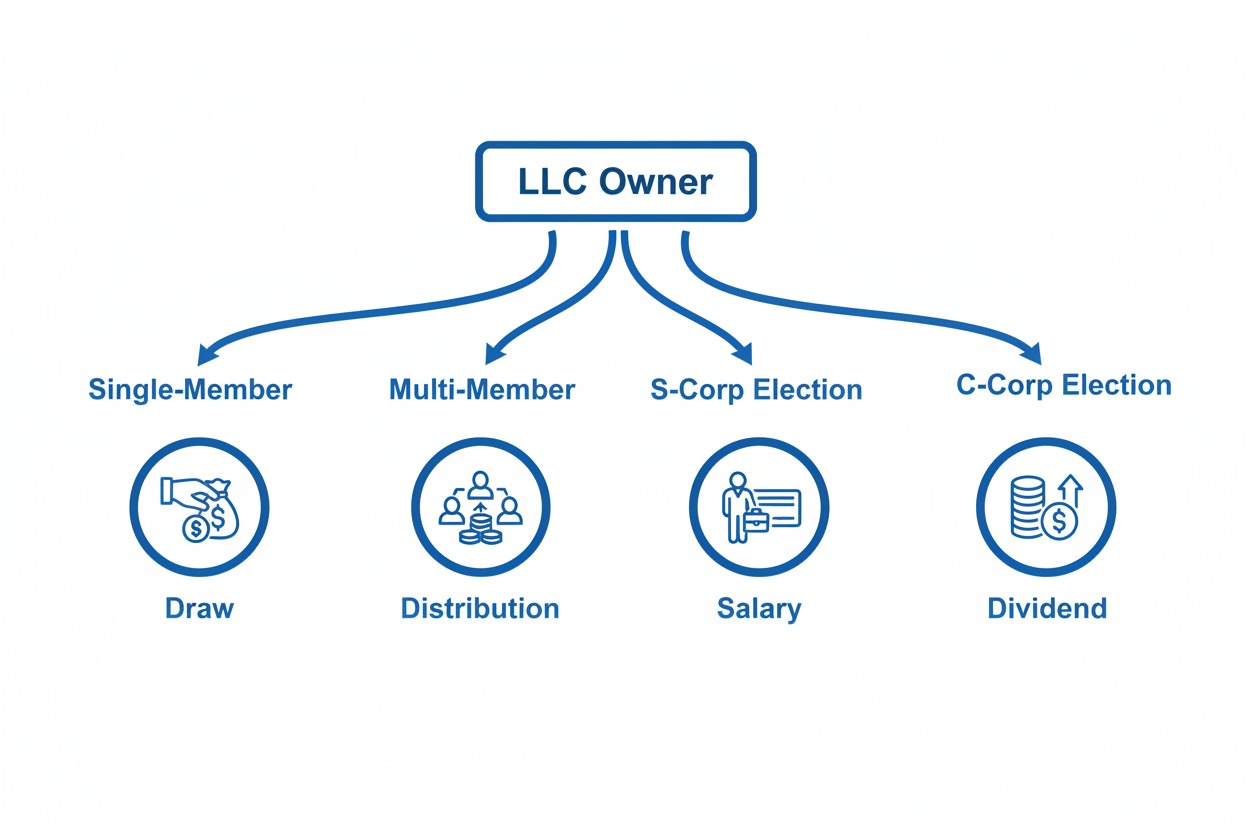
Quick Answer: How LLC Owners Get Paid
| LLC Type | Default Tax Status | How You Get Paid |
|---|---|---|
| Single-member LLC | Sole proprietorship (disregarded entity) | Owner’s draw |
| Multi-member LLC | Partnership | Distributions + guaranteed payments |
| LLC electing S-corp | S corporation | Salary (payroll) + distributions |
| LLC electing C-corp | C corporation | Salary (payroll) + dividends |
If you remember only one thing from this article, remember this: how you pay yourself is determined by your LLC’s tax classification, not by what feels easiest. Everything else follows from that one choice.
Why Your LLC’s Tax Classification Decides Everything
An LLC is a legal structure, not a tax structure. That distinction trips up more new owners than anything else.
By default, the IRS taxes LLCs based on how many members they have, not based on the fact that it’s an LLC at all:
- One owner → taxed as a sole proprietorship automatically
- Two or more owners → taxed as a partnership automatically
- Either type → can elect to be taxed as an S corporation (Form 2553) or C corporation (Form 8832) instead
This election determines whether you’re allowed to take a salary. Nothing about forming an LLC gives you payroll access — that only happens once you elect corporate tax treatment.
How to Pay Yourself Single Member LLC
If you’re the only owner, the IRS treats your LLC as a “disregarded entity.” In plain English: for tax purposes, you and the business are the same person. There’s no separation between “the business’s money” and “your money” until you decide to move it.
That means you pay yourself through an owner’s draw rather than a paycheck.
How an Owner’s Draw Actually Works
- Transfer money from your business bank account to your personal account (check or electronic transfer both work)
- Label the transfer clearly, such as “Owner’s Draw,” in your bookkeeping
- Take draws as often as you want; weekly, monthly, or whenever cash flow allows
There’s no legal limit on how much or how often you can draw. But there’s a catch: your entire business profit is taxable to you, whether you draw it out or leave it sitting in the business account. The draw itself isn’t a taxable event — it’s just moving money you already owe tax on.
Tax Implications of a Single-Member LLC Draw
- Business profit flows onto your personal return via Schedule C
- You’ll owe self-employment tax (15.3%) on net earnings, covering Social Security and Medicare
- No taxes are withheld automatically. You’re responsible for quarterly estimated payments
- Draws are not a deductible business expense (unlike a salary would be)
A good rule of thumb many bookkeepers recommend is to set aside 25–30% of every draw in a separate savings account earmarked for taxes, so April doesn’t blindside you.
How to Pay Yourself as a Business Owner in a Multi-Member LLC
If your LLC has more than one owner, it is taxed as a partnership by default. The payment setup needs to be fair to all owners.
Multi-member LLCs typically use two payment methods, often together:
1. Profit Distributions
Each member receives a share of the profits based on their ownership of the business, as stated in the LLC’s operating agreement. For example, if you own 40% of the business and it makes $200,000 in profit, you get $80,000 — no matter how much money you take out.
2. Guaranteed Payments
These work like a fixed salary for members who are actively working in the business, and they’re paid regardless of whether the company turned a profit that period. Guaranteed payments are especially useful in early-stage businesses where profits are unpredictable, but the work still needs to get done.
| Feature | Profit Distribution | Guaranteed Payment |
|---|---|---|
| Based on ownership % | Yes | No — set by agreement |
| Paid even if no profit | No | Yes |
| Deductible business expense | No | Yes |
| Subject to self-employment tax | Yes | Yes |
Every multi-member LLC should have a written operating agreement specifying how and when payments happen. Without one, state default partnership rules apply automatically, which almost never matches what the owners actually intended.

Can the Owner of an LLC Pay Himself Through Payroll?
Yes, but only if the LLC has elected to be taxed as a corporation, either as an S-corp or a C-corp. This is the single biggest source of confusion in every guide on this topic, so let’s be precise about it.
By default, LLC owners (whether single-member or multi-member) are not employees. The IRS is explicit that partners “are not employees and should not be issued a Form W-2… for distributions or guaranteed payments from the partnership,” and that you cannot simply decide to call yourself an employee by issuing yourself a W-2 or 1099. The IRS states directly that you cannot designate a worker, including yourself, as an employee or independent contractor solely by issuing a form.
Once you file Form 2553 to elect S-corp status, everything changes:
- You become a W-2 employee of your own business
- You must pay yourself “reasonable compensation”. A salary that reflects what someone else would be paid for doing your job, in your industry and location
- Payroll taxes (Social Security and Medicare) are withheld from that salary, the same as any employee
- Any profit beyond your salary can be taken as a distribution, which is not subject to self-employment or payroll tax
This last point is exactly why many profitable LLC owners elect S-corp status. It’s the core tax strategy behind “paying yourself through payroll.” We’ll walk through the actual math on this shortly, because the savings are real, but they only kick in once the business hits a certain profit level.
Can I 1099 Myself From My LLC?
Short answer: no, not in almost any standard situation.
A 1099 is meant for independent contractors — people who are not employees of the business paying them. If you’re a single-member LLC (disregarded entity), issuing yourself a 1099 accomplishes nothing because the IRS already treats your business income as your personal income directly on Schedule C. Adding a 1099 to the mix doesn’t change your tax bill; it just adds unnecessary paperwork.
If your LLC has elected S-corp or C-corp status and you actively work in the business, you’re legally an employee, not a contractor — so the correct form is a W-2, not a 1099.
There are rare exceptions: if you personally own a separate LLC that performs contract work for your main business, that second entity could legitimately issue an invoice and receive a 1099. But that’s a genuinely separate business relationship, not “1099’ing yourself” from the same company.
If you’re tempted to 1099 yourself to look more “official” for a loan application or to simplify bookkeeping, don’t. It creates a paper trail that doesn’t align with your actual tax classification and can attract IRS scrutiny rather than avoid it.
How Much Should I Pay Myself From My LLC?
This is where most owners get stuck because the honest answer is “it depends”. But here’s a practical framework to work through it instead of guessing.
For Single-Member and Multi-Member LLCs (Draws/Distributions)
Since there’s no legal minimum or maximum, base your draw amount on:
- Personal living expenses. Start with your actual monthly budget, not an aspirational number
- Business cash flow. Never draw more than what’s left after covering payroll, rent, inventory, and a cash cushion
- Tax reserve. Set aside 25–30% of every draw for quarterly estimated taxes
- Growth reinvestment. Leave enough in the business to cover slow months and planned expansion
A common approach small business advisors recommend is the “profit-first” method: pay all business expenses, set aside your tax percentage, and only then take a draw from what’s left, rather than drawing first and hoping there’s enough left for expenses.
For S-Corp Owners (Reasonable Compensation)
Here, the IRS actually has a standard, even if it’s not a fixed number. Reasonable compensation should reflect:
- What someone in your role, industry, and location would typically earn
- Your actual time and duties in the business (full-time operator vs. part-time investor)
- Your experience, training, and qualifications
- What the business can sustainably afford to pay
If you underpay yourself and take excessive distributions instead, the IRS can reclassify those distributions as wages, triggering back payroll taxes, penalties, and interest. This isn’t a minor technicality. It’s one of the most common IRS red flags for small S-Corps.
The Real Numbers: LLC Default Taxation vs. S-Corp Election
Most articles tell you an S-corp election “may reduce self-employment tax” without ever showing you what that actually looks like. Here’s a worked example using the current 2026 federal rates.
Scenario: Your LLC nets $120,000 in profit for the year, and you’re the sole owner actively working in the business.
Option A: Default LLC Taxation (Sole Proprietorship)
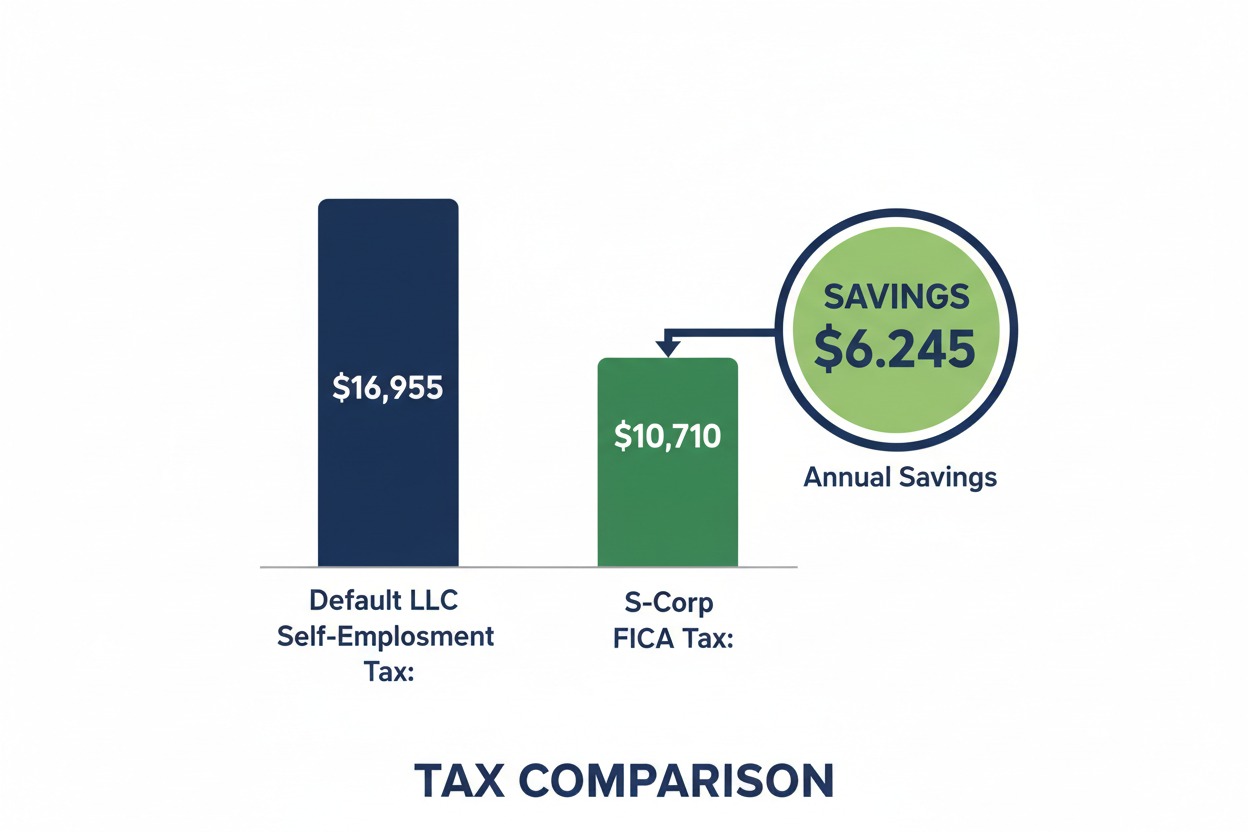
All net profit is subject to self-employment tax at the current rate of 15.3%, calculated on 92.35% of net earnings:
| Step | Calculation | Amount |
|---|---|---|
| Net profit | — | $120,000 |
| Taxable SE income | $120,000 × 92.35% | $110,820 |
| Self-employment tax | $110,820 × 15.3% | ≈ $16,955 |
Option B: S-Corp Election
Say you set a reasonable salary of $70,000 and take the remaining $50,000 as a distribution:
| Step | Calculation | Amount |
|---|---|---|
| Salary (payroll-taxed) | $70,000 × 15.3% (combined employer + employee FICA) | ≈ $10,710 |
| Distribution (not payroll-taxed) | $50,000 | $0 in FICA |
| Total FICA/payroll tax | — | ≈ $10,710 |
Estimated FICA savings: roughly $6,245 per year.
But S-corp status isn’t free. Factor in the added costs before deciding:
- Payroll processing: roughly $40–$100/month
- Additional tax preparation for Form 1120-S: roughly $800–$1,500/year
- State-specific S-corp fees, if applicable
Even after those costs, this example still nets a few thousand dollars in real annual savings, which is why the Social Security wage base and payroll tax rates matter more than most owners realize when deciding on an entity election. That said, this math changes significantly at lower profit levels. Most accountants and payroll providers suggest the S-corp election starts to make financial sense once net profit consistently exceeds roughly $80,000–$100,000 a year, since below that, the added administrative costs can eat up most or all of the tax savings.
What About C-Corp Election? (The Option Most Guides Skip)
Electing C-corp status is rare for small LLCs, but it’s worth understanding why. Mainly so you know why most owners avoid it.
Under a C-corp election, you’re paid a salary through payroll, just like an S-corp owner. The difference shows up in how the remaining profit is handled:
- S-corp: remaining profit passes through to you as a distribution, taxed once on your personal return
- C-corp: remaining profit is taxed at the corporate level first, and if it’s later paid out to you as a dividend, it’s taxed again on your personal return; a structure known as double taxation
For most single-owner or small multi-owner LLCs, this makes the C-corp election a poor fit. It occasionally makes sense for businesses planning to raise venture capital, retain significant earnings inside the company for reinvestment, or take advantage of a lower flat corporate tax rate on money that stays in the business rather than being distributed. If any of those apply to you, this is a conversation for a CPA, not a DIY decision. The numbers are highly situational.
LLC Payment Methods: Pros and Cons Compared
Here’s the full picture side by side, so you can see the tradeoffs at a glance before deciding.
| Method | Best For | Pros | Cons |
|---|---|---|---|
| Owner’s Draw | Single-member LLCs | Simple, flexible, no payroll setup | Full self-employment tax on all profits |
| Distribution | Multi-member LLCs | Matches ownership share automatically | Not deductible; SE tax still applies |
| Guaranteed Payment | Active multi-member partners | Predictable, paid even without profit | Still subject to self-employment tax |
| S-Corp Salary + Distribution | Profitable LLCs ($80K+ net) | Can meaningfully lower SE/FICA tax | Payroll costs, added tax filing complexity |
| C-Corp Salary + Dividend | Rare — reinvestment-heavy businesses | Lower flat corporate rate on retained earnings | Double taxation on distributed profit |
How to Switch From Owner’s Draw to S-Corp Payroll
If your business has grown past the point where a simple draw makes sense, here’s the general sequence for making the switch. This isn’t a DIY tax filing (loop in a CPA before you file anything)but knowing the steps helps you understand what your accountant is actually doing.
- File Form 2553 with the IRS to elect S-corp tax treatment for your LLC. This has to be filed by a specific deadline relative to your tax year, so timing matters.
- Get an EIN for the business if you don’t already have one — it’s required to run payroll.
- Set up a payroll system (QuickBooks Payroll, Gusto, or a similar provider) rather than running payroll manually.
- Determine your reasonable salary using industry salary data, your role, and time commitment — document how you arrived at the number.
- Run payroll on a consistent schedule, with taxes withheld each pay period automatically.
- Take the remaining profit as distributions, recorded separately from payroll through an equity account.
- Adjust quarterly estimated tax payments accordingly, since your withholding structure has fundamentally changed.
Most owners make this switch either at the start of a new tax year or when electing S-corp status for the first time, since retroactively restructuring mid-year adds complexity to your books.
Record-Keeping Checklist for LLC Owner Pay
Regardless of which method you use, keep these records on hand. They matter far more at tax time (and in an audit) than most new owners expect:
- A dedicated business bank account, completely separate from personal accounts
- A written log of every draw, distribution, or guaranteed payment (date, amount, purpose)
- Your operating agreement, kept current with actual ownership percentages
- Documentation supporting your “reasonable salary” figure, if S-corp elected
- Quarterly estimated tax payment confirmations
- Year-end reconciliation showing total draws/distributions against total business profit
Benefits of Paying Yourself Through an LLC
Beyond the tax mechanics, there are real practical advantages to formalizing how you pay yourself, rather than treating the business account like a personal wallet.
- Preserves liability protection. Commingling personal and business funds is one of the fastest ways to weaken the liability shield an LLC is supposed to provide. Courts can “pierce the corporate veil” if finances aren’t kept separate.
- Cleaner bookkeeping. Clearly labeled draws, distributions, or payroll entries make tax season dramatically faster and cheaper with your accountant.
- Proof of income. A consistent salary (via S-corp payroll) is often easier to document for mortgage applications and loans than irregular draws.
- Tax flexibility. LLCs are among the few structures that let you choose your tax treatment as your business grows, without changing your legal entity type.
- Easier profit tracking. Distinguishing what you paid yourself from what the business retained gives you a clearer read on the business’s actual health.
How to Pay Yourself as a Business Owner in QuickBooks
Whether you’re taking a draw or running payroll, QuickBooks handles the two very differently. And mixing them up is one of the most common bookkeeping errors new owners make.
Recording an Owner’s Draw in QuickBooks Online
- Go to the Gear icon → Chart of Accounts → New
- Set Account Type to Equity, and Detail Type to Owner’s Equity
- Name the account “Owner’s Draw” and save
- When you’re ready to pay yourself, select + New → Check (not payroll)
- Choose the bank account funds are coming from, enter the amount, and categorize it under the Owner’s Draw equity account you just created
- Save and close
According to QuickBooks’ own support documentation, sole proprietors must be paid this way, through a regular check against an equity account, rather than through payroll, since QuickBooks Payroll is built for W-2 employees only.
Important: owner’s draws show up on your Balance Sheet under equity, not on your Profit & Loss report, since a draw is not a business expense.
Setting Up Payroll for S-Corp Salary in QuickBooks
If your LLC has elected S-corp status, you’ll instead use QuickBooks Payroll (a separate subscription add-on):
- Set yourself up as an employee under Payroll → Employees
- Enter your reasonable salary amount and standard pay schedule
- QuickBooks calculates and withholds federal/state income tax, Social Security, and Medicare automatically
- Distributions on top of your salary are recorded separately, through an equity account — the same way draws are recorded, not through payroll
Don’t Forget Quarterly Estimated Taxes
Whichever method you choose, one thing stays true for owner’s draws, distributions, and guaranteed payments: no one is withholding tax on your behalf. That responsibility falls entirely on you.
The IRS expects self-employed individuals and LLC owners taking draws to pay quarterly estimated taxes, generally due in mid-April, June, September, and January of the following year. Missing these payments doesn’t just delay your tax bill — it can trigger an underpayment penalty even if you pay everything in full by the April filing deadline.
A safe harbor most tax professionals recommend: pay at least 100% of last year’s total tax liability (or 110% if your prior-year income was higher), spread across the four quarterly payments. That approach protects you from penalties even if your estimate for the current year is off.
One upside worth knowing: you can deduct half of your self-employment tax when calculating your adjusted gross income. This deduction won’t reduce the self-employment tax itself, but it does lower the income on which your regular federal tax is calculated. A detail that’s easy to miss when you’re estimating your quarterly payments by hand.
If your S-corp salary already has payroll withholding built in, your quarterly burden shrinks significantly, since taxes are already being paid throughout the year rather than all at once. One more practical (if less obvious) reason many growing LLCs eventually make the switch.
Common Mistakes to Avoid
- Treating the business account as a personal ATM. Irregular, undocumented withdrawals blur the line courts look at for liability protection.
- Skipping quarterly estimated taxes. Since draws and distributions don’t withhold taxes automatically, missing quarterly payments can lead to IRS underpayment penalties.
- Setting an unreasonably low S-corp salary. This is one of the fastest ways to trigger an IRS audit. The agency actively watches for S corporations paying suspiciously small salaries next to large distributions.
- Recording a draw as a business expense. It isn’t one, and doing so distorts your Profit & Loss statement and can misstate your actual taxable income.
- Electing S-corp status too early. Below roughly $80,000 in consistent net profit, the added payroll and accounting costs often outweigh the tax savings.
Expert Tips
- Pay yourself on a schedule, even as a sole owner. Treating your own compensation like a recurring bill — rather than “whatever’s left over” — makes both personal budgeting and business forecasting far more predictable.
- Revisit your entity election annually. As profit grows, the math around S-corp election shifts. What didn’t make sense at $60,000 in profit might make real sense at $130,000.
- Keep your operating agreement current. For multi-member LLCs, outdated agreements are one of the most common causes of payment disputes between partners.
- Document your reasonable salary reasoning. Keep notes or salary survey data showing how you arrived at your S-corp salary figure — this is your best defense if the IRS ever questions it.
- Separate your tax savings account immediately. Don’t let quarterly tax money sit in your operating account where it’s tempting to spend.
FAQs
1. How to pay yourself as a single-member LLC without a salary?
You take an owner’s draw. A direct transfer from your business bank account to your personal account. This is the standard method unless you’ve elected S-corp taxation, since single-member LLCs can’t legally issue themselves a W-2 salary under default tax treatment.
2. How much should I pay myself from my LLC?
For draws, base it on your personal budget, tax reserve needs (25–30% set aside), and what the business can sustain after expenses. For S-corp salary, it must be a “reasonable” amount that matches what someone in a similar role, industry, and location would earn; not an arbitrarily low amount designed to avoid payroll tax.
3. Can the owner of an LLC pay himself through payroll?
Only if the LLC has elected to be taxed as an S corporation or a C corporation. Under default LLC tax treatment (sole proprietorship or partnership), owners are not considered employees and cannot be paid a W-2 salary.
4. Can I 1099 myself from my LLC?
Generally no. A 1099 is for independent contractors, and in nearly every standard LLC structure, you’re either a disregarded owner (no 1099 needed) or an employee under an S-corp or C-corp election (W-2 required, not 1099).
5. What are the benefits of paying yourself through an LLC?
It protects your liability shield by keeping business and personal funds separate, simplifies bookkeeping and tax filing, and, depending on your entity election, can meaningfully reduce your overall self-employment tax burden.
Final Thoughts
Paying yourself as an LLC owner isn’t about choosing the method that sounds simplest. It’s about matching your payment method to your actual tax classification, then reviewing that choice as your profit grows.
If you’re a single-member LLC just starting out, an owner’s draw is almost certainly your answer, and it’s genuinely simple to set up. Once your profit consistently exceeds $80,000–$100,000 a year, it’s worth sitting down with a CPA to run the real numbers on an S-corp election. The savings, as shown above, can be substantial, but only once the math actually supports it.
Whatever stage you’re at, keep your draws, distributions, or payroll entries clearly documented from day one. Future-you, filing taxes in April, will genuinely thank you.
Also Read: How to Start an HVAC Business: Full 2026 Guide
What Companies Are in the Consumer Services Field? (2026 Guide)